– The Hook Model is a framework developed by Nir Eyal that explains how certain products and services can create habit-forming behavior in users. It consists of
Four Key Steps
– 1. Trigger: The process begins with a Trigger, which can be either an external trigger (e.g., a notification) or an internal trigger (e.g., an emotion or need
Behavioral Design
– The Hook Model is a powerful tool in behavioral design. It leverages principles of psychology and user experience to encourage users to form habitual behavior
Ethical Considerations
– While the Hook Model can be highly effective, it also raises ethical considerations. Companies must use this framework responsibly, considering the potential
Applications
– The Hook Model has been widely applied in the design of consumer technology products, such as social media platforms, mobile apps, and gaming. However, its pr
Critiques and Concerns
– Critics argue that the Hook Model can contribute to excessive screen time, internet addiction, and the erosion of user privacy. Designers must address these c
Balancing User Benefits
– To create ethical and responsible products using the Hook Model, designers must strive for a balance between providing value to users and encouraging healthy
Continual Improvement
– The Hook Model is not static; it requires continual improvement and adaptation. Designers should gather user feedback, monitor usage patterns, and make iterat
The Hook Model is a framework designed by Nir Eyal, author of the book “Hooked,” which consists of four elements: trigger, action, reward, and investment. This is a process of gamification that helps startups create habit-forming products.
Aspect
Explanation
Concept Overview
– The Hook Model is a framework developed by Nir Eyal that explains how certain products and services can create habit-forming behavior in users. It consists of a four-step cycle that leads to habituation: Trigger, Action, Variable Reward, and Investment. The goal is to build products that users return to repeatedly.
Four Key Steps
– 1. Trigger: The process begins with a Trigger, which can be either an external trigger (e.g., a notification) or an internal trigger (e.g., an emotion or need). The trigger prompts the user to take action. – 2. Action: The user responds to the trigger by taking a specific Action, such as opening an app, clicking a link, or scrolling through a news feed. – 3. Variable Reward: After the action, the user receives a Variable Reward, which can be tangible (e.g., a like on a social media post) or psychological (e.g., feeling connected). The unpredictability of the reward keeps users engaged. – 4. Investment: To complete the cycle, the user invests time, effort, or resources into the product or service, increasing their commitment and making them more likely to return.
Behavioral Design
– The Hook Model is a powerful tool in behavioral design. It leverages principles of psychology and user experience to encourage users to form habitual behaviors around a product or service. The aim is to create a product that becomes an integral part of the user’s routine.
Ethical Considerations
– While the Hook Model can be highly effective, it also raises ethical considerations. Companies must use this framework responsibly, considering the potential for addictive behaviors and the impact on users’ well-being. Ethical design focuses on balancing habit formation with user empowerment and wellness.
Applications
– The Hook Model has been widely applied in the design of consumer technology products, such as social media platforms, mobile apps, and gaming. However, its principles can extend to various domains, including education, healthcare, and business services. Understanding user psychology is key to its effective application.
Critiques and Concerns
– Critics argue that the Hook Model can contribute to excessive screen time, internet addiction, and the erosion of user privacy. Designers must address these concerns and consider the broader social and ethical implications of habit-forming products. – Designers should also be aware of potential regulatory scrutiny surrounding products designed using the Hook Model.
Balancing User Benefits
– To create ethical and responsible products using the Hook Model, designers must strive for a balance between providing value to users and encouraging healthy usage patterns. This entails considering user wellness, digital detox, and features that empower users to control their engagement.
Continual Improvement
– The Hook Model is not static; it requires continual improvement and adaptation. Designers should gather user feedback, monitor usage patterns, and make iterative changes to enhance the user experience and align it with evolving user needs and expectations.
User Empowerment
– An emerging trend in Hook Model design is to focus on user empowerment. This involves giving users more control over their engagement, providing them with insights into their usage patterns, and offering tools to manage and balance their digital interactions.
Responsible Design
– The future of the Hook Model lies in responsible design practices that prioritize user well-being and mental health. Companies and designers should collaborate to ensure that habit-forming products are created with empathy and a commitment to ethical design.
Background story
As I dive into the startup world, I find out about a staggering truth. It isn’t a fight about power, prestige, or money. Instead, another currency that, as we progress, becomes more and more scarce is at the center of this battle. It is all about people’s attention.
That attention gets triggered and channeled by a set of hooks, that make the users wanting more in this fight over people’s attention.
The boundary between product development and people’s manipulation is thin. Thus, my dilemma is how to make sure we’re building an ethical product? Before finding the answer, let me give you a quick introduction to the Hook Model.
The Hook Model
Source: NirandFar.com
Instead of relying on expensive marketing, habit-forming companies link their services to the users’ daily routines and emotions. ― Nir Eyal, Hooked: How to Build Habit-Forming Products
For anyone running a startup, the Hook Model is one of those frameworks you must keep on top of your mind. A four-step framework, from the trigger to investment and back to trigger. The user builds a habit that makes her wanting more and more of that product.
A trigger is “the spark plug in the Hook Model.” Usually, an external trigger (e.g., a push notification from your phone) connects with an internal trigger (boredom) to bridge the gap between the user and the product. Once triggered into the model, the user is incentivized to act (open your phone when seeing the push notification from Facebook).
The core of making a product habit-forming is its variable reward. In short, our brain expects a reward, and it prepares for it. Yet after meeting the expected reward if the user finds an additional unexpected reward it gets almost hooked.
Before the user leaves, it is time to ask for investment regarding time, data, effort, social capital, or money.
Big companies all over the world; from Facebook to LinkedIn, hooked us, and we can’t live without their services.
Therefore the model is so powerful that it brings up a few questions on what is the proper way of using it.
Indeed, with such a robust framework, how do we make sure to use it for good? Nir Eyal proposes the drug dealer test.
Ethics: A Problem as Old as Humankind
Bad people…are in conflict with themselves; they desire one thing and will another, like the incontinent who choose harmful pleasures instead of what they themselves believe to be good. ― Aristotle, Nicomachean Ethics
Ethics is not an easy issue. Deriving from the Greek ἦθος, meaning habit, custom. Ethics is an attempt to discern between good and evil, right or wrong. In other words, to define what are the absolute human values that should be part of anyone’s life.
Per se, this approach is utopian and doomed to failure. Things are often shaded. They’re neither right nor wrong on their own. Instead, based on context, perspective, and cultural norms, most human behaviors are goal-driven.
Also, ethics is the byproduct of human cultural evolution. What was right in the past it is considered unjust nowadays.
We have reasons to believe that what we deem right today will be regarded as wrong tomorrow. How do we solve this impasse?
Rather than focusing on theoretical differences and definitions, we could use a much simpler approach.
For instance, in the startup world, we could define ethics as a process. That process leverages unconscious clues and hooks. But it also should bring towards conscious behaviors.
The final aim is to improve the user’s mental well-being. In short, those hooks should be accompanied by a strong ethical understanding.
In this respect, Nir Eyal proposes an interesting framework.
Ethical Manipulation: The Drug Dealer Test
Source: NirandFar.com
As Nir Eyal explains the first rule of drug dealing is “never get high on your own supply.” If you want to build an ethical product, you have to break this rule!
Indeed, the Manipulation Matrix is a two questions quadrant to assess whether the product you’re building is ethnically manipulative. The first question is, “Do you believe that the product or service you’re working on is materially improving people’s lives?”
The answer is either “Yes” or “No.”
Yes classifies you as a peddler. No, classifies you as a dealer.
The second question is, “am I the user?”
“Yes,” puts you in the facilitator quadrant.
“No” makes you the entertainer.
According to Nir Eyal, the companies that are successful at building ethical habit-forming products are those whose founders turned out to be also facilitators.
Of course, as those companies scaled up, it’s hard to keep this distinction in mind, but it’s a good place to start to understand how to counterbalance a powerful framework like the Hook Model, with ethical checks and balances.
Are you a dealer or a facilitator?
DuckDuckGo: Hook model case study
Key Highlights
The Hook Model:
The Hook Model is a framework designed by Nir Eyal for creating habit-forming products.
It consists of four elements: Trigger, Action, Variable Reward, and Investment.
Habit-forming companies link their services to users’ routines and emotions to drive engagement.
External triggers connect with internal triggers to spark user engagement with a product.
The variable reward component creates anticipation and hooks users more effectively.
Investment refers to the commitment of time, data, effort, social capital, or money by users.
Ethics and the Hook Model:
Attention is a valuable currency, and habit-forming products vie for it using triggers and hooks.
The boundary between product development and manipulation can be thin, raising ethical concerns.
The challenge lies in building ethical products that focus on user well-being and conscious behaviors.
Nir Eyal’s “Drug Dealer Test” is a framework to assess the ethical nature of a product’s impact on users.
The test categorizes builders as peddlers (ethical) or dealers (unethical) based on the impact and involvement in product use.
Case Study: DuckDuckGo:
DuckDuckGo is a search engine focused on user privacy, gaining traction after privacy concerns escalated.
Google’s business model relies on advertising networks: Google Ads and AdSense.
Google makes revenue from businesses bidding on keywords and from publishers hosting targeted ads.
Google’s search algorithms balance credibility by showing organic and non-paid content.
DuckDuckGo avoids search leakage by not tracking users and prioritizes user privacy.
The Hook Model can be applied to DuckDuckGo’s growthstrategy.
DuckDuckGo’s Application of the Hook Model:
DuckDuckGo’s external trigger is privacy concerns arising from widespread data tracking.
Users experience a different search engine UI but realize it provides effective results.
Variable rewards include instant answers, customizable UI, and unique features like “bangs.”
Users invest time in personalizing the search engine and participating in its open-source community.
DuckDuckGo’s growth leverages enthusiastic supporters and developers, forming a positive loop.
Key Takeaways:
The Hook Model is a framework for habit-forming products involving triggers, actions, rewards, and investment.
Ethical product development aims to improve user well-being and emphasizes conscious behavior.
The “Drug Dealer Test” helps assess the ethical impact of products on users.
The DuckDuckGo case study showcases how the Hook Model can be applied to a privacy-focused search engine’s growthstrategy.
Related Concepts
Description
When to Apply
Hook Model
Hook Model is a framework developed by Nir Eyal to create habit-forming products. It consists of four stages: Trigger, Action, Variable Reward, and Investment. The model aims to capture users’ attention, encourage engagement, and foster repeated use by creating a cycle of cues, actions, rewards, and investments that reinforce user behavior.
– Product Development: Incorporating the Hook Model into product design to increase user engagement and retention. – Marketing Strategy: Utilizing the Hook Model principles to design compelling marketing campaigns that prompt user action and repeat interactions. – Behavioral Design: Applying the Hook Model to influence user behavior in various contexts, such as health, finance, and education. – User Experience Design: Integrating the Hook Model into UX design to create intuitive and habit-forming digital experiences. – Digital Product Management: Leveraging the Hook Model to optimize user journeys and drive desired actions within digital products and services.
Behavioral Psychology
Behavioral Psychology is the study of human behavior and the factors that influence it. It encompasses theories and principles from psychology, neuroscience, and behavioral economics to understand how people make decisions and form habits. Behavioral psychology informs the design of interventions and strategies to promote desired behaviors and outcomes.
– User Engagement: Applying behavioral psychology principles to design products and experiences that appeal to user motivations and preferences. – Behavior Change: Using behavioral psychology techniques to encourage positive behavior change, such as adopting healthy habits or improving productivity. – Marketing and Advertising: Incorporating behavioral psychology insights into marketing strategies to influence consumer behavior and decision-making. – Learning and Education: Leveraging behavioral psychology principles to design effective learning experiences and educational interventions. – Psychological Research: Conducting research to explore behavioral phenomena and develop theories and models for understanding human behavior.
Gamification
Gamification is the application of game design elements and mechanics in non-game contexts to engage and motivate users. It involves incorporating features such as points, badges, leaderboards, and challenges to make tasks or activities more enjoyable and rewarding. Gamification aims to enhance user engagement, promote learning, and drive desired behaviors through game-like experiences.
– Employee Engagement: Implementing gamification techniques in workplace environments to motivate employees, foster collaboration, and increase productivity. – Health and Fitness: Using gamification elements in wellness apps and fitness programs to encourage users to exercise regularly and adopt healthy habits. – Education and Training: Incorporating gamified elements into learning platforms and training programs to make learning more interactive, engaging, and effective. – Customer Loyalty Programs: Designing gamified loyalty programs that incentivize customers to make repeat purchases, refer friends, and engage with brand content. – Productivity Tools: Introducing gamification features in task management apps and productivity tools to help users stay focused, set goals, and track progress.
Behavioral Economics
Behavioral Economics combines insights from psychology and economics to understand how individuals make decisions in economic contexts. It focuses on cognitive biases, heuristics, and social influences that affect decision-making processes. Behavioral economics principles inform strategies to nudge people towards desired behaviors and outcomes.
– Consumer Behavior: Applying behavioral economics theories to influence consumer decision-making, pricing strategies, and purchasing behavior. – Financial Decision-Making: Using behavioral economics insights to design interventions that encourage saving, investing, and responsible financial behavior. – Public Policy: Leveraging behavioral economics to design policies and interventions that promote societal well-being, such as encouraging healthy eating or reducing energy consumption. – Organizational Behavior: Incorporating behavioral economics principles into management practices to improve employee motivation, productivity, and decision-making. – User Experience Design: Integrating behavioral economics concepts into UX design to create interfaces and experiences that facilitate desired user actions and behaviors.
Persuasive Design
Persuasive Design focuses on influencing user behavior and decision-making through design elements and techniques. It draws on principles from psychology, rhetoric, and human-computer interaction to create persuasive interfaces and experiences. Persuasive design aims to motivate users, guide them towards specific actions, and facilitate behavior change.
– E-commerce: Implementing persuasive design strategies in online retail environments to increase conversions, reduce cart abandonment, and drive sales. – Healthcare and Wellness: Using persuasive design techniques in health apps and wellness platforms to encourage users to adopt healthy habits, track progress, and adhere to treatment plans. – Environmental Conservation: Applying persuasive design principles to promote sustainable behaviors, such as energy conservation, waste reduction, and eco-friendly purchasing. – Social Media and Marketing: Leveraging persuasive design elements in social media platforms and digital marketing campaigns to influence user engagement, brand perception, and purchase decisions. – Education and Learning: Designing persuasive learning experiences that motivate learners, promote knowledge retention, and encourage skill development through interactive content and feedback mechanisms.
Motivational Design
Motivational Design focuses on designing experiences that inspire and sustain user motivation. It involves understanding intrinsic and extrinsic motivators, such as autonomy, mastery, purpose, and rewards, to create engaging and meaningful interactions. Motivational design aims to foster a sense of progress, achievement, and fulfillment in users.
– Productivity Apps: Designing motivational features in productivity apps to help users set goals, track progress, and stay motivated to complete tasks. – Learning Platforms: Incorporating motivational design elements in educational platforms to encourage active participation, skill development, and knowledge acquisition. – Wellness and Self-Improvement: Creating motivational experiences in wellness apps and self-improvement platforms to inspire users to adopt healthy habits, pursue personal goals, and cultivate well-being. – Community Engagement: Building motivational features into online communities and social networks to encourage collaboration, contribution, and peer support among members. – Employee Engagement: Implementing motivational design strategies in workplace tools and systems to increase employee engagement, job satisfaction, and performance.
Business modelinnovation is about increasing the success of an organization with existing products and technologies by crafting a compelling value proposition able to propel a new business model to scale up customers and create a lasting competitive advantage. And it all starts by mastering the key customers.
The innovation loop is a methodology/framework derived from the Bell Labs, which produced innovation at scale throughout the 20th century. They learned how to leverage a hybrid innovation management model based on science, invention, engineering, and manufacturing at scale. By leveraging individual genius, creativity, and small/large groups.
According to how well defined is the problem and how well defined the domain, we have four main types of innovations: basic research (problem and domain or not well defined); breakthrough innovation (domain is not well defined, the problem is well defined); sustaining innovation (both problem and domain are well defined); and disruptive innovation (domain is well defined, the problem is not well defined).
That is a process that requires a continuous feedback loop to develop a valuable product and build a viable business model. Continuous innovation is a mindset where products and services are designed and delivered to tune them around the customers’ problem and not the technical solution of its founders.
Disruptive innovation as a term was first described by Clayton M. Christensen, an American academic and business consultant whom The Economist called “the most influential management thinker of his time.” Disruptive innovation describes the process by which a product or service takes hold at the bottom of a market and eventually displaces established competitors, products, firms, or alliances.
In a business world driven by technology and digitalization, competition is much more fluid, as innovation becomes a bottom-up approach that can come from anywhere. Thus, making it much harder to define the boundaries of existing markets. Therefore, a proper business competition analysis looks at customer, technology, distribution, and financial model overlaps. While at the same time looking at future potential intersections among industries that in the short-term seem unrelated.
Technological modeling is a discipline to provide the basis for companies to sustain innovation, thus developing incremental products. While also looking at breakthrough innovative products that can pave the way for long-term success. In a sort of Barbell Strategy, technological modeling suggests having a two-sided approach, on the one hand, to keep sustaining continuous innovation as a core part of the business model. On the other hand, it places bets on future developments that have the potential to break through and take a leap forward.
Sociologist E.M Rogers developed the Diffusion of Innovation Theory in 1962 with the premise that with enough time, tech products are adopted by wider society as a whole. People adopting those technologies are divided according to their psychologic profiles in five groups: innovators, early adopters, early majority, late majority, and laggards.
In the TED talk entitled “creative problem-solving in the face of extreme limits” Navi Radjou defined frugal innovation as “the ability to create more economic and social value using fewer resources. Frugal innovation is not about making do; it’s about making things better.” Indian people call it Jugaad, a Hindi word that means finding inexpensive solutions based on existing scarce resources to solve problems smartly.
A consumer brand company like Procter & Gamble (P&G) defines “Constructive Disruption” as: a willingness to change, adapt, and create new trends and technologies that will shape our industry for the future. According to P&G, it moves around four pillars: lean innovation, brand building, supply chain, and digitalization & data analytics.
In the FourWeekMBA growth matrix, you can apply growth for existing customers by tackling the same problems (gain mode). Or by tackling existing problems, for new customers (expand mode). Or by tackling new problems for existing customers (extend mode). Or perhaps by tackling whole new problems for new customers (reinvent mode).
An innovation funnel is a tool or process ensuring only the best ideas are executed. In a metaphorical sense, the funnel screens innovative ideas for viability so that only the best products, processes, or business models are launched to the market. An innovation funnel provides a framework for the screening and testing of innovative ideas for viability.
Tim Brown, Executive Chair of IDEO, defined design thinking as “a human-centered approach to innovation that draws from the designer’s toolkit to integrate the needs of people, the possibilities of technology, and the requirements for business success.” Therefore, desirability, feasibility, and viability are balanced to solve critical problems.
A Blockchain Business Model according to the FourWeekMBA framework is made of four main components: Value Model (Core Philosophy, Core Values and Value Propositions for the key stakeholders), Blockchain Model (Protocol Rules, Network Shape and Applications Layer/Ecosystem), Distribution Model (the key channels amplifying the protocol and its communities), and the Economic Model (the dynamics/incentives through which protocol players make money). Those elements coming together can serve as the basis to build and analyze a solid Blockchain Business Model.
In a business world driven by technology and digitalization, competition is much more fluid, as innovation becomes a bottom-up approach that can come from anywhere. Thus, making it much harder to define the boundaries of existing markets. Therefore, a proper business competition analysis looks at customer, technology, distribution, and financial model overlaps. While at the same time looking at future potential intersections among industries that in the short-term seem unrelated.
Technological modeling is a discipline to provide the basis for companies to sustain innovation, thus developing incremental products. While also looking at breakthrough innovative products that can pave the way for long-term success. In a sort of Barbell Strategy, technological modeling suggests having a two-sided approach, on the one hand, to keep sustaining continuous innovation as a core part of the business model. On the other hand, it places bets on future developments that have the potential to break through and take a leap forward.
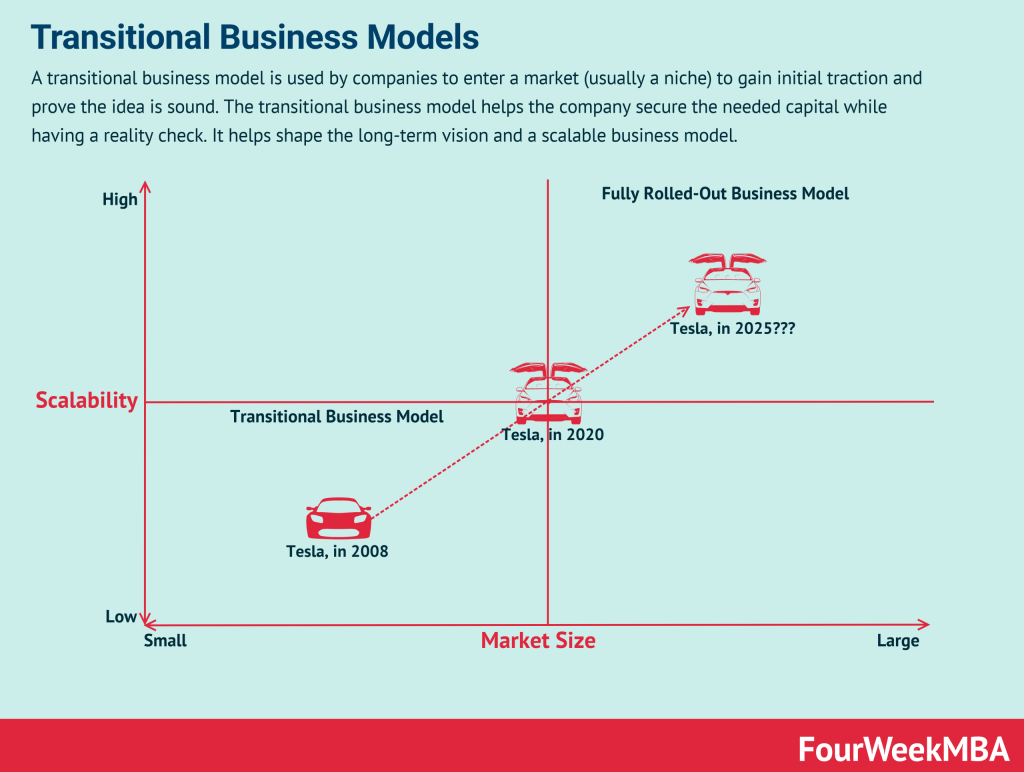
A transitional business model is used by companies to enter a market (usually a niche) to gain initial traction and prove the idea is sound. The transitional business model helps the company secure the needed capital while having a reality check. It helps shape the long-term vision and a scalable business model.
The minimum viable audience (MVA) represents the smallest possible audience that can sustain your business as you get it started from a microniche (the smallest subset of a market). The main aspect of the MVA is to zoom into existing markets to find those people which needs are unmet by existing players.
Business scaling is the process of transformation of a business as the product is validated by wider and wider market segments. Business scaling is about creating traction for a product that fits a small market segment. As the product is validated it becomes critical to build a viable business model. And as the product is offered at wider and wider market segments, it’s important to align product, business model, and organizational design, to enable wider and wider scale.
The market expansion consists in providing a product or service to a broader portion of an existing market or perhaps expanding that market. Or yet, market expansions can be about creating a whole new market. At each step, as a result, a company scales together with the market covered.
In the FourWeekMBA growth matrix, you can apply growth for existing customers by tackling the same problems (gain mode). Or by tackling existing problems, for new customers (expand mode). Or by tackling new problems for existing customers (extend mode). Or perhaps by tackling whole new problems for new customers (reinvent mode).
In the FourWeekMBA Revenue Streams Matrix, revenue streams are classified according to the kind of interactions the business has with its key customers. The first dimension is the “Frequency” of interaction with the key customer. As the second dimension, there is the “Ownership” of the interaction with the key customer.
Revenue model patterns are a way for companies to monetize their business models. A revenue model pattern is a crucial building block of a business model because it informs how the company will generate short-term financial resources to invest back into the business. Thus, the way a company makes money will also influence its overall business model.
Gennaro is the creator of FourWeekMBA, which reached about four million business people, comprising C-level executives, investors, analysts, product managers, and aspiring digital entrepreneurs in 2022 alone | He is also Director of Sales for a high-tech scaleup in the AI Industry | In 2012, Gennaro earned an International MBA with emphasis on Corporate Finance and Business Strategy.


 Source: NirandFar.com