The Cost Structure building block of the Business Model Canvas details the monetary cost of operating as a business. Cost structure represents all the costs a business will incur under a specific business model, especially those costs to maintain the key resources that make up the core business model.
Aspect
Explanation
Cost Structure
– Cost Structure is one of the nine building blocks in the Business Model Canvas, a strategic management tool that helps organizations describe, design, and analyze their business model. It outlines the types of costs a business incurs while operating.
Importance
– Understanding cost structure is crucial because it directly impacts a company’s profitability, pricing strategy, and overall financial health. An efficient cost structure can give a business a competitive advantage.
Categories
– Cost Structure is typically divided into two main categories: Fixed Costs and Variable Costs. – Fixed Costs remain constant regardless of production or sales volume (e.g., rent, salaries). – Variable Costs change in direct proportion to production or sales (e.g., materials, labor).
Key Considerations
– Businesses need to carefully manage their cost structure by optimizing their cost-to-value ratio. – Economies of scale can help reduce per-unit costs as production volume increases. – Innovations and new technologies can impact cost structures, making them more efficient.
Business Models
– Different business models have distinct cost structures. For example, a subscription-based model may have high initial customer acquisition costs but lower ongoing service costs. In contrast, a retail model may have significant inventory costs.
Cost Reduction
– Businesses often seek ways to reduce costs through process optimization, outsourcing, automation, and strategic sourcing. – Lean methodologies are commonly used to eliminate waste and reduce costs.
Revenue vs. Costs
– Achieving a balance between revenue generation and cost management is essential for profitability. A business must ensure that its revenue exceeds its total costs to generate a profit.
Cost Allocation
– Allocating costs accurately to specific products or services is vital for pricing decisions and identifying profitable offerings. It helps businesses understand which products or services contribute positively to the bottom line.
Scenario Analysis
– Businesses should conduct scenario analysis to understand how changes in production volume, pricing, or cost structure affect their financial performance. It helps in making informed decisions and managing financial risks.
Conclusion
– Cost Structure in the Business Model Canvas is a fundamental component that defines the types of costs a business incurs. Understanding and optimizing cost structure is essential for achieving profitability and long-term sustainability.
Do costs become variable or remain fixed by considering other structures?
Cost structure types
While minimizing cost is fundamental to good business, organizations nonetheless employ different cost structure strategies.
Some are on a dogged mission to reduce costs as much as possible, while others pride themselves on their luxury or bespoke product ranges. In truth, most organizations are somewhere in between.
Various strategies occupy opposite ends of a cost structure spectrum, with a cost-driven structure at one end and a value-driven structure at the other.
With all that said, let’s take a look at both types in more detail:
Value-driven structure
A strategy where there is a complete focus on customer value at the expense of cost. Value is created by customizing the product or service to individual preferences.
Hyatt Hotel repeat customers are on a first-name basis with hotel staff and are provided with a personalized room before they arrive.
Cost-driven structure
Which focuses on minimizing the cost of a product or service wherever possible.
Businesses focus on creating a lean cost structure through cheap pricing, automation, and the outsourcing of costly activities.
Walmart uses immense economies of scale to reduce costs to a point where other retailers cannot compete.
Most budget airlines reduce costs by increasing seat capacity, not offering meals, and limiting luggage size.
Cost structure attributes
A typical cost structure, regardless of strategy or type, has one or more of the following attributes:
Economies of scale
Where a company with a high output quota benefits from a lower cost per unit amount.
This occurs because large volume orders spread fixed costs more evenly than smaller orders.
Economies of scale are common in large organizations that make bulk purchases from a supplier.
Economies of scope
Here, costs are reduced when an organization expands its operational scope or invests in multiple markets.
To derive maximum benefit from economies of scope, each product should require similar marketing messages or utilize the same distribution channel.
Fixed costs
Or business expenses that remain constant irrespective of volume.
Fixed costs can be time-bound, such as a fortnightly employee salary or monthly rent for an office space.
Manufacturing companies are also subject to fixed costs such as equipment and facility rental.
Fixed costs do not remain fixed indefinitely and will change over time while remaining relatively stable.
Variable costs
These are costs that are heavily dependent on volume output and are influenced by supply and demand.
In a production scenario, variable costs may be associated with sourcing raw materials, utility bills, and employee labor.
Cost structure examples
In the final section, let’s take a look at a few cost structure examples from some notable companies.
Netflix
Netflix is a subscription-based business model making money with three simple plans: basic, standard, and premium, giving access to stream series, movies, and shows. Leveraging on a streaming platform, Netflix generated over $33.7 billion in 2023, with an operating income of over $6.95 billion and a net income of over $5.4 billion. Starting in 2013, Netflix started to develop its content under the Netflix Originals brand, which today represents the most important strategic asset for the company that, in 2023, counted over 260 million paying members worldwide.
The cost structure of Netflix was significant enough in the company’s early days to impact cash flow and growth. Some of these costs include:
The acquisition, production, delivery, and licensing of streaming content. These are likely to be the largest costs for the company today.
Platform maintenance.
Software development.
Research and patents.
Amazon Web Services (AWS) for database, analytics, recommendation engines, and video transcoding, to name a few functions.
Data centers to provide streaming content.
Marketing, human resources, and related infrastructure.
Netflix has also benefitted from economies of scope and key activities that match its value proposition.
Nike
The cost structure of Nike is such that the company pockets a relatively small amount of profit from each item it sells. Costs associated with the sale of a pair of sneakers, for example, include:
Free on Board (FOB) costs, which cover the cost of shipping from the factory.
Selling, general, and administrative expenses.
Customs duties and taxes.
In addition to these costs, Nike spends billions on advertising, marketing, sponsorships, brand presentation, and other promotional costs. In 2021, this amounted to $3.11 billion.
Tesla
Tesla’s cost structure is characterized by fixed manufacturing costs. For each vehicle that rolls off the production line, these include equipment (20%), body (12%), chassis (7%), drive system (15%), battery (35%), and other (11%).
In addition, Tesla has the following costs:
Research and development – consisting of personnel costs related to engineering, research, prototyping, contract and professional services, and costs from amortized equipment.
Selling, general and administrative expenses – personal and facilities related costs such as stores, sales, finances, human resources, information technology, and any fees related to legal or contract services and litigation settlements.
Restructuring and others – including employee termination costs, disposal of tangible assets, facility sub-leasing losses, and impairment losses.
Interest and taxes.
Airbnb
Airbnb generated $4.79 billion in profits for 2023, compared to $1.9 billion in 2022. 2022 was the first profitable year for Airbnb since 2018. As the pandemic hit, the company reached the bottom in net losses in 2020, and Airbnb reported back then net losses for almost $4.6 billion in net losses.
Airbnb has a relatively simple cost structure when compared to some of its competitors in the hotel industry.
This is because the company does not own the accommodation listed on its website and as a result, avoids the many costs associated with hospitality staff and hotel upkeep.
The company’s cost structure consists of the following:
Cost of revenue – which includes online payment processing fees that are paid to Visa and Mastercard. Cost of revenue also encompasses insurance. In the rare event that a guest, host, or cleaner is injured or has their personal property damaged or stolen, Airbnb is responsible for paying out insurance claims.
Sales and marketing – such as customer acquisition, customer retention, discounts, promotions, referral fees, and refunds.
Research and development – there are also costs associated with ensuring the Airbnb platform is functional, on-trend, intuitive, and streamlined. Other research and development costs include engineering and product development.
General and administration – this includes costs related to administration and employees such as HR and finance, legal fees, executives, general managers, and professional services such as freelance photography.
Key takeaways
The Cost Structure building block of the Business Model Canvas details the monetary cost of operating as a business. This block is important to get right since many businesses fail due to misunderstanding or underestimating their costs.
Cost-structures may be value-driven or cost-driven. As the name suggests, value-driven structures focus on delivering customer value at the expense of minimizing cost. In a cost-driven structure, the opposite is true.
Regardless of type, most cost-structure have one or more of the following attributes: economies of scale, economies of scope, fixed costs, and variable costs.
Key Highlights
Cost Structure Defined: The cost structure is a fundamental building block in the Business Model Canvas (BMC), which outlines the monetary costs associated with operating a business. It encompasses all expenses necessary to maintain the key resources that form the core of the business model.
Importance of Cost Structure: Many businesses fail within the first three years because they often underestimate the costs involved in delivering the goods and services outlined in their value proposition. Understanding and managing cost structure is crucial for sustainability.
Operational Costs: Operational costs cover expenditures related to employees, infrastructure, activities, and partnerships. These costs are influenced by other BMC building blocks, including the value proposition, revenue streams, and long-term customer relationships.
Detailed Understanding: To gain a clear understanding of cost structure, businesses should also consider and detail key resources, activities, and partnerships, as these factors directly impact costs.
Key Questions: When creating a cost structure, businesses should address important questions such as fundamental costs, costliest key activities and resources, the relationship between key activities and costs, alignment with the value proposition, and the potential for variable or fixed costs.
Cost Structure Types: Different organizations adopt varying cost structure strategies, ranging from a strong focus on reducing costs to a focus on delivering high customer value. Two main types are highlighted: value-driven and cost-driven structures.
Value-Driven Structure: In a value-driven cost structure, the primary emphasis is on delivering exceptional customer value, often at the expense of higher costs. Customization and personalized services are common features. For example, Hyatt Hotel provides personalized services to repeat customers.
Cost-Driven Structure: A cost-driven cost structure prioritizes minimizing costs wherever possible. Companies focus on creating a lean cost structure through strategies like cost-effective pricing, automation, and outsourcing. Walmart’s use of economies of scale and budget airlines’ cost-cutting measures are examples.
Cost Structure Attributes: Regardless of the type of cost structure, several attributes can be found:
Economies of Scale: Larger companies with high output can benefit from lower costs per unit due to the spreading of fixed costs, common in bulk purchasing.
Economies of Scope: Cost reduction occurs as an organization expands its operations or enters multiple markets, particularly when products share marketing or distribution channels.
Fixed Costs: Expenses that remain constant regardless of output volume, such as salaries or rent.
Variable Costs: Costs heavily dependent on output volume and influenced by supply and demand, such as raw materials and utility bills.
Cost Structure Examples: The article provides cost structure examples from notable companies:
Netflix: Costs associated with content acquisition, production, delivery, platform maintenance, software development, research, and infrastructure.
Nike: Costs related to retail markup, shipping, customs duties, advertising, marketing, and promotional expenses.
Tesla: Fixed manufacturing costs for equipment, body, chassis, drive system, battery, and other components, along with research and development, administrative expenses, and interest and taxes.
Airbnb: Costs of revenue (payment processing fees and insurance), sales and marketing, research and development, and general administration.
Sustainability and Profitability: Understanding and managing cost structures are crucial for a business’s sustainability and profitability. Companies must strike a balance between minimizing costs and delivering value to customers.
Adaptability: Cost structures may evolve over time in response to changing market conditions, technology advancements, and shifts in customer preferences. Adaptation is essential for long-term success.
Related Frameworks, Models, or Concepts
Description
When to Apply
Lean Startup Methodology
The Lean Startup Methodology is an approach to developing and managing startups that focuses on rapid iteration, customer feedback, and validated learning. It involves creating a minimum viable product (MVP), testing hypotheses through experimentation, and iterating based on customer feedback. By applying lean startup principles, entrepreneurs can minimize waste, mitigate risks, and increase the chances of building successful and sustainable businesses.
Consider Lean Startup Methodology when launching a new venture or developing innovative products or services. Use it to validate assumptions, identify customer needs, and iterate on your business model based on real-world feedback. Implement Lean Startup Methodology as a framework for achieving product-market fit, accelerating growth, and maximizing the chances of startup success within your organization.
Value Proposition Canvas
The Value Proposition Canvas is a tool for designing and refining value propositions that resonate with customer needs and preferences. It involves mapping customer profiles (jobs, pains, gains) and corresponding value propositions (products, services, solutions) to identify areas of alignment and opportunities for differentiation. By using the Value Proposition Canvas, organizations can develop compelling value propositions that address customer needs and create competitive advantage.
Consider the Value Proposition Canvas when designing or refining your organization’s value propositions. Use it to understand customer needs, pain points, and aspirations, and align your offerings to deliver unique value and differentiation. Implement the Value Proposition Canvas as a framework for developing customer-centric products, services, and solutions that drive customer satisfaction and loyalty within your organization.
Business Model Innovation
Business Model Innovation involves creating, adapting, or reinventing the fundamental structure and logic of how a business creates, delivers, and captures value. It encompasses changes to key elements of the business model, such as revenue streams, cost structure, value proposition, and customer segments, to drive growth and competitiveness. By innovating their business models, organizations can seize new opportunities, respond to market disruptions, and outperform competitors.
Consider Business Model Innovation when seeking to transform or disrupt traditional business models within your industry. Use it to explore new revenue streams, business models, and value creation opportunities that capitalize on emerging trends and technologies. Implement Business Model Innovation as a framework for driving organizational change, fostering innovation, and creating sustainable competitive advantage within your organization.
Blue Ocean Strategy
Blue Ocean Strategy is a strategic approach that focuses on creating uncontested market space and making competition irrelevant. It involves identifying and capturing new market opportunities by offering innovative value propositions that differentiate from existing competitors. By pursuing Blue Ocean Strategy, organizations can unlock new growth opportunities, differentiate themselves from competitors, and capture untapped market demand.
Consider Blue Ocean Strategy when seeking to develop innovative value propositions and new market opportunities. Use it to identify unmet customer needs, challenge industry assumptions, and create new market spaces where competition is irrelevant. Implement Blue Ocean Strategy as a framework for driving innovation, differentiation, and growth within your organization by offering compelling value propositions that resonate with customers.
Design Thinking
Design Thinking is a human-centered approach to innovation and problem-solving that emphasizes empathy, creativity, and iterative prototyping. It involves understanding user needs, ideating potential solutions, prototyping and testing concepts, and iterating based on feedback. By applying design thinking principles, organizations can develop customer-centric products, services, and experiences that meet user needs and preferences effectively.
Consider Design Thinking when developing new products, services, or processes within your organization. Use it to gain deep insights into user needs, generate creative solutions, and iterate rapidly to develop prototypes that address customer pain points and aspirations. Implement Design Thinking as a framework for fostering innovation, collaboration, and customer-centricity within your organization to drive business growth and success.
Platform Business Model
The Platform Business Model is a business model that creates value by facilitating interactions between two or more distinct groups of users. Platforms provide a marketplace or infrastructure that enables users to connect, interact, and exchange goods, services, or information. By leveraging network effects and economies of scale, platform businesses can create value for both users and stakeholders and achieve rapid growth and scalability.
Consider the Platform Business Model when building digital platforms or ecosystems that connect multiple users or stakeholders. Use it to create network effects, drive user engagement, and unlock new value creation opportunities through platform interactions and transactions. Implement the Platform Business Model as a framework for building scalable and sustainable businesses that leverage network effects and ecosystem dynamics to create value within your organization.
Business Ecosystem
A Business Ecosystem is a network of interconnected organizations, stakeholders, and resources that collaborate and compete to create and capture value. Business ecosystems involve complex relationships and interdependencies between participants, such as suppliers, partners, customers, and competitors, that influence industry dynamics and market outcomes. By understanding and leveraging business ecosystems, organizations can identify strategic partners, seize new opportunities, and navigate competitive landscapes effectively.
Consider Business Ecosystems when analyzing industry dynamics and market opportunities within your organization. Use it to identify key stakeholders, ecosystem partners, and value chain relationships that influence your organization’s competitiveness and growth prospects. Implement Business Ecosystems as a framework for building strategic alliances, fostering collaboration, and creating value within interconnected business networks within your organization.
Frugal Innovation
Frugal Innovation is an approach to innovation that focuses on creating affordable and accessible solutions to address the needs of resource-constrained consumers and markets. It involves simplifying products, processes, or business models to reduce costs while maintaining quality and functionality. By adopting frugal innovation principles, organizations can reach new customer segments, penetrate emerging markets, and drive inclusive growth and sustainability.
Consider Frugal Innovation when developing products or services for price-sensitive or underserved markets. Use it to design simple, affordable solutions that address basic needs and preferences of target consumers while optimizing resource utilization. Implement Frugal Innovation as a framework for expanding market reach, driving affordability, and fostering sustainable growth within your organization.
Open Innovation
Open Innovation is a collaborative approach to innovation that involves sourcing ideas, technologies, and expertise from external partners, such as customers, suppliers, universities, and competitors. It involves leveraging external knowledge and resources to complement internal capabilities and accelerate innovation processes. By embracing open innovation principles, organizations can access diverse perspectives, stimulate creativity, and drive breakthrough innovations more effectively.
Consider Open Innovation when seeking to access external expertise, insights, and resources to drive innovation within your organization. Use it to establish partnerships, collaborations, and ecosystems that facilitate knowledge exchange, idea generation, and technology transfer. Implement Open Innovation as a framework for leveraging external networks, crowdsourcing, and collaborative platforms to accelerate innovation and enhance competitiveness within your organization.
Agile Business Model Canvas
The Agile Business Model Canvas is an adaptation of the traditional Business Model Canvas that incorporates agile principles and practices into the strategic planning process. It involves iterative development, continuous feedback, and flexible adaptation to changing market conditions and customer needs. By adopting the Agile Business Model Canvas, organizations can respond quickly to market dynamics, experiment with new ideas, and iterate on business models effectively.
Consider the Agile Business Model Canvas when operating in fast-paced and uncertain environments. Use it to visualize and iterate on your business model, test assumptions, and adapt strategies based on real-time feedback and market insights. Implement the Agile Business Model Canvas as a framework for fostering agility, responsiveness, and innovation within your organization to drive sustainable growth and competitiveness.
This framework has been thought for any type of business model, be it digital or not. It’s a framework to start mind mapping the key components of your business or how it might look as it grows. Here, as usual, what matters is not the framework itself (let’s prevent to fall trap of the Maslow’s Hammer), what matters is to have a framework that enables you to hold the key components of your business in your mind, and execute fast to prevent running the business on too many untested assumptions, especially about what customers really want. Any framework that helps us test fast, it’s welcomed in our business strategy.
An effective business model has to focus on two dimensions: the people dimension and the financial dimension. The people dimension will allow you to build a product or service that is 10X better than existing ones and a solid brand. The financial dimension will help you develop proper distribution channels by identifying the people that are willing to pay for your product or service and make it financially sustainable in the long run.
This framework is well suited for all these cases where technology plays a key role in enhancing the value proposition for the users and customers. In short, when the company you’re building, analyzing, or looking at is a tech or platform business model, the template below is perfect for the job.
A tech business model is made of four main components: value model (value propositions, mission, vision), technological model (R&D management), distributionmodel (sales and marketingorganizational structure), and financial model (revenue modeling, cost structure, profitability and cash generation/management). Those elements coming together can serve as the basis to build a solid tech business model.
This framework is well suited to analyze and understand blockchain-based business models. Here, the underlying blockchain protocol, and the token economics behind it play a key role in aligning incentives and also in creating disincentives for the community of developers, individual contributors, entrepreneurs, and investors that enable the whole business model. The blockchain-based model is similar to a platform-based business model, but with an important twist, decentralization should be the key element enabling both decision-making and how incentives are distributed across the network.
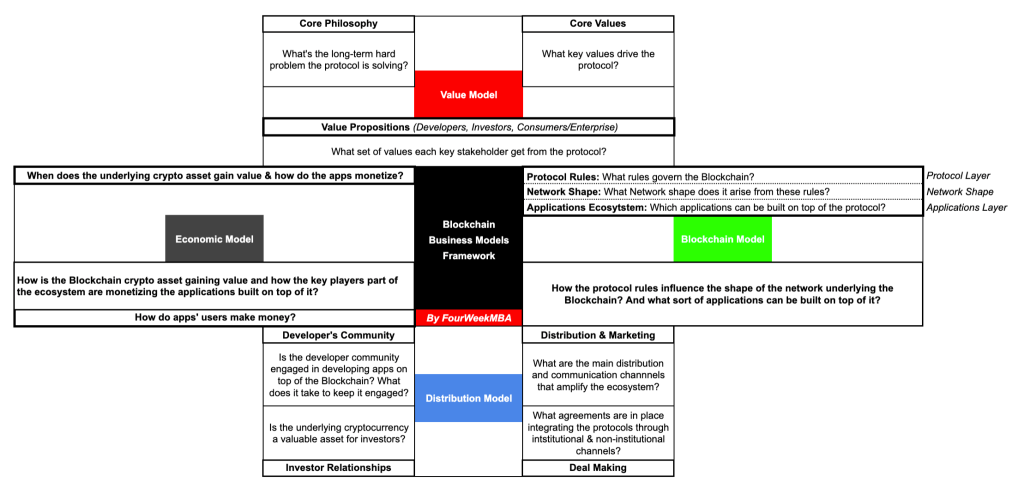
A Blockchain Business Model according to the FourWeekMBA framework is made of four main components: Value Model (Core Philosophy, Core Values and Value Propositions for the key stakeholders), Blockchain Model (Protocol Rules, Network Shape and Applications Layer/Ecosystem), Distribution Model (the key channels amplifying the protocol and its communities), and the Economic Model (the dynamics/incentives through which protocol players make money). Those elements coming together can serve as the basis to build and analyze a solid Blockchain Business Model.
Venture capitalist, Dave McClure, coined the acronym AARRR which is a simplified model that enables us to understand what metrics and channels to look at, at each stage for the users’ path toward becoming customers and referrers of a brand.
A north star metric (NSM) is any metric a company focuses on to achieve growth. A north star metric is usually a key component of an effective growth hackingstrategy, as it simplifies the whole strategy, making it simpler to execute at high speed. Usually, when picking up a North Start Metric, it’s critical to avoid vanity metrics (those who do not really impact the business) and instead find a metric that really matters for the businessgrowth.
The profit margin is a profitability financial ratio, given by the net income divided by the net sales, and multiplied by a hundred. That is expressed as a percentage. That is a key profitability measure as combined with other financial metrics, it helps assess the overall viability of a business model.
The purpose of the balance sheet is to report how the resources to run the operations of the business were acquired. The Balance Sheet helps to assess the financial risk of a business and the simplest way to describe it is given by the accounting equation (assets = liability + equity).
Business analysis is a research discipline that helps drive change within an organization by identifying the key elements and processes that drive value. Business analysis can also be used in Identifying new business opportunities or how to take advantage of existing business opportunities to grow your business in the marketplace.
The cash flow statement is the third main financial statement, together with the income statement and the balance sheet. It helps to assess the liquidity of an organization by showing the cash balances coming from operations, investing, and financing. The cash flow statement can be prepared with two separate methods: direct and indirect.
A comparable company analysis is a process that enables the identification of similar organizations to be used as a comparison to understand the business and financial performance of the target company. To find comparables you can look at two key profiles: the business and financial profile. From the comparable company analysis, it is possible to understand the competitive landscape of the target organization.
The cost structure is one of the building blocks of a business model. It represents how companies spend most of their resources to keep generating demand for their products and services. The cost structure together with revenue streams, help assess the operational scalability of an organization.
Economic or market moats represent long-term business defensibility. Or how long a business can retain its competitive advantage in the marketplace over the years. Warren Buffet who popularized the term “moat” referred to it as a share of mind, opposite to market share, as such it is the characteristic that all valuable brands have.
Financial statements help companies assess several aspects of the business, from profitability (income statement) to how assets are sourced (balance sheet), and cash inflows and outflows (cash flow statement). Financial statements are also mandatory for companies for tax purposes. They are also used by managers to assess the performance of the business.
A marketplace is a platform where buyers and sellers interact and transact. The platform acts as a marketplace that will generate revenues in fees from one or all the parties involved in the transaction. Usually, marketplaces can be classified in several ways, like those selling services vs. products or those connecting buyers and sellers at B2B, B2C, or C2C level. And those marketplaces connecting two core players, or more.
A network effect is a phenomenon in which as more people or users join a platform, the more the value of the service offered by the platform improves for those joining afterward.
A platform business model generates value by enabling interactions between people, groups, and users by leveraging network effects. Platform business models usually comprise two sides: supply and demand. Kicking off the interactions between those two sides is one of the crucial elements for a platform business model success.
The virtuous cycle is a positive loop or a set of positive loops that trigger a non-linear growth. Indeed, in the context of digital platforms, virtuous cycles – also defined as flywheel models – help companies capture more market shares by accelerating growth. The classic example is Amazon’s lower prices driving more consumers, driving more sellers, thus improving variety and convenience, thus accelerating growth.
The Amazon Flywheel or Amazon Virtuous Cycle is a strategy that leverages on customer experience to drive traffic to the platform and third-party sellers. That improves the selections of goods, and Amazon further improves its cost structure so it can decrease prices which spins the flywheel.
Gennaro is the creator of FourWeekMBA, which reached about four million business people, comprising C-level executives, investors, analysts, product managers, and aspiring digital entrepreneurs in 2022 alone | He is also Director of Sales for a high-tech scaleup in the AI Industry | In 2012, Gennaro earned an International MBA with emphasis on Corporate Finance and Business Strategy.