Argumentation theory is a multidisciplinary field that investigates the principles and techniques of constructing and evaluating arguments in communication and discourse. It examines how individuals use reasoning, evidence, and persuasion to support claims, challenge opposing views, and engage in productive dialogue.
Claims are statements or propositions that assert a position, opinion, or viewpoint. In argumentation theory, claims serve as the central assertions that individuals seek to support or refute through reasoning and evidence.
Evidence
Evidence consists of facts, examples, statistics, or expert testimony that support or justify a claim. Effective arguments rely on credible and relevant evidence to persuade audiences and strengthen the validity of claims.
Reasoning
Reasoning involves the process of making inferences, drawing conclusions, and forming logical connections between claims and evidence. Logical reasoning helps individuals support their arguments and counter opposing viewpoints effectively.
Fallacies
Fallacies are errors in reasoning or flawed arguments that undermine the validity of claims. Common fallacies include ad hominem attacks, strawman arguments, and appeal to authority, which distract from the substantive issues and weaken the overall argument.
Persuasive Techniques
Persuasive techniques are strategies used to influence beliefs, attitudes, and behaviors through communication. These techniques include appeals to emotions, credibility, logic, and values, as well as rhetorical devices such as analogies, metaphors, and anecdotes.
Strategies for Effective Argumentation
Understand Audience Perspectives
Consider the perspectives, beliefs, and values of your audience when constructing arguments. Tailor your message to resonate with their interests and concerns, addressing potential objections and building common ground.
Use Credible Evidence and Sources
Support your claims with credible evidence from reputable sources, such as academic research, expert opinions, and empirical data. Verify the accuracy and reliability of your evidence to enhance the credibility of your argument.
Employ Logical Reasoning
Use logical reasoning to establish clear connections between claims and evidence, avoiding fallacies and logical errors that undermine the validity of your argument. Present your reasoning in a structured and coherent manner to enhance clarity and persuasiveness.
Anticipate and Address Counterarguments
Anticipate potential counterarguments and objections to your claims, and preemptively address them in your argumentation. Acknowledging opposing viewpoints demonstrates intellectual honesty and strengthens your argument by addressing potential doubts or objections.
Appeal to Emotions and Values
Utilize emotional appeals and value-based arguments to connect with your audience on a personal level and evoke empathy or sympathy. Appeal to shared values, aspirations, or concerns to resonate with your audience’s emotions and motivations.
Benefits of Argumentation Theory
Enhanced Critical Thinking Skills
Studying argumentation theory develops critical thinking skills by fostering the ability to analyze, evaluate, and construct persuasive arguments. Individuals learn to assess evidence, detect fallacies, and engage in reasoned discourse across diverse topics and contexts.
Improved Communication and Persuasion
Understanding argumentation theory enhances communication and persuasion skills by providing insights into effective argument construction and evaluation. Individuals learn to communicate their ideas persuasively, respond to opposing viewpoints, and engage in constructive dialogue.
Informed Decision-Making
Argumentation theory informs informed decision-making by equipping individuals with the tools to assess and evaluate competing arguments and perspectives. By critically analyzing evidence and reasoning, individuals can make well-informed decisions based on sound judgment and reasoning.
Conflict Resolution and Negotiation
Argumentation theory facilitates conflict resolution and negotiation by promoting constructive dialogue and compromise. Individuals learn to identify common ground, find mutually acceptable solutions, and resolve differences through reasoned discourse and negotiation.
Challenges of Argumentation Theory
Subjectivity and Bias
Argumentation theory encounters challenges related to subjectivity and bias in evaluating arguments, as individuals’ beliefs and perspectives may influence their assessment of evidence and reasoning. Critical thinking skills are essential for mitigating bias and ensuring objective evaluation.
Complexity and Ambiguity
Argumentation theory deals with the complexity and ambiguity of language and communication, as arguments may contain multiple interpretations or layers of meaning. Clarifying definitions, assumptions, and premises helps mitigate ambiguity and facilitate clearer communication.
Resistance to Persuasion
Individuals may resist persuasion or be skeptical of arguments that challenge their existing beliefs or attitudes. Overcoming resistance to persuasion requires building trust, establishing credibility, and appealing to emotions and values to engage audiences effectively.
Ethical Considerations
Argumentation theory raises ethical considerations related to the use of persuasive techniques and manipulation in communication. Individuals must uphold ethical principles such as honesty, integrity, and respect for others’ autonomy when engaging in argumentation and persuasion.
Implications of Argumentation Theory
Education and Pedagogy
Argumentation theory informs education and pedagogy by promoting critical thinking, reasoning, and communication skills across academic disciplines. Educators incorporate argumentation theory into curriculum design and teaching practices to cultivate students’ analytical thinking and persuasive abilities.
Public Discourse and Civic Engagement
Argumentation theory shapes public discourse and civic engagement by fostering informed and reasoned dialogue on social, political, and ethical issues. Citizens engage in constructive debates, deliberation, and advocacy informed by evidence-based reasoning and ethical persuasion.
Professional Communication and Advocacy
Argumentation theory influences professional communication and advocacy by enhancing individuals’ ability to articulate ideas, influence decisions, and advocate for causes. Professionals in fields such as law, public relations, and marketing use argumentation theory to craft persuasive messages, negotiate agreements, and advocate for their clients’ interests.
Policy-Making and Governance
Argumentation theory informs policy-making and governance by providing frameworks for evaluating competing arguments and perspectives. Policymakers and leaders engage in evidence-based decision-making and public deliberation informed by argumentation theory principles to address complex societal challenges and promote the public good.
Conclusion
Argumentation theory is a multidisciplinary field that examines the principles and techniques of constructing and evaluating arguments in communication and discourse.
Key components of argumentation theory include claims, evidence, reasoning, fallacies, and persuasive techniques, which shape how individuals engage in constructive dialogue and persuasion.
Strategies for effective argumentation include understanding audience perspectives, using credible evidence and sources, employing logical reasoning, anticipating and addressing counterarguments, and appealing to emotions and values.
Argumentation theory offers benefits such as enhanced critical thinking skills, improved communication and persuasion, informed decision-making, and conflict resolution and negotiation.
However, challenges such as subjectivity and bias, complexity and ambiguity, resistance to persuasion, and ethical considerations must be addressed when applying argumentation theory in practice.
Implementing argumentation theory has implications for education and pedagogy, public discourse and civic engagement, professional communication and advocacy, and policy-making and governance, shaping individuals’ ability to engage in reasoned discourse and influence beliefs, attitudes, and behaviors in diverse contexts.
Related Frameworks, Models, or Concepts
Description
When to Apply
Argumentation Theory
Argumentation Theory studies the principles and methods of constructing and evaluating arguments. The Toulmin Model is a key framework within Argumentation Theory, providing a structured approach to analyzing and assessing arguments by identifying their components, including claims, evidence, warrants, backing, qualifiers, and rebuttals.
Apply Argumentation Theory to understand the principles of persuasive communication and critical thinking. Use it alongside the Toulmin Model to analyze and evaluate arguments in various contexts, such as academic writing, public discourse, and decision-making processes.
Rhetorical Analysis
Rhetorical Analysis examines how language, structure, and persuasion techniques are used to influence audiences and convey messages effectively. The Toulmin Model complements Rhetorical Analysis by providing a systematic framework for analyzing arguments and identifying rhetorical strategies, such as appeals to logic, emotion, and authority.
Utilize Rhetorical Analysis to analyze speeches, advertisements, and other forms of communication to understand how persuasion techniques are employed to achieve specific objectives. Apply it alongside the Toulmin Model to assess the effectiveness of arguments and rhetorical strategies in influencing audience beliefs, attitudes, and behaviors.
Critical Thinking
Critical Thinking involves analyzing, evaluating, and synthesizing information to make reasoned judgments and decisions. The Toulmin Model supports Critical Thinking by providing a structured framework for analyzing arguments, identifying strengths and weaknesses, and making informed assessments based on evidence and reasoning.
Apply Critical Thinking skills to assess the validity and reliability of arguments, claims, and evidence presented in various contexts. Use the Toulmin Model as a tool for organizing thoughts, evaluating arguments, and communicating reasoned judgments in academic, professional, and everyday contexts.
Debate and Persuasion
Debate and Persuasion involve presenting arguments and evidence to convince others of a particular position or viewpoint. The Toulmin Model is commonly used in debate formats and persuasive communication to structure arguments, provide evidence, and respond to opposing viewpoints effectively.
Participate in debates, discussions, or persuasive presentations to practice applying the Toulmin Model in constructing and defending arguments. Use it to organize arguments logically, support claims with evidence, and counter opposing viewpoints persuasively to enhance argumentative skills and influence others effectively.
Legal Reasoning
Legal Reasoning involves applying legal principles, precedents, and arguments to analyze and resolve legal issues and disputes. The Toulmin Model is used in legal reasoning to structure legal arguments, present evidence, and justify legal conclusions based on logic, precedent, and legal authority.
Apply Legal Reasoning skills to analyze case law, statutes, and legal arguments in legal research and writing. Use the Toulmin Model to construct persuasive legal arguments, analyze judicial opinions, and advocate for clients’ interests effectively in legal proceedings and written submissions.
Academic Writing
Academic Writing involves the systematic and scholarly presentation of ideas, arguments, and research findings. The Toulmin Model is commonly used in academic writing to structure arguments, provide evidence, and engage in critical analysis and synthesis of ideas.
Apply Academic Writing principles to compose essays, research papers, and academic articles that present well-structured arguments supported by evidence and reasoning. Use the Toulmin Model as a framework for organizing arguments, evaluating sources, and synthesizing information to contribute to scholarly discourse and knowledge advancement in various academic fields.
Scientific Reasoning
Scientific Reasoning involves applying scientific methods, principles, and evidence to investigate phenomena, formulate hypotheses, and draw conclusions based on empirical data and logical reasoning. The Toulmin Model supports Scientific Reasoning by providing a framework for structuring scientific arguments, presenting evidence, and evaluating scientific claims and theories.
Apply Scientific Reasoning skills to design experiments, analyze data, and draw conclusions based on empirical evidence and logical reasoning. Use the Toulmin Model to communicate scientific findings, justify conclusions, and engage in peer-reviewed scientific discourse to advance scientific knowledge and understanding in various disciplines.
fixed mindset believes their intelligence and talents are fixed traits that cannot be developed. The two mindsets were developed by American psychologist Carol Dweck while studying human motivation.
Both mindsets are comprised of conscious and subconscious thought patterns established at a very young age. In adult life, they have profound implications for personal and professional success.
Individuals with a growthmindset devote more time and effort to achieving difficult goals and by extension, are less concerned with the opinions or abilities of others. Individuals with a fixed mindset are sensitive to criticism and may be preoccupied with proving their talents to others.
Constructive feedback is supportive in nature and designed to help employees improve or correct their performance or behavior. Note that the intention of such feedback is to achieve a positive outcome for the employee based on comments, advice, or suggestions.
High-performance coaches work with individuals in personal and professional contexts to enable them to reach their full potential. While these sorts of coaches are commonly associated with sports, it should be noted that the act of coaching is a specific type of behavior that is also useful in business and leadership.
The training of trainers model seeks to engage master instructors in coaching new, less experienced instructors with a particular topic or skill. The training of trainers (ToT) model is a framework used by master instructors to train new instructors, enabling them to subsequently train other people in their organization.
Active listening is the process of listening attentively while someone speaks and displaying understanding through verbal and non-verbal techniques. Active listening is a fundamental part of good communication, fostering a positive connection and building trust between individuals.
Active recall enables the practitioner to remember information by moving it from short-term to long-term memory, where it can be easily retrieved. The technique is also known as active retrieval or practice testing. With active recall, the process is reversed since learning occurs when the student retrieves information from the brain.
The phrase “baptism by fire” originates from the Bible in Matthew 3:11. In Christianity, the phrase was associated with personal trials and tribulations and was also used to describe the martyrdom of an individual. Many years later, it was associated with a soldier going to war for the first time. Here, the baptism was the battle itself. “Baptism by fire” is a phrase used to describe the process of an employee learning something the hard way with great difficulty.
The Dreyfus model of skill acquisition was developed by brothers Hubert and Stuart Dreyfus at the University of California, Berkeley, in 1980. The Dreyfus model of skill acquisition is a learning progression framework. It argues that as one learns a new skill via external instruction, they pass through five stages of development: novice, advanced beginner, competent, proficient, and expert.
The Kolb reflective cycle was created by American educational theorist David Kolb. In 1984, Kolb created the Experiential Learning Theory (ELT) based on the premise that learning is facilitated by direct experience. In other words, the individual learns through action. The Kolb reflective cycle is a holistic learning and development process based on the reflection of active experiences.
The Method of Loci is a mnemonic strategy for memorizing information. The Method of Loci gets its name from the word “loci”, which is the plural of locus – meaning location or place. It is a form of memorization where an individual places information they want to remember along with points of an imaginary journey. By retracing the same route through the journey, the individual can recall the information in a specific order. For this reason, many consider this memory tool a location-based mnemonic.
The Experience Curve argues that the more experience a business has in manufacturing a product, the more it can lower costs. As a company gains un know-how, it also gains in terms of labor efficiency, technology-driven learning, product efficiency, and shared experience, to reduce the cost per unit as the cumulative volume of production increases.
The Feynman Technique is a mental model and strategy for learning something new and committing it to memory. It is often used in exam preparation and for understanding difficult concepts. Physicist Richard Feynman elaborated this method, and it’s a powerful technique to explain anything.
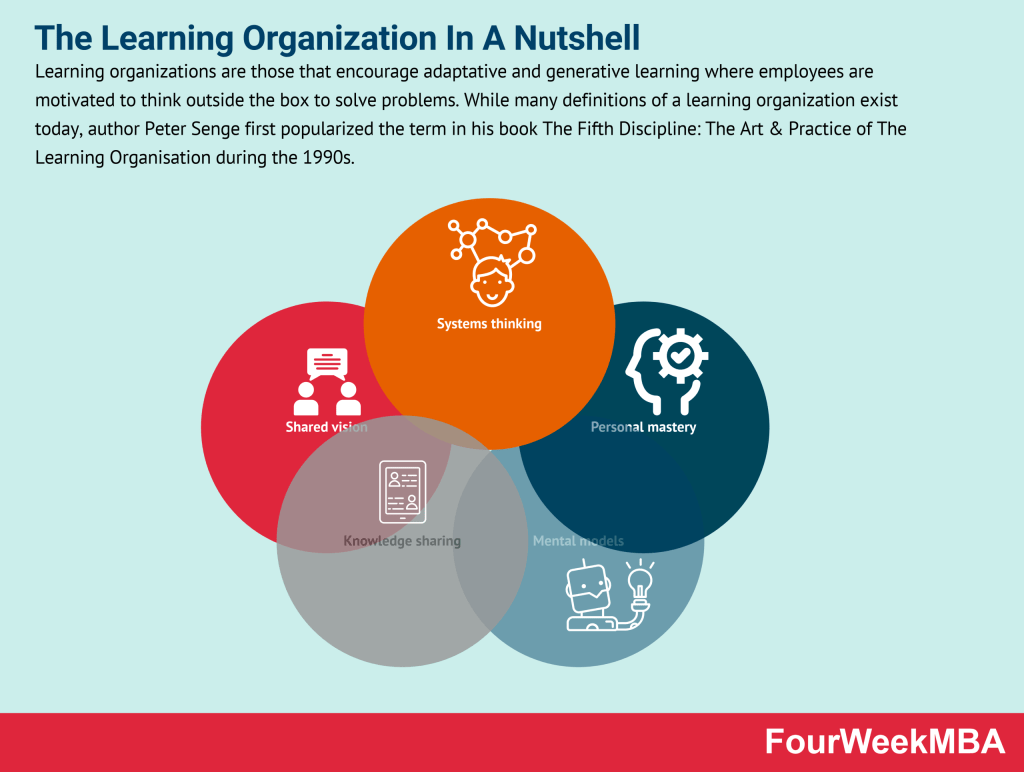
Learning organizations are those that encourage adaptative and generative learning where employees are motivated to think outside the box to solve problems. While many definitions of a learning organization exist today, author Peter Senge first popularized the term in his book The Fifth Discipline: The Art & Practice of The Learning Organisation during the 1990s.
The forgetting curve was first proposed in 1885 by Hermann Ebbinghaus, a German psychologist and pioneer of experimental research into memory. The forgetting curve illustrates the rate at which information is lost over time if the individual does not make effort to retain it.
Instructor-led training is a more traditional, top-down, teacher-oriented approach to learning that occurs in online or offline classroom environments. The approach connects instructors with students to encourage discussion and interaction in a group or individual context, with many enjoying ILT over other methods as they can seek direct clarification on a topic from the source. Instructor-led training (ILT), therefore, encompasses any form of training provided by an instructor in an online or offline classroom setting.
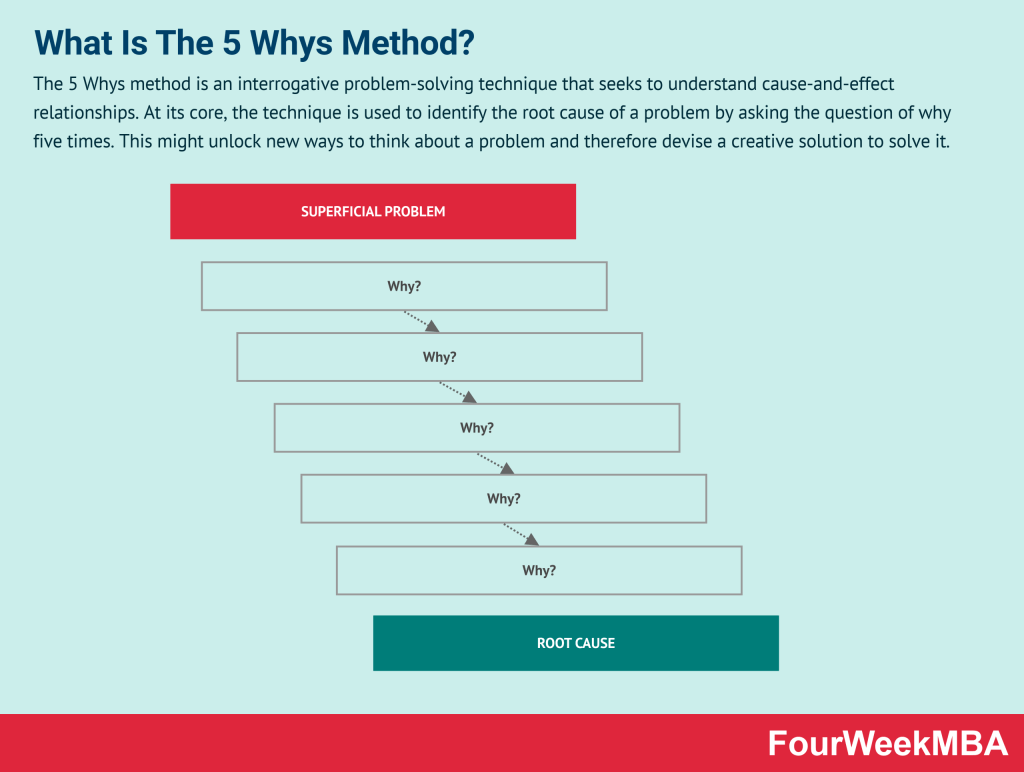
The 5 Whys method is an interrogative problem-solving technique that seeks to understand cause-and-effect relationships. At its core, the technique is used to identify the root cause of a problem by asking the question of why five times. This might unlock new ways to think about a problem and therefore devise a creative solution to solve it.
Single-loop learning was developed by Dr. Chris Argyris, a well-respected author and Harvard Business School professor in the area of metacognitive thinking. He defined single-loop learning as “learning that changes strategies of action (i.e. the how) in ways that leave the values of a theory of action unchanged (i.e. the why).” Single-loop learning is a learning process where people, groups, or organizations modify their actions based on the difference between expected and actual outcomes.
Spaced repetition is a technique where individuals review lessons at increasing intervals to memorize information. Spaced repetition is based on the premise that the brain learns more effectively when the individual “spaces out” the learning process. Thus, it can be used as a mnemonic technique to transform short-term memory into long-term memory.
Blended learning is a broad and imprecise field that makes it difficult to define. However, in most cases, it is considered to be a form of hybrid learning that combines online and offline instructional methods.
The term lessons learned refers to the various experiences project team members have while participating in a project. Lessons are shared in a review session which usually occurs once the project has been completed, with any improvements or best practices incorporated into subsequent projects.
Post-mortem analyses review projects from start to finish to determine process improvements and ensure that inefficiencies are not repeated in the future. In the Project Management Book of Knowledge (PMBOK), this process is referred to as “lessons learned”.
Instructor-led training is a more traditional, top-down, teacher-oriented approach to learning that occurs in online or offline classroom environments. The approach connects instructors with students to encourage discussion and interaction in a group or individual context, with many enjoying ILT over other methods as they can seek direct clarification on a topic from the source. Instructor-led training (ILT), therefore, encompasses any form of training provided by an instructor in an online or offline classroom setting.
The 5E Instructional Model is a framework for improving teaching practices through discussion, observation, critique, and reflection. Teachers and students move through each phase linearly, but some may need to be repeated or cycled through several times to ensure effective learning. This is a form of inquiry-based learning where students are encouraged to discover information and formulate new insights themselves.
Gennaro is the creator of FourWeekMBA, which reached about four million business people, comprising C-level executives, investors, analysts, product managers, and aspiring digital entrepreneurs in 2022 alone | He is also Director of Sales for a high-tech scaleup in the AI Industry | In 2012, Gennaro earned an International MBA with emphasis on Corporate Finance and Business Strategy.