The 5E Model, an instructional framework, comprises Engage, Explore, Explain, Elaborate, and Evaluate stages. It fosters engagement, inquiry learning, and concept mastery. Challenges include time management and resource availability. Applied in science classrooms and STEM education, the model facilitates active learning through hands-on exploration and application.
5E Model in Education
Description
Implications
Examples
Applications
Engage
The “Engage” phase is the first step in the learning process. It aims to capture students’ attention and activate their prior knowledge about the topic. Teachers use engaging activities, questions, or demonstrations to stimulate curiosity and interest in the subject matter.
– Fosters curiosity and interest in the topic. – Activates prior knowledge to build connections. – Sets the stage for the learning experience. – Encourages participation and engagement.
– Starting a lesson on photosynthesis with a striking image of a lush forest. – Asking thought-provoking questions related to the topic, encouraging discussion. – Conducting a hands-on experiment as an introduction to a science concept.
– Lesson Planning: Design engaging activities to kickstart the learning process. – Student Engagement: Capture students’ attention and curiosity at the beginning of the lesson. – Assessing Prior Knowledge: Activate and assess what students already know about the topic. – Creating a Positive Learning Environment: Establish a positive and interactive classroom atmosphere.
Explore
In the “Explore” phase, students actively investigate and experiment with the topic. They explore concepts, ask questions, and gather information through hands-on activities, group discussions, or research. This phase encourages students to discover and construct their own understanding.
– Promotes active learning and inquiry. – Allows students to make observations and gather data. – Encourages critical thinking and problem-solving. – Supports collaborative learning experiences.
– Conducting a group experiment to observe chemical reactions. – Engaging in a class debate on a historical event, encouraging multiple perspectives. – Exploring primary sources and conducting research on a given topic.
– Project-Based Learning: Engage students in hands-on projects and investigations. – Group Activities: Foster collaboration and discussion among students. – Inquiry-Based Learning: Encourage students to ask questions and explore topics independently. – Promoting Critical Thinking: Develop activities that challenge students to think critically.
Explain
The “Explain” phase involves the teacher providing explanations, content, and context to support students’ understanding. Teachers clarify concepts, share information, and model processes. This phase helps students connect their exploration to formal knowledge and gain a deeper understanding of the subject.
– Provides structured content and explanations. – Offers context and background information. – Clarifies misconceptions and answers questions. – Supports concept comprehension and knowledge transfer.
– Delivering a lecture to explain the principles of Newton’s laws of motion. – Using multimedia presentations to illustrate complex scientific concepts. – Providing step-by-step instructions for solving mathematical problems.
– Content Delivery: Present information and concepts clearly and effectively. – Concept Clarification: Address misconceptions and provide additional context. – Multimedia Resources: Utilize multimedia tools for visual explanations. – Modeling: Demonstrate processes and procedures to enhance understanding.
Elaborate
The “Elaborate” phase encourages students to deepen their understanding and apply their knowledge in diverse contexts. Students engage in extended activities, discussions, or projects that require critical thinking, analysis, and problem-solving. This phase reinforces learning and challenges students to think creatively.
– Promotes application of knowledge in real-world scenarios. – Encourages critical thinking and problem-solving. – Reinforces learning through extended activities. – Fosters creativity and independent thinking.
– Assigning a project that requires students to apply scientific principles to solve a real-world problem. – Organizing a debate where students defend their viewpoints on a historical issue using evidence. – Encouraging students to write essays analyzing a literary work from different perspectives.
– Project-Based Assessment: Evaluate students’ ability to apply knowledge in practical projects. – Critical Thinking Activities: Engage students in discussions and activities that require analysis. – Creative Assignments: Encourage students to express their understanding in creative ways. – Real-World Applications: Connect lessons to real-world contexts to reinforce learning.
Evaluate
The “Evaluate” phase involves assessing students’ understanding and learning outcomes. Teachers use various assessment methods, such as quizzes, tests, projects, or discussions, to gauge the effectiveness of the learning experience. Assessment results guide further instruction and help measure students’ progress.
– Measures learning outcomes and comprehension. – Provides feedback for both students and teachers. – Guides instructional adjustments based on assessment results. – Ensures alignment with learning objectives.
– Administering a quiz to assess students’ knowledge of a specific topic. – Reviewing project submissions and providing constructive feedback. – Conducting group discussions to evaluate students’ ability to analyze and apply concepts.
– Formative Assessment: Use ongoing assessments to monitor learning progress. – Summative Assessment: Assess overall learning outcomes at the end of a unit or course. – Feedback and Improvement: Provide feedback to students and adjust instruction accordingly. – Learning Objectives Alignment: Ensure assessments align with defined learning objectives.
The 5E Model is a widely adopted instructional framework used in education to facilitate effective and engaging learning experiences. The model consists of five phases, all beginning with the letter “E”: Engage, Explore, Explain, Elaborate, and Evaluate. Each phase is designed to guide educators in planning and implementing lessons that promote active learning and conceptual understanding.
Key Phases of the 5E Model:
Engage: Capturing students’ interest and curiosity at the beginning of a lesson to motivate their learning.
Explore: Allowing students to actively investigate and experience concepts through hands-on activities or experiments.
Explain: Providing clear explanations and introducing key concepts, often followed by teacher-led discussions.
Elaborate: Extending students’ understanding through more in-depth activities, discussions, and applications.
Evaluate: Assessing students’ learning through various methods, including quizzes, tests, and performance assessments.
Why the 5E Model Matters:
Understanding the significance of the 5E Model is essential for educators aiming to create dynamic and effective learning environments that foster critical thinking and deeper understanding.
The Impact of the 5E Model:
Engagement: The 5E Model promotes student engagement by involving them in hands-on activities and discussions.
Conceptual Understanding: It supports students in building a solid conceptual foundation by encouraging exploration and questioning.
Critical Thinking: The model encourages critical thinking skills as students actively participate in problem-solving and inquiry-based activities.
Benefits of Using the 5E Model:
Increased Retention: Active engagement and exploration often lead to better retention of knowledge.
Inclusivity: The 5E Model can be adapted to accommodate diverse learning styles and abilities.
Challenges of Using the 5E Model:
Time-Intensive: Implementing the model can be time-consuming due to the preparation required for engaging activities.
Assessment: Designing assessments that align with the 5E Model can be challenging.
Challenges in Using the 5E Model:
Understanding the challenges and limitations associated with the 5E Model is crucial for educators seeking to implement it effectively.
Time-Intensive:
Preparation: Designing engaging activities and experiments for each phase can be time-consuming for educators.
Solution: Collaborative lesson planning and access to pre-designed resources can help streamline the preparation process.
Assessment:
Alignment: Designing assessments that effectively measure students’ understanding of concepts explored in the 5E Model can be complex.
Solution: Educators can develop assessment rubrics and performance tasks that align with the learning objectives of each phase.
The 5E Model in Action:
To better understand the 5E Model, let’s explore how it functions in various educational scenarios and what it reveals about the effectiveness of modern teaching and learning practices.
Elementary Science Lesson: States of Matter
Scenario: A second-grade teacher uses the 5E Model to teach students about the states of matter (solid, liquid, gas).
The 5E Model in Action:
Engage: The teacher starts the lesson by showing a video of water changing from ice to vapor, sparking curiosity and questions from students.
Explore: Students participate in a hands-on activity where they touch, feel, and describe different materials (e.g., ice, water, and steam).
Explain: The teacher explains the concepts of solids, liquids, and gases using simple language and visuals.
Elaborate: Students engage in group discussions and experiments, such as observing how heating and cooling affect the states of matter.
Evaluate: The teacher assesses students’ understanding through individual and group assessments, such as drawing the water cycle.
High School History Lesson: The American Revolution
Scenario: A high school history teacher uses the 5E Model to teach students about the American Revolution.
The 5E Model in Action:
Engage: The teacher begins the lesson with a provocative question about the causes of the American Revolution, sparking a class discussion.
Explore: Students analyze primary source documents and artifacts from the time period to gain insights into the historical context.
Explain: The teacher provides a structured explanation of the events leading up to the American Revolution, emphasizing key figures and concepts.
Elaborate: Students work on group projects, such as creating a timeline of significant events or debating the motivations of key historical figures.
Evaluate: Assessment includes both a written test on historical facts and an oral presentation in which students defend their interpretations of the Revolution’s causes.
Examples and Applications:
STEM Education:
The 5E Model is commonly used in science, technology, engineering, and mathematics (STEM) education to promote inquiry-based learning and experimentation.
Language Arts:
Educators adapt the 5E Model to language arts instruction, using it to engage students in literature analysis, creative writing, and critical reading.
Professional Development:
The 5E Model is used in teacher training programs to model effective instructional strategies for educators.
Applications and Use Cases:
K-12 Education:
The 5E Model is widely applied in K-12 classrooms across various subjects to enhance student engagement and understanding.
Higher Education:
Colleges and universities incorporate the 5E Model into their pedagogy to promote active learning and critical thinking.
Professional Development:
Teacher training programs and workshops use the 5E Model to demonstrate effective teaching strategies.
Conclusion:
In conclusion, the 5E Model is a versatile and effective instructional framework for educators seeking to create engaging and impactful learning experiences.
The applications of the 5E Model span various educational settings and contexts, offering educators a structured approach to foster student engagement, conceptual understanding, and critical thinking. While it presents challenges related to time-intensive preparation and assessment alignment, its emphasis on active exploration and inquiry-based learning makes it a powerful tool for modern education. By acknowledging the significance of the 5E Model and addressing its challenges proactively, educators can create dynamic learning environments that empower students to become lifelong learners and critical thinkers.
Key Highlights
Instructional Framework: The 5E Model is designed for science education, promoting hands-on learning and inquiry-based teaching.
Components: Engage, Explore, Explain, Elaborate, and Evaluate stages create a comprehensive learning experience.
Stages: Each stage has distinct goals, from capturing curiosity to assessing outcomes.
Benefits: It fosters engagement, develops critical thinking, and enhances concept mastery.
Challenges: Time management and resource availability pose implementation challenges.
Applications: Effective in science classrooms and STEM education, promoting active learning.
Use Cases: Applied in biology lessons, physics experiments, and environmental studies.
Examples: Environmental observations and chemistry labs demonstrate its practical application.
A Blockchain Business Model according to the FourWeekMBA framework is made of four main components: Value Model (Core Philosophy, Core Values and Value Propositions for the key stakeholders), Blockchain Model (Protocol Rules, Network Shape and Applications Layer/Ecosystem), Distribution Model (the key channels amplifying the protocol and its communities), and the Economic Model (the dynamics/incentives through which protocol players make money). Those elements coming together can serve as the basis to build and analyze a solid Blockchain Business Model.
In a business world driven by technology and digitalization, competition is much more fluid, as innovation becomes a bottom-up approach that can come from anywhere. Thus, making it much harder to define the boundaries of existing markets. Therefore, a proper business competition analysis looks at customer, technology, distribution, and financial model overlaps. While at the same time looking at future potential intersections among industries that in the short-term seem unrelated.
Technological modeling is a discipline to provide the basis for companies to sustain innovation, thus developing incremental products. While also looking at breakthrough innovative products that can pave the way for long-term success. In a sort of Barbell Strategy, technological modeling suggests having a two-sided approach, on the one hand, to keep sustaining continuous innovation as a core part of the businessmodel. On the other hand, it places bets on future developments that have the potential to break through and take a leap forward.
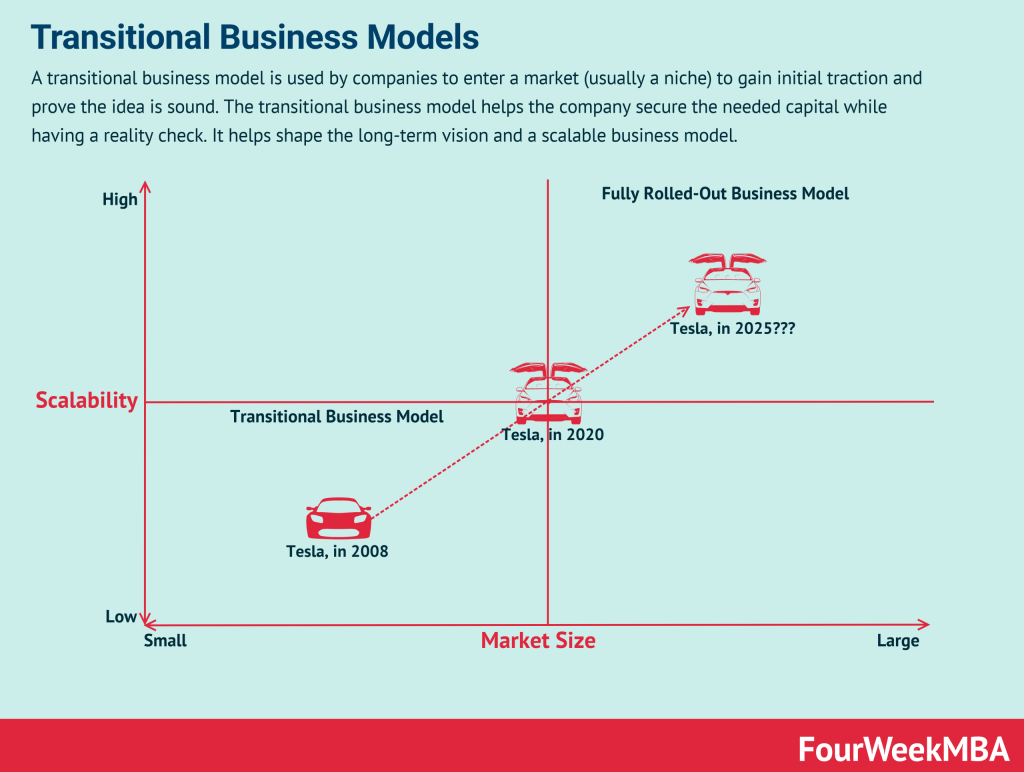
A transitional business model is used by companies to enter a market (usually a niche) to gain initial traction and prove the idea is sound. The transitional business model helps the company secure the needed capital while having a reality check. It helps shape the long-term vision and a scalable businessmodel.
The minimum viable audience (MVA) represents the smallest possible audience that can sustain your business as you get it started from a microniche (the smallest subset of a market). The main aspect of the MVA is to zoom into existing markets to find those people which needs are unmet by existing players.
Business scaling is the process of transformation of a business as the product is validated by wider and wider market segments. Business scaling is about creating traction for a product that fits a small market segment. As the product is validated it becomes critical to build a viable businessmodel. And as the product is offered at wider and wider market segments, it’s important to align product, businessmodel, and organizational design, to enable wider and wider scale.
The market expansion consists in providing a product or service to a broader portion of an existing market or perhaps expanding that market. Or yet, market expansions can be about creating a whole new market. At each step, as a result, a company scales together with the market covered.
In the FourWeekMBA growth matrix, you can apply growth for existing customers by tackling the same problems (gain mode). Or by tackling existing problems, for new customers (expand mode). Or by tackling new problems for existing customers (extend mode). Or perhaps by tackling whole new problems for new customers (reinvent mode).
In the FourWeekMBA Revenue Streams Matrix, revenue streams are classified according to the kind of interactions the business has with its key customers. The first dimension is the “Frequency” of interaction with the key customer. As the second dimension, there is the “Ownership” of the interaction with the key customer.
Revenue model patterns are a way for companies to monetize their business models. A revenue model pattern is a crucial building block of a business model because it informs how the company will generate short-term financial resources to invest back into the business. Thus, the way a company makes money will also influence its overall business model.
The Cynefin Framework gives context to decision making and problem-solving by providing context and guiding an appropriate response. The five domains of the Cynefin Framework comprise obvious, complicated, complex, chaotic domains and disorder if a domain has not been determined at all.
A SWOT Analysis is a framework used for evaluating the business’s Strengths, Weaknesses, Opportunities, and Threats. It can aid in identifying the problematic areas of your business so that you can maximize your opportunities. It will also alert you to the challenges your organization might face in the future.
The SWOT analysis is commonly used as a strategic planning tool in business. However, it is also well suited for personal use in addressing a specific goal or problem. A personal SWOT analysis helps individuals identify their strengths, weaknesses, opportunities, and threats.
The Pareto Analysis is a statistical analysis used in business decision making that identifies a certain number of input factors that have the greatest impact on income. It is based on the similarly named Pareto Principle, which states that 80% of the effect of something can be attributed to just 20% of the drivers.
A failure mode and effects analysis (FMEA) is a structured approach to identifying design failures in a product or process. Developed in the 1950s, the failure mode and effects analysis is one the earliest methodologies of its kind. It enables organizations to anticipate a range of potential failures during the design stage.
A Blindspot Analysis is a means of unearthing incorrect or outdated assumptions that can harm decision making in an organization. The term “blindspot analysis” was first coined by American economist Michael Porter. Porter argued that in business, outdated ideas or strategies had the potential to stifle modern ideas and prevent them from succeeding. Furthermore, decisions a business thought were made with care caused projects to fail because major factors had not been duly considered.
A comparable company analysis is a process that enables the identification of similar organizations to be used as a comparison to understand the business and financial performance of the target company. To find comparables you can look at two key profiles: the business and financial profile. From the comparable company analysis it is possible to understand the competitive landscape of the target organization.
A cost-benefit analysis is a process a business can use to analyze decisions according to the costs associated with making that decision. For a cost analysis to be effective it’s important to articulate the project in the simplest terms possible, identify the costs, determine the benefits of project implementation, assess the alternatives.
Agile Business Analysis (AgileBA) is certification in the form of guidance and training for business analysts seeking to work in agile environments. To support this shift, AgileBA also helps the business analyst relate Agile projects to a wider organizational mission or strategy. To ensure that analysts have the necessary skills and expertise, AgileBA certification was developed.
A SOAR analysis is a technique that helps businesses at a strategic planning level to:
Focus on what they are doing right.
Determine which skills could be enhanced.
Understand the desires and motivations of their stakeholders.
The STEEPLE analysis is a variation of the STEEP analysis. Where the step analysis comprises socio-cultural, technological, economic, environmental/ecological, and political factors as the base of the analysis. The STEEPLE analysis adds other two factors such as Legal and Ethical.
The PESTEL analysis is a framework that can help marketers assess whether macro-economic factors are affecting an organization. This is a critical step that helps organizations identify potential threats and weaknesses that can be used in other frameworks such as SWOT or to gain a broader and better understanding of the overall marketing environment.
A DESTEP analysis is a framework used by businesses to understand their external environment and the issues which may impact them. The DESTEP analysis is an extension of the popular PEST analysis created by Harvard Business School professor Francis J. Aguilar. The DESTEP analysis groups external factors into six categories: demographic, economic, socio-cultural, technological, ecological, and political.
A paired comparison analysis is used to rate or rank options where evaluation criteria are subjective by nature. The analysis is particularly useful when there is a lack of clear priorities or objective data to base decisions on. A paired comparison analysis evaluates a range of options by comparing them against each other.
Gennaro is the creator of FourWeekMBA, which reached about four million business people, comprising C-level executives, investors, analysts, product managers, and aspiring digital entrepreneurs in 2022 alone | He is also Director of Sales for a high-tech scaleup in the AI Industry | In 2012, Gennaro earned an International MBA with emphasis on Corporate Finance and Business Strategy.