The 5C Model empowers marketing strategies through five components—Company, Customers, Competitors, Collaborators, and Context. It aligns communication with goals, tailors messages for relevance, and provides a competitive edge. Applied in marketing campaigns and product launches, with Apple’s branding and Nike’s campaigns illustrating its effectiveness in driving successful communication.
5C Model
Description
Implications
Examples
Applications
Company
The “Company” aspect of the 5C Model focuses on understanding the internal characteristics and capabilities of the organization. This includes assessing the company’s mission, values, culture, structure, resources, and overall strengths and weaknesses.
– Provides insights into the organization’s identity and culture. – Identifies internal strengths and weaknesses. – Helps in aligning strategies with the company’s core values and mission. – Guides resource allocation and talent management.
– Analyzing the company’s corporate culture to determine its impact on decision-making. – Assessing the organization’s resource allocation and distribution. – Evaluating the company’s structure and hierarchy for potential bottlenecks.
– Strategic Planning: Align strategies with the organization’s mission and values. – Organizational Development: Enhance company culture and address weaknesses. – Resource Allocation: Optimize resource allocation based on internal capabilities. – Leadership and Talent Management: Align leadership practices with company culture and values.
Customers
The “Customers” aspect involves understanding the target audience and their needs. This includes defining customer segments, preferences, behavior, and expectations. It also involves gathering feedback and data to enhance customer satisfaction and loyalty.
– Aids in identifying and prioritizing target customer segments. – Enables the customization of products/services to meet customer needs. – Drives customer-centric strategies and marketing efforts. – Supports the development of customer retention and loyalty programs.
– Conducting market research to segment customers based on demographics and preferences. – Gathering customer feedback through surveys and interviews to improve product features. – Creating customer personas to guide marketing campaigns and messaging.
– Marketing Strategy: Tailor marketing efforts to specific customer segments. – Product Development: Customize products based on customer preferences. – Customer Relationship Management (CRM): Build loyalty and retention strategies. – Market Research: Understand customer behavior and preferences for informed decisions.
Competitors
The “Competitors” aspect involves analyzing the competitive landscape to identify key rivals, their strengths and weaknesses, market positioning, and strategies. Understanding competitors is essential for differentiating products/services and gaining a competitive edge.
– Provides insights into competitive strengths and weaknesses. – Informs strategies for differentiation and market positioning. – Helps in identifying potential threats and opportunities in the market. – Guides pricing, marketing, and product development decisions.
– Conducting a competitive analysis to assess market share and the competitive advantage of rivals. – Monitoring competitors’ marketing campaigns and product launches. – Identifying gaps in the market that competitors have not addressed.
– Competitive Analysis: Formulate strategies to outperform competitors. – Product Differentiation: Identify opportunities to create unique value propositions. – Pricing Strategy: Determine competitive pricing based on market analysis. – Market Entry: Identify market gaps that competitors have not explored.
Collaborators
The “Collaborators” aspect involves identifying and evaluating potential partners, suppliers, distributors, and alliances that can enhance the organization’s capabilities and reach. Collaborations and partnerships can lead to improved resources, access to new markets, and mutual benefits.
– Identifies opportunities for strategic partnerships and alliances. – Enhances the organization’s resource base and market reach. – Facilitates efficient supply chain management. – Mitigates risks through collaboration with reliable partners.
– Exploring partnerships with suppliers to secure a stable supply chain. – Forming strategic alliances with complementary businesses to expand market reach. – Evaluating the performance and reliability of distribution partners.
– Strategic Partnerships: Establish collaborations for mutual growth and benefits. – Supply Chain Management: Ensure a reliable and efficient supply chain through collaboration. – Market Expansion: Extend market reach through partnerships and alliances. – Risk Management: Share risks and resources with trusted collaborators.
Climate
The “Climate” aspect involves assessing the external factors and macro-environmental forces that can impact the organization. This includes analyzing economic conditions, regulatory changes, technological advancements, social trends, and environmental factors. Understanding the external environment is crucial for adaptation and risk management.
– Enables proactive response to external factors affecting the organization. – Guides risk assessment and mitigation strategies. – Supports market forecasting and scenario planning. – Helps in identifying emerging opportunities and threats in the business environment.
– Analyzing economic trends and their potential impact on consumer spending behavior. – Monitoring regulatory changes that may affect industry standards and compliance. – Assessing technological advancements that could disrupt traditional business models.
– Risk Management: Anticipate and mitigate risks arising from external factors. – Strategic Planning: Incorporate environmental scanning into long-term strategies. – Market Research: Understand the impact of external trends on consumer behavior. – Scenario Planning: Develop scenarios based on various environmental factors for strategic decision-making.
The 5C Model is a strategic communication framework designed to help organizations plan, execute, and evaluate their communication efforts effectively. It comprises five key elements, often referred to as the 5Cs: Context, Content, Channels, Cadence, and Consistency.
Key Elements of the 5C Model:
Context: Understanding the communication environment, target audience, and objectives within which communication takes place.
Content: Developing relevant and compelling messaging, stories, or information that align with the communication objectives.
Channels: Selecting the appropriate communication channels and platforms to reach the target audience effectively.
Cadence: Establishing a strategic timing and frequency for communication activities to maintain audience engagement.
Consistency: Ensuring that the messaging, tone, and branding are consistent across all communication touchpoints.
Why the 5C Model Matters:
Understanding the significance of the 5C Model is essential for organizations looking to improve their communication strategies and effectively engage with their target audiences.
The Impact of the 5C Model:
Strategic Alignment: The 5C Model ensures that communication efforts align with organizational goals and objectives.
Audience-Centric: It places a strong emphasis on understanding and meeting the needs of the target audience.
Efficiency: By considering context, content, channels, cadence, and consistency, organizations can streamline their communication efforts.
Benefits of Using the 5C Model:
Improved Engagement: The 5C Model helps organizations create more engaging and relevant communication content.
Measurable Results: It enables organizations to set clear communication objectives and measure the effectiveness of their efforts.
Challenges of Using the 5C Model:
Resource Allocation: Developing and maintaining consistent communication can require significant resources.
Adaptation: The model may need to be adapted to suit different communication contexts and audiences.
Challenges in Using the 5C Model:
Understanding the challenges and limitations associated with the 5C Model is crucial for organizations seeking to implement it successfully.
Resource Allocation:
Budget: Organizations may need to allocate sufficient budget and resources to maintain consistent communication efforts.
Solution: Strategic resource planning and prioritization can help organizations make the most of their communication resources.
Adaptation:
Diverse Audiences: Communicating with various audiences may require tailoring the 5C Model to suit specific needs.
Solution: Flexibility and audience analysis can help organizations adapt the model effectively.
The 5C Model in Action:
To better understand the 5C Model, let’s explore how it functions in various communication scenarios and what it reveals about the effectiveness of modern communication strategies.
Corporate Branding and Reputation Management:
Scenario: A global corporation wants to enhance its brand image and manage its reputation.
The 5C Model in Action:
Context: The company conducts extensive research to understand its stakeholders’ perceptions and concerns.
Content: Based on research findings, it develops authentic and transparent messaging that addresses key issues.
Channels: The company employs a multi-channel approach, including social media, PR campaigns, and stakeholder engagement.
Cadence: Communication activities are strategically timed to respond to emerging issues and maintain engagement.
Consistency: The messaging is consistent across all communication touchpoints, reinforcing the desired brand image.
Nonprofit Fundraising Campaign:
Scenario: A nonprofit organization aims to raise funds for a specific cause through a digital fundraising campaign.
The 5C Model in Action:
Context: The organization identifies its target donors and their motivations for giving.
Content: Compelling stories, videos, and testimonials are created to resonate with donors.
Channels: The campaign leverages social media, email marketing, and a dedicated website.
Cadence: Communications are timed to coincide with key events and milestones in the campaign.
Consistency: The campaign maintains a consistent visual identity and messaging.
Examples and Applications:
Crisis Communication:
Organizations use the 5C Model to develop crisis communication plans, ensuring that messaging is consistent, timely, and appropriate to the crisis context.
Employee Engagement:
Internal communication efforts benefit from the 5C Model, helping organizations maintain a consistent and engaging dialogue with their employees.
Product Launches:
Companies apply the 5C Model when launching new products or services to effectively communicate their value proposition to customers.
Applications and Use Cases:
Public Relations:
PR professionals use the 5C Model to plan and execute communication strategies that manage reputation, respond to crises, and promote positive narratives.
Marketing Campaigns:
Marketing teams leverage the 5C Model to develop and implement campaigns that resonate with target audiences and drive sales.
Internal Communication:
Organizations use the 5C Model for internal communication to ensure that employees are well-informed, engaged, and aligned with company goals.
Conclusion:
In conclusion, the 5C Model is a valuable framework for organizations seeking to improve their communication strategies and engage effectively with their target audiences.
The applications of the 5C Model span various communication contexts and industries, offering organizations a structured approach to strategic communication. While it presents challenges related to resource allocation and adaptation, its emphasis on strategic alignment, audience-centricity, and efficiency makes it a powerful tool for modern communication professionals. By acknowledging the significance of the 5C Model and addressing its challenges proactively, organizations can enhance their communication efforts and achieve their communication objectives more effectively.
Key Highlights
Marketing Framework: The 5C Model offers a structured approach to effective marketing communication strategies.
Components: It focuses on understanding Company, Customers, Competitors, Collaborators, and Context.
Benefits: The model helps in aligning communication, tailoring messages, and gaining a competitive edge.
Challenges: Addressing data collection and complexity challenges for accurate analysis.
Applications: Useful for crafting marketing campaigns and product launches.
– The 5Cs of Credit Analysis are character, capacity, capital, collateral, and conditions. This framework is used by lenders to evaluate the creditworthiness of borrowers. It assesses factors such as the borrower’s payment history, income, assets, debt-to-equity ratio, and economic conditions to determine the likelihood of repayment.
– When evaluating the creditworthiness of individuals or businesses applying for loans or credit facilities, assessing the risk of default or non-payment, and making lending decisions based on a comprehensive analysis of borrower characteristics and financial stability.
5Cs of Marketing
– The 5Cs of Marketing are company, customers, collaborators, competitors, and climate. This framework provides a holistic view of the marketing environment, including internal and external factors that influence marketing strategy and decision-making. It helps marketers understand their organization’s strengths, target market, partnerships, competitive landscape, and industry trends.
– When developing marketing strategies and plans, analyzing market opportunities and threats, identifying target customers and competitors, assessing internal capabilities and resources, and adapting to changes in the business environment.
5Cs of Strategic Analysis
– The 5Cs of Strategic Analysis are context, content, computation, communication, and change. This framework is used to analyze complex problems or situations from multiple perspectives, including the broader context, relevant content or information, computational models, communication channels, and potential change strategies.
– When conducting strategic analysis and planning, exploring complex issues or challenges, identifying key factors and drivers of change, communicating insights and recommendations effectively, and developing strategies to navigate uncertainty and drive organizational change.
5Cs of Communication
– The 5Cs of Communication are clarity, conciseness, coherence, consistency, and credibility. This framework provides guidelines for effective communication, emphasizing the importance of clear, concise, and coherent messaging that is consistent and credible to build trust and credibility with the audience.
– When crafting written or verbal communications, preparing presentations or reports, delivering messages to internal or external stakeholders, and seeking to enhance communication effectiveness and impact.
5Cs of Leadership
– The 5Cs of Leadership are competence, character, commitment, communication, and courage. This framework highlights the key attributes and behaviors of effective leaders, including their skills, integrity, dedication, ability to communicate vision and values, and willingness to take risks and make tough decisions.
– When developing leadership capabilities, assessing leadership potential or performance, identifying areas for improvement or development, and fostering a culture of leadership excellence within organizations.
5Cs of Digital Marketing
– The 5Cs of Digital Marketing are content, context, connection, communication, and conversion. This framework focuses on key elements of successful digital marketing campaigns, including creating compelling content, understanding the context of user interactions, building connections with target audiences, effective communication, and driving conversions or desired actions.
– When planning and executing digital marketing campaigns, developing content strategies, engaging with customers across digital channels, measuring campaign effectiveness, and optimizing conversion rates and return on investment.
5Cs of Innovation
– The 5Cs of Innovation are creativity, culture, collaboration, communication, and commercialization. This framework emphasizes the essential components of an innovative organization, including fostering a culture of creativity and experimentation, collaboration across teams and disciplines, effective communication of ideas, and the successful commercialization of innovative products or services.
– When cultivating an innovation mindset and culture within organizations, encouraging collaboration and knowledge sharing, developing and implementing innovative strategies, and bringing new products or services to market successfully.
5Cs of Coaching
– The 5Cs of Coaching are clarity, curiosity, challenge, commitment, and compassion. This framework guides coaches in supporting clients to clarify goals, explore possibilities, overcome obstacles, stay accountable, and cultivate self-awareness and resilience. It emphasizes the importance of asking powerful questions, providing constructive challenges, and demonstrating empathy and support.
– When coaching individuals or teams to achieve personal or professional goals, facilitating self-discovery and growth, building confidence and motivation, and fostering a positive and supportive coaching relationship.
5Cs of Conflict Resolution
– The 5Cs of Conflict Resolution are communication, collaboration, compromise, creativity, and commitment. This framework provides strategies for resolving conflicts constructively, focusing on effective communication, finding common ground, exploring creative solutions, and maintaining a commitment to reaching mutually beneficial outcomes.
– When managing conflicts in personal or professional relationships, negotiating agreements or resolutions, mediating disputes, or facilitating conflict resolution processes within teams or organizations.
5Cs of Entrepreneurship
– The 5Cs of Entrepreneurship are clarity, capital, customers, channels, and control. This framework helps entrepreneurs navigate the challenges of starting and growing a business by focusing on key factors such as defining their vision and goals, securing financing, identifying target customers and distribution channels, and maintaining control over their venture’s operations and direction.
– When launching a new business venture, developing a business plan, securing funding or investment, identifying market opportunities, building customer relationships, and managing the strategic growth and direction of the business.
A Blockchain Business Model according to the FourWeekMBA framework is made of four main components: Value Model (Core Philosophy, Core Values and Value Propositions for the key stakeholders), Blockchain Model (Protocol Rules, Network Shape and Applications Layer/Ecosystem), Distribution Model (the key channels amplifying the protocol and its communities), and the Economic Model (the dynamics/incentives through which protocol players make money). Those elements coming together can serve as the basis to build and analyze a solid Blockchain Business Model.
In a business world driven by technology and digitalization, competition is much more fluid, as innovation becomes a bottom-up approach that can come from anywhere. Thus, making it much harder to define the boundaries of existing markets. Therefore, a proper business competition analysis looks at customer, technology, distribution, and financial model overlaps. While at the same time looking at future potential intersections among industries that in the short-term seem unrelated.
Technological modeling is a discipline to provide the basis for companies to sustain innovation, thus developing incremental products. While also looking at breakthrough innovative products that can pave the way for long-term success. In a sort of Barbell Strategy, technological modeling suggests having a two-sided approach, on the one hand, to keep sustaining continuous innovation as a core part of the businessmodel. On the other hand, it places bets on future developments that have the potential to break through and take a leap forward.
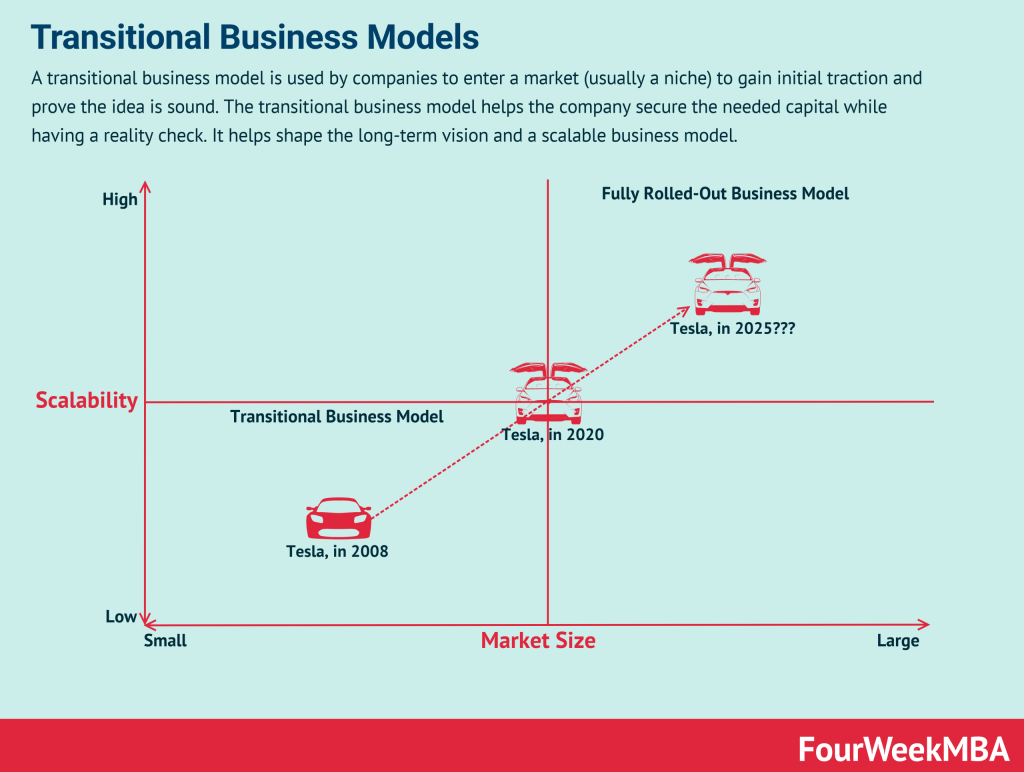
A transitional business model is used by companies to enter a market (usually a niche) to gain initial traction and prove the idea is sound. The transitional business model helps the company secure the needed capital while having a reality check. It helps shape the long-term vision and a scalable businessmodel.
The minimum viable audience (MVA) represents the smallest possible audience that can sustain your business as you get it started from a microniche (the smallest subset of a market). The main aspect of the MVA is to zoom into existing markets to find those people which needs are unmet by existing players.
Business scaling is the process of transformation of a business as the product is validated by wider and wider market segments. Business scaling is about creating traction for a product that fits a small market segment. As the product is validated it becomes critical to build a viable business model. And as the product is offered at wider and wider market segments, it’s important to align product, business model, and organizational design, to enable wider and wider scale.
The market expansion consists in providing a product or service to a broader portion of an existing market or perhaps expanding that market. Or yet, market expansions can be about creating a whole new market. At each step, as a result, a company scales together with the market covered.
In the FourWeekMBA growth matrix, you can apply growth for existing customers by tackling the same problems (gain mode). Or by tackling existing problems, for new customers (expand mode). Or by tackling new problems for existing customers (extend mode). Or perhaps by tackling whole new problems for new customers (reinvent mode).
In the FourWeekMBA Revenue Streams Matrix, revenue streams are classified according to the kind of interactions the business has with its key customers. The first dimension is the “Frequency” of interaction with the key customer. As the second dimension, there is the “Ownership” of the interaction with the key customer.
Revenue model patterns are a way for companies to monetize their business models. A revenue model pattern is a crucial building block of a business model because it informs how the company will generate short-term financial resources to invest back into the business. Thus, the way a company makes money will also influence its overall business model.
The Cynefin Framework gives context to decision making and problem-solving by providing context and guiding an appropriate response. The five domains of the Cynefin Framework comprise obvious, complicated, complex, chaotic domains and disorder if a domain has not been determined at all.
A SWOT Analysis is a framework used for evaluating the business’s Strengths, Weaknesses, Opportunities, and Threats. It can aid in identifying the problematic areas of your business so that you can maximize your opportunities. It will also alert you to the challenges your organization might face in the future.
The SWOT analysis is commonly used as a strategic planning tool in business. However, it is also well suited for personal use in addressing a specific goal or problem. A personal SWOT analysis helps individuals identify their strengths, weaknesses, opportunities, and threats.
The Pareto Analysis is a statistical analysis used in business decision making that identifies a certain number of input factors that have the greatest impact on income. It is based on the similarly named Pareto Principle, which states that 80% of the effect of something can be attributed to just 20% of the drivers.
A failure mode and effects analysis (FMEA) is a structured approach to identifying design failures in a product or process. Developed in the 1950s, the failure mode and effects analysis is one the earliest methodologies of its kind. It enables organizations to anticipate a range of potential failures during the design stage.
A Blindspot Analysis is a means of unearthing incorrect or outdated assumptions that can harm decision making in an organization. The term “blindspot analysis” was first coined by American economist Michael Porter. Porter argued that in business, outdated ideas or strategies had the potential to stifle modern ideas and prevent them from succeeding. Furthermore, decisions a business thought were made with care caused projects to fail because major factors had not been duly considered.
A comparable company analysis is a process that enables the identification of similar organizations to be used as a comparison to understand the business and financial performance of the target company. To find comparables you can look at two key profiles: the business and financial profile. From the comparable company analysis it is possible to understand the competitive landscape of the target organization.
A cost-benefit analysis is a process a business can use to analyze decisions according to the costs associated with making that decision. For a cost analysis to be effective it’s important to articulate the project in the simplest terms possible, identify the costs, determine the benefits of project implementation, assess the alternatives.
Agile Business Analysis (AgileBA) is certification in the form of guidance and training for business analysts seeking to work in agile environments. To support this shift, AgileBA also helps the business analyst relate Agile projects to a wider organizational mission or strategy. To ensure that analysts have the necessary skills and expertise, AgileBA certification was developed.
A SOAR analysis is a technique that helps businesses at a strategic planning level to:
Focus on what they are doing right.
Determine which skills could be enhanced.
Understand the desires and motivations of their stakeholders.
The STEEPLE analysis is a variation of the STEEP analysis. Where the step analysis comprises socio-cultural, technological, economic, environmental/ecological, and political factors as the base of the analysis. The STEEPLE analysis adds other two factors such as Legal and Ethical.
The PESTEL analysis is a framework that can help marketers assess whether macro-economic factors are affecting an organization. This is a critical step that helps organizations identify potential threats and weaknesses that can be used in other frameworks such as SWOT or to gain a broader and better understanding of the overall marketing environment.
A DESTEP analysis is a framework used by businesses to understand their external environment and the issues which may impact them. The DESTEP analysis is an extension of the popular PEST analysis created by Harvard Business School professor Francis J. Aguilar. The DESTEP analysis groups external factors into six categories: demographic, economic, socio-cultural, technological, ecological, and political.
A paired comparison analysis is used to rate or rank options where evaluation criteria are subjective by nature. The analysis is particularly useful when there is a lack of clear priorities or objective data to base decisions on. A paired comparison analysis evaluates a range of options by comparing them against each other.
Gennaro is the creator of FourWeekMBA, which reached about four million business people, comprising C-level executives, investors, analysts, product managers, and aspiring digital entrepreneurs in 2022 alone | He is also Director of Sales for a high-tech scaleup in the AI Industry | In 2012, Gennaro earned an International MBA with emphasis on Corporate Finance and Business Strategy.