Vendor lock-in refers to any measure a company implements to dissuade customers from migrating away from its products or services.
Real-world consumer examples of vendor lock-in include brands such as Apple, Lexmark, and Keurig. More generally speaking, DSLR and cordless tool manufacturers also lock their customers into proprietary systems.
Avoiding vendor lock-in may involve evaluating the market and the vendor before doing business, reading the contractual fine print, and clarifying whether an exit plan or migration support is available.
Aspect
Explanation
Vendor Lock-in
– Vendor Lock-in is a situation in which a customer becomes heavily dependent on a particular vendor’s products, services, or technologies to the extent that switching to an alternative vendor becomes costly, complex, or practically infeasible.
Dependency on a Vendor
– It involves a significant dependency on a single vendor for critical aspects of an organization’s operations, such as software, infrastructure, or services. This dependency can extend to data formats, proprietary technologies, and specialized skills.
Risks and Challenges
– Vendor lock-in poses several risks and challenges to organizations, including reduced flexibility, limited choice, higher costs, and vulnerability to vendor-specific issues or changes in terms and conditions. Organizations may also face challenges in negotiating favorable contracts.
Long-Term Costs
– One of the critical aspects of vendor lock-in is the long-term cost implications. While initial offerings from vendors may seem attractive, the costs can escalate over time, making it challenging to migrate to alternative solutions without incurring substantial expenses.
Compatibility Issues
– Compatibility issues can arise when organizations use proprietary formats or technologies provided by a specific vendor. This can hinder interoperability with other systems or limit the ability to integrate with new solutions in the future.
Mitigation Strategies
– Organizations employ various mitigation strategies to minimize vendor lock-in, such as standardizing on open standards, negotiating exit clauses in contracts, using abstraction layers, and regularly evaluating alternative vendors and solutions.
Vendor Neutrality
– Vendor neutrality is a strategy that promotes independence from any single vendor. It allows organizations to choose solutions and services based on merit rather than being tied to a specific vendor’s ecosystem. Vendor-neutral approaches often prioritize open standards and interoperability.
Due Diligence
– Due diligence in vendor selection is crucial. Organizations should thoroughly assess vendor lock-in risks and evaluate the long-term implications before committing to a vendor’s products or services.
Cloud Computing
– Vendor lock-in is a notable concern in cloud computing, where organizations may face challenges in migrating data and applications between cloud providers due to differences in architecture and services. Strategies like multi-cloud adoption can mitigate this risk.
Benefits of Competition
– Encouraging competition among vendors can be beneficial as it promotes innovation, better pricing, and improved service quality. Organizations should strive to maintain leverage in vendor relationships to avoid undue lock-in.
Flexibility and Agility
– Maintaining flexibility and agility in technology decisions is essential. Organizations should be prepared to adapt to changing market conditions, technology advancements, and evolving business needs, even if it requires transitioning away from a current vendor.
Vendor lock-in refers to any measure a company implements to dissuade customers from migrating away from its products or services.
For the customer, vendor lock-in occurs when the cost of switching to another service provider is prohibitively expensive. In addition to the financial cost, the customer may also be “locked in” because of an insufficient workforce, contractual restraints, or the need to avoid operational interruptions.
Consider the example of an office that hires a vendor to install 20 spring water stations, with each station only compatible with bottles the vendor sells. Now consider what would happen if employees found the spring water to be of poor quality.
Switching to a new vendor (with different sized bottles) would require each station to be replaced. Since this is a cost that the company cannot absorb, it is effectively forced to endure the less palatable water or remove the stations entirely. Here, the deliberate measure by the water company is a station whose unique dimensions mean it cannot dispense water from a competitor’s product.
Other examples of vendor lock-in
Here are some real-world consumer examples of vendor lock-in at work:
Apple iTunes – in the early days of iTunes, consumers who purchased music in the iTunes store could only play it on Apple brand products such as the iPod. Each file was encoded in a proprietary format to ensure the music was kept in the company’s ecosystem.
Ink manufacturers – printer ink is a lucrative business, and many ink manufacturers warn customers that any use of a non-branded ink will void the printer’s warranty. Lexmark is one brand that asks its customers to enter a 12-digit code to verify the authenticity of each toner cartridge.
Coffee pods – branded coffee pods, such as those offered by Keurig, are only compatible with Keurig coffee machines. The company has remained a source of vendor lock-in despite partnerships between other companies in the industry to standardize the size of different pods.
DSLR lenses – while adapters are available in limited situations, a photographer with a Nikon DSLR camera will not be able to mount a Canon lens, and vice versa. This locks the customer into whatever branded lenses are available.
Cordless tools – with cordless, battery-powered tools becoming increasingly popular, some brands manufacture batteries that will only fit their products. This includes battery recharger systems.
How can vendor lock-in be avoided?
For consumers and business customers alike, there are several ways vendor lock-in can be avoided:
Evaluate the market and the provider – it’s important to perform some prior market research to understand the various solutions and how they compare. Choosing a vendor that does not have a history of vendor lock-in saves a lot of pain later. Customer reviews can be an effective way to scrutinize a company’s past behavior in this regard.
Read the fine print – for subscription-based services like cloud computing, the client should search the fine print for the auto-renew clause. Many vendors will auto-renew a contract unless otherwise instructed, meaning the business misses an opportunity to move elsewhere at no cost.
Ask questions – before entering into an agreement, it can also be helpful to ask the vendor questions. What would an exit plan look like? Does it provide migration tools, support, and other services to facilitate a smooth transition to another product?
Key Highlights
Definition of Vendor Lock-In:
Vendor lock-in refers to strategies implemented by companies to discourage customers from switching to alternative products or services.
It occurs when the cost or effort of switching becomes prohibitive, often due to factors like proprietary systems, contractual restraints, or operational interruptions.
Examples of Vendor Lock-In:
Spring Water Stations: An example involving water stations and compatible bottles that prevent easy switching to a new vendor’s water supply due to unique station dimensions.
Apple iTunes: Early iTunes music files were encoded in a proprietary format, only playable on Apple devices like iPods.
Ink Manufacturers: Using non-branded ink in printers could void warranties; Lexmark uses verification codes for toner cartridges.
Coffee Pods: Keurig coffee pods only work with Keurig machines, limiting compatibility with other brands’ coffee makers.
DSLR Lenses: Brands like Nikon and Canon have proprietary lens mounts, preventing cross-brand compatibility.
Cordless Tools: Some cordless tool brands have batteries that only fit their specific products.
Avoiding Vendor Lock-In:
Evaluate the Market and Provider: Research different solutions and vendors before committing, choosing those without a history of lock-in.
Read the Fine Print: Scrutinize subscription-based service contracts for auto-renew clauses to avoid missing chances to switch.
Ask Questions: Inquire about exit plans, migration tools, and support services offered by the vendor to ensure a smooth transition.
Related Frameworks, Models, or Concepts
Description
When to Apply
Cloud Computing
– Cloud computing involves the delivery of computing services, such as servers, storage, databases, networking, software, and more, over the internet, offering flexibility, scalability, and cost-efficiency. – Vendor lock-in can occur when organizations rely heavily on specific cloud service providers for their infrastructure and applications, making it challenging and costly to migrate to alternative providers or on-premises solutions.
– Infrastructure Planning: Consider potential vendor lock-in risks when selecting cloud providers and designing infrastructure architectures. – Contract Negotiation: Negotiate flexible terms and exit clauses to mitigate vendor lock-in risks. – Migration Planning: Develop migration strategies and contingency plans to address vendor lock-in and ensure portability of workloads between cloud providers or between cloud and on-premises environments.
Enterprise Resource Planning (ERP) Systems
– ERP systems integrate core business processes, such as finance, human resources, supply chain management, and customer relationship management, into a unified platform. – Vendor lock-in can occur when organizations heavily customize or integrate ERP systems with proprietary technologies or modules, making it difficult and costly to switch to alternative ERP vendors or solutions.
– ERP Selection: Evaluate ERP vendors based on factors like customization flexibility, open standards support, and data portability to minimize vendor lock-in risks. – Customization Strategy: Adopt a balanced approach to customization to avoid excessive reliance on vendor-specific features or technologies. – Data Migration Planning: Develop data migration strategies and contingency plans to mitigate vendor lock-in and ensure data interoperability between ERP systems or with other applications and platforms.
Proprietary Software Solutions
– Proprietary software solutions are developed, owned, and licensed by specific vendors, offering unique features, functionalities, and integrations. – Vendor lock-in can occur when organizations heavily invest in proprietary software solutions and become dependent on vendor-specific technologies, formats, or APIs, limiting interoperability and flexibility.
– Vendor Evaluation: Assess vendor lock-in risks when selecting proprietary software solutions and consider factors like vendor lock-in mitigation strategies and exit options. – Interoperability Planning: Evaluate integration capabilities and data portability features to ensure interoperability with other systems and minimize vendor lock-in risks. – Exit Strategy Development: Develop exit strategies and transition plans to mitigate the impact of vendor lock-in and facilitate migration to alternative solutions or vendors if necessary.
Hardware Procurement
– Hardware procurement involves acquiring physical computing equipment, such as servers, storage devices, networking devices, and peripherals, from specific vendors or manufacturers. – Vendor lock-in can occur when organizations standardize on proprietary hardware platforms, architectures, or technologies, making it difficult and costly to switch to alternative hardware vendors or platforms.
– Vendor Diversification: Diversify hardware procurement sources and consider open standards and interoperability to minimize vendor lock-in risks. – Technology Evaluation: Evaluate hardware vendors based on factors like vendor lock-in mitigation strategies, compatibility with industry standards, and support for open architectures. – Vendor Management: Negotiate flexible contracts and exit clauses with hardware vendors to mitigate vendor lock-in risks and ensure the ability to transition to alternative vendors or technologies if necessary.
Software as a Service (SaaS) Solutions
– SaaS solutions provide software applications hosted and maintained by third-party providers, accessible over the internet on a subscription basis. – Vendor lock-in can occur when organizations rely heavily on specific SaaS vendors for critical business applications, data storage, or collaboration tools, making it challenging to transition to alternative solutions or migrate data.
– Vendor Assessment: Assess vendor lock-in risks when selecting SaaS solutions and consider factors like data portability, integration capabilities, and exit strategies. – Data Backup and Export: Implement data backup and export mechanisms to ensure data portability and mitigate the impact of vendor lock-in. – Contingency Planning: Develop contingency plans and exit strategies to address vendor lock-in and ensure business continuity in the event of service disruptions or vendor changes.
Integrated Software Suites
– Integrated software suites combine multiple software applications or modules into a unified platform, offering seamless interoperability and data exchange. – Vendor lock-in can occur when organizations heavily invest in integrated suites and become reliant on specific vendors for their end-to-end business processes, making it challenging to switch to alternative vendors or modular solutions.
– Vendor Evaluation: Evaluate vendor lock-in risks when selecting integrated software suites and consider factors like interoperability, modular architecture, and vendor neutrality. – Modularization Strategy: Adopt a modularization strategy to minimize dependence on integrated suites and facilitate the integration of best-of-breed solutions from multiple vendors. – Exit Planning: Develop exit plans and transition strategies to mitigate the impact of vendor lock-in and facilitate migration to alternative solutions or vendors if necessary.
Telecommunications Services
– Telecommunications services provide voice, data, and internet connectivity to organizations through various technologies and providers. – Vendor lock-in can occur when organizations rely heavily on specific telecommunications providers for network infrastructure, services, or proprietary technologies, limiting flexibility and choice.
– Provider Evaluation: Assess vendor lock-in risks when selecting telecommunications providers and consider factors like network compatibility, interoperability, and contractual terms. – Technology Standards: Embrace industry standards and open architectures to minimize dependence on proprietary telecommunications technologies and mitigate vendor lock-in risks. – Vendor Management: Negotiate flexible contracts and exit clauses with telecommunications providers to mitigate vendor lock-in risks and ensure the ability to transition to alternative providers or technologies if necessary.
Outsourcing Contracts
– Outsourcing contracts involve engaging third-party service providers to perform specific business functions, such as IT services, customer support, or back-office operations, on behalf of organizations. – Vendor lock-in can occur when organizations enter into long-term contracts with specific outsourcing providers, making it difficult and costly to transition to alternative vendors or insource services internally.
– Vendor Selection: Assess vendor lock-in risks when selecting outsourcing providers and consider factors like contract flexibility, exit options, and service portability. – Contract Negotiation: Negotiate outsourcing contracts with clear terms, service-level agreements (SLAs), and exit clauses to mitigate vendor lock-in risks and ensure flexibility. – Transition Planning: Develop transition plans and contingency measures to facilitate the termination of outsourcing contracts and the transition to alternative providers or insourcing arrangements if necessary.
Enterprise License Agreements (ELAs)
– Enterprise License Agreements (ELAs) provide organizations with access to a bundle of software licenses from specific vendors at a discounted rate. – Vendor lock-in can occur when organizations commit to long-term ELAs with specific software vendors, limiting flexibility and choice in software procurement and licensing.
– Vendor Assessment: Assess vendor lock-in risks when entering into ELAs and evaluate alternative licensing models for flexibility. – License Management: Implement robust license management practices to optimize software usage and mitigate vendor lock-in risks. – Contract Review: Regularly review ELAs and negotiate amendments or alternative agreements to maintain flexibility and avoid prolonged vendor lock-in.
Custom Application Development
– Custom application development involves building tailor-made software solutions to meet specific business requirements or objectives. – Vendor lock-in can occur when organizations rely heavily on external vendors or consultants for application development and become dependent on proprietary technologies, codebases, or support services.
– Vendor Selection: Assess vendor lock-in risks when selecting application development partners and consider factors like technology neutrality, ownership of intellectual property, and transferability of skills. – Technology Standards: Adopt open standards and modular architectures to minimize dependence on proprietary technologies and mitigate vendor lock-in risks. – Knowledge Transfer: Invest in internal capabilities and knowledge transfer to reduce reliance on external vendors and foster in-house development expertise.
An effective business model has to focus on two dimensions: the people dimension and the financial dimension. The people dimension will allow you to build a product or service that is 10X better than existing ones and a solid brand. The financial dimension will help you develop proper distribution channels by identifying the people that are willing to pay for your product or service and make it financially sustainable in the long run.
Business modelinnovation is about increasing the success of an organization with existing products and technologies by crafting a compelling value proposition able to propel a new business model to scale up customers and create a lasting competitive advantage. And it all starts by mastering the key customers.
Digital and tech business models can be classified according to four levels of transformation into digitally-enabled, digitally-enhanced, tech or platform business models, and business platforms/ecosystems.
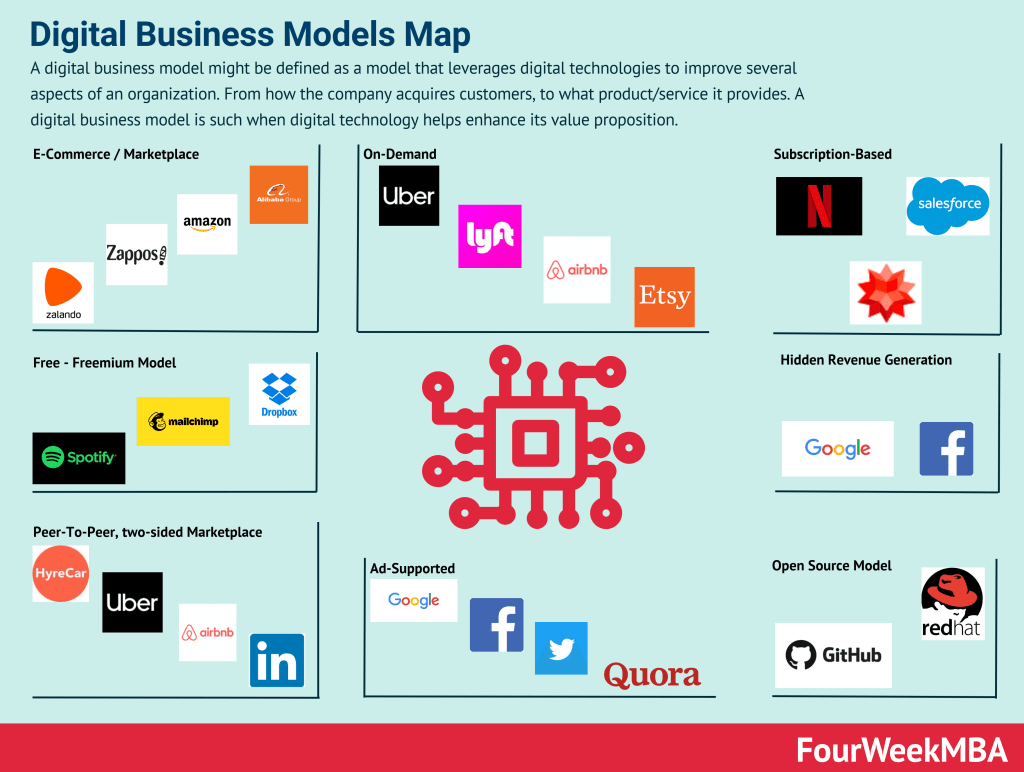
A digital business model might be defined as a model that leverages digital technologies to improve several aspects of an organization. From how the company acquires customers, to what product/service it provides. A digital business model is such when digital technology helps enhance its value proposition.
A tech business model is made of four main components: value model (value propositions, mission, vision), technological model (R&D management), distributionmodel (sales and marketingorganizational structure), and financial model (revenue modeling, cost structure, profitability and cash generation/management). Those elements coming together can serve as the basis to build a solid tech business model.
A platform business model generates value by enabling interactions between people, groups, and users by leveraging network effects. Platform business models usually comprise two sides: supply and demand. Kicking off the interactions between those two sides is one of the crucial elements for a platform business model success.
A Blockchain Business Model is made of four main components: Value Model (Core Philosophy, Core Value and Value Propositions for the key stakeholders), Blockchain Model (Protocol Rules, Network Shape and Applications Layer/Ecosystem), Distribution Model (the key channels amplifying the protocol and its communities), and the Economic Model (the dynamics through which protocol players make money). Those elements coming together can serve as the basis to build and analyze a solid Blockchain Business Model.
In an asymmetric businessmodel, the organization doesn’t monetize the user directly, but it leverages the data users provide coupled with technology, thus have a key customer pay to sustain the core asset. For example, Google makes money by leveraging users’ data, combined with its algorithms sold to advertisers for visibility.
In an asymmetric businessmodel, the organization doesn’t monetize the user directly, but it leverages the data users provide coupled with technology, thus having a key customer pay to sustain the core asset. For example, Google makes money by leveraging users’ data, combined with its algorithms sold to advertisers for visibility. This is how attention merchants make monetize their business models.
While the term has been coined by Andrew Lampitt, open-core is an evolution of open-source. Where a core part of the software/platform is offered for free, while on top of it are built premium features or add-ons, which get monetized by the corporation who developed the software/platform. An example of the GitLab open core model, where the hosted service is free and open, while the software is closed.
Cloud business models are all built on top of cloud computing, a concept that took over around 2006 when former Google’s CEO Eric Schmit mentioned it. Most cloud-based business models can be classified as IaaS (Infrastructure as a Service), PaaS (Platform as a Service), or SaaS (Software as a Service). While those models are primarily monetized via subscriptions, they are monetized via pay-as-you-go revenue models and hybrid models (subscriptions + pay-as-you-go).
Open source is licensed and usually developed and maintained by a community of independent developers. While the freemium is developed in-house. Thus the freemium give the company that developed it, full control over its distribution. In an open-source model, the for-profit company has to distribute its premium version per its open-source licensing model.
The freemium – unless the whole organization is aligned around it – is a growth strategy rather than a business model. A free service is provided to a majority of users, while a small percentage of those users convert into paying customers through the sales funnel. Free users will help spread the brand through word of mouth.
A freeterprise is a combination of free and enterprise where free professional accounts are driven into the funnel through the free product. As the opportunity is identified the company assigns the free account to a salesperson within the organization (inside sales or fields sales) to convert that into a B2B/enterprise account.
A marketplace is a platform where buyers and sellers interact and transact. The platform acts as a marketplace that will generate revenues in fees from one or all the parties involved in the transaction. Usually, marketplaces can be classified in several ways, like those selling services vs. products or those connecting buyers and sellers at B2B, B2C, or C2C level. And those marketplaces connecting two core players, or more.
B2B, which stands for business-to-business, is a process for selling products or services to other businesses. On the other hand, a B2C sells directly to its consumers.
A B2B2C is a particular kind of business model where a company, rather than accessing the consumer market directly, it does that via another business. Yet the final consumers will recognize the brand or the service provided by the B2B2C. The company offering the service might gain direct access to consumers over time.
Direct-to-consumer (D2C) is a business model where companies sell their products directly to the consumer without the assistance of a third-party wholesaler or retailer. In this way, the company can cut through intermediaries and increase its margins. However, to be successful the direct-to-consumers company needs to build its own distribution, which in the short term can be more expensive. Yet in the long-term creates a competitive advantage.
The C2C business model describes a market environment where one customer purchases from another on a third-party platform that may also handle the transaction. Under the C2C model, both the seller and the buyer are considered consumers. Customer to customer (C2C) is, therefore, a business model where consumers buy and sell directly between themselves. Consumer-to-consumer has become a prevalent business model especially as the web helped disintermediate various industries.
A retail business model follows a direct-to-consumer approach, also called B2C, where the company sells directly to final customers a processed/finished product. This implies a business model that is mostly local-based, it carries higher margins, but also higher costs and distribution risks.
The wholesale model is a selling model where wholesalers sell their products in bulk to a retailer at a discounted price. The retailer then on-sells the products to consumers at a higher price. In the wholesale model, a wholesaler sells products in bulk to retail outlets for onward sale. Occasionally, the wholesaler sells direct to the consumer, with supermarket giant Costco the most obvious example.
The term “crowdsourcing” was first coined by Wired Magazine editor Jeff Howe in a 2006 article titled Rise of Crowdsourcing. Though the practice has existed in some form or another for centuries, it rose to prominence when eCommerce, social media, and smartphone culture began to emerge. Crowdsourcing is the act of obtaining knowledge, goods, services, or opinions from a group of people. These people submit information via social media, smartphone apps, or dedicated crowdsourcing platforms.
In a franchained business model (a short-term chain, long-term franchise) model, the company deliberately launched its operations by keeping tight ownership on the main assets, while those are established, thus choosing a chain model. Once operations are running and established, the company divests its ownership and opts instead for a franchising model.
Businesses employing the brokerage business model make money via brokerage services. This means they are involved with the facilitation, negotiation, or arbitration of a transaction between a buyer and a seller. The brokerage business model involves a business connecting buyers with sellers to collect a commission on the resultant transaction. Therefore, acting as a middleman within a transaction.
Dropshipping is a retail business model where the dropshipper externalizes the manufacturing and logistics and focuses only on distribution and customer acquisition. Therefore, the dropshipper collects final customers’ sales orders, sending them over to third-party suppliers, who ship directly to those customers. In this way, through dropshipping, it is possible to run a business without operational costs and logistics management.
Gennaro is the creator of FourWeekMBA, which reached about four million business people, comprising C-level executives, investors, analysts, product managers, and aspiring digital entrepreneurs in 2022 alone | He is also Director of Sales for a high-tech scaleup in the AI Industry | In 2012, Gennaro earned an International MBA with emphasis on Corporate Finance and Business Strategy.