Starbucks is a global consumer brand with direct distribution, recognized brands, and products that make it a viable business. Its reliance on the Americas as a primary operating segment makes it a weakness. At the same time, Starbucks faces risks related to coffee beans price volatility. Yet the company still has global expansion opportunities.
Starbucks is a global consumer brand with direct distribution , recognized brands, and products that make it a viable business. Its reliance on the Americas as a primary operating segment makes it a weakness.
Strong brand: across the globe Starbucks stores are the most recognized coffee shops in the world. With their blend of coffee, other products, and with its beautifully designed, yet standardized stores, Starbucks feels like a second home for many.
A viable and proved business model: Starbucks has also a consolidated and viable business model which had the chance to grow organically in the last decades:
Product and geographical diversification: Starbucks has been investing substantially in expanding its global operations. Thus, diversifying its revenue streams.
Direct distribution: Thanks to its stores present in most cities across the globe, Starbucks enjoys a direct distribution channel with its customers.
Starbucks is a retail company that sells beverages (primarily consisting of coffee-related drinks) and food. In 2023, Starbucks had 44% of company-operated stores vs. 56% of licensed stores which might make you think Starbucks is a franchise business, when in reality most of its revenue (nearly 82% in 2023) came from company-operated stores, thus making Starbucks a chain business model.
Starbucks’ Weaknesses
Operating income too dependent on the Americas: while Starbucks has been investing in diversifying its revenue streams across markets and geographies. It is still highly dependent on the financial performance of its Americas operating segment. Thus, if that will suffer the whole company viability might be jeopardized.
Owned stores can turn in massive costs: the company runs a mix of owned and franchises stores, where the company-operated stores help the company keep the right mix, over franchised. This helps Starbucks control and keep a great customer experience. However, those stores can burn substantial resources when the economy slows down.
Starbucks’ Threats
The volatility of coffee’s price: cost of high-quality arabica coffee beans or other commodities can change swifty and it can also decreases in availability which can cause a disruption in the ability of Starbucks to serve its customers at the best.
Interruption of our supply chain could affect also the ability of Starbucks to keep operating its business at the best.
Pandemic: The global pandemic has turned already in a huge threat for the company who will need to redefine part of its value chain in the coming years.
Starbucks’ Opportunities
Further global expansion: Starbucks is still among the most recognized brands in the world. As such, it still has a big potential of global expansion, which can enable the company to further grow.
Starbucks’ main individual shareholder is Howard Schultz, the founder of Starbucks. Major institutional shareholders comprise BlackRock, with 7.18%, and The Vanguard Group, with 8.6% ownership. Starbucks follows a heavy-chained business model, where the company-operated stores play a critical role in the company’s long-term strategy, compared to McDonald’s heavy-franchised business model, where the long-term plan is to have over 95% of the stores as franchising.
Starbucks is a retail company that sells beverages (primarily consisting of coffee-related drinks) and food. In 2023, Starbucks had 44% of company-operated stores vs. 56% of licensed stores which might make you think Starbucks is a franchise business, when in reality most of its revenue (nearly 82% in 2023) came from company-operated stores, thus making Starbucks a chain business model.
Starbucks follows a chain business model strategy, where most of its revenue comes from its owned stores. For instance, in 2023, with nearly $36 billion in revenue, most of the revenue came from owned stores ($29.46 billion) compared to franchised stores ($4.51 billion) and other revenue sources ($2 billion). Yet owned stores have higher operational costs compared to franchised stores.
Starbucks follows a chain business model, building its brand through its owned stores. And its owned stores are also where most of the revenue is generated. In addition, the owned stores are a great asset to keep experimenting with new products while maintaining tight control over the customer experience.
In 2023, Starbucks operated 19,592vs. 18,253 licensed stores. Starbucks leverages primarily company-operated stores to keep tight control over product development, branding, distribution, and customer experience. It also leverages licensed stores for better amplification of brand, revenue, and profits.
Starbucks made 60% of its revenue, in 2023, from beverages, followed by other revenue, which accounted for 22% of the total revenue (that comprises packaged and single-serve coffees and teas, plus royalty and licensing revenues, beverage-related ingredients, serve ware, and ready-to-drink beverages, among other items.) and food, which accounted for 18% of the total sales in 2023.
Starbucks’s mission is “to inspire and nurture the human spirit – one person, one cup and one neighborhood at a time.” And its vision is to “treat people like family, and they will be loyal and give their all.”
Starbucks is a multinational coffee chain headquartered in Seattle, Washington. It was founded by Jerry Baldwin, Zev Siegl, and Gordon Bowker in 1971. From a single and very humble bean roasting store in Pike Place Market, the company is now a global giant operating over 37,711 stores around the world. This large global footprint obviously increases the competition for Starbucks in many different markets. The coffee industry itself is also highly competitive, with established players including McDonald’s and Dunkin’ Donuts.
Starbucks follows a matrix organizational structure with a combination of vertical and horizontal structures. It is characterized by multiple overlapping chains of command and divisions.
McDonald’s and Starbucks sit in the opposite spectrum of retail business models. Indeed, whereas McDonald’s follows a heavily franchised business model, Starbucks follows a heavy-chained one.
Starbucks highlights its mission as “to inspire and nurture the human spirit – one person, one cup and one neighborhood at a time.” And its vision is to “treat people like family, and they will be loyal and give their all.”
Starbucks is a global consumer brand with direct distribution, recognized brands, and products that make it a viable business. Its reliance on the Americas as a primary operating segment makes it a weakness. At the same time, Starbucks faces risks related to coffee beans price volatility. Yet the company still has global expansion opportunities.
Samsung was founded in South Korea in 1938 by Lee Byung-Chul. Originally a trading company, it took Samsung 22 years to become the fully-fledged electronics company that most people recognize today. Indeed, the company is a leader in technological innovation through telecommunications, electronics, and home appliances.
Costco is a large American multinational corporation with a focus on low-cost, membership-only retail warehouse clubs. Costco is the 4th largest retail operator in the world, operating 785 warehouses in 10 different countries. Indeed, it has enjoyed rapid success growing from zero to $3 billion in sales within six years.
From humble beginnings just over 50 years ago, Walmart has grown to become the world’s largest retail company. A single small discount store in Arkansas has now expanded to over 11,000 stores in 28 countries. Some reports suggest that the company now makes $1.8 million of profit every hour.
Headquartered in San Francisco, California, Uber started as a peer-to-peer ridesharing platform. In more recent times, the company has moved into food delivery, rental cars, and bike-sharing. In one form or another, Uber now has a presence in over 900 cities worldwide.
It would be hard to argue the case for a more recognizable entertainment brand than Disney. Disney is of course synonymous with Walt Disney, but it was Walt and his brother Roy who started the company in 1923 in Burbank, California. Disney content is now broadcast on over 100 channels in 34 different languages across the globe.
Coca-Cola is the market leader of the soft drink industry. It is also the most widely recognized brand, with a Business Insider study revealing that a staggering 94% of the world population recognizes the red and white logo. However, Coca-Cola faces significant challenges with increasingly health-conscious consumers and less access to water resources.
Founded in 1903 by Henry Ford and is the fifth-largest family-owned company in the world. Ford is a globally recognized brand in the automotive industry for a couple of reasons. First, Henry Ford is well-known as the inventor of the production line and thus the modern automobile industry. Today, Ford has also maintained relevance as the seventh-largest car manufacturer worldwide, selling a range of passenger cars, trucks, and vans.
Tesco was founded in 1919 by Jack Cohen, as a small group of market stalls. After rapid expansion in the following years, the company became the largest retailer in the UK and is now the second-largest in the world. To put their dominance into perspective, consider that Tesco serves around 66 shoppers per second across 7000 retails stores, delivering approximately $180,000 worth of sales every minute.
Nestlé is a large multinational food and beverage manufacturer with more than 2000 brands spread across 197 countries. Some of Nestlé’s well-known brands include Nescafe, Kit-Kat, Purina, Aero, Butterfinger, Maggi, and Haagen-Dazs. Originally a producer of infant food in 1867, it is now considered to be the world’s largest food manufacturer.
Amazon is among the most diversified business model in the tech industry. The company is well-positioned to dominate e-commerce further. And while its online stores have tight profit margins, Amazon still unlocks cash for growth, while consolidating its dominance in the cloud and grabbing new opportunities like voice.
Facebook, with its products, with its strong appeal, and consumer brand has a solid business model, threatened in the last years by privacy concerns, which open up the way to potential regulation to break up the company. If that will not happen, Facebook will have the chance to expand to define other markets like VR.
Starbucks is a global consumer brand with direct distribution, recognized brands, and products that make it a viable business. Its reliance on the Americas as a primary operating segment makes it a weakness. At the same time, Starbucks faces risks related to coffee beans price volatility. Yet the company still has global expansion opportunities.
Among the most recognized car manufacturers, Tesla is valued more than the combined market capitalization of GM and Ford. While the company’s direct distribution is a strength, its lack of financial viability is a weakness. Competition is a future threat. However, if Tesla defines a new market for car manufacturing its potential growth will be massive.
Netflix is among the most popular streaming platforms, with a subscription-based business model. The brand, platform, and content are strengths. The volatility of content licensing and production are weaknesses. The streaming market is a potential blue ocean. Inability to attract and retain premium members, and its fixed long-term costs are threats to its business model.
Apple can leverage a strong consumer brand and set of successful products as a strength. Yet the company is still too reliant on the iPhone as a primary revenue stream. Though Apple is working to open up new markets as an opportunity, it has to make sure to sustain its stores’ sales.
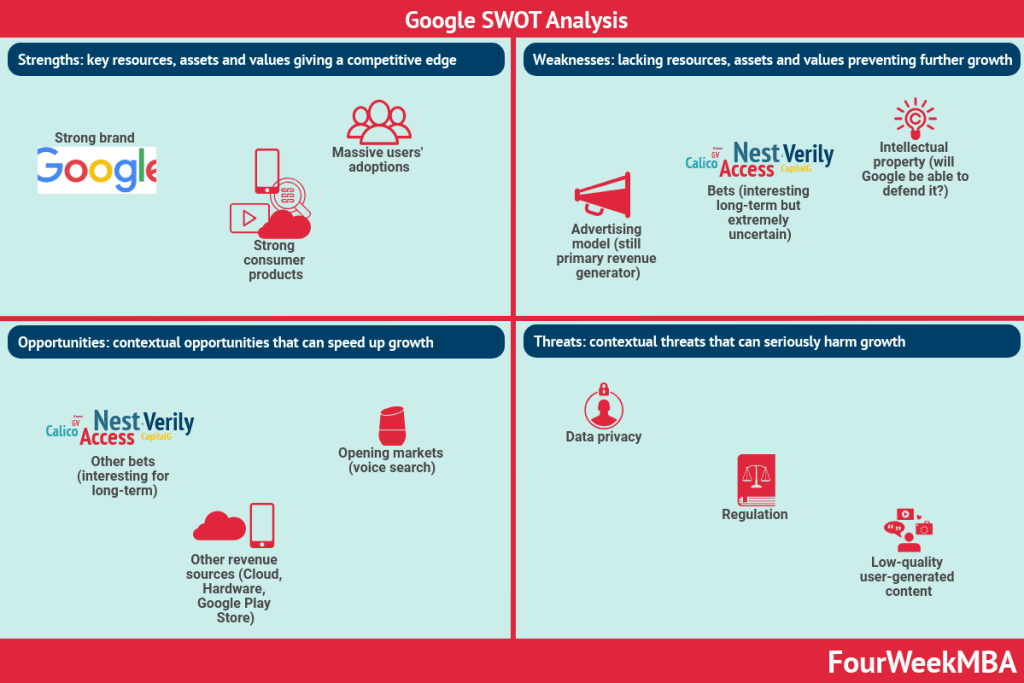
Google’s strength is its strong consumer brand. The company is grabbing new opportunities by opening up industries like voice search and consolidating in industries like the cloud. As a weakness, its revenues primarily come from advertising. A primary threat is the quick change of search and potential intervention by regulators.
Gennaro is the creator of FourWeekMBA, which reached about four million business people, comprising C-level executives, investors, analysts, product managers, and aspiring digital entrepreneurs in 2022 alone | He is also Director of Sales for a high-tech scaleup in the AI Industry | In 2012, Gennaro earned an International MBA with emphasis on Corporate Finance and Business Strategy.
Scroll to Top
Discover more from FourWeekMBA
Subscribe now to keep reading and get access to the full archive.