Vivino is an online wine marketplace founded in Denmark by Heini Zachariassen and Theis Søndergaard in 2010. Zachariassen started the company to help consumers make better wine purchasing decisions. Vivino earns money by charging its sellers a marketing fee for every bottle of wine they sell on the platform. The company also manages a subscription-based wine club for consumers. Vivino sells advertising spots and consumer aggregate data to interested parties. The popularity of both options is likely to be enhanced by the vast size of the Vivino marketplace and user base.
Vivino is an online wine marketplace with an app for Android and Apple devices. The company was founded in Denmark by Heini Zachariassen and Theis Søndergaard in 2010.
Zachariassen started the company to solve a problem many consumers face when choosing a bottle of wine: determining the good from the bad amongst the hundreds of different brands for sale.
Though smartphone apps were just beginning to take off, there were almost 1,000 existing wine apps available when Vivino was launched in 2010.
Many were run by industry experts, but Zachariassen and Søndergaard were unfazed.
Their strategy from the beginning was to build the largest wine database in the world while remaining steadfast to their mission to help consumers make better purchasing decisions.
To build their marketplace, Vivino sent wine labels to India where 50 people manually researched information about those wines and added it to the app.
This process continued for 18 months until there was a 70% chance that a consumer could find reviews about a bottle of wine in the Vivino database.
At this point, the company had achieved critical mass. Vivino’s commitment to serving its users who were wine enthusiasts but not wine experts gave it a critical point of differentiation in the market.
Vivino also listened to its audience and helped them understand the various wines they were interested in.
This high-level engagement increased the likelihood a user would purchase a bottle of wine and leave a review.
By 2017, the platform had enough user data with which to make recommendations.
To that end, Zachariassen and Søndergaard built a machine learning tool that read all the user reviews on a particular wine and compiled a structured description of its taste.
This led to some calling Vivino the “Netflix of wine”.
As the largest wine marketplace in the world, Vivino has no difficulty selling lucrative advertising spots to wineries and related businesses.
Advertising fees are based on the length of the campaign and category competitiveness.
Consumer aggregate data
Vivino also collects vast amounts of consumer purchasing behavior data. This information helps guide the merchandising strategies of various wineries and wine retailers who pay Vivino for access and exposure.
Key Highlights:
Founding and Mission: Vivino was founded in Denmark in 2010 by Heini Zachariassen and Theis Søndergaard with a mission to assist consumers in making better wine purchasing decisions amidst a saturated market of wine apps.
Unique Value Proposition: Vivino’s value proposition includes wine discovery, purchasing, community engagement, and wine scanning, offering users a comprehensive platform for all their wine-related needs.
Customer Segments: Vivino caters to wine enthusiasts, buyers, and industry professionals, providing tailored services and tools to meet diverse needs within these segments.
Distribution Strategy: Vivino employs mobile apps, an online marketplace, partnerships, and social media engagement to ensure accessibility, expand its wine selection, and engage with users effectively.
Revenue Streams: The company generates revenue through wine sales commissions, subscription services, marketplace fees, and advertising, diversifying its income sources within the wine tech industry.
Marketing Strategy: Vivino focuses on user-generated content, social media engagement, content marketing, and partnerships to build a comprehensive wine database, create a vibrant community, enhance user engagement, and promote its platform effectively.
Organizational Structure: Vivino maintains a structured organization led by executive leadership, with dedicated teams for technology, marketing, partnerships, and sales, aligned with its mission in the wine tech industry.
History and Growth: Vivino started by manually building a vast wine database and achieved critical mass by engaging with users effectively. By 2017, it leveraged machine learning to provide personalized recommendations, earning the moniker “Netflix of wine,” and grew to become the largest online wine marketplace with millions of user reviews.
Revenue Generation: Vivino operates on a marketplacemodel, earning revenue through marketing fees, subscriptions, advertising, and consumer aggregate data, leveraging its position as the largest wine marketplace to attract wineries and related businesses for advertising and data services.
Business Model Element
Analysis
Implications
Examples
Value Proposition
Vivino’s value proposition includes: – Wine Discovery: Allowing users to discover and explore a vast selection of wines through ratings, reviews, and personalized recommendations. – Wine Purchasing: Enabling users to purchase wines directly through the platform. – Community Engagement: Building a wine enthusiast community for sharing experiences and knowledge. – Wine Scanning: Using image recognition to identify and learn more about wines from labels. Vivino appeals to wine enthusiasts by providing a one-stop platform for discovering, purchasing, and engaging with wines.
Enhances the wine discovery experience with user-generated ratings and reviews. Facilitates wine purchasing, creating a convenient shopping experience. Fosters a community of wine lovers for sharing and learning. Utilizes technology like wine scanning for user engagement and information. Offers a unique value proposition in the wine industry.
– Discovering and exploring a vast selection of wines. – Purchasing wines directly through the platform. – Engaging with a wine enthusiast community. – Using image recognition to identify and learn about wines.
Customer Segments
Vivino serves the following customer segments: 1. Wine Enthusiasts: Targeting individuals passionate about wine and seeking recommendations and reviews. 2. Wine Buyers: Attracting consumers looking to purchase wines online. 3. Wine Industry Professionals: Serving sommeliers, wineries, and retailers for marketing and engagement. Vivino caters to a broad range of wine-related interests and needs within its customer segments.
Appeals to wine enthusiasts seeking recommendations and reviews. Provides a convenient online platform for purchasing wines. Offers tools and services for wine industry professionals. Targets a diverse audience with different wine-related interests.
– Wine enthusiasts and connoisseurs. – Wine buyers looking for convenience. – Wine industry professionals, including sommeliers and wineries.
Distribution Strategy
Vivino’s distribution strategy includes: – Mobile Apps: Offering user-friendly mobile applications for iOS and Android devices, making wine discovery and purchasing accessible on the go. – Online Marketplace: Operating an online marketplace for users to browse and buy wines. – Partnerships: Collaborating with wineries, retailers, and distributors to expand its wine selection. – Social Media Engagement: Utilizing social media platforms to engage with users and share wine-related content. Vivino combines mobile apps, an online marketplace, partnerships, and social media to distribute its services.
Ensures accessibility and convenience through mobile apps. Provides a platform for users to discover and purchase wines online. Expands its wine selection through collaborations with industry partners. Engages with users and shares wine-related content via social media. Utilizes a multi-faceted distribution strategy in the wine industry.
– Mobile apps for iOS and Android devices. – Online marketplace for browsing and buying wines. – Partnerships with wineries, retailers, and distributors. – Social media engagement and wine-related content sharing.
Revenue Streams
Vivino generates revenue through the following channels: 1. Wine Sales: Earning a commission on wine sales made through its platform. 2. Vivino Premium: Offering a subscription service with benefits like discounts and exclusive access. 3. Marketplace Fees: Charging wineries, retailers, and distributors fees for listing and selling wines on the platform. 4. Advertising: Generating income from advertising placements within the app and website. Vivino diversifies its revenue streams through wine sales, subscription services, marketplace fees, and advertising.
Earns commissions from wine sales facilitated on the platform. Generates recurring revenue from Vivino Premium subscriptions. Collects fees from industry partners for listing and selling wines. Monetizes its platform through advertising placements. Diversifies income sources within the wine tech industry.
– Revenue from commissions on wine sales. – Income from Vivino Premium subscriptions. – Fees charged to industry partners for listing and selling wines. – Advertising revenue from placements within the app and website.
Marketing Strategy
Vivino’s marketing strategy involves: – User-Generated Content: Encouraging users to rate, review, and share their wine experiences to build a rich database of wine information. – Social Media Engagement: Actively engaging with users on social media platforms to create a community of wine enthusiasts. – Content Marketing: Creating and sharing informative content about wines, regions, and food pairings. – Partnerships: Collaborating with wineries, retailers, and influencers to promote wine-related products and events. Vivino focuses on user-generated content, social media engagement, content marketing, and partnerships to market its platform.
Builds a comprehensive wine database through user-generated content. Creates a vibrant community of wine enthusiasts on social media. Enhances user engagement with informative content. Collaborates with industry partners and influencers for promotion. Implements a holistic marketing strategy in the wine tech sector.
– User-generated ratings, reviews, and wine experiences. – Social media engagement with a community of wine enthusiasts. – Informative content about wines, regions, and pairings. – Collaborations with industry partners and influencers.
Organization Structure
Vivino’s organizational structure includes: – Executive Leadership: Comprising executives responsible for strategic direction and decision-making. – Technology and Development Teams: Managing the development and maintenance of Vivino’s technology platform. – Marketing and User Engagement Teams: Handling marketing campaigns, user engagement, and community building. – Partnerships and Sales Teams: Collaborating with wineries, retailers, and distributors. Vivino maintains a structured organization to support platform development, marketing, partnerships, and user engagement.
Led by executive leadership for strategic guidance. Manages technology development and platform maintenance. Handles marketing, user engagement, and community-building functions. Collaborates with industry partners for sales and promotion. Maintains an organized structure aligned with its mission in the wine tech industry.
– Executive leadership for strategic direction. – Technology and development teams. – Marketing and user engagement teams. – Partnerships and sales teams.
DoorDash is a platform business model that enables restaurants to set up at-no-cost delivery operations. At the same time, customers get their food at home, and dashers (delivery people) earn some extra money. DoorDash makes money by markup prices through delivery fees, memberships, and advertising for restaurants on the marketplace.
Glovo is a Spanish on-demand courier service that purchases and delivers products ordered through a mobile app—founded in 2015 by Oscar Pierre and Sacha Michaud as a way to “uberize” local services. Glovo makes money via delivery fees, mini-supermarkets (fulfillment centers that Glovo operates in partnership with grocery store chains), and dark kitchens (enabling restaurants to increase their capacity).
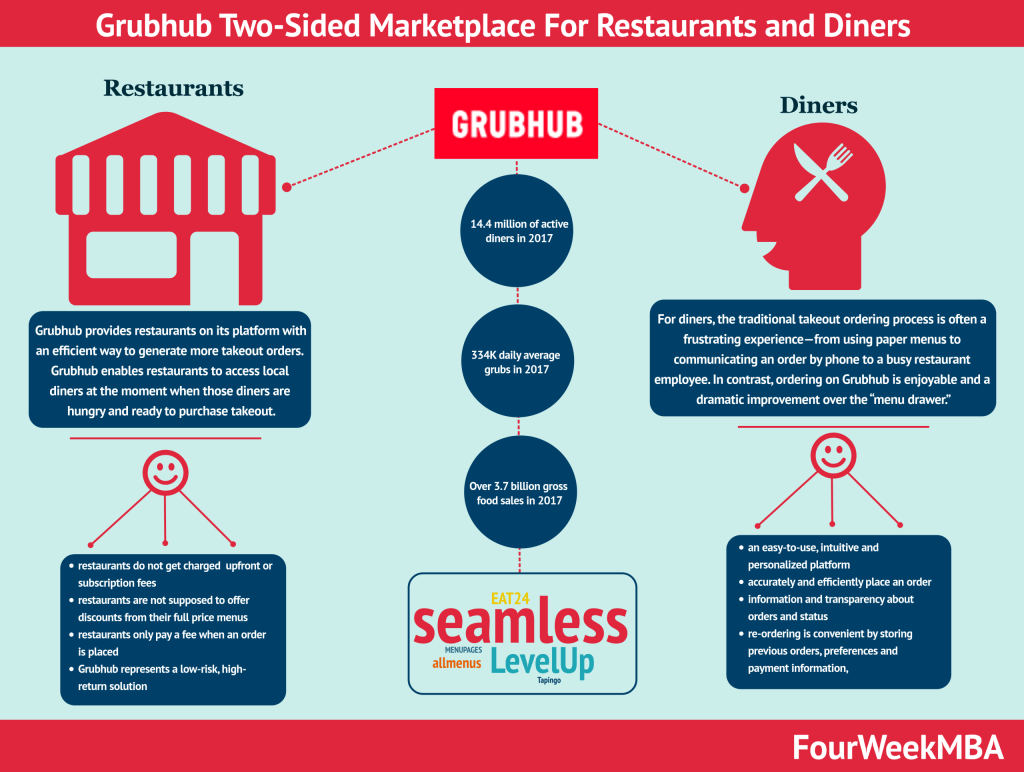
Grubhub is an online and mobile platform for restaurant pick-up and delivery orders. In 2018 the company connected 95,000 takeout restaurants in over 1,700 U.S. cities and London. The Grubhub portfolio of brands like Seamless, LevelUp, Eat24, AllMenus, MenuPages, and Tapingo. The company makes money primarily by charging restaurants a pre-order commission, and it generates revenues when diners place an order on its platform. Also, it charges restaurants that use Grubhub delivery services when diners pay for them.
Instacart’s business model enables an easy setup for grocery stores, the comfort for customers to get their shopping delivered at home, and an additional income stream for personal shoppers. Instacart makes money by charging service fees via memberships and running performance advertising on its platform.
Lyft is a transportation-as-a-service marketplace allowing riders to find a driver for a ride. Lyft has also expanded with a multimodal platform that gives more options like bike-sharing or electric scooters. Lyft primarily makes money by collecting fees from drivers who complete rides on the platform.
Uber is a two-sided marketplace, a platform business model that connects drivers and riders, with an interface that has elements of gamification that makes it easy for two sides to connect and transact. Uber makes money by collecting fees from the platform’s gross bookings.
Postmates is a food delivery service built as a last-mile delivery service platform connecting locals with shops. Postmates makes money by collecting fees (commission, delivery, service, cart, and cancellation fees). It also makes money via its subscription service (called Unlimted – $9.99/month or $99.99 annually), giving free delivery on orders of more than $12.
Uber Eats is a three-sided marketplace connecting a driver, a restaurant owner, and a customer with the Uber Eats platform at the center. The three-sided marketplace moves around three players: Restaurants pay commission on the orders to Uber Eats; Customers pay small delivery charges and, at times, cancellation fees; Drivers earn through making reliable deliveries on time.
Coupang is a South Korean eCommerce company. Coupang makes money by selling consumer items through its desktop and mobile eCommerce platforms. The company also collects fees from its food delivery, video streaming, and advertising services.
Amazon has a diversified businessmodel. Amazon’s primary revenue streams comprise its e-commerce platform, made of Amazon-labeled products and Amazon third-party stores. In addition to that, Amazon makes money via third-party seller services (like those fulfilled by Amazon), advertising on its platform, AWS cloud platform, and Prime membership.
Getir is a Turkish grocery and restaurant food delivery platform founded by Serkan Borancili, Tuncay Tutek, Dogancan Dalyan, and Nazim Salur. Salur got the idea for the company after wondering if food could be delivered nearly as quickly as taxis could be hailed. As a dark supermarket operator, Getir makes money by selling items at a 10% premium to traditional supermarkets and retailers. Margins are higher because the company only leases the dark stores’ warehouses. Getir also charges a flat delivery fee on orders above a certain threshold, with fees varying according to the country served.
Gennaro is the creator of FourWeekMBA, which reached about four million business people, comprising C-level executives, investors, analysts, product managers, and aspiring digital entrepreneurs in 2022 alone | He is also Director of Sales for a high-tech scaleup in the AI Industry | In 2012, Gennaro earned an International MBA with emphasis on Corporate Finance and Business Strategy.