Spaceship's value proposition includes: – Innovative Investment Products: Offering diversified and innovative investment portfolios designed to outperform tradi
Customer Segments
Spaceship serves the following customer segments: 1. Retail Investors: Individuals looking to invest their savings in diversified portfolios. 2. Young Professio
Distribution Strategy
Spaceship's distributionstrategy includes: – Online Platform: Operating a user-friendly web-based platform and mobile app for easy access to investment service
Revenue Streams
Spaceship generates revenue through the following streams: 1. Management Fees: Earnings from fees charged on the assets under management (AUM) in its investment
Marketing Strategy
Spaceship's marketingstrategy involves: – Digital Advertising: Running online advertising campaigns to promote its innovative investment products and user-frie
Organization Structure
Spaceship's organizational structure includes: – Executive Leadership: Responsible for strategic direction and decision-making. – Investment Team: Managing and
Competitive Advantage
Spaceship's competitive advantage stems from: – Innovative Investment Approach: Offering diversified investment portfolios with a focus on tech and innovation c
Spaceship is an online micro-investment platform founded by Dave Kuhn, Andrew Sellen, Paul Bennet, and Kaushik Sen in 2016. The platform was created to give young or inexperienced investors the chance to build wealth in a simple and affordable way.
Spaceship makes money by charging management fees and administration fees across its various investment and superannuation (retirement) products.
Management fees are capped at $2.50 per month for investment portfolio balances exceeding $100. Investment fees and administration fees are the domain of Spaceship’s two superannuation products, with the latter fee waived for balances under $6,000.
Business Model Element
Analysis
Implications
Examples
Value Proposition
Spaceship’s value proposition includes: – Innovative Investment Products: Offering diversified and innovative investment portfolios designed to outperform traditional funds. – User-Friendly Interface: Providing an easy-to-use mobile app and website for hassle-free investing. – Transparent Fees: Offering transparent fee structures to attract cost-conscious investors. Spaceship appeals to tech-savvy investors looking for innovative investment options and transparency.
Attracts investors seeking innovative and high-performing investment portfolios. Engages users with a user-friendly platform for easy investing. Builds trust with transparent fee structures and communication. Provides a unique value proposition in the competitive financial services industry. Caters to tech-savvy and cost-conscious investors.
– Innovative investment portfolios designed for outperformance. – User-friendly mobile app and website for easy investing. – Transparent fee structures to build trust with investors.
Customer Segments
Spaceship serves the following customer segments: 1. Retail Investors: Individuals looking to invest their savings in diversified portfolios. 2. Young Professionals: Tech-savvy and cost-conscious young professionals seeking modern investment solutions. 3. Superannuation Fund Members: Individuals looking for superannuation options with innovative investment choices. Spaceship targets retail investors, young professionals, and superannuation fund members with its offerings.
Attracts retail investors seeking modern investment solutions. Engages tech-savvy young professionals looking for cost-effective options. Provides superannuation products for long-term retirement planning. Focuses on key customer segments for business growth. Connects with individuals looking for innovative financial services.
– Retail investors seeking diversified portfolios. – Young professionals interested in cost-effective investment options. – Superannuation fund members planning for retirement.
Distribution Strategy
Spaceship’s distribution strategy includes: – Online Platform: Operating a user-friendly web-based platform and mobile app for easy access to investment services. – Digital Marketing: Leveraging digital channels and online advertising for customer acquisition. – Partnering with Employers: Collaborating with employers to offer superannuation options to their employees. Spaceship ensures online accessibility, digital marketing, and partnerships for extended reach.
Provides accessibility through a web-based platform and mobile app. Expands reach through digital marketing channels. Collaborates with employers to offer superannuation options to a broader audience. Implements a multi-channel distribution strategy to acquire and serve customers.
– Web-based platform and mobile app for investment access. – Utilization of digital marketing for customer acquisition. – Partnerships with employers to offer superannuation options.
Revenue Streams
Spaceship generates revenue through the following streams: 1. Management Fees: Earnings from fees charged on the assets under management (AUM) in its investment portfolios. 2. Superannuation Fees: Collecting fees for managing superannuation accounts and investments. 3. Performance Fees: Charging fees based on investment performance if certain benchmarks are met. 4. Insurance Premiums: Earning income through insurance products offered to superannuation members. Management fees on AUM are the primary source of revenue.
Earns income from management fees on assets under management. Collects fees for managing superannuation accounts and investments. Generates performance fees when investment benchmarks are met. Earns income through insurance products offered to superannuation members. Diversifies revenue streams within the investment and superannuation sectors. Ensures financial sustainability through multiple income sources.
– Earnings from management fees on assets under management. – Fees collected for managing superannuation accounts and investments. – Performance fees based on investment performance. – Income generated through insurance products for superannuation members.
Marketing Strategy
Spaceship’s marketing strategy involves: – Digital Advertising: Running online advertising campaigns to promote its innovative investment products and user-friendly platform. – Content Marketing: Providing educational content on investing and superannuation topics to inform and engage users. – Referral Program: Offering rewards to users who refer new investors to the platform. Spaceship focuses on digital advertising, content marketing, and referrals for user acquisition and engagement.
Increases brand visibility through online advertising campaigns. Educates users about investing and superannuation through content marketing. Encourages user acquisition and growth through a referral program. Implements a comprehensive marketing strategy for customer acquisition and retention.
– Online advertising campaigns for brand visibility. – Educational content on investing and superannuation topics. – Referral program for user acquisition.
Organization Structure
Spaceship’s organizational structure includes: – Executive Leadership: Responsible for strategic direction and decision-making. – Investment Team: Managing and optimizing investment portfolios. – Technology Team: Overseeing software development, app maintenance, and user experience. – Customer Support: Providing assistance to users and addressing their inquiries and concerns. – Marketing Team: Promoting Spaceship’s services and collaborating on customer acquisition. Spaceship maintains a structured approach to efficiently deliver its services and support its user base.
Led by executive leadership for strategic direction and growth. Employs teams dedicated to portfolio management, technology, customer support, and marketing. Focuses on customer support to ensure user satisfaction. Promotes services and collaborates with employers for brand visibility. Maintains an organized structure for efficient operation.
– Led by executive leadership for strategic direction and growth. – Teams responsible for portfolio management, technology, and customer support. – Focus on customer support to ensure user satisfaction. – Marketing and partnerships for service promotion and engagement. – Organized structure for efficient operation and ecosystem growth.
Competitive Advantage
Spaceship’s competitive advantage stems from: – Innovative Investment Approach: Offering diversified investment portfolios with a focus on tech and innovation companies. – User-Friendly Platform: Providing a user-friendly mobile app and website for easy investing. – Transparent Fees: Communicating fee structures clearly to build trust with investors. – Superannuation Options: Offering superannuation products with modern investment choices. Spaceship’s strengths in innovative investments, user-friendly platforms, transparency, and superannuation options position it as a compelling choice in the finance and superannuation industry.
Distinguishes itself with a focus on tech and innovation companies in its investment portfolios. Attracts users with a user-friendly mobile app and website. Builds trust with transparent fee communication. Provides modern investment choices within superannuation options. Enjoys a competitive edge in the finance and superannuation sector.
– Diversified investment portfolios with a tech and innovation focus. – User-friendly mobile app and website for easy investing. – Transparent fee structures to build trust with investors. – Superannuation products with modern investment choices. – A competitive edge in the finance and superannuation industry.
Origin story
Spaceship is an online micro-investment platform founded by Dave Kuhn, Andrew Sellen, Paul Bennet, and Kaushik Sen in 2016.
Spaceship was founded to create a product that would disrupt the Australian investment industry, which at the time was dominated by outdated governmental practices and a distinct lack of diversity and transparency.
The platform is targeted at millennial consumers who have become disenfranchised from investing because of excessive fees, complicated processes, or jargon-heavy products.
Spaceship Super was launched in 2017, a retirement fund the company claims can be set up in as little as five minutes.
Spaceship Voyager was launched the following year, offering a simple and affordable way to invest in over 200 companies across various diversified portfolios.
Many of the companies users can invest in meet what Spaceship calls “Where the World is Going” criteria, with Spotify, Apple, Tesla, Square, and Microsoft the most obvious examples.
Investors who consider ESG criteria to be more relevant can invest in another portfolio comprised of companies such as Atlassian, Shopify, Starbucks, and Nvidia.
Spaceship makes money by charging management fees, investment fees, and administration fees across its various investment and superannuation (retirement) products.
Let’s take a look at these below.
Investment
Spaceship Universe Portfolio – for investors who want a portfolio comprised of companies with growth potential or a competitive advantage. Some of the criteria Spaceship considers include innovation, the presence of a moat, robust management, and high expected returns.
Spaceship Earth Portfolio – for investors who want a portfolio of companies making a positive impact on people and the planet.
Spaceship Origin Portfolio – for investors who want exposure to some of the world’s largest companies, including Alphabet, Amazon, and Johnson & Johnson.
The management fee for all three portfolios is $2.50/month for balances exceeding $100.
Note that there are no other fees or costs, even if the user wants to set up multiple portfolios.
Superannuation
Spaceship GrowthX Option – the company’s flagship investment option with a diversified portfolio of global technology companies. Spaceship charges a 0.196% investment fee and an administration fee of $78 + 0.720% per annum.
Spaceship Global Index Option – for the index investor looking for a passive investment option. The portfolio is predominantly comprised of finance, healthcare, consumer discretionary, industrial, and communication services companies. Here, Spaceship charges no investment fee but does charge an administration fee of $78 + 0.577% per annum.
For both superannuation products, the administration fee is waived for balances under $6,000.
Key Takeaways
Foundation and Mission:
Founded in 2016 by Dave Kuhn, Andrew Sellen, Paul Bennet, and Kaushik Sen.
Aimed at disrupting the Australian investment industry with a focus on millennials disenfranchised by high fees and complex processes.
Value Proposition:
Offers innovative investment and superannuation products.
User-friendly interface through a mobile app and website.
Transparent fee structures for cost-conscious investors.
Customer Segments:
Retail investors looking for diversified investment portfolios.
Young professionals seeking modern, easy-to-use investment solutions.
Individuals interested in superannuation options with innovative investments.
Distribution Strategy:
Utilizes an online platform and mobile app for easy investment access.
Employs digital marketing and online advertising for customer acquisition.
Partners with employers to offer superannuation options.
Revenue Streams:
Charges management fees for investment portfolios.
Collects investment and administration fees for superannuation products.
Offers superannuation options with a focus on global technology companies and ESG criteria.
Marketing Strategy:
Runs digital advertising campaigns and uses content marketing to educate users.
Operates a referral program to encourage new investor sign-ups.
Organization Structure:
Led by a team of founders and executive leadership for strategic direction.
Includes investment, technology, customer support, and marketing teams.
Competitive Advantage:
Focuses on tech and innovation companies for investment portfolios.
Provides a user-friendly platform with transparent fees.
Offers diversified portfolios including the Universe, Earth, and Origin Portfolios for investors with different interests.
Origin Story:
Launched to provide a simple and affordable investment platform.
Introduced Spaceship Super and Spaceship Voyager for retirement funds and diversified investments, respectively.
Acorns is a fintech platform providing services related to Robo-investing and micro-investing. The company makes money primarily through three subscription tiers: Lite – ($1/month), which gives users access to Acorns Invest, Personal ($3/month) that includes Invest plus the Later (retirement) and Spend (personal checking account) suite of products, Family ($5/month) with features from both the Lite and Personal plans with the addition of Early.
Starting as a pay-later solution integrated into merchants’ checkouts, Affirm makes money from merchants’ fees as consumers pick up the pay-later solution. Affirm also makes money through interest earned from the consumer loans when those are repurchased from the originating bank. In 2020 Affirm made 50% of its revenues from merchants’ fees, about 37% from interests, and the remaining from virtual cards and servicing fees.
Alipay is a Chinese mobile and online payment platform created in 2004 by entrepreneur Jack Ma as the payment arm of Taobao, a major Chinese eCommerce site. Alipay, therefore, is the B2C component of Alibaba Group. Alipay makes money via escrow transaction fees, various value-added ancillary services, and its Credit Pay Instalment fees.
Betterment is an American financial advisory company founded in 2008 by MBA graduate Jon Stein and lawyer Eli Broverman. Betterment makes money via investment plans, financial advice packages, betterment for advisors, betterment for business, cash reserve, and checking accounts.
Chime is an American neobank (internet-only bank) company, providing fee-free financial services through its mobile banking app, thus providing personal finance services free of charge while making the majority of its money via interchange fees (paid by merchants when consumers use their debit cards) and ATM fees.
Coinbase is among the most popular platforms for trading and storing crypto-assets, whose mission is “to create an open financial system for the world” by enabling customers to trade cryptocurrencies. Its platform serves both as a search and discovery engine for crypto assets. The company makes money primarily through fees earned for the transactions processed through the platform, custodial services offered, interest, and subscriptions.
Compass is a licensed American real-estate broker incorporating online real estate technology as a marketing medium. The company makes money via sales commissions (collected whenever a sale is facilitated or tenants are found for a rental property) and bridge loans (a service allowing the seller to purchase a home before the revenue from the sale of their previous home is available).
Dosh is a Fintech platform that enables automatic cash backs for consumers. Its business model connects major card providers with online and offline local businesses to develop automatic cash back programs. The company makes money by earning an affiliate commission on each eligible sale from consumers.
E-Trade is a trading platform allowing investors to trade common and preferred stocks, exchange-traded funds (ETFs), options, bonds, mutual funds, and futures contracts; acquired by Morgan Stanley in 2020 for $13 billion. E-Trade makes money through interest income, order flow, margin interests, options, future and bonds trading, and other fees and service charges.
Klarna is a financial technology company allowing consumers to shop with a temporary Visa card. Thus it then performs a soft credit check and pays the merchant. Klarna makes money by charging merchants. Klarna also earns a percentage of interchange fees as a commission and for interests earned on customers’ accounts.
Lemonade is an insurance tech company using behavioral economics and artificial intelligence to process claims efficiently. The company leverages technology to streamline onboarding customers while also applying a financial model to reduce conflicts of interest with customers (perhaps by donating the variable premiums to charity). The company makes money by selling its core insurance products, and via its tech platform, it tries to enhance its sales.
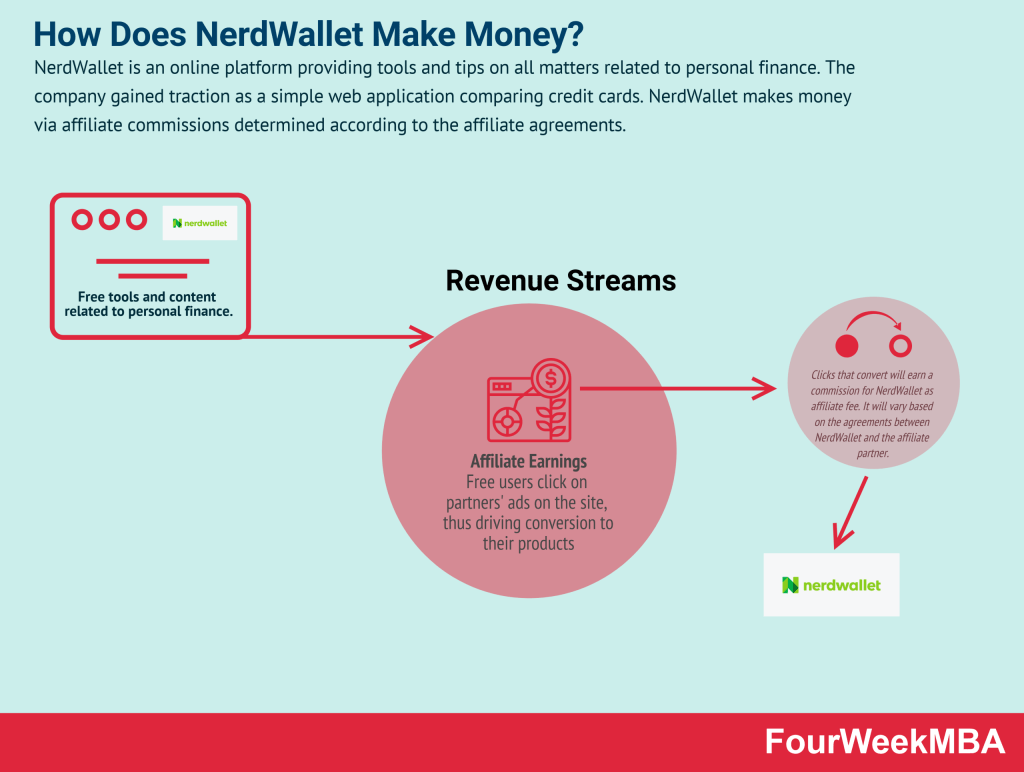
NerdWallet is an online platform providing tools and tips on all matters related to personal finance. The company gained traction as a simple web application comparing credit cards. NerdWallet makes money via affiliate commissions determined according to the affiliate agreements.
Robinhood is an app that helps to invest in stocks, ETFs, options, and cryptocurrencies, all commission-free. Robinhood earns money by offering: Robinhood Gold, a margin trading service, which starts at $6 a month, earns interests from customer cash and stocks, and rebates from market makers and trading venues.
SoFi is an online lending platform that provides affordable education loans to students, and it expanded into financial services, including loans, credit cards, investment services, and insurance. It makes money primarily via payment processing fees and loan securitization.
Stash is a FinTech platform offering a suite of financial tools for young investors, personalized investment advice, and life insurance. The company primarily makes money via subscriptions, cashback, payment for order flows, and interest for cash sitting on members’ accounts.
Wealthfront is an automated Fintech investment platform providing investment, retirement, and cash management products to retail investors, mostly making money on the annual 0.25% advisory fee the company charges for assets under management. It also makes money via a line of credits and interests on the cash accounts.
Zelle is a peer-to-peer payment network that indirectly benefits the banks’ consortium that backs it. Zelle also enables users to pay businesses for goods and services free for users. Merchants pay a 1% fee to Visa or Mastercard, who share it with the bank that issued the card.
Gennaro is the creator of FourWeekMBA, which reached about four million business people, comprising C-level executives, investors, analysts, product managers, and aspiring digital entrepreneurs in 2022 alone | He is also Director of Sales for a high-tech scaleup in the AI Industry | In 2012, Gennaro earned an International MBA with emphasis on Corporate Finance and Business Strategy.