Houseparty is a social networking service incorporating video chat on mobile and desktop apps. The platform is the brainchild of Ben Rubin and Itai Danino, Israeli developers who also created the similar service Meerkat.
Houseparty has an underdeveloped revenue generation model. Currently, the company makes money through the sale of in-app items designed to enhance gameplay.
Houseparty CEO Sima Sistani wants to avoid introducing advertising on the platform for fear of degrading the user experience. Moving forward, the platform may instead focus on monetizing other games or game-like experiences with partners.
Houseparty is a social networking service incorporating video chat on mobile and desktop apps.
The platform was created by Israeli developers Ben Rubin and Itai Danino in 2015.
Three years earlier, Rubin and Danino founded Life On Air to develop several social media platforms. One of these platforms was Meerkat, a live-streaming app created in just eight weeks and connected to Twitter’s social graph.
Meerkat was an instant hit because users could transfer their Twitter friends without starting from scratch. The platform also received several high-profile endorsements from the likes of Gary Vaynerchuk and Ashton Kutcher.
However, Twitter soon cut access to the social graph after it acquired competing service Periscope.
User growth then began to stagnate, so Rubin and Danino attempted to bolster its popularity by partnering with Facebook and the Discovery Channel. By the beginning of 2016, the founders saw the writing on the wall and decided to pivot.
Houseparty was then developed in February that same year, using millions leftover from a previous funding round. The new platform, touted as a live-video social network, reached the number two position in the Apple App Store just three months after launch.
Life On Air headquarters then moved from Israel to San Francisco to better manage the surge in users.
Teenagers and Young Adults: The app is particularly popular among teenagers and young adults, who use it to stay connected with friends and family through group video chats. The app’s social features, such as games and virtual rooms, cater to the social needs of this demographic.
Casual Users: These are individuals who use Houseparty occasionally for social interaction. They might not use the app daily but appreciate its features for virtual gatherings.
Content Creators:
Influencers and Streamers: Some content creators use Houseparty to engage with their audience in a more personal and interactive manner. The app’s integration with games and other interactive features allows creators to host engaging sessions with their followers.
Event Organizers:
Virtual Event Hosts: Event organizers use Houseparty to host virtual events, such as online parties, game nights, and social gatherings. The app’s ability to host multiple participants in a single chat room makes it ideal for such purposes.
Houseparty revenue generation
At present, Houseparty has a somewhat underdeveloped revenue generation strategy.
The company earns some money through in-app purchases. For example, the app teamed up with Warner Brothers to create a new version of Heads Up – a game similar to charades popularised by celebrity Ellen DeGeneres.
Here, users can purchase additional card decks to enhance their gaming experience. This allows Houseparty to collect an undisclosed percentage of the tens of millions of dollars the game earns in both app stores every year.
In response to the COVID-19 pandemic, however, owner Epic Games then announced the full Heads Up game would be available for free.
In terms of other revenue models, Houseparty CEO Sima Sistani has expressed reservations about selling advertising on the platform.
Sistani, who had previously spent time at Tumblr, saw how advertisements there disrupted the community.
Many have also speculated that Houseparty may become more integrated with Epic Games products such as Fortnite and the Unreal Engine. Some others believe integration with Spotify and Netflix is more likely.
Market Strategy
Houseparty’s market strategy focuses on digital marketing, community building, and strategic partnerships.
Digital Marketing:
The app leverages social media platforms like Instagram, Twitter, and TikTok to reach its target audience. Influencer partnerships and viral marketing campaigns have played a significant role in Houseparty’s growth.
Content Marketing:
Houseparty produces content such as tutorials, user stories, and tips to engage users and showcase the app’s features. This content is shared across social media and the app itself to educate users and enhance their experience.
Community Engagement:
The app fosters a sense of community by encouraging users to invite friends and participate in group activities. Regular in-app events and challenges keep the user base engaged and promote social interaction.
Strategic Partnerships:
Houseparty forms partnerships with game developers, content creators, and brands to offer exclusive content and experiences. These partnerships not only generate revenue but also attract new users and retain existing ones.
Distribution Strategy
Houseparty’s distributionstrategy is primarily digital, focusing on app stores and online platforms.
Mobile App Stores:
The Houseparty app is available for download on both iOS and Android platforms. This wide availability ensures that the app can reach a broad audience across different devices.
SEO and Online Presence:
The company invests in search engine optimization (SEO) to ensure high visibility in app stores and online searches. This strategy helps attract organic traffic and new users.
User Referrals and Virality:
Houseparty leverages its users to promote the app through referral programs and viral features. By making it easy for users to invite friends and share their experiences on social media, Houseparty amplifies its reach and user base.
Competitive Advantages
Houseparty’s competitive advantages lie in its unique features, ease of use, and social focus.
Interactive Features:
The app’s integration of games and interactive activities within video chats sets it apart from traditional video conferencing tools. This feature makes Houseparty more engaging and fun for users, encouraging prolonged usage.
User-Friendly Interface:
Houseparty’s simple and intuitive interface makes it accessible to users of all ages. The ease of use reduces the learning curve and encourages frequent use.
Social Integration:
The app’s strong social focus, with features like virtual rooms and notifications when friends are online, fosters real-time interaction and enhances the sense of community among users.
Key Highlights
Creation and Founders: Houseparty is a social networking service that offers video chat functionality on mobile and desktop apps. It was created by Israeli developers Ben Rubin and Itai Danino in 2015. Prior to Houseparty, they had also developed Meerkat, a live-streaming app connected to Twitter’s social graph.
Meerkat’s Success and Setbacks: Meerkat gained popularity quickly due to its ability to connect with users’ Twitter friends and received endorsements from notable figures like Gary Vaynerchuk and Ashton Kutcher. However, when Twitter acquired Periscope, they cut access to Meerkat’s social graph, leading to stagnating user growth.
Pivot to Houseparty: In 2016, Rubin and Danino pivoted from Meerkat and launched Houseparty. The new platform, described as a live-video social network, achieved rapid success, reaching the number two position on the Apple App Store within three months of its launch.
Epic Games Acquisition: Less than two years after its launch, Houseparty was acquired by Epic Games for around $35 million. This acquisition positioned Houseparty within a larger gaming and entertainment ecosystem.
Growth During the Pandemic: Houseparty experienced significant growth during the COVID-19 pandemic, with over 17 million downloads in March 2020 alone. Integration with popular games like Fortnite, Uno, and Magic 8-Ball contributed to this growth.
Revenue Generation Model: Houseparty’s revenue generation model is primarily based on in-app purchases. For instance, the app partnered with Warner Brothers to offer a new version of the game “Heads Up,” where users could buy additional card decks to enhance gameplay. The platform earns a portion of the game’s revenue from app store sales.
CEO’s Stance on Advertising: Houseparty’s CEO, Sima Sistani, is cautious about introducing advertising to the platform due to concerns about degrading the user experience. Her experience at Tumblr, where ads disrupted the community, likely influences this stance.
Potential Integration: There is speculation about Houseparty’s integration with other products, including Epic Games’ offerings like Fortnite and the Unreal Engine. Some also believe integration with platforms like Spotify and Netflix is possible in the future.
Development and Relocation: As Houseparty gained popularity, its parent company, Life On Air, relocated from Israel to San Francisco to better manage the user surge and continued development of the platform.
Underlying Success: Houseparty’s success can be attributed to its innovative approach to video chat, rapid user adoption, integration with popular games, and its position within the broader entertainment industry through the Epic Games acquisition.
Business Model Element
Analysis
Implications
Examples
Value Proposition
Houseparty’s value proposition centers on social connection through real-time, group video chats. For Users, Houseparty offers: – Social Interaction: An easy-to-use platform for connecting with friends and family via video chats. – Fun and Games: In-app games and activities to enhance social experiences. – Spontaneity: Encouraging impromptu social gatherings. – Privacy Control: Users have control over who can join their chats. For Advertisers, Houseparty provides: – Engaged Audience: Access to an engaged and interactive user base for targeted advertising. Houseparty enhances social connections and fosters a sense of togetherness.
Provides users with a platform for easy and fun group video chats with friends and family. Attracts individuals seeking spontaneous and interactive social experiences. Offers privacy controls for user safety. Offers advertisers access to an engaged user base for targeted advertising. Promotes social connection and engagement.
– Social interaction features facilitate video chats with friends and family. – In-app games and activities add fun and entertainment. – Spontaneous gatherings encourage more frequent use. – Privacy controls enhance user safety. – Advertisers benefit from an engaged audience for targeted ads.
Customer Segments
Houseparty serves several customer segments, including: 1. Social Users: Individuals looking for virtual social interaction and fun activities. 2. Friends and Family: Groups of friends and family members seeking to connect. 3. Gamers and Entertainment Enthusiasts: Users interested in in-app games and interactive experiences. Houseparty caters to a broad user base, focusing on fostering social connections and engagement.
Focuses on diverse customer segments, including social users, friends and family, gamers, and entertainment enthusiasts. Customizes the platform to address the unique needs and preferences of each group. Provides a versatile platform for various social interactions and experiences.
– Serving diverse customer segments broadens Houseparty’s user base. – Tailoring the platform enhances customer satisfaction and engagement.
Distribution Strategy
Houseparty’s distribution strategy primarily relies on mobile app stores (iOS and Android). Users can download the Houseparty app from these stores and create accounts to start using the platform. The app is designed for accessibility and ease of use. It has also leveraged word-of-mouth marketing and social sharing to attract users.
Primarily utilizes mobile app distribution through iOS and Android app stores. Offers easy access to the Houseparty app for users. Focuses on accessibility and user-friendliness. Utilizes word-of-mouth marketing and social sharing for user acquisition. Ensures convenient access to the platform.
– Mobile app distribution caters to users’ preference for app-based convenience. – User-friendliness enhances the onboarding experience. – Word-of-mouth marketing and social sharing drive user growth.
Revenue Streams
Houseparty generates revenue through in-app advertising and sponsored activities. It offers branded games and activities within the app that promote engagement and interaction. Advertisers pay to promote their products and services to Houseparty’s user base. The platform may also explore additional revenue streams, such as premium features or subscriptions, in the future.
Relies on revenue streams from: 1. In-app advertising for brand promotions. 2. Sponsored games and activities that encourage user engagement. Diversifies income sources through advertising and sponsored content. Considers potential future revenue streams like premium features or subscriptions.
– In-app advertising provides a source of revenue. – Sponsored activities enhance user engagement and monetization. – Exploring premium features or subscriptions could further diversify income.
Marketing Strategy
Houseparty’s marketing strategy focuses on organic growth through social sharing, word-of-mouth, and user-generated content. The platform encourages users to invite friends to join, fostering viral growth. Houseparty also collaborates with influencers and celebrities to reach wider audiences. It may explore partnerships and collaborations to promote sponsored content.
Prioritizes organic growth through social sharing, word-of-mouth, and user-generated content. Encourages users to invite friends, fostering viral user acquisition. Collaborates with influencers and celebrities for broader reach. Considers partnerships for promoting sponsored content. Relies on users and influencers for brand promotion.
– Organic growth strategies leverage user networks for expansion. – Influencer collaborations increase visibility. – Partnerships for sponsored content can boost revenue.
Organization Structure
Houseparty’s organizational structure includes teams dedicated to technology development, user support, marketing, partnerships, and content creation. Technology development teams focus on app enhancements. User support teams assist users with inquiries and issues. Marketing teams promote Houseparty’s services, while partnerships and content creation teams collaborate with influencers and creators. This structure supports innovation, user satisfaction, and content quality.
Employs specialized teams for technology development, user support, marketing, partnerships, and content creation. Enhances the app through technology development teams. Assists users with inquiries and issues through user support teams. Promotes services through marketing teams. Collaborates with influencers and creators through partnerships and content creation teams. Supports innovation, user satisfaction, and content quality.
– Specialized teams drive innovation and app improvement. – User support builds trust and addresses user needs. – Marketing promotes services effectively. – Partnerships and content creation enhance content quality and engagement.
Competitive Advantage
Houseparty’s competitive advantage stems from its user-friendly interface, focus on real-time interaction, in-app games, privacy controls, and viral growth. The user-friendly interface attracts users seeking easy and accessible video chats. Real-time interaction fosters engagement and spontaneity. In-app games add entertainment value. Privacy controls enhance user safety. Viral growth through social sharing differentiates it in the social networking space.
Derives a competitive advantage from: – A user-friendly and accessible interface. – Real-time interaction for engagement and spontaneity. – In-app games and activities for entertainment. – Privacy controls for user safety. – Viral growth through social sharing for increased adoption. Sets itself apart in the social networking sector by prioritizing real-time interactions, entertainment, and user safety.
– A user-friendly interface simplifies the social networking experience. – Real-time interaction promotes engagement and spontaneity. – In-app games add entertainment value. – Privacy controls build trust and safety. – Viral growth enhances adoption and user engagement.
In an asymmetric businessmodel, the organization doesn’t monetize the user directly. Still, it leverages the data users provide and technology, thus having a key customer pay to sustain the core asset. For example, Google makes money by leveraging users’ data and its algorithms sold to advertisers for visibility. This is how attention merchants make monetize their business models.
In an asymmetric businessmodel, the organization doesn’t monetize the user directly. Still, it leverages the data users provide and technology, thus having a key customer pay to sustain the core asset. For example, Google makes money by leveraging users’ data and its algorithms sold to advertisers for visibility.
Facebook, the main product of Meta, is an attention merchant. As such, its algorithms condense the attention of over 2.91 billion monthly active users as of June 2021. Meta generated $117.9 billion in revenues, in 2021, of which $114.9 billion was from advertising (97.4% of the total revenues) and over $2.2 billion from Reality Labs (the augmented and virtual reality products arm).
The ARPU, or average revenue per user, is a key metric to track the success of Facebook – now Meta – family of products. For instance, by the end of 2021, Meta’s ARPU worldwide was $11.57. While in US & Canada, it was $60.57, in Europe, it was $19.68, in Asia $4.89, and in the rest of the world, it was $3.43.
Facebook is characterized by a multi-faceted matrix organizational structure. The company utilizes a flat organizational structure in combination with corporate function-based teams and product-based or geographic divisions. The flat organizational structure is organized around the leadership of Mark Zuckerberg and the key executives around him. On the other hand, the function-based teams are based on the main corporate functions (like HR, productmanagement, investor relations, and so on).
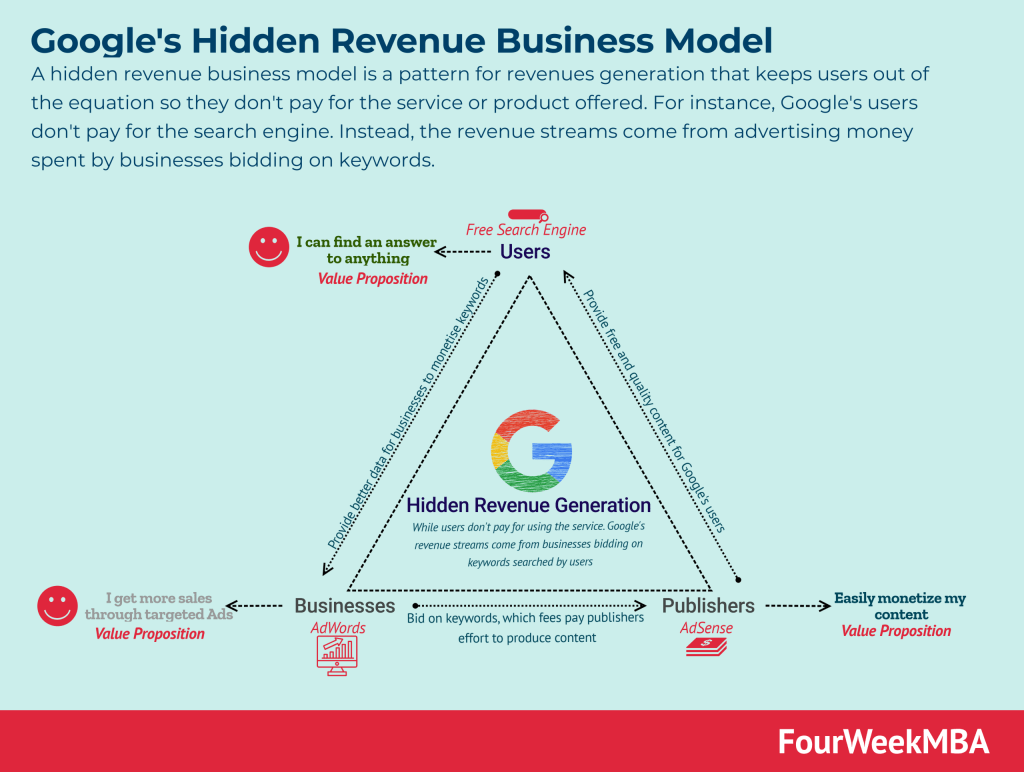
A hidden revenue business model is a pattern for revenue generation that keeps users out of the equation, so they don’t pay for the service or product offered. For instance, Google’s users don’t pay for the search engine. Instead, the revenue streams come from advertising money spent by businesses bidding on keywords.
TikTok is a Chinese creative social media platform driven by short-form video content enabling users to interact and generate content at scale. TikTok primarily makes money through advertising, and it generated $4.6 billion in advertising revenues in 2021, thus making it among the most popular attention-based business models or attention merchants.
Instagram makes money via visual advertising. As part of Facebook products, the company generates revenues for Facebook Inc.’s overall businessmodel. Acquired by Facebook for a billion dollars in 2012, today Instagram is integrated into the overall Facebook business strategy. In 2018, Instagram founders, Kevin Systrom and Mike Krieger left the company, as Facebook pushed toward tighter integration of the two platforms.
YouTube was acquired for almost $1.7 billion in 2006 by Google. It makes money through advertising and subscription revenues. YouTube advertising network is part of Google Ads, and it generated more than $28B in revenue by 2021. YouTube also makes money with its paid memberships and premium content.
Twitter makes money in two ways: advertising and data licensing. In 2021, Twitter generated $4.5 billion from advertising and $570 million from data licensing. While Twitter generated $5 billion in total revenues, it lost 221 million.
Gennaro is the creator of FourWeekMBA, which reached about four million business people, comprising C-level executives, investors, analysts, product managers, and aspiring digital entrepreneurs in 2022 alone | He is also Director of Sales for a high-tech scaleup in the AI Industry | In 2012, Gennaro earned an International MBA with emphasis on Corporate Finance and Business Strategy.