– Honey offers a browser extension that automatically searches for and applies relevant coupon codes and discounts during online shopping. – The extension is av
Price Comparison Tool
– Honey includes a price comparison tool that allows users to track price changes and receive alerts when a product’s price drops. – This tool helps users make
Cash Back Program
– Honey offers a cashback program known as "Honey Gold." Users can earn rewards in the form of Gold Points for eligible purchases made through the platform. – G
Affiliate Marketing Model
– Honey generates revenue through affiliate marketing by partnering with online retailers. When users make purchases through Honey and its affiliate links, Hone
User Data and Insights
– Honey collects data on user shopping behavior, preferences, and purchase history. This data is used to improve the relevance of deals and recommendations.
Mobile App
– Honey offers a mobile app that extends its services to smartphones and tablets. Users can access the same features as the browser extension, including coupon
Value Proposition
– Honey’s value proposition revolves around saving users time and money during online shopping. It offers a one-stop solution for finding coupons, tracking pric
Customer Segments
– Honey’s customer segments include online shoppers, deal seekers, and individuals looking to optimize their online shopping experience.
Honey earns affiliate commissions from stores when users find savings, as the purchase is confirmed. Honey also makes money with its Honey Gold earning a commission when the member visits a partner store while it offers members a digital coupon to apply at purchase. PayPal acquired honey in 2020 for a $4 billion cash acquisition.
Business Model Element
Analysis
Implications
Examples
Browser Extension
– Honey offers a browser extension that automatically searches for and applies relevant coupon codes and discounts during online shopping. – The extension is available for popular web browsers like Chrome, Firefox, and Safari. – Users can easily install the extension, and it functions seamlessly in the background.
– Simplifies the online shopping experience for users by saving time and effort in searching for coupons and discounts. – Encourages users to shop online by providing the potential for savings. – The extension integrates with users’ web browsers, ensuring convenience and ease of use.
When users shop online at participating retailers, the Honey browser extension activates and displays available coupons and discounts for the selected store or product.
Price Comparison Tool
– Honey includes a price comparison tool that allows users to track price changes and receive alerts when a product’s price drops. – This tool helps users make informed purchasing decisions and potentially save money.
– Provides transparency in pricing and helps users find the best deals. – Fosters trust with users by assisting them in finding value for their money. – Drives user engagement and loyalty by offering a valuable money-saving feature.
When users are viewing a product on an e-commerce website, Honey’s price comparison tool displays historical price data and notifies users of price drops or deals.
Cash Back Program
– Honey offers a cashback program known as “Honey Gold.” Users can earn rewards in the form of Gold Points for eligible purchases made through the platform. – Gold Points can be redeemed for gift cards at various partner stores.
– Incentivizes users to shop through Honey, increasing user retention and engagement. – Provides an additional layer of savings and value for users. – Establishes partnerships with retailers to offer rewards, creating a win-win scenario.
Users accumulate Gold Points for making purchases through Honey, and once they reach a certain threshold, they can redeem those points for gift cards.
Affiliate Marketing Model
– Honey generates revenue through affiliate marketing by partnering with online retailers. When users make purchases through Honey and its affiliate links, Honey earns a commission from the retailer.
– Allows Honey to monetize its service without charging users. – Encourages retailers to collaborate with Honey to tap into its user base. – Aligns Honey’s revenue generation with the value it provides to users.
Honey collaborates with various e-commerce websites and earns commissions for driving sales through its platform.
User Data and Insights
– Honey collects data on user shopping behavior, preferences, and purchase history. This data is used to improve the relevance of deals and recommendations.
– Enhances the user experience by personalizing offers and deals based on individual preferences. – Provides valuable insights to retailers about consumer behavior and market trends. – Raises potential concerns about user privacy and data security, requiring responsible data handling.
Honey uses user data to tailor its recommendations and offers, ensuring that users receive relevant deals and discounts.
Mobile App
– Honey offers a mobile app that extends its services to smartphones and tablets. Users can access the same features as the browser extension, including coupon searches and price tracking.
– Provides convenience and accessibility for users who prefer to shop using mobile devices. – Expands Honey’s user base by catering to mobile shoppers. – Ensures a seamless shopping experience across multiple devices.
Users can download the Honey mobile app to access its features and enjoy savings while shopping on their smartphones.
Value Proposition
– Honey’s value proposition revolves around saving users time and money during online shopping. It offers a one-stop solution for finding coupons, tracking prices, and earning rewards.
– Appeals to users seeking convenience and savings when shopping online. – Positions Honey as a valuable tool for optimizing the online shopping experience. – Drives user acquisition and loyalty through its value-driven offerings.
Honey’s value proposition aligns with consumers looking for effortless ways to maximize savings while shopping online.
Customer Segments
– Honey’s customer segments include online shoppers, deal seekers, and individuals looking to optimize their online shopping experience.
– Targets a broad audience of internet users who engage in online shopping across various demographics. – Attracts users seeking ways to make smarter and more cost-effective purchasing decisions. – Appeals to both occasional and frequent online shoppers.
Honey caters to a diverse user base, including tech-savvy consumers, bargain hunters, and those looking to make the most of their online purchases.
Distribution Strategy
– Honey’s distribution strategy involves offering its browser extension and mobile app directly to users through its website and app stores. – It also partners with e-commerce retailers to promote its services.
– Maximizes accessibility by making its browser extension and mobile app readily available for download. – Leverages partnerships with online retailers to expand its user base and reach potential customers. – Enhances visibility and user adoption through its own marketing efforts.
Users can easily install the Honey browser extension from its website or download the mobile app from app stores. Additionally, Honey collaborates with partner retailers to promote its services during the checkout process.
Marketing Strategy
– Honey employs various marketing tactics, including online advertising, social media campaigns, and affiliate marketing, to raise awareness and acquire new users. – Partnerships with influencers and content creators help promote the platform.
– Builds brand recognition and attracts a larger user base through targeted marketing efforts. – Utilizes user-generated content and social media engagement to foster community and trust. – Collaborates with influencers to reach a wider audience of potential users.
Honey’s marketing strategy leverages digital advertising, social media engagement, and influencer partnerships to reach and engage with its target audience.
Competitive Advantage
– Honey’s competitive advantage lies in its user-friendly tools for saving money and time while shopping online. – It boasts a large user base and extensive partnerships with retailers. – Its cashback rewards program, Honey Gold, sets it apart from competitors. – Strong brand recognition and a loyal user community enhance its competitive position.
– Positions Honey as a leading player in the online shopping optimization space. – Encourages user loyalty and retention through its value-driven services. – Fosters relationships with partner retailers to provide exclusive deals and promotions. – Gains a competitive edge through its reputation and user trust.
Honey’s competitive advantage includes its user-focused features, extensive retailer partnerships, unique rewards program, and strong brand presence in the online shopping ecosystem.
Origin story
The founding story of Honey recounts that his co-founder Ryan Hudson, was looking for a Pizza online for his two kids.
He was looking for a coupon code, and yet the search wasn’t that smooth.
So he thought, “Why can’t I just automate the process?” As an engineer, that was a normal thought process.
As the story goes, as Ryan Hudson put the kids to bed, he then put together a prototype of the Chrome extension to solve this problem.
Ryan Hudson and the other co-founder George Ruan, for over two and a half years, had been looking, unsuccessfully for investors, until money run out.
Indeed, Hudson also went back to work as a product manager at an ad tech company. And yet, while he returned on Honey, the extension had been growing organically, through a beta testing group.
Until it leaked over Reddit and it started to gain traction.
From there it started to grow rapidly on the Chrome’s store, until it reached over five million downloads by 2017.
In 2020, the Honey Chrome extension counted more than 10 million users. This is how a business model was created out of a browser extension.
“Make the world more fair” as “everyone should have the information they need to make the best decisions with their money.”
As the company explains:
“We give everyone the tools it takes to find the best savings, perks, and all around value. And we make them free and easy-to-use. So you can always spend with confidence.“
Honey claimed to have saved more than a billion dollars to its over seventeen million worldwide members and it rewarded them more than $8 millions.
Seek the core principles: Meant “digging deep into the root cause of why something is the way it is.”
Do the right thing: Explained as “We always prioritize what’s right for members over what’s profitable.”
Think Clever: Where data is mixed with imagination to solve members’ problems. The company also claims to always be “scrappy” also as it scales.
Build things that make you proud.
Make everyone around you better.
Own the outcome.
Grow without limit: Explained as “…We stretch ourselves to the limits of our abilities until we start to feel uncomfortable. That’s where the magic happens.“
How does Honey work and make money?
The Honey revenue model is organized around earning an affiliate commission from stores when users find savings.
As soon as the purchase is confirmed Honey accrues its earnings.
Honey also makes money with its Honey Gold where the company earns a commission when the member visits a partner store.
While offering its members a digital coupon to apply at purchase in the parters’ stores.
Honey primarily comprised a set of six tools: Droplist, Savings Finder, Honey Gold, Price History, Amazon Best Price and the Honey Mobile App.
Honey key products comprise:
Savings Finder: Honey’s primary tool was the Droplist which “automatically finds and applies coupon codes on 40,000+ popular sites.”
Honey Gold: On top of that the company built the Honey Gold program, which is a cashback card unlocking offers to the stores partnering with Honey.
Droplist: an alert system that notifies the user when there is a price drop on the selected items.
Price History: This shows “how much an item’s price has gone up and down in the past” thus enabling users to pick the right time to buy.
Amazon Best Price: an Amazon comparison app, that looks at the prices applied by several sellers on the platform.
Mobile App
How much is Honey worth?
In January 2020, PayPal completed the acquisition of Honey for $4 billion dollars, paid in cash.
As PayPal announced:
“The addition of Honey to our platform enables a significant step forward in our commitment to provide powerful services and tools for merchants and consumers, move beyond our core checkout proposition and significantly enhance the shopping experience for our 300 million consumers and merchants.”
What made Honey so interesting to PayPal?
There are several elements but one in particular.
Payment processing companies like PayPal usually intervene in the customer journey only at the end.
They don’t have much data or control over the previous journey those people had.
Honey gives the chance to PayPal to have more information about also the deal discovery journey, thus potentially giving it an edge over other payments processing players.
Key takeaways
It started as a browser extension, which in its initial beta didn’t gain enough traction to enable its founders to make a living out of it. Honey also organically grew in the course of over two years, until it leaked on a Reddit post, and it gained viral traction.
By 2017, the extension had more than five million users, and by 2020, it counted more than ten million users.
Honey makes money from affiliations as members find saving and complete the purchase. And with its Honey Gold program, it also makes money from partners’ stores as they get traffic from members, which in turn gets a digital coupon to spend on those partners’ stores.
The company got acquired by PayPal in 2020, for almost $4 billion, in a cash transition, which valued Honey, probably, as one of the most expensive browser extension ever built.
Yet PayPal in turn will gain access to the members’ journey in the process of deal discovery, thus giving it more access to the part of the journey where the platform is weaker.
Key Highlights
Origin Story:
Honey was founded by Ryan Hudson and George Ruan.
The idea for Honey emerged when co-founder Ryan Hudson was looking for online coupons while ordering pizza for his kids. He realized the coupon search process could be automated.
Hudson, an engineer, created a prototype of the Chrome extension to simplify finding coupons.
Over two and a half years, Hudson and Ruan struggled to find investors, leading Hudson to return to work while Honey’s extension grew organically.
Honey gained traction when mentioned on Reddit, leading to rapid growth on Chrome’s store, with over five million downloads by 2017.
In 2020, Honey’s Chrome extension had more than ten million users.
Honey’s Mission and Core Values:
Honey’s mission is to “make the world more fair” by providing users with the information needed to make informed decisions about their money.
The company focuses on offering tools for finding savings, perks, and value to empower confident spending.
Core values include seeking core principles, doing the right thing for members, thinking cleverly, building things to be proud of, improving everyone, owning outcomes, and pursuing limitless growth.
Revenue Generation:
Honey’s primary revenue model involves earning affiliate commissions from stores when users find savings and complete purchases.
The company also profits from its Honey Gold program, where Honey earns a commission when users visit partner stores, offering members digital coupons to apply at purchase.
Honey employs an all-or-nothing model, ensuring creators receive the necessary funds before releasing them.
Key Products and Tools:
Honey offers tools such as Droplist, Savings Finder, Honey Gold, Price History, Amazon Best Price, and the Honey Mobile App.
Savings Finder automatically applies coupon codes on popular sites, while Honey Gold is a cashback program for partner stores.
Droplist alerts users about price drops, Price History shows item price fluctuations, and Amazon Best Price compares prices on the platform.
Acquisition by PayPal:
In January 2020, PayPal acquired Honey for $4 billion in cash.
PayPal saw value in Honey due to its ability to capture the deal discovery journey, offering insights into consumer behavior before the payment stage.
The acquisition aligns with PayPal’s strategy to enhance the shopping experience and expand its offerings beyond core checkout services.
Growth and User Base:
Honey’s journey began as a browser extension, initially struggling to gain traction.
Over time, Honey’s organic growth, a mention on Reddit, and viral traction led to millions of users.
Honey’s user base grew from five million downloads by 2017 to over ten million users by 2020.
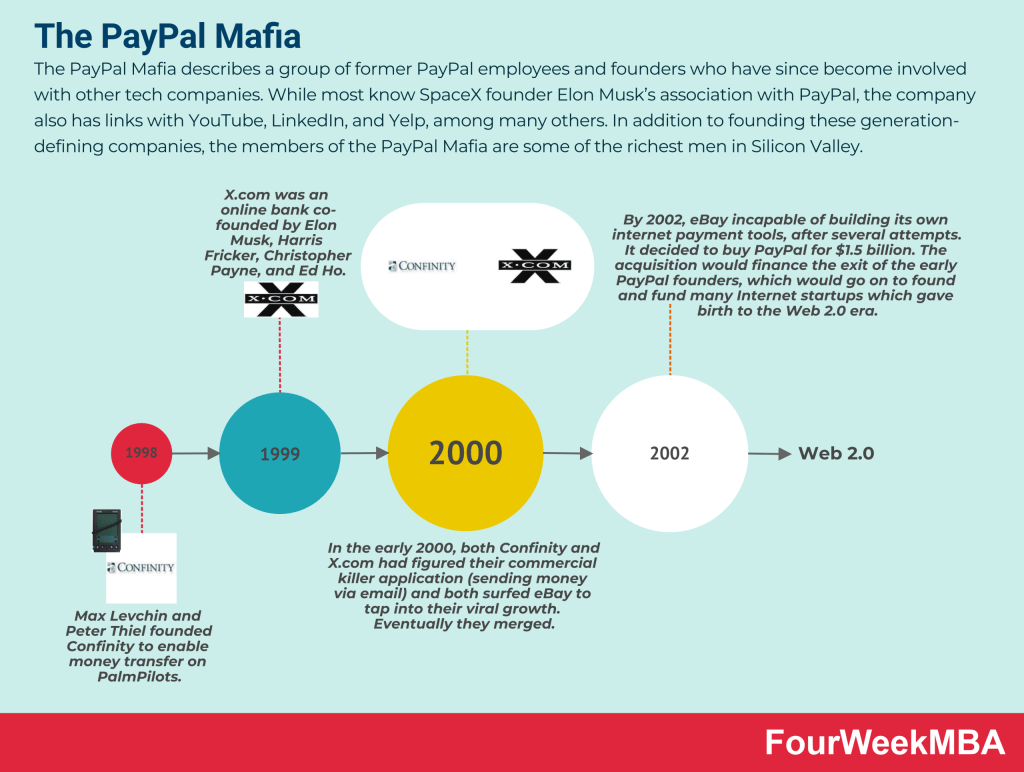
The PayPal Mafia describes a group of former PayPal employees and founders who have since become involved with other tech companies. While most know SpaceX founder Elon Musk’s association with PayPal, the company also has links with YouTube, LinkedIn, and Yelp, among many others. In addition to founding these generation-defining companies, the members of the PayPal Mafia are some of the richest men in Silicon Valley.
PayPal makes money primarily by processing customer transactions on the Payments Platform and other value-added services. Thus, the revenue streams are divided into transaction revenues based on the volume of activity or total payments volume. And value-added services, such as interest and fees earned on loans and interest receivable. As of 2021, PayPal processed $1.25 trillion in total transactions, with net revenues of $25.4 billion and $4.3B in operating income.
Elon Musk, seen as one of the most visionary tech entrepreneurs from the Silicon Valley scene, started his “career” as an entrepreneur at an early age. After selling his first startup, Zip2, in 1999, he made $22 million, which he used to find X.com, which would later become PayPal, and sell for over a billion to eBay (Musk made $180 million from the deal). He founded other companies like Tesla (he didn’t start it but became a major investor in the early years) and SpaceX. Tesla started as an electric sports car niche player and eventually became a mass-manufacturing electric car maker.
Acorns is a fintech platform providing services related to Robo-investing and micro-investing. The company makes money primarily through three subscription tiers: Lite – ($1/month), which gives users access to Acorns Invest, Personal ($3/month) that includes Invest plus the Later (retirement) and Spend (personal checking account) suite of products, Family ($5/month) with features from both the Lite and Personal plans with the addition of Early.
Starting as a pay-later solution integrated into merchants’ checkouts, Affirm makes money from merchants’ fees as consumers pick up the pay-later solution. Affirm also makes money through interest earned from the consumer loans when those are repurchased from the originating bank. In 2020 Affirm made 50% of its revenues from merchants’ fees, about 37% from interests, and the remaining from virtual cards and servicing fees.
Alipay is a Chinese mobile and online payment platform created in 2004 by entrepreneur Jack Ma as the payment arm of Taobao, a major Chinese eCommerce site. Alipay, therefore, is the B2C component of Alibaba Group. Alipay makes money via escrow transaction fees, various value-added ancillary services, and its Credit Pay Instalment fees.
Betterment is an American financial advisory company founded in 2008 by MBA graduate Jon Stein and lawyer Eli Broverman. Betterment makes money via investment plans, financial advice packages, betterment for advisors, betterment for business, cash reserve, and checking accounts.
Chime is an American neobank (internet-only bank) company, providing fee-free financial services through its mobile banking app, thus providing personal finance services free of charge while making the majority of its money via interchange fees (paid by merchants when consumers use their debit cards) and ATM fees.
Coinbase is among the most popular platforms for trading and storing crypto-assets, whose mission is “to create an open financial system for the world” by enabling customers to trade cryptocurrencies. Its platform serves both as a search and discovery engine for crypto assets. The company makes money primarily through fees earned for the transactions processed through the platform, custodial services offered, interest, and subscriptions.
Compass is a licensed American real-estate broker incorporating online real estate technology as a marketing medium. The company makes money via sales commissions (collected whenever a sale is facilitated or tenants are found for a rental property) and bridge loans (a service allowing the seller to purchase a home before the revenue from the sale of their previous home is available).
Dosh is a Fintech platform that enables automatic cash backs for consumers. Its business model connects major card providers with online and offline local businesses to develop automatic cash back programs. The company makes money by earning an affiliate commission on each eligible sale from consumers.
E-Trade is a trading platform allowing investors to trade common and preferred stocks, exchange-traded funds (ETFs), options, bonds, mutual funds, and futures contracts; acquired by Morgan Stanley in 2020 for $13 billion. E-Trade makes money through interest income, order flow, margin interests, options, future and bonds trading, and other fees and service charges.
Klarna is a financial technology company allowing consumers to shop with a temporary Visa card. Thus it then performs a soft credit check and pays the merchant. Klarna makes money by charging merchants. Klarna also earns a percentage of interchange fees as a commission and for interests earned on customers’ accounts.
Lemonade is an insurance tech company using behavioral economics and artificial intelligence to process claims efficiently. The company leverages technology to streamline onboarding customers while also applying a financial model to reduce conflicts of interest with customers (perhaps by donating the variable premiums to charity). The company makes money by selling its core insurance products, and via its tech platform, it tries to enhance its sales.
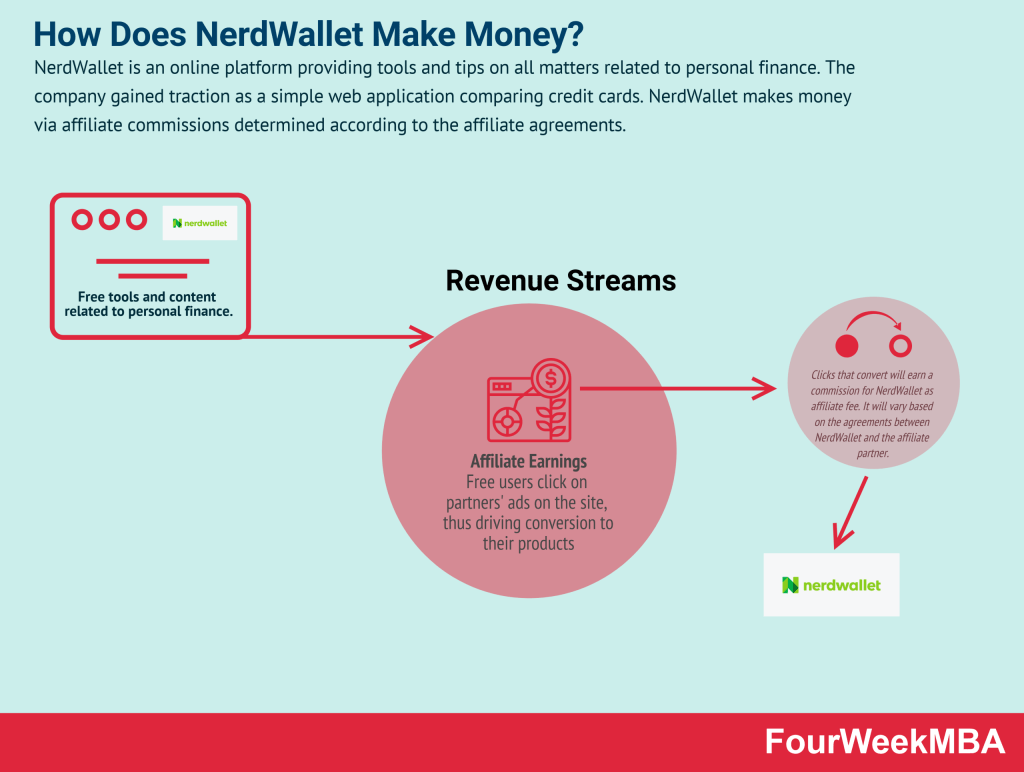
NerdWallet is an online platform providing tools and tips on all matters related to personal finance. The company gained traction as a simple web application comparing credit cards. NerdWallet makes money via affiliate commissions determined according to the affiliate agreements.
Robinhood is an app that helps to invest in stocks, ETFs, options, and cryptocurrencies, all commission-free. Robinhood earns money by offering: Robinhood Gold, a margin trading service, which starts at $6 a month, earns interests from customer cash and stocks, and rebates from market makers and trading venues.
SoFi is an online lending platform that provides affordable education loans to students, and it expanded into financial services, including loans, credit cards, investment services, and insurance. It makes money primarily via payment processing fees and loan securitization.
Squarespace is a North American hosting and website building company. Founded in 2004 by college student Anthony Casalena as a blog hosting service, it grew to become of the most successful website building companies. The company mostly makes money via its subscription plans. It also makes money via customizations on top of its subscription plans. And in part also transaction fees for the website where it processes the sales.
Stash is a FinTech platform offering a suite of financial tools for young investors, personalized investment advice, and life insurance. The company primarily makes money via subscriptions, cashback, payment for order flows, and interest for cash sitting on members’ accounts.
Wealthfront is an automated Fintech investment platform providing investment, retirement, and cash management products to retail investors, mostly making money on the annual 0.25% advisory fee the company charges for assets under management. It also makes money via a line of credits and interests on the cash accounts.
Zelle is a peer-to-peer payment network that indirectly benefits the banks’ consortium that backs it. Zelle also enables users to pay businesses for goods and services, free for users. Merchants pay a 1% fee to Visa or Mastercard, who share it with the bank that issued the card.
Gennaro is the creator of FourWeekMBA, which reached about four million business people, comprising C-level executives, investors, analysts, product managers, and aspiring digital entrepreneurs in 2022 alone | He is also Director of Sales for a high-tech scaleup in the AI Industry | In 2012, Gennaro earned an International MBA with emphasis on Corporate Finance and Business Strategy.
Scroll to Top
Discover more from FourWeekMBA
Subscribe now to keep reading and get access to the full archive.