Gravy generates a significant portion of its revenue through event ticket sales. Users can browse and purchase tickets for various events directly through the G
Partnerships and Promotions
Gravy partners with event organizers, venues, and promoters to promote and sell tickets to their events. These partnership agreements often involve revenue-shar
Premium Features
Gravy offers premium features and services to enhance the event discovery and ticketing experience for users. While the core platform is free to use, premium su
Sponsored Content and Advertising
Gravy may incorporate sponsored content and advertising within its platform. Event organizers and brands may pay for promotional placement, sponsored event list
Data Insights and Analytics
Gravy collects data on user preferences, event attendance, and engagement with its platform. This valuable data analytics can be anonymized and aggregated to pr
Challenges and Competition
Gravy faces challenges related to competition in the event discovery and ticketing space, as there are several other platforms offering similar services. Mainta
Future Growth Strategies
Gravy's future growth strategies may involve: – Expanding Event Categories: Diversifying the types of events offered, including niche and local events. – Enhanc
Gravy is a payment recovery platform for subscription-based businesses. The company was founded by Casey Graham and his partner Renee Weber in 2017. Graham created the platform after finding it difficult to recover failed credit card payments and reduce customer churn rates.
Gravy makes money by selling its payment recovery service to businesses on a subscription basis. Customers pay a flat fee of between $997 and $8,000 depending on the total transaction volume.
Gravy’s single product features several add-ons and is seamlessly integrated with the client’s pre-existing payment infrastructure.
Aspect
Description
Event Ticket Sales
Gravy generates a significant portion of its revenue through event ticket sales. Users can browse and purchase tickets for various events directly through the Gravy platform. When users buy tickets to events, Gravy earns a commission or service fee on each ticket sold. This revenue stream is a primary source of income for the platform.
Partnerships and Promotions
Gravy partners with event organizers, venues, and promoters to promote and sell tickets to their events. These partnership agreements often involve revenue-sharing arrangements, where Gravy earns a percentage of the ticket sales generated through its platform. Additionally, Gravy may collaborate with event organizers to run promotions, offering discounts or exclusive deals to its users in exchange for a portion of the sales. These partnerships create a win-win scenario, benefiting both Gravy and event organizers.
Premium Features
Gravy offers premium features and services to enhance the event discovery and ticketing experience for users. While the core platform is free to use, premium subscriptions may be available for a monthly or annual fee. These subscriptions can provide users with benefits such as early access to tickets, exclusive event offers, and ad-free browsing. Revenue generated from premium subscriptions contributes to Gravy’s income.
Sponsored Content and Advertising
Gravy may incorporate sponsored content and advertising within its platform. Event organizers and brands may pay for promotional placement, sponsored event listings, or featured content to increase their visibility to Gravy users. These advertising deals generate revenue for Gravy, and they can provide valuable exposure and marketing opportunities for event organizers and brands looking to reach a targeted audience of event-goers.
Data Insights and Analytics
Gravy collects data on user preferences, event attendance, and engagement with its platform. This valuable data analytics can be anonymized and aggregated to provide insights and trends to event organizers and marketers. These insights help event organizers refine their strategies and make data-driven decisions. Gravy may offer data analytics services to its partners as an additional source of revenue.
Challenges and Competition
Gravy faces challenges related to competition in the event discovery and ticketing space, as there are several other platforms offering similar services. Maintaining a comprehensive and up-to-date event database, providing a seamless user experience, and differentiating itself from competitors are ongoing challenges. Building strong relationships with event organizers and offering competitive pricing is also essential for sustained growth.
Future Growth Strategies
Gravy’s future growth strategies may involve: – Expanding Event Categories: Diversifying the types of events offered, including niche and local events. – Enhanced User Experience: Continuously improving the platform’s features and user interface. – Advanced Analytics: Offering more advanced data analytics and marketing insights to event organizers and partners.
Origin story
Gravy is a payment recovery platform for subscription-based businesses. The company was founded by Casey Graham and his partner Renee Weber in 2017.
Before founding the company, Graham owned an online business built on recurring subscriptions and memberships.
Despite experiencing tremendous growth, he found it difficult to recover failed credit card payments and reduce customer churn rates.
Failed payment recovery was a problem echoed by many of his colleagues, yet none could justify the cost of employing an in-house team to deal with the issue.
To remedy this problem, Graham created a platform designed for subscription-based businesses backed by a team of US-based specialists and technology that alerts them to missed payments.
Gravy specialists also use a warmer communication style with more of a human touch since customers tend to respond to this form of outreach positively.
They may also entice the customer to stay with the company through discounts, stay bonuses, and custom arrangements for COVID-impacted businesses.
These strategies help the client retain its customers, which is a much easier task than acquiring new ones.
Gravy makes money by selling payment recovery services to businesses on a subscription basis.
Customers pay a flat fee of between $997 and $8,000 depending on the total transaction volume.
Once payment has been received, Gravy seamlessly integrates with the client’s payment processor, subscription-manager, and any other product they use to manage regular payments such as Stripe, Braintree, or Keap.
Company specialists then set up a Gravy channel on Slack to communicate with the client’s staff.
The company claims it is committed to working with clients of all sizes. As a result, it encourages prospects to contact the company for a custom quote.
Nevertheless, there are two general options:
Standard – the core plan that is ideal for start-ups and medium-sized businesses. Features include personalized failed payment recovery, monthly recovery reporting, payment processor optimization, volume-based pricing, and a dedicated, full-time retention team.
Standard add-ons – for customers who desire extra functionality there are several add-on features, including qualitative churn reports, historical payment status, user access and permission reporting, and Facebook group management.
Key Takeaways
Gravy Specialists: Utilizes a team of US-based specialists who employ a warmer communication style with customers, offering discounts, stay bonuses, and custom arrangements to encourage customer retention.
Integration: Seamlessly integrates with clients’ existing payment infrastructure, including payment processors and subscription managers like Stripe, Braintree, or Keap.
Communication Channel: Sets up a dedicated Gravy channel on Slack to facilitate communication between Gravy specialists and the client’s staff.
Client Size Flexibility: Works with businesses of all sizes and offers customized quotes based on specific needs.
Standard Plan: Core plan ideal for start-ups and medium-sized businesses, offering personalized failed payment recovery, monthly recovery reporting, payment processor optimization, volume-based pricing, and a dedicated, full-time retention team.
Standard Add-ons: Additional features available for customers who desire extra functionality, including qualitative churn reports, historical payment status, user access and permission reporting, and Facebook group management.
Acorns is a fintech platform providing services related to Robo-investing and micro-investing. The company makes money primarily through three subscription tiers: Lite – ($1/month), which gives users access to Acorns Invest, Personal ($3/month) that includes Invest plus the Later (retirement) and Spend (personal checking account) suite of products, Family ($5/month) with features from both the Lite and Personal plans with the addition of Early.
Starting as a pay-later solution integrated into merchants’ checkouts, Affirm makes money from merchants’ fees as consumers pick up the pay-later solution. Affirm also makes money through interest earned from the consumer loans when those are repurchased from the originating bank. In 2020 Affirm made 50% of its revenues from merchants’ fees, about 37% from interests, and the remaining from virtual cards and servicing fees.
Alipay is a Chinese mobile and online payment platform created in 2004 by entrepreneur Jack Ma as the payment arm of Taobao, a major Chinese eCommerce site. Alipay, therefore, is the B2C component of Alibaba Group. Alipay makes money via escrow transaction fees, various value-added ancillary services, and its Credit Pay Instalment fees.
Betterment is an American financial advisory company founded in 2008 by MBA graduate Jon Stein and lawyer Eli Broverman. Betterment makes money via investment plans, financial advice packages, betterment for advisors, betterment for business, cash reserve, and checking accounts.
Chime is an American neobank (internet-only bank) company, providing fee-free financial services through its mobile banking app, thus providing personal finance services free of charge while making the majority of its money via interchange fees (paid by merchants when consumers use their debit cards) and ATM fees.
Coinbase is among the most popular platforms for trading and storing crypto-assets, whose mission is “to create an open financial system for the world” by enabling customers to trade cryptocurrencies. Its platform serves both as a search and discovery engine for crypto assets. The company makes money primarily through fees earned for the transactions processed through the platform, custodial services offered, interest, and subscriptions.
Compass is a licensed American real-estate broker incorporating online real estate technology as a marketing medium. The company makes money via sales commissions (collected whenever a sale is facilitated or tenants are found for a rental property) and bridge loans (a service allowing the seller to purchase a home before the revenue from the sale of their previous home is available).
Dosh is a Fintech platform that enables automatic cash backs for consumers. Its business model connects major card providers with online and offline local businesses to develop automatic cash back programs. The company makes money by earning an affiliate commission on each eligible sale from consumers.
E-Trade is a trading platform allowing investors to trade common and preferred stocks, exchange-traded funds (ETFs), options, bonds, mutual funds, and futures contracts; acquired by Morgan Stanley in 2020 for $13 billion. E-Trade makes money through interest income, order flow, margin interests, options, future and bonds trading, and other fees and service charges.
Klarna is a financial technology company allowing consumers to shop with a temporary Visa card. Thus it then performs a soft credit check and pays the merchant. Klarna makes money by charging merchants. Klarna also earns a percentage of interchange fees as a commission and for interests earned on customers’ accounts.
Lemonade is an insurance tech company using behavioral economics and artificial intelligence to process claims efficiently. The company leverages technology to streamline onboarding customers while also applying a financial model to reduce conflicts of interest with customers (perhaps by donating the variable premiums to charity). The company makes money by selling its core insurance products, and via its tech platform, it tries to enhance its sales.
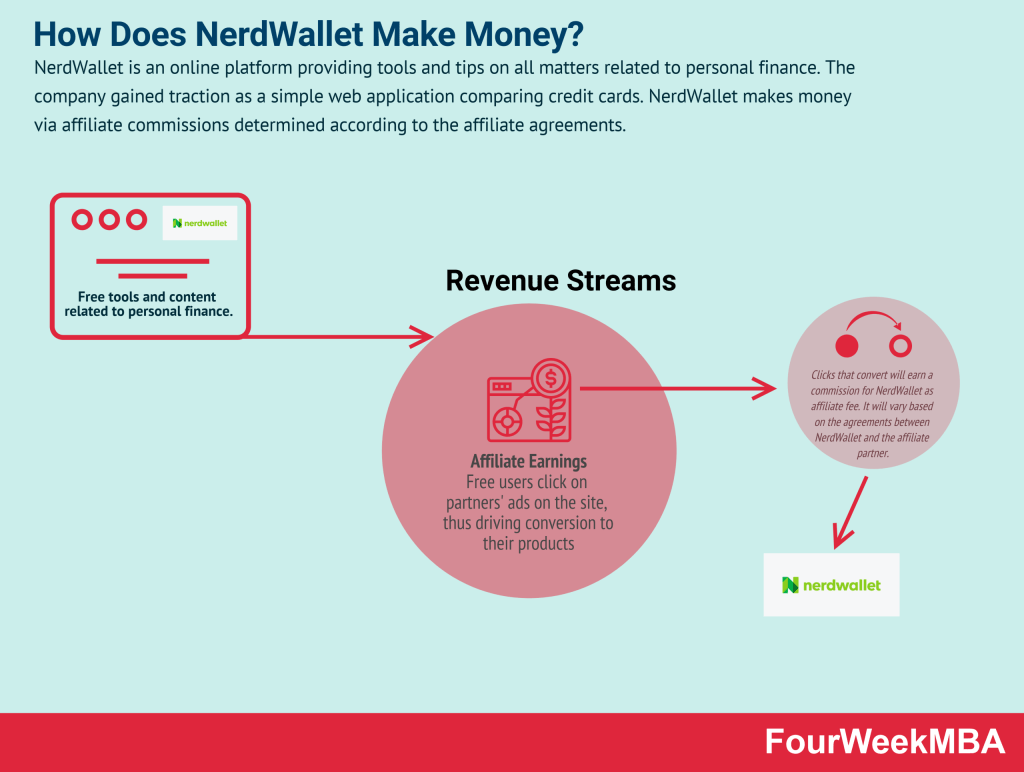
NerdWallet is an online platform providing tools and tips on all matters related to personal finance. The company gained traction as a simple web application comparing credit cards. NerdWallet makes money via affiliate commissions determined according to the affiliate agreements.
Robinhood is an app that helps to invest in stocks, ETFs, options, and cryptocurrencies, all commission-free. Robinhood earns money by offering: Robinhood Gold, a margin trading service, which starts at $6 a month, earns interests from customer cash and stocks, and rebates from market makers and trading venues.
SoFi is an online lending platform that provides affordable education loans to students, and it expanded into financial services, including loans, credit cards, investment services, and insurance. It makes money primarily via payment processing fees and loan securitization.
Stash is a FinTech platform offering a suite of financial tools for young investors, personalized investment advice, and life insurance. The company primarily makes money via subscriptions, cashback, payment for order flows, and interest for cash sitting on members’ accounts.
Wealthfront is an automated Fintech investment platform providing investment, retirement, and cashmanagement products to retail investors, mostly making money on the annual 0.25% advisory fee the company charges for assets under management. It also makes money via a line of credits and interests on the cash accounts.
Zelle is a peer-to-peer payment network that indirectly benefits the banks’ consortium that backs it. Zelle also enables users to pay businesses for goods and services free for users. Merchants pay a 1% fee to Visa or Mastercard, who share it with the bank that issued the card.
Gennaro is the creator of FourWeekMBA, which reached about four million business people, comprising C-level executives, investors, analysts, product managers, and aspiring digital entrepreneurs in 2022 alone | He is also Director of Sales for a high-tech scaleup in the AI Industry | In 2012, Gennaro earned an International MBA with emphasis on Corporate Finance and Business Strategy.