Direct-to-consumer (D2C) is a business model where companies sell their products directly to the consumer without the assistance of a third-party wholesaler or retailer. In this way, the company can cut through intermediaries and increase its margins. However, to be successful the direct-to-consumers company needs to build its own distribution, which in the short term can be more expensive. Yet in the long-term creates a competitive advantage.
Aspect
Explanation
Definition
The Direct-to-Consumer (DTC) Business Model is a strategy employed by companies to sell their products or services directly to consumers, bypassing traditional intermediaries such as wholesalers, retailers, or distributors. DTC businesses engage with customers through various sales channels, including online stores, mobile apps, and physical showrooms. This model has gained prominence in the digital age, fueled by e-commerce, social media, and technology that enable companies to build direct relationships with their customers. DTC brands often prioritize customer experience, personalization, and data-driven marketing to create a strong and loyal customer base. By eliminating middlemen, DTC companies aim to offer competitive pricing, control over branding, and faster response to customer feedback. It has been particularly popular among startups and established brands looking to adapt to changing consumer preferences and market dynamics.
Key Concepts
– Disintermediation: The core concept is removing intermediaries from the distribution chain. – Customer-Centricity: DTC businesses prioritize customer needs and preferences. – E-commerce: Online sales channels play a central role in DTC strategies. – Data-Driven Marketing: Utilizing customer data for targeted marketing and personalization. – Brand Control: Maintaining control over brand messaging and customer interactions.
Characteristics
– Online Presence: DTC companies have a strong online presence through websites and social media. – Customer Engagement: They actively engage with customers through social platforms, reviews, and feedback. – Vertical Integration: Many DTC brands control the entire production and distribution process. – Subscription Models: Some DTC companies offer subscription services for recurring revenue. – Customization: Personalization and customization are often key features.
Implications
– Brand Control: DTC brands have full control over how their brand is presented and perceived by customers. – Data Utilization: They leverage customer data for targeted marketing and product development. – Market Disruption: DTC models can disrupt traditional retail channels and challenge established brands. – Direct Customer Feedback: Direct engagement with customers provides valuable feedback for product improvements. – Competitive Pricing: Eliminating intermediaries can lead to competitive pricing for consumers.
Advantages
– Brand Control: Maintaining control over branding and messaging. – Direct Customer Relationships: Building direct relationships with customers fosters loyalty. – Data-Driven Decision-Making: Data analytics support informed decision-making. – Agility: Quick response to market changes and customer feedback. – Higher Margins: Eliminating middlemen can lead to higher profit margins.
Drawbacks
– Distribution Challenges: Establishing and managing distribution can be complex. – Initial Costs: Setting up an e-commerce infrastructure may require significant investment. – Competition: The DTC space can be highly competitive, especially in saturated markets. – Logistics: Efficient logistics and order fulfillment are crucial for success. – Customer Acquisition Costs: Acquiring and retaining customers can be costly.
Applications
– Apparel and Fashion: Many fashion brands use the DTC model to sell clothing, shoes, and accessories directly to consumers. – Beauty and Cosmetics: Cosmetic companies market products directly through their websites and physical stores. – Food and Beverage: Some food and beverage companies offer subscription services for meal kits and beverages. – Technology and Electronics: Electronics brands sell their products directly to consumers online. – Furniture and Home Goods: Companies in this category sell furniture and home decor items directly through online stores.
Use Cases
– Online Fashion Brand: A startup fashion brand launches an online store, bypassing traditional retail. The brand focuses on direct customer engagement through social media, offering personalized recommendations and convenient returns. – Subscription Meal Service: A company starts a DTC subscription meal kit service, delivering fresh ingredients and recipes directly to customers’ doors. – Direct-to-Consumer Electronics: A well-known electronics manufacturer establishes an online store to sell its products directly to customers, providing competitive pricing and exceptional customer support. – Personalized Beauty Products: A cosmetics company offers a DTC service where customers can personalize their makeup products online and have them delivered to their homes. – Direct-to-Consumer Furniture: A furniture manufacturer creates an online store, enabling customers to customize and purchase furniture directly from the manufacturer.
Direct-to-consumer is a strategy where a business sells directly to consumers through an online medium. The approach is in stark contrast to more traditional B2B strategies, where a manufactured product may pass through a wholesaler, distributor, and retailer before it is purchased by the consumer.
Manufacturers operating under the D2C model must necessarily wear the hat of the wholesaler, distributor, and retailer in addition to meeting their production and fulfillment responsibilities. So why would a manufacturer take on more work voluntarily? There are two answers to this question, and both are related to the evolving needs and expectations of modern consumers.
For one, consumers prefer to go directly to the source when purchasing from a specific brand. For example, a golf fanatic is more likely to visit the TaylorMade website than they are a traditional sports retailer when looking for more information. When more consumers are going direct to TaylorMade, this also means the company can no longer rely on third-party sports retailers to adequately sell its products. Essentially, TaylorMade may be forced to adopt the direct-to-consumer model and make its products available for direct sale.
Advantages of the direct-to-consumer model
While it is clear manufacturers may have to take on extra work, there are nevertheless quite a few benefits to adopting the direct-to-consumer model:
Customer data – manufacturers who sell to a retailer or wholesaler are less exposed to important purchasing data regarding their products. The D2C model helps manufacturers learn more about their target audience, resulting in smarter product development and increased awareness around consumer trends and demand.
Customer experience – selling direct to the consumer means the business has control over the entire buyer journey. The business will learn where consumers shop and how they prefer to pay. By interacting with consumers directly, the business can offer more responsive customer support and develop targeted and consistent marketing campaigns using SMS or email, among other channels.
Brand engagement and reputation – many businesses who sell through a retailer have little say in how their products are presented. Retail salespeople may have limited interest or knowledge in promoting their range, which can lead to a poor first impression of the brand itself. In the D2C model, manufacturers ensure the company brand and associated products are painted in the best light possible.
Direct-to-consumer examples
Here are three companies utilizing the direct-to-consumer model:
Glossier – a cosmetics company founded by blogger Emily Weiss, who built a strong relationship with her readers before developing products to sell to them. By asking consumers what they wanted directly, Weiss was able to bypass selling her goods in traditional cosmetics retailers.
Dollar Shave Club – a company that was started because its founders were tired of paying for expensive razor blades in supermarkets. Dollar Shave Club sells cheap razors direct-to-consumer on a subscription basis.
Casper – a manufacturer and direct seller of innovative mattresses, pillows, sheets, weighted blankets, and even dog beds. Casper enables consumers to avoid buying these items from aggressive salespeople in traditional furniture stores.
More examples of the D2C approach
To solidify the concept of D2C, we have listed a few more examples below.
Reformation
Reformation is a sustainable fashion company that started operations in Los Angeles in 2009.
With a mission to bring sustainable fashion to everyone, Reformation wants its customers to know that it makes the people who manufacture clothes a priority. To realize this mission, the company constructed its own factory in Los Angeles to create a safe, fair, and healthy working environment for employees.
With many of its competitors manufacturing their clothes in cheap and sometimes exploitative labor markets, Reformation’s D2C approach has allowed it to build a strong brand following in a short period of time.
Nanit
Nanit is a D2C manufacturer of baby sleep monitoring devices that can also track the health and wellness of the child and allow the parents to celebrate growth milestones.
The industry was perfect for the D2C approach since these devices required specialist manufacturer knowledge to develop and then market to consumers. The company has raised $75 million to date, with much of the capital invested and research and development and global expansion.
As both the manufacturer and the seller, Nanit can offer expert after-sales support to customers. The company also operates a community forum where new parents can share the collective experience of raising a child and ask questions.
Bombas
Bombas is an apparel manufacturer with a particular focus on socks. While its competitors looked to differentiate their products with design, Bombas decided to fix the engineering issues that seemed to be inherent to most socks on the market.
According to company founders Randy Goldberg and David Heath, it took almost two years of testing to fix issues such as slipping, chafing, and an uncomfortable sensation from the toe seam, among other problems. While Bombas socks are more expensive than most others, Goldberg likened the company’s pricing strategy to that of Starbucks, which improved the coffee experience so much that it was able to sell it at a premium.
Today, Bombas is a certified B-Corporation that matches every customer purchase with a donation to someone affected by homelessness. The brand is now worth around $100 million.
Quip
Quip is a D2C brand that sells oral care products such as floss, dental gum, mouthwash, and electric toothbrushes. The company was started to improve poor dental health among millennial consumers, with 30% only brushing their teeth once a day with many others are simply afraid to visit the dentist.
To make oral care more appealing, Quip sells beautifully designed products with a strong digital marketingstrategy that appeals to its core demographic. Like other D2C brands that sell personal care items, Quip’s products are available for a small monthly subscription.
In recent times, Quip has also started selling its products in retail chains such as Target. However, the importance of D2C for Quip and ensuring it stays relevant among consumers is not lost on the company. Quip VP of growth Shane Pittson once noted in an interview that D2C allowed the company to build a supportive customer base and high-quality products based on constructive feedback, with over 80% of customers completing a post-purchase survey.
Key takeaways:
Direct-to-consumer (D2C) is a business model where companies sell their products directly to the consumer without the assistance of a third-party wholesaler or retailer.
Despite requiring extra work and involvement, direct-to-consumer has several benefits for manufacturers. They include more transparent customer buying data, a higher-quality customer experience, and increased brand engagement and reputation.
Examples of businesses employing the D2C model include Glossier, Dollar Shave Club, and Casper.
Key Highlights
Definition: Direct-to-Consumer (D2C) is a business strategy where companies sell their products directly to consumers without involving intermediaries like wholesalers or retailers.
Growth and Importance: D2C has gained prominence as eCommerce sales are projected to exceed $6 trillion by 2024, with a significant portion attributed to D2C sales.
Process: Under the D2C model, manufacturers take on roles of wholesaler, distributor, and retailer, selling their products directly to consumers through online channels.
Consumer Preferences: Modern consumers prefer buying directly from brands, seeking an authentic connection and more control over their purchasing experience.
Advantages of D2C:
Customer Data: Manufacturers gain valuable insights into consumer behavior and trends, aiding smarter product development.
Customer Experience: Direct sales allow for personalized customer support, targeted marketing, and control over the buyer journey.
Brand Engagement: Manufacturers can present their products in the best possible light and maintain consistency in branding.
D2C Examples:
Glossier: Founded by Emily Weiss, it engaged with readers before launching cosmetics directly to them.
Dollar Shave Club: Offers affordable razors directly to consumers via subscription.
Casper: Sells mattresses, pillows, and more directly, avoiding traditional furniture stores.
More D2C Examples:
Reformation: A sustainable fashion brand that ensures ethical production practices and sells directly to consumers.
Nanit: Manufacturer of baby sleep monitoring devices that offers expert after-sales support.
Bombas: Apparel brand focusing on socks, fixing common issues and donating to the homeless.
Quip: Sells oral care products directly, emphasizing a digital marketingstrategy and subscription options.
Related Framework
Description
When to Apply
Direct-to-Consumer (DTC) Model
The Direct-to-Consumer (DTC) Model involves selling products or services directly to consumers, bypassing traditional retail intermediaries such as wholesalers or brick-and-mortar stores. DTC brands typically leverage e-commerce platforms, social media, and digital marketing channels to build brand awareness, engage customers, and facilitate online transactions. By eliminating middlemen and controlling the entire customer experience, DTC brands can offer competitive pricing, personalized products, and direct communication with customers. Understanding the DTC model can inform strategies for market entry, customer acquisition, and brand development in the digital age.
When launching a new product or brand, entering a competitive market, or expanding distribution channels, considering the DTC model to establish direct relationships with customers, leverage digital marketing channels, and gain insights into consumer preferences and behaviors, thus enhancing brand visibility, customer engagement, and market penetration.
Disintermediation
Disintermediation refers to the process of removing intermediaries or middlemen from a supply chain or distribution channel. Similar to the DTC model, disintermediation aims to streamline the buying process, reduce costs, and improve efficiency by connecting producers directly with end consumers. Disintermediation is often facilitated by technological advancements such as e-commerce platforms, online marketplaces, and digital payment systems. Embracing disintermediation can enable businesses to exert greater control over pricing, branding, and customer relationships while adapting to shifting market dynamics and consumer preferences.
When evaluating supply chain or distribution strategies, identifying opportunities for disintermediation to streamline operations, reduce dependency on third-party intermediaries, and enhance direct engagement with customers, thus improving cost efficiency, responsiveness, and agility in meeting customer demands and market trends.
Subscription Model
The Subscription Model involves offering products or services to customers through recurring subscription plans or memberships. Like the DTC model, subscription-based businesses aim to establish direct relationships with customers, generate recurring revenue streams, and foster loyalty and retention. Subscription models can be applied across various industries, including media streaming, software-as-a-service (SaaS), meal delivery, and beauty products. By providing convenience, value, and personalization, subscription models can drive customer engagement and lifetime value while reducing reliance on one-time transactions.
When diversifying revenue streams, enhancing customer retention, or capitalizing on recurring revenue opportunities, exploring subscription-based offerings to provide ongoing value, predictability, and convenience to customers, thus fostering loyalty, maximizing customer lifetime value, and ensuring long-term sustainability and growth for the business.
Brand Directing
Brand Directing refers to the strategic approach of building and managing a brand’s identity, image, and relationships with customers directly. Like the DTC model, brand directing emphasizes direct communication, engagement, and interaction with customers across various touchpoints, including digital platforms, social media, and experiential marketing. Brand directing involves understanding customer needs and preferences, delivering consistent brand experiences, and fostering brand loyalty and advocacy. By taking a proactive role in brand management, businesses can differentiate themselves in competitive markets and build lasting relationships with customers.
When refining brand strategies, enhancing customer engagement, or differentiating in competitive markets, adopting a brand directing approach to cultivate direct connections with customers, deliver personalized experiences, and strengthen brand affinity and loyalty, thus driving brand preference, advocacy, and long-term value creation for the business.
Personalization Marketing
Personalization Marketing entails tailoring marketing messages, offers, and experiences to individual preferences, behaviors, and characteristics. Similar to the DTC model, personalization marketing aims to create relevant, timely, and meaningful interactions with customers to drive engagement and conversions. Personalization techniques may include data-driven segmentation, dynamic content optimization, and AI-powered recommendation engines. By delivering personalized experiences, businesses can enhance customer satisfaction, loyalty, and lifetime value while optimizing marketing ROI and conversion rates.
When optimizing marketing campaigns, improving customer engagement, or increasing conversion rates, implementing personalization strategies to deliver targeted and relevant messaging, offers, and experiences to individual customers, thus enhancing brand perception, customer satisfaction, and overall marketing effectiveness while driving revenue growth and competitive advantage in the marketplace.
An effective business model has to focus on two dimensions: the people dimension and the financial dimension. The people dimension will allow you to build a product or service that is 10X better than existing ones and a solid brand. The financial dimension will help you develop proper distribution channels by identifying the people that are willing to pay for your product or service and make it financially sustainable in the long run.
Business model innovation is about increasing the success of an organization with existing products and technologies by crafting a compelling value proposition able to propel a new business model to scale up customers and create a lasting competitive advantage. And it all starts by mastering the key customers.
Digital and tech business models can be classified according to four levels of transformation into digitally-enabled, digitally-enhanced, tech or platform business models, and business platforms/ecosystems.
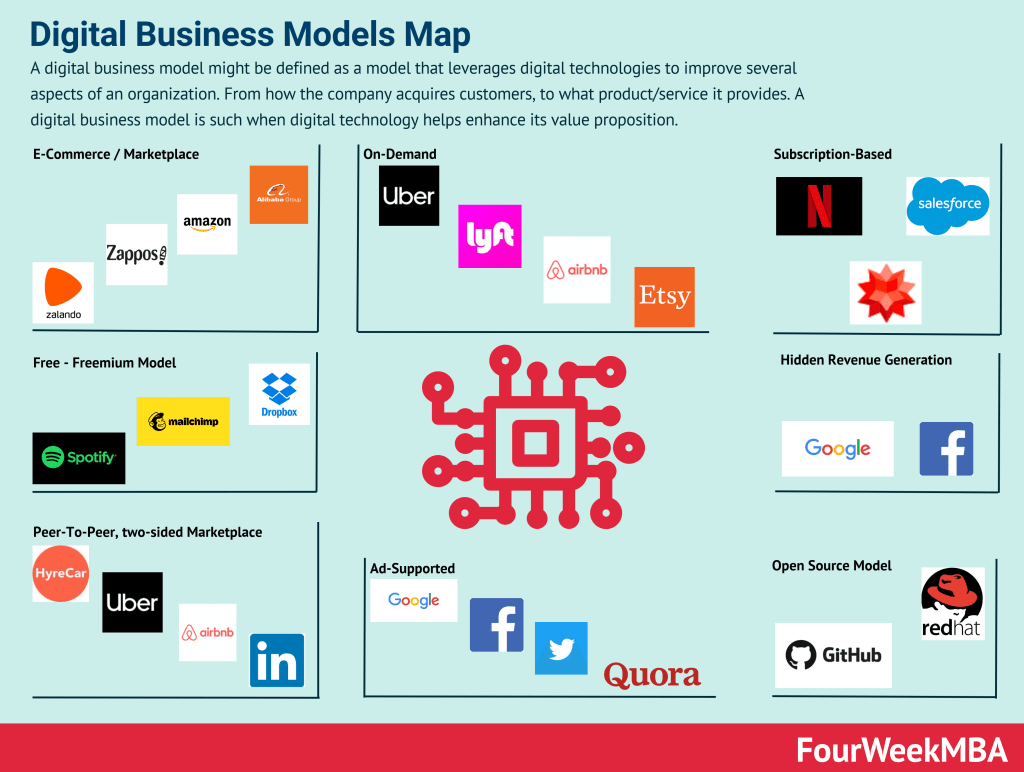
A digital business model might be defined as a model that leverages digital technologies to improve several aspects of an organization. From how the company acquires customers, to what product/service it provides. A digital business model is such when digital technology helps enhance its value proposition.
A tech business model is made of four main components: value model (value propositions, mission, vision), technological model (R&D management), distribution model (sales and marketing organizational structure), and financial model (revenue modeling, cost structure, profitability and cash generation/management). Those elements coming together can serve as the basis to build a solid tech business model.
A platform business model generates value by enabling interactions between people, groups, and users by leveraging network effects. Platform business models usually comprise two sides: supply and demand. Kicking off the interactions between those two sides is one of the crucial elements for a platform business model success.
A Blockchain Business Model is made of four main components: Value Model (Core Philosophy, Core Value and Value Propositions for the key stakeholders), Blockchain Model (Protocol Rules, Network Shape and Applications Layer/Ecosystem), Distribution Model (the key channels amplifying the protocol and its communities), and the Economic Model (the dynamics through which protocol players make money). Those elements coming together can serve as the basis to build and analyze a solid Blockchain Business Model.
In an asymmetric businessmodel, the organization doesn’t monetize the user directly, but it leverages the data users provide coupled with technology, thus have a key customer pay to sustain the core asset. For example, Google makes money by leveraging users’ data, combined with its algorithms sold to advertisers for visibility.
In an asymmetric businessmodel, the organization doesn’t monetize the user directly, but it leverages the data users provide coupled with technology, thus having a key customer pay to sustain the core asset. For example, Google makes money by leveraging users’ data, combined with its algorithms sold to advertisers for visibility. This is how attention merchants make monetize their business models.
While the term has been coined by Andrew Lampitt, open-core is an evolution of open-source. Where a core part of the software/platform is offered for free, while on top of it are built premium features or add-ons, which get monetized by the corporation who developed the software/platform. An example of the GitLab open core model, where the hosted service is free and open, while the software is closed.
Cloud business models are all built on top of cloud computing, a concept that took over around 2006 when former Google’s CEO Eric Schmit mentioned it. Most cloud-based business models can be classified as IaaS (Infrastructure as a Service), PaaS (Platform as a Service), or SaaS (Software as a Service). While those models are primarily monetized via subscriptions, they are monetized via pay-as-you-go revenue models and hybrid models (subscriptions + pay-as-you-go).
Open source is licensed and usually developed and maintained by a community of independent developers. While the freemium is developed in-house. Thus the freemium give the company that developed it, full control over its distribution. In an open-source model, the for-profit company has to distribute its premium version per its open-source licensing model.
The freemium – unless the whole organization is aligned around it – is a growth strategy rather than a business model. A free service is provided to a majority of users, while a small percentage of those users convert into paying customers through the sales funnel. Free users will help spread the brand through word of mouth.
A freeterprise is a combination of free and enterprise where free professional accounts are driven into the funnel through the free product. As the opportunity is identified the company assigns the free account to a salesperson within the organization (inside sales or fields sales) to convert that into a B2B/enterprise account.
A marketplace is a platform where buyers and sellers interact and transact. The platform acts as a marketplace that will generate revenues in fees from one or all the parties involved in the transaction. Usually, marketplaces can be classified in several ways, like those selling services vs. products or those connecting buyers and sellers at B2B, B2C, or C2C level. And those marketplaces connecting two core players, or more.
B2B, which stands for business-to-business, is a process for selling products or services to other businesses. On the other hand, a B2C sells directly to its consumers.
A B2B2C is a particular kind of business model where a company, rather than accessing the consumer market directly, it does that via another business. Yet the final consumers will recognize the brand or the service provided by the B2B2C. The company offering the service might gain direct access to consumers over time.
Direct-to-consumer (D2C) is a business model where companies sell their products directly to the consumer without the assistance of a third-party wholesaler or retailer. In this way, the company can cut through intermediaries and increase its margins. However, to be successful the direct-to-consumers company needs to build its own distribution, which in the short term can be more expensive. Yet in the long-term creates a competitive advantage.
The C2C business model describes a market environment where one customer purchases from another on a third-party platform that may also handle the transaction. Under the C2C model, both the seller and the buyer are considered consumers. Customer to customer (C2C) is, therefore, a business model where consumers buy and sell directly between themselves. Consumer-to-consumer has become a prevalent business model especially as the web helped disintermediate various industries.
A retail business model follows a direct-to-consumer approach, also called B2C, where the company sells directly to final customers a processed/finished product. This implies a business model that is mostly local-based, it carries higher margins, but also higher costs and distribution risks.
The wholesale model is a selling model where wholesalers sell their products in bulk to a retailer at a discounted price. The retailer then on-sells the products to consumers at a higher price. In the wholesale model, a wholesaler sells products in bulk to retail outlets for onward sale. Occasionally, the wholesaler sells direct to the consumer, with supermarket giant Costco the most obvious example.
The term “crowdsourcing” was first coined by Wired Magazine editor Jeff Howe in a 2006 article titled Rise of Crowdsourcing. Though the practice has existed in some form or another for centuries, it rose to prominence when eCommerce, social media, and smartphone culture began to emerge. Crowdsourcing is the act of obtaining knowledge, goods, services, or opinions from a group of people. These people submit information via social media, smartphone apps, or dedicated crowdsourcing platforms.
In a franchained business model (a short-term chain, long-term franchise) model, the company deliberately launched its operations by keeping tight ownership on the main assets, while those are established, thus choosing a chain model. Once operations are running and established, the company divests its ownership and opts instead for a franchising model.
Businesses employing the brokerage business model make money via brokerage services. This means they are involved with the facilitation, negotiation, or arbitration of a transaction between a buyer and a seller. The brokerage business model involves a business connecting buyers with sellers to collect a commission on the resultant transaction. Therefore, acting as a middleman within a transaction.
Dropshipping is a retail business model where the dropshipper externalizes the manufacturing and logistics and focuses only on distribution and customer acquisition. Therefore, the dropshipper collects final customers’ sales orders, sending them over to third-party suppliers, who ship directly to those customers. In this way, through dropshipping, it is possible to run a business without operational costs and logistics management.
Gennaro is the creator of FourWeekMBA, which reached about four million business people, comprising C-level executives, investors, analysts, product managers, and aspiring digital entrepreneurs in 2022 alone | He is also Director of Sales for a high-tech scaleup in the AI Industry | In 2012, Gennaro earned an International MBA with emphasis on Corporate Finance and Business Strategy.