The term “crowdsourcing” was first coined by Wired Magazine editor Jeff Howe in a 2006 article titled Rise of Crowdsourcing. Though the practice has existed in some form or another for centuries, it rose to prominence when eCommerce, social media, and smartphone culture began to emerge. Crowdsourcing is the act of obtaining knowledge, goods, services, or opinions from a group of people. These people submit information via social media, smartphone apps, or dedicated crowdsourcing platforms.
Aspect
Explanation
Crowdsourcing Business Model
Crowdsourcing is a business model that leverages the collective intelligence, skills, and contributions of a diverse group of individuals or a “crowd” to solve problems, generate ideas, fund projects, or complete tasks. It offers various benefits, including cost-efficiency, innovation, and scalability.
Types of Crowdsourcing
Crowdsourcing can take several forms, including Crowdfunding (raising funds from a crowd), Crowdsolving (solving complex problems), Crowdvoting (collecting opinions or votes), Crowdcollaboration (collaborating on projects), and more.
Open vs. Closed Crowdsourcing
Open crowdsourcing involves engaging a broad and open community of participants, while closed crowdsourcing limits participation to a specific group or platform users. The choice depends on the goals and nature of the project.
Examples of Crowdsourcing
Prominent examples include Kickstarter (crowdfunding for creative projects), Wikipedia (crowdsourced encyclopedia), InnoCentive (solving scientific challenges), and Amazon Mechanical Turk (crowdsourced microtasks).
Benefits
– Cost-Effective: Crowdsourcing can be more cost-effective than traditional methods. – Innovation: It fosters innovation by tapping into a diverse pool of ideas. – Scalability: Projects can scale easily with the participation of a large crowd. – Speed: Tasks can be completed quickly.
Challenges
– Quality Control: Ensuring the quality of contributions can be challenging. – Intellectual Property: Managing ownership and rights can be complex. – Crowdsourcing Fatigue: Contributors may experience burnout. – Privacy and Security: Data security concerns must be addressed.
Management and Moderation
Effective management and moderation are crucial for successful crowdsourcing initiatives. This includes setting clear goals, providing guidelines, monitoring contributions, and offering rewards or recognition.
Use Cases
Crowdsourcing is used in various industries, such as technology, healthcare, research, and entertainment. It can fund startups, gather scientific research, improve software, and even solve complex global challenges.
Future Trends
The future of crowdsourcing may involve AI-driven curation, blockchain for trust and transparency, and greater integration into businesses’ core strategies. As technology evolves, crowdsourcing will continue to play a vital role in innovation and problem-solving.
Essentially, crowdsourcing describes the process of collecting input from a large group of people. This group of people is a third-party unrelated to the business seeking results and usually performs the necessary tasks on a voluntary basis.
Consumer reviews on a product or service represent the most basic form of crowdsourcing, with freelancing sites and knowledge repositories such as Wikipedia owing much of their success to the collective power of people.
However, the strategy is also used in more complex scenarios where engineering, scientific, or other technical expertise is required. Businesses also use social media platforms like Twitter, Facebook, and Instagram to crowdsource new ideas for products and services.
Crowdsourcing types
Crowdsourcing is an industry experiencing rapid growth and innovation, with the chosen approach depending on the outcome the business desires.
With that said, here is a look at three crowdsourcing types:
Crowdfunding
Where large groups of people come together to fund a project. SeedInvest Technology is a popular platform for start-ups, while creative professionals looking to raise money prefer Patreon.
Crowd-wisdom
Where companies seek out the collective opinion of a group of people on a variety of topics, including election outcome predictions and investor behavior on the stock market. Crowd-wisdom is based on the idea that large groups of people are collectively smarter than individual experts in terms of problem-solving, decision-making, innovation, and prediction. Examples of platforms include Quora, Reddit, and Stack Exchange.
Micro-tasking
Where a large project is separated into smaller tasks for completion by a crowd. Starbucks employed micro-tasking when it asked fans to design a new motif for its coffee cups. Amazon’s Mechanical Turk is another example of a micro-tasking platform.
Benefits of crowdsourcing
For organizations, there are many obvious and not-so-obvious crowdsourcing benefits. We have listed a few of these below:
Scalability
A problem many businesses face when trying to scale is a lack of adequate resources. Crowdsourcing enables the business to cut costs by farming out small portions of the project to remote workers who offer more attractive rates. In some cases, the work may even be done for free.
Addresses knowledge gaps
Crowdsourcing is also used to fill knowledge gaps quickly and easily. There is no need for the organization to undertake a costly and time-consuming recruitment process.
Reduces operational costs – businesses can also reduce or avoid many of the overhead costs of hiring skilled or unskilled labor. These costs include employee salaries, benefits, and training. Crowdsourcing may also obviate the need for a dedicated workspace and associated equipment and utility costs.
Better consumer engagement
When a group of people is energized and motivated to work collaboratively or share their opinion, they tend to be more engaged in the task at hand. With consumer attention spans now lasting a mere eight seconds, participating in the crowdsourcing process is likely to hold their attention for longer than a traditional marketingstrategy might.
Case Studies
Threadless T-shirts:
Problem: Designing trendy T-shirts that resonate with the younger generation.
Crowdsourcing Solution: Threadless allowed users to submit their T-shirt designs, and the community voted on their favorites. The winning designs were then produced and sold.
NASA Planet Hunters:
Problem: The vast amount of data from space that needed analysis.
Crowdsourcing Solution: NASA launched the ‘Planet Hunters’ initiative, enlisting the help of the public to identify new planets from the data collected by the Kepler space telescope.
Duolingo Language Translation:
Problem: Translating the internet’s content into multiple languages.
Crowdsourcing Solution: Duolingo offers a free language learning platform. As users progress, they help translate websites and other content into the language they are learning.
LEGO Ideas:
Problem: Coming up with innovative LEGO set designs.
Crowdsourcing Solution: LEGO Ideas allows fans to submit their designs. If a design receives enough community support, it might be turned into an official LEGO set.
Waze Traffic Updates:
Problem: Providing real-time traffic updates and road conditions.
Crowdsourcing Solution: Waze app users share real-time traffic and road information, helping others to get driving directions based on current conditions.
Minecraft Game Development:
Problem: Continual development and introduction of new features to the game.
Crowdsourcing Solution: Minecraft regularly incorporates user-generated content and mods into the official game, keeping it fresh and updated.
My Starbucks Idea:
Problem: Innovation in products, services, and experience.
Crowdsourcing Solution: Starbucks set up “My Starbucks Idea” platform for customers to submit ideas, which are then voted on by the community. Popular ideas are implemented in stores.
Foldit – Protein Folding Game:
Problem: Understanding protein structures and their folding patterns.
Crowdsourcing Solution: Scientists created a game called Foldit, allowing players to help with predicting the structure of protein molecules. Some discoveries made by players have even led to scientific breakthroughs.
reCAPTCHA – Digitizing Books:
Problem: Digitizing old books and newspapers with words that computer OCR might not recognize.
Crowdsourcing Solution: reCAPTCHA shows words that couldn’t be identified by OCR to users across the internet when they verify they’re not robots. By doing so, they help digitize content.
Local Motors – Car Design:
Problem: Designing innovative vehicles.
Crowdsourcing Solution: Local Motors runs competitions where the community can submit vehicle designs. Winning designs might be developed into real vehicles.
Key takeaways:
Crowdsourcing is the act of obtaining knowledge, goods, services, or opinions from a group of people. Information is submitted via social media, smartphone apps, or dedicated crowdsourcing platforms
Crowdsourcing types include crowdfunding, crowd-wisdom, and micro-tasking, with each type resulting in a different outcome for the business.
Crowdsourcing helps organizations scale because the work is performed by remote employees or in some cases, voluntarily. The strategy also addresses knowledge gaps, reduces operational costs, and increases consumer engagement.
Key Highlights
Definition: Crowdsourcing is the process of collecting input, knowledge, goods, services, or opinions from a large group of people, usually on a voluntary basis, through social media, smartphone apps, or dedicated crowdsourcing platforms.
Origin: The term “crowdsourcing” was coined by Jeff Howe in a 2006 Wired Magazine article, and it gained prominence with the rise of eCommerce, social media, and smartphone culture.
Examples: Crowdsourcing is commonly seen in consumer reviews, freelancing sites, and knowledge repositories like Wikipedia. It is also used in more complex scenarios requiring technical expertise or to seek ideas for new products and services through social media platforms.
Crowdsourcing Types:
Crowdfunding: Large groups of people come together to fund a project on platforms like SeedInvest and Patreon.
Crowd-wisdom: Companies seek collective opinions on various topics using platforms such as Quora, Reddit, and Stack Exchange.
Micro-tasking: Large projects are divided into smaller tasks for completion by a crowd, seen on platforms like Amazon’s Mechanical Turk.
Benefits:
Scalability: Businesses can cut costs by outsourcing small portions of projects to remote workers or volunteers.
Knowledge Gap Filling: Crowdsourcing quickly fills knowledge gaps without extensive recruitment processes.
Operational Cost Reduction: Overhead costs like salaries, benefits, and workspace can be reduced or avoided.
Better Consumer Engagement: Engaged and motivated participants provide more attention and feedback compared to traditional marketing.
Related Concepts
Description
When to Apply
Crowdsourcing
Crowdsourcing involves outsourcing tasks, projects, or ideas to a large group of people or an online community, typically via an open call. It harnesses the collective intelligence, skills, and resources of a diverse crowd to solve problems, generate ideas, or complete tasks more efficiently and cost-effectively than traditional methods.
– Idea Generation: Use crowdsourcing to gather diverse perspectives and innovative ideas for product development, marketing campaigns, or business strategies. – Problem Solving: Leverage the collective intelligence of the crowd to tackle complex challenges or find creative solutions to specific problems faced by your organization. – Content Creation: Engage users to create user-generated content, such as reviews, testimonials, or multimedia assets, to enhance brand visibility and credibility. – Data Collection: Tap into the crowd to collect and analyze large datasets for research, market analysis, or trend forecasting purposes. – Product Testing: Involve consumers in product testing and feedback processes to validate product features, usability, and performance before launch.
Open Innovation
Open Innovation embraces external collaboration and knowledge-sharing to drive innovation and business growth. It intersects with crowdsourcing by leveraging external expertise and insights to accelerate idea generation, product development, and problem-solving initiatives.
– Collaborative Research: Partner with external organizations, research institutions, or individuals to co-create new technologies, products, or solutions. – Industry Challenges: Host open innovation challenges or competitions to invite external participants to solve specific industry or business challenges. – Startup Acceleration: Establish incubator or accelerator programs to support startups and entrepreneurs in developing innovative products or services with the help of mentors, experts, and resources. – Community Engagement: Foster a culture of open innovation by engaging employees, customers, and external stakeholders in idea-sharing and collaboration initiatives. – Technology Licensing: License or acquire external technologies, patents, or intellectual property to complement internal R&D efforts and accelerate innovation cycles.
Crowdfunding
Crowdfunding enables individuals or organizations to raise funds for projects, ventures, or initiatives by soliciting small contributions from a large number of people, typically through online platforms. It aligns with crowdsourcing by leveraging collective support and financial backing to bring ideas to life or fuel entrepreneurial endeavors.
– Project Funding: Launch crowdfunding campaigns to raise capital for creative projects, artistic endeavors, or community initiatives without relying on traditional financing sources. – Product Pre-Sales: Offer early access or exclusive rewards to backers in exchange for pre-orders or pledges to fund product development or production costs. – Social Causes: Rally supporters and donors around charitable causes, social impact projects, or disaster relief efforts to mobilize resources and make a positive difference in communities or society at large. – Startup Validation: Validate market demand and investor interest by gauging public interest and financial backing for new business ideas, products, or prototypes through crowdfunding campaigns. – Event Sponsorship: Secure sponsorship or funding for events, conferences, or creative performances by offering sponsor perks or recognition to backers.
Citizen Science
Citizen Science engages members of the public in scientific research or data collection initiatives to contribute to scientific discovery, environmental monitoring, or conservation efforts. It intersects with crowdsourcing by enlisting the help of volunteers to collect, analyze, or interpret data on a large scale.
– Environmental Monitoring: Mobilize citizen scientists to track changes in biodiversity, air quality, water pollution, or climate patterns to support environmental research and conservation projects. – Health Research: Crowdsource health data, patient outcomes, or disease prevalence information from individuals or communities to advance medical research, public health initiatives, or epidemiological studies. – Space Exploration: Involve amateur astronomers, space enthusiasts, or citizen scientists in astronomical observations, celestial mapping, or asteroid tracking efforts to contribute to space exploration and discovery. – Community Mapping: Collaborate with local residents or volunteers to map ecological habitats, urban landscapes, or archaeological sites using geographic information systems (GIS) technology for urban planning, land management, or heritage preservation purposes. – Education and Outreach: Offer educational programs, workshops, or citizen science projects to engage students, educators, or the general public in hands-on learning experiences and scientific inquiry.
Crowdtesting
Crowdtesting employs a distributed network of testers or users to evaluate software applications, websites, or digital products across various devices, platforms, and environments. It complements traditional testing methods by leveraging the diversity and scalability of the crowd to identify bugs, usability issues, or performance bottlenecks.
– Quality Assurance: Augment internal QA processes with crowdtesting to uncover bugs, glitches, or compatibility issues across different devices, browsers, or operating systems. – Usability Testing: Solicit feedback from real users to assess user interface design, navigation flow, and overall user experience to optimize product usability and accessibility. – Localization Testing: Validate linguistic and cultural aspects of software localization or internationalization efforts by engaging testers from diverse regions or language backgrounds to ensure linguistic accuracy and cultural relevance. – Regression Testing: Conduct periodic regression testing cycles to validate software updates, patches, or feature enhancements while minimizing the risk of introducing new bugs or regressions. – Accessibility Compliance: Verify compliance with accessibility standards (e.g., WCAG) by involving testers with disabilities or accessibility needs to evaluate product accessibility features and usability for all users.
Wisdom of Crowds
Wisdom of Crowds refers to the collective intelligence or decision-making ability of a group of individuals when aggregated together, often outperforming the judgments of individual experts. It leverages diverse perspectives, opinions, and insights to make more accurate predictions, assessments, or evaluations.
– Prediction Markets: Harness collective wisdom to forecast future events, market trends, or election outcomes by aggregating individual predictions or bets from participants. – Crowdsourced Ratings: Aggregate user reviews, ratings, or recommendations to inform purchasing decisions, product evaluations, or service comparisons based on collective sentiment or consensus. – Group Problem-Solving: Tap into the collective problem-solving capabilities of teams or communities to generate solutions, ideas, or strategies for complex challenges or decision-making scenarios. – Crowdsourced Innovation: Crowdsource ideas, suggestions, or feedback from stakeholders, customers, or employees to drive innovation, product development, or process improvement initiatives by leveraging diverse insights and perspectives. – Opinion Aggregation: Pool together individual opinions, preferences, or judgments to form aggregated assessments, rankings, or prioritizations that reflect the collective wisdom of the crowd and inform decision-making processes.
An effective business model has to focus on two dimensions: the people dimension and the financial dimension. The people dimension will allow you to build a product or service that is 10X better than existing ones and a solid brand. The financial dimension will help you develop proper distribution channels by identifying the people that are willing to pay for your product or service and make it financially sustainable in the long run.
Business model innovation is about increasing the success of an organization with existing products and technologies by crafting a compelling value proposition able to propel a new business model to scale up customers and create a lasting competitive advantage. And it all starts by mastering the key customers.
Digital and tech business models can be classified according to four levels of transformation into digitally-enabled, digitally-enhanced, tech or platform business models, and business platforms/ecosystems.
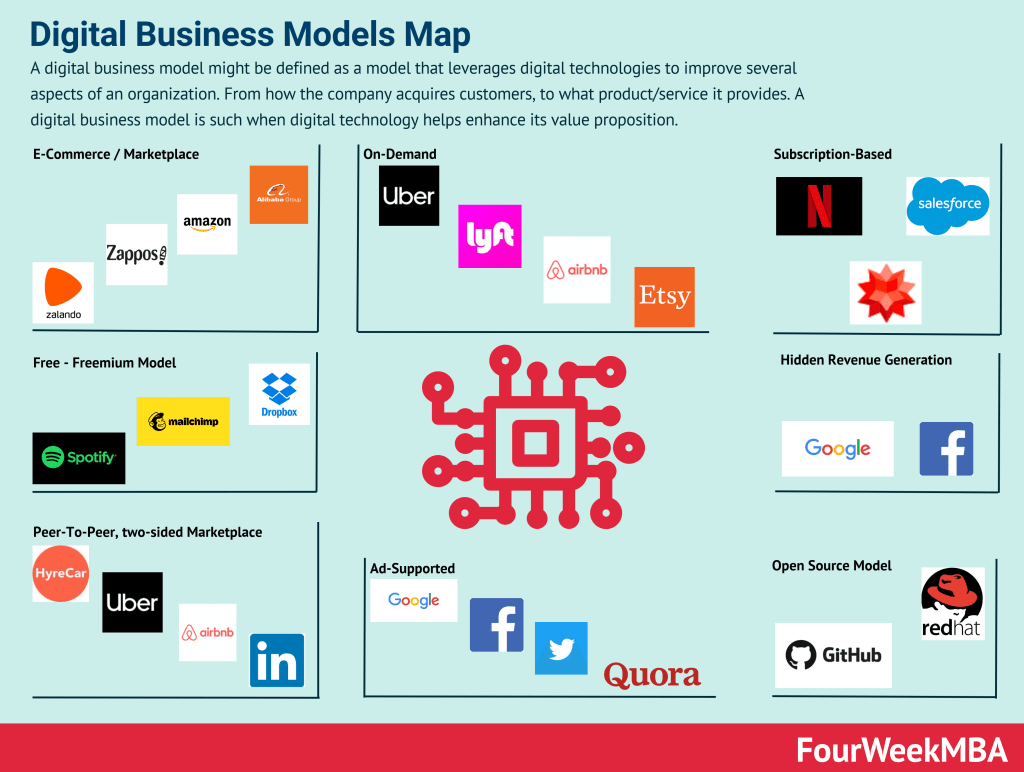
A digital business model might be defined as a model that leverages digital technologies to improve several aspects of an organization. From how the company acquires customers, to what product/service it provides. A digital business model is such when digital technology helps enhance its value proposition.
A tech business model is made of four main components: value model (value propositions, mission, vision), technological model (R&D management), distribution model (sales and marketingorganizational structure), and financial model (revenue modeling, cost structure, profitability and cash generation/management). Those elements coming together can serve as the basis to build a solid tech business model.
A platform business model generates value by enabling interactions between people, groups, and users by leveraging network effects. Platform business models usually comprise two sides: supply and demand. Kicking off the interactions between those two sides is one of the crucial elements for a platform business model success.
A Blockchain Business Model is made of four main components: Value Model (Core Philosophy, Core Value and Value Propositions for the key stakeholders), Blockchain Model (Protocol Rules, Network Shape and Applications Layer/Ecosystem), Distribution Model (the key channels amplifying the protocol and its communities), and the Economic Model (the dynamics through which protocol players make money). Those elements coming together can serve as the basis to build and analyze a solid Blockchain Business Model.
In an asymmetric businessmodel, the organization doesn’t monetize the user directly, but it leverages the data users provide coupled with technology, thus have a key customer pay to sustain the core asset. For example, Google makes money by leveraging users’ data, combined with its algorithms sold to advertisers for visibility.
In an asymmetric businessmodel, the organization doesn’t monetize the user directly, but it leverages the data users provide coupled with technology, thus having a key customer pay to sustain the core asset. For example, Google makes money by leveraging users’ data, combined with its algorithms sold to advertisers for visibility. This is how attention merchants make monetize their business models.
While the term has been coined by Andrew Lampitt, open-core is an evolution of open-source. Where a core part of the software/platform is offered for free, while on top of it are built premium features or add-ons, which get monetized by the corporation who developed the software/platform. An example of the GitLab open core model, where the hosted service is free and open, while the software is closed.
Cloud business models are all built on top of cloud computing, a concept that took over around 2006 when former Google’s CEO Eric Schmit mentioned it. Most cloud-based business models can be classified as IaaS (Infrastructure as a Service), PaaS (Platform as a Service), or SaaS (Software as a Service). While those models are primarily monetized via subscriptions, they are monetized via pay-as-you-go revenue models and hybrid models (subscriptions + pay-as-you-go).
Open source is licensed and usually developed and maintained by a community of independent developers. While the freemium is developed in-house. Thus the freemium give the company that developed it, full control over its distribution. In an open-source model, the for-profit company has to distribute its premium version per its open-source licensing model.
The freemium – unless the whole organization is aligned around it – is a growth strategy rather than a business model. A free service is provided to a majority of users, while a small percentage of those users convert into paying customers through the sales funnel. Free users will help spread the brand through word of mouth.
A freeterprise is a combination of free and enterprise where free professional accounts are driven into the funnel through the free product. As the opportunity is identified the company assigns the free account to a salesperson within the organization (inside sales or fields sales) to convert that into a B2B/enterprise account.
A marketplace is a platform where buyers and sellers interact and transact. The platform acts as a marketplace that will generate revenues in fees from one or all the parties involved in the transaction. Usually, marketplaces can be classified in several ways, like those selling services vs. products or those connecting buyers and sellers at B2B, B2C, or C2C level. And those marketplaces connecting two core players, or more.
B2B, which stands for business-to-business, is a process for selling products or services to other businesses. On the other hand, a B2C sells directly to its consumers.
A B2B2C is a particular kind of business model where a company, rather than accessing the consumer market directly, it does that via another business. Yet the final consumers will recognize the brand or the service provided by the B2B2C. The company offering the service might gain direct access to consumers over time.
Direct-to-consumer (D2C) is a business model where companies sell their products directly to the consumer without the assistance of a third-party wholesaler or retailer. In this way, the company can cut through intermediaries and increase its margins. However, to be successful the direct-to-consumers company needs to build its own distribution, which in the short term can be more expensive. Yet in the long-term creates a competitive advantage.
The C2C business model describes a market environment where one customer purchases from another on a third-party platform that may also handle the transaction. Under the C2C model, both the seller and the buyer are considered consumers. Customer to customer (C2C) is, therefore, a business model where consumers buy and sell directly between themselves. Consumer-to-consumer has become a prevalent business model especially as the web helped disintermediate various industries.
A retail business model follows a direct-to-consumer approach, also called B2C, where the company sells directly to final customers a processed/finished product. This implies a business model that is mostly local-based, it carries higher margins, but also higher costs and distribution risks.
The wholesale model is a selling model where wholesalers sell their products in bulk to a retailer at a discounted price. The retailer then on-sells the products to consumers at a higher price. In the wholesale model, a wholesaler sells products in bulk to retail outlets for onward sale. Occasionally, the wholesaler sells direct to the consumer, with supermarket giant Costco the most obvious example.
The term “crowdsourcing” was first coined by Wired Magazine editor Jeff Howe in a 2006 article titled Rise of Crowdsourcing. Though the practice has existed in some form or another for centuries, it rose to prominence when eCommerce, social media, and smartphone culture began to emerge. Crowdsourcing is the act of obtaining knowledge, goods, services, or opinions from a group of people. These people submit information via social media, smartphone apps, or dedicated crowdsourcing platforms.
In a franchained business model (a short-term chain, long-term franchise) model, the company deliberately launched its operations by keeping tight ownership on the main assets, while those are established, thus choosing a chain model. Once operations are running and established, the company divests its ownership and opts instead for a franchising model.
Businesses employing the brokerage business model make money via brokerage services. This means they are involved with the facilitation, negotiation, or arbitration of a transaction between a buyer and a seller. The brokerage business model involves a business connecting buyers with sellers to collect a commission on the resultant transaction. Therefore, acting as a middleman within a transaction.
Dropshipping is a retail business model where the dropshipper externalizes the manufacturing and logistics and focuses only on distribution and customer acquisition. Therefore, the dropshipper collects final customers’ sales orders, sending them over to third-party suppliers, who ship directly to those customers. In this way, through dropshipping, it is possible to run a business without operational costs and logistics management.
Gennaro is the creator of FourWeekMBA, which reached about four million business people, comprising C-level executives, investors, analysts, product managers, and aspiring digital entrepreneurs in 2022 alone | He is also Director of Sales for a high-tech scaleup in the AI Industry | In 2012, Gennaro earned an International MBA with emphasis on Corporate Finance and Business Strategy.