Corporate social responsibility (CSR) is a self-regulating business model that helps an organization remain socially accountable to itself, its stakeholders, and the general public. Corporate social responsibility is typically categorized into four types: environmental, ethical, philantropic, and economic.
Aspect
Explanation
Definition
Corporate Social Responsibility (CSR) is a business approach that encourages companies to consider the social, environmental, and ethical impacts of their operations and to take proactive steps to mitigate harm and promote positive contributions to society and the environment. It involves a commitment to ethical behavior, sustainability, and stakeholder engagement. CSR initiatives can encompass a wide range of activities, including philanthropy, environmental sustainability efforts, ethical labor practices, and community engagement. CSR is driven by the belief that businesses should be accountable for their impact on society beyond purely financial considerations and that they have a role to play in addressing societal challenges.
Key Concepts
– Ethical Conduct: CSR encourages businesses to uphold ethical standards in all their activities. – Sustainability: Companies should aim for sustainable practices to minimize environmental impact. – Stakeholder Engagement: Engaging with stakeholders, including employees, customers, communities, and shareholders, is essential. – Transparency: Transparency in reporting CSR efforts is crucial for accountability. – Social Impact: CSR initiatives should aim to have a positive impact on society. – Environmental Responsibility: Companies should reduce their environmental footprint and promote conservation.
Characteristics
– Ethical Practices: CSR emphasizes ethical behavior and responsible business conduct. – Sustainability Initiatives: Companies implement sustainability measures to reduce their environmental impact. – Community Engagement: Engaging with local communities through philanthropy and volunteerism is common. – Stakeholder Collaboration: Collaboration with various stakeholders helps shape CSR strategies. – Impact Reporting: Companies report on their CSR efforts and outcomes transparently. – Diversity and Inclusion: Promoting diversity and inclusion is often part of CSR initiatives.
Implications
– Positive Reputation: Effective CSR can enhance a company’s reputation and brand value. – Risk Mitigation: CSR efforts can mitigate risks associated with ethical lapses or environmental issues. – Competitive Advantage: CSR can give businesses a competitive edge by appealing to socially conscious consumers. – Employee Engagement: CSR can boost employee morale and attract top talent. – Environmental Stewardship: Companies contribute to environmental sustainability through CSR. – Regulatory Compliance: CSR can help businesses comply with evolving regulations.
Advantages
– Enhanced Reputation: CSR enhances a company’s reputation and brand image. – Customer Loyalty: Socially responsible companies often enjoy greater customer loyalty. – Employee Satisfaction: CSR initiatives improve employee morale and job satisfaction. – Competitive Edge: It provides a competitive advantage in the market. – Risk Reduction: CSR mitigates risks associated with unethical or unsustainable practices. – Positive Impact: Companies contribute positively to society and the environment.
Drawbacks
– Costs: Implementing CSR initiatives can be costly in terms of resources and investment. – Greenwashing: Some companies may engage in superficial CSR efforts for marketing purposes (greenwashing). – Complexity: Managing and reporting CSR activities can be complex and require expertise. – Measuring Impact: Measuring the direct impact of CSR initiatives can be challenging. – Consumer Skepticism: Consumers may be skeptical of CSR efforts if they perceive them as insincere. – Stakeholder Conflicts: Balancing the interests of various stakeholders can be challenging.
Applications
CSR is applied across various industries and sectors, including technology, finance, healthcare, retail, and manufacturing. Companies of all sizes, from small businesses to multinational corporations, engage in CSR efforts.
Use Cases
– Environmental Sustainability: Companies implement eco-friendly practices and reduce carbon footprints. – Philanthropy: Donations to charitable causes and community support initiatives are common. – Ethical Labor Practices: Ensuring fair labor practices, including ethical sourcing and labor rights. – Diversity and Inclusion: Promoting diversity in the workplace and creating an inclusive culture. – Transparency and Reporting: Regular reporting on CSR activities to stakeholders and the public. – Product Responsibility: Ensuring products meet ethical and safety standards. – Community Engagement: Involvement in local communities through volunteering and support.
For most of recorded history, businesses have been driven by the singular desire to turn a profit, with money-making potential impacting every action taken or initiative pursued.
However, modern businesses have started to realize that they must do more than simply maximize profits for shareholders and executives. They now have a social responsibility to act in the best interests of employees, consumers, and society as a whole.
Corporate social responsibility is a form of self-regulation where the business strives to become socially accountable. While there is no single way to implement CSR principles, employees, consumers, and other stakeholders are now more likely to choose a brand that contributes to society in some shape or form.
Corporate social responsibility is typically categorized into four types:
Environmental
One of the most common forms of CSR is environmental responsibility. Here, companies seek to become environmentally friendly by reducing their greenhouse gas emissions and increasing their reliance on renewable energy. Alternatively, some companies choose to offset their environmental impact by planting trees or funding scientific research.
Ethical
Or any practice that compels the organization to behave in a fair and ethical manner, including the equitable treatment of stakeholders, leadership, investors, suppliers, employees, and customers. Ethical responsibility may also be demonstrated by an organization paying above minimum wage or making a commitment to avoid sourcing products from child labor.
Philanthropic
Where a business aims to make a positive impact on society by donating to charities, non-profits, or a similar organization of their own making. Certified B Corporations are a new kind of business type that balances purpose with profit. These organisations are legally required to consider the impact of their decisions on stakeholders.
Economic
The foundation for environmental, ethical, and philanthropic responsibility for without profit, the business would not survive long enough to implement other initiatives.
Corporate social responsibility case studies
Who are the companies leading the way in corporate social responsibility?
Let’s take a look at three examples below:
Starbucks
Starbucks is a retail company that sells beverages (primarily consisting of coffee-related drinks) and food. In 2023, Starbucks had 44% of company-operated stores vs. 56% of licensed stores which might make you think Starbucks is a franchise business, when in reality most of its revenue (nearly 82% in 2023) came from company-operated stores, thus making Starbucks a chain business model.
On its website, Starbucks states that “It’s our commitment to do things that are good to people, each other and the planet. From the way we buy our coffee, to minimising environmental impact, to being involved in local communities.” To that end, Starbucks only purchases responsibly grown, ethically traded coffee. The company is also on a mission to donate 100 million coffee trees to suppliers by 2025 and also offers a pioneering college program for its employees.
Lego
Over the years, the Danish toy company has invested millions of dollars into addressing climate change and reducing waste. The company has an ambitious goal to go carbon neutral by 2022. It also recently launched the Lego Replay scheme, where unwanted Lego bricks are donated and redistributed to children in need.
The strategy was popularized by TOMS Shoes in 2006, with the shoe company donating a new pair of shoes to a child in a developing country for every pair of shoes sold to a consumer. The one-for-one business model is based on the idea that for every consumer purchase, an equivalent or similar product is given away to someone in need.
A shoe, eyewear, and apparel company that was founded with corporate social responsibility embedded in its mission. TOMS donates a pair of shoes to disadvantaged children from more than 50 countries with every customer purchase. The company also has a strong environmental focus, with shoes made from hemp, organic cotton, and recycled polyester. Shoe boxes are also made from 80% consumer waste and printed with soy-based ink.
Key takeaways:
Corporate social responsibility (CSR) is a business model helping an organization remain socially accountable to itself, its stakeholders, and the general public. Most consumers now expect businesses to adopt CSR principles before they make a purchase.
Corporate social responsibility is broadly divided into four different types: environmental, ethical, philanthropic, and economic. The latter is important in ensuring the business remains viable long enough to make a positive impact.
Starbucks is a company with established corporate social responsibility principles, sourcing fair-trade coffee beans and donating coffee plants to its farmers. Danish toy company Lego is reducing toy waste and donating used bricks to those in need, while shoe company TOMS matches every shoe purchase with a donation to disadvantaged children in over 50 countries.
Related Frameworks, Models, or Concepts
Description
When to Apply
Triple Bottom Line (TBL)
Triple Bottom Line (TBL) is a framework that evaluates organizational performance based on three dimensions: economic, social, and environmental. The TBL concept emphasizes the importance of considering not only financial profits (economic dimension) but also social equity (social dimension) and environmental sustainability (environmental dimension) in business decision-making. By adopting a triple bottom line approach, organizations aim to achieve long-term sustainable growth and maximize value creation for all stakeholders, including shareholders, employees, communities, and the environment.
Apply the Triple Bottom Line (TBL) framework to assess organizational performance and impact across economic, social, and environmental dimensions. Use it to measure and report on financial, social, and environmental indicators, set sustainability goals and targets, and integrate sustainability considerations into business strategies, operations, and decision-making processes. Implement the TBL framework as part of corporate governance, stakeholder engagement, and sustainability reporting to enhance transparency, accountability, and value creation for all stakeholders.
Stakeholder Theory
Stakeholder Theory is a perspective that argues that organizations have ethical and moral responsibilities not only to shareholders but also to a broader range of stakeholders, including employees, customers, suppliers, communities, and society at large. Stakeholder theory emphasizes the importance of considering the interests and needs of all stakeholders in business decision-making and value creation processes. By adopting a stakeholder-centric approach, organizations seek to build trust, foster long-term relationships, and create shared value for all stakeholders, leading to sustainable business success and societal impact.
Apply Stakeholder Theory to identify and prioritize key stakeholders and their interests and expectations. Use it to engage stakeholders in dialogue, collaboration, and decision-making processes, and incorporate stakeholder feedback into strategic planning, product development, and corporate governance. Implement Stakeholder Theory as a framework for stakeholder engagement, relationship management, and corporate social responsibility (CSR) initiatives to build trust, enhance reputation, and create shared value for all stakeholders.
ISO 26000: Guidance on Social Responsibility
ISO 26000: Guidance on Social Responsibility is an international standard developed by the International Organization for Standardization (ISO) that provides guidelines for organizations on how to integrate social responsibility into their operations and practices. ISO 26000 defines principles and core subjects of social responsibility, such as organizational governance, human rights, labor practices, environmental sustainability, fair operating practices, consumer issues, community involvement, and stakeholder engagement. By adhering to ISO 26000 principles, organizations demonstrate their commitment to ethical behavior, sustainability, and societal well-being.
Apply ISO 26000: Guidance on Social Responsibility to develop and implement social responsibility strategies and initiatives within organizations. Use it to assess organizational performance against social responsibility principles and core subjects, identify gaps and opportunities for improvement, and develop action plans to address key issues and challenges. Implement ISO 26000 as a framework for corporate social responsibility (CSR) reporting, certification, and benchmarking to demonstrate organizational commitment to social responsibility and enhance credibility and transparency with stakeholders.
Global Reporting Initiative (GRI) Standards
Global Reporting Initiative (GRI) Standards are a set of sustainability reporting guidelines developed by the Global Reporting Initiative, a leading organization in sustainability reporting. GRI Standards provide a framework for organizations to disclose their economic, environmental, and social impacts, performance, and governance practices in a standardized and transparent manner. By following GRI Standards, organizations can enhance the quality, comparability, and credibility of their sustainability reporting and demonstrate their commitment to transparency, accountability, and continuous improvement in sustainability performance.
Apply Global Reporting Initiative (GRI) Standards to develop and publish sustainability reports that disclose organizational performance and impacts across economic, environmental, and social dimensions. Use GRI Standards to identify relevant sustainability topics, define reporting indicators and metrics, collect and analyze data, and communicate sustainability achievements and challenges to stakeholders. Implement GRI Standards as a framework for sustainability reporting, disclosure, and stakeholder engagement to enhance transparency, accountability, and trust and drive continuous improvement in sustainability performance and impact.
Corporate Citizenship
Corporate Citizenship refers to the responsibilities and obligations of organizations to contribute positively to society and the environment beyond legal and regulatory requirements. Corporate citizenship encompasses a wide range of activities and initiatives, including philanthropy, volunteerism, environmental stewardship, ethical business practices, and community engagement. By embracing corporate citizenship, organizations demonstrate their commitment to ethical behavior, sustainability, and social impact, and contribute to the well-being of communities, ecosystems, and future generations.
Apply Corporate Citizenship principles to integrate social and environmental considerations into organizational strategies, operations, and decision-making processes. Use it to identify opportunities to create positive social and environmental impacts through business activities and initiatives, engage employees, customers, and other stakeholders in corporate citizenship efforts, and measure and communicate the social and environmental value created. Implement Corporate Citizenship as a framework for corporate social responsibility (CSR) programs, community partnerships, and sustainability initiatives to enhance organizational reputation, brand value, and societal impact.
Shared Value Creation
Shared Value Creation is a concept that emphasizes the potential for businesses to generate economic value while simultaneously addressing social and environmental challenges. Shared value creation involves identifying business opportunities that align with societal needs and priorities and creating innovative solutions that deliver both business benefits and social impact. By adopting a shared value approach, organizations can unlock new sources of value, drive business growth, and contribute to sustainable development and societal progress.
Apply Shared Value Creation principles to identify and pursue business opportunities that create positive social and environmental impacts while delivering economic value. Use it to integrate social and environmental considerations into business strategies, products, and services, and collaborate with stakeholders to co-create shared value solutions that address systemic challenges and meet societal needs. Implement Shared Value Creation as a framework for innovation, business development, and corporate social responsibility (CSR) to drive business growth, enhance competitiveness, and contribute to sustainable development and societal well-being.
Corporate Sustainability
Corporate Sustainability is a business approach that seeks to create long-term value for shareholders while considering and balancing economic, environmental, and social impacts. Corporate sustainability involves integrating sustainability principles into core business strategies, operations, and decision-making processes to manage risks, seize opportunities, and create value for all stakeholders. By embracing corporate sustainability, organizations aim to achieve financial success, environmental stewardship, social responsibility, and ethical leadership in a rapidly changing and interconnected world.
Apply Corporate Sustainability principles to embed sustainability into organizational culture, governance, and performance management systems. Use it to set sustainability goals and targets, measure and monitor sustainability performance, and integrate sustainability considerations into strategic planning, risk management, and stakeholder engagement processes. Implement Corporate Sustainability as a framework for sustainable business practices, responsible investments, and stakeholder collaboration to enhance organizational resilience, competitiveness, and societal impact in the face of global challenges and uncertainties.
Circular Economy
Circular Economy is an economic model that aims to decouple economic growth from resource consumption and environmental degradation by designing out waste and pollution, keeping products and materials in use, and regenerating natural systems. Circular economy principles promote resource efficiency, product durability, reuse, recycling, and renewable energy, and encourage new business models and value chains that prioritize sustainability and regeneration. By transitioning to a circular economy, organizations can reduce environmental impact, mitigate climate change, and create new opportunities for innovation, growth, and competitive advantage.
Apply Circular Economy principles to redesign products, processes, and business models to minimize waste, maximize resource efficiency, and promote circularity throughout the value chain. Use it to explore opportunities for product reuse, remanufacturing, recycling, and renewable energy adoption, and collaborate with stakeholders to accelerate the transition to a circular economy. Implement Circular Economy as a framework for sustainable business innovation, supply chain management, and corporate social responsibility (CSR) to drive environmental sustainability, economic resilience, and social progress in a resource-constrained world.
Ethical Supply Chain Management
Ethical Supply Chain Management is an approach that focuses on ensuring ethical and responsible practices throughout the supply chain, from sourcing raw materials to delivering products and services to customers. Ethical supply chain management involves addressing issues such as human rights violations, labor exploitation, environmental degradation, and corruption in supply chain operations and relationships. By promoting transparency, accountability, and integrity in supply chain practices, organizations can mitigate risks, enhance reputation, and create sustainable value for all stakeholders.
Apply Ethical Supply Chain Management principles to assess and manage ethical risks and impacts throughout the supply chain. Use it to establish ethical sourcing policies and standards, conduct due diligence on suppliers and partners, and implement monitoring and auditing mechanisms to ensure compliance with ethical standards and regulations. Implement Ethical Supply Chain Management as a framework for supply chain governance, risk management, and corporate social responsibility (CSR) to promote ethical behavior, sustainability, and responsible business practices across the supply chain and drive positive social and environmental impacts.
An effective business model has to focus on two dimensions: the people dimension and the financial dimension. The people dimension will allow you to build a product or service that is 10X better than existing ones and a solid brand. The financial dimension will help you develop proper distribution channels by identifying the people that are willing to pay for your product or service and make it financially sustainable in the long run.
Business modelinnovation is about increasing the success of an organization with existing products and technologies by crafting a compelling value proposition able to propel a new business model to scale up customers and create a lasting competitive advantage. And it all starts by mastering the key customers.
Digital and tech business models can be classified according to four levels of transformation into digitally-enabled, digitally-enhanced, tech or platform business models, and business platforms/ecosystems.
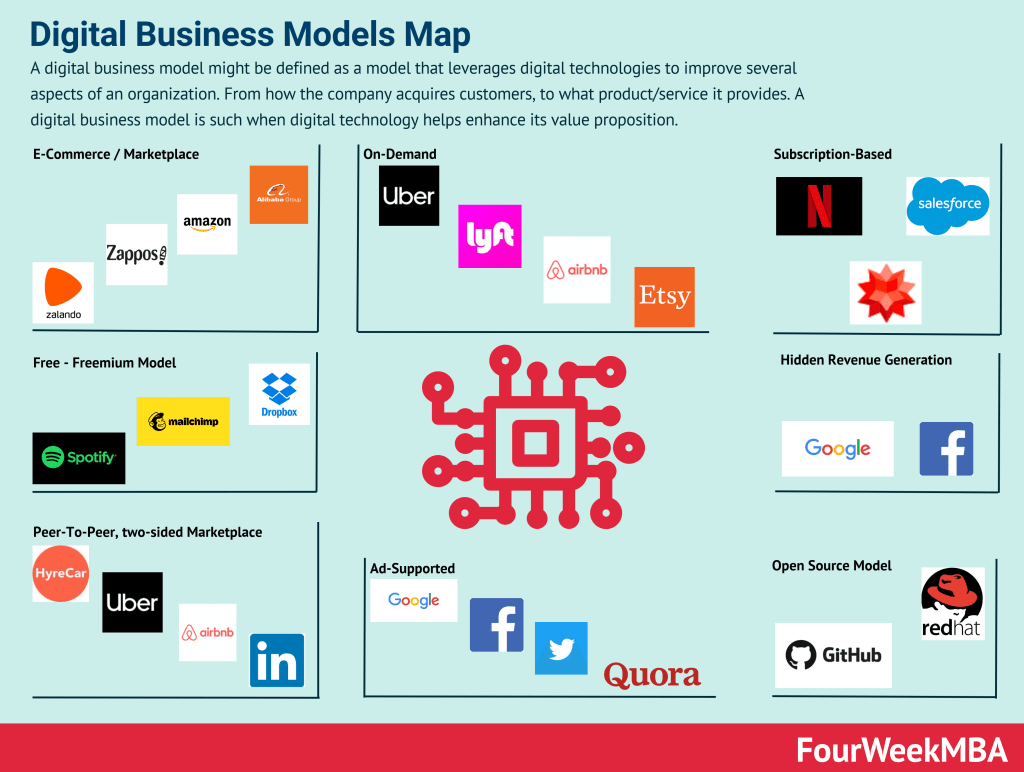
A digital business model might be defined as a model that leverages digital technologies to improve several aspects of an organization. From how the company acquires customers, to what product/service it provides. A digital business model is such when digital technology helps enhance its value proposition.
A tech business model is made of four main components: value model (value propositions, mission, vision), technological model (R&D management), distribution model (sales and marketingorganizational structure), and financial model (revenue modeling, cost structure, profitability and cash generation/management). Those elements coming together can serve as the basis to build a solid tech business model.
A platform business model generates value by enabling interactions between people, groups, and users by leveraging network effects. Platform business models usually comprise two sides: supply and demand. Kicking off the interactions between those two sides is one of the crucial elements for a platform business model success.
A Blockchain Business Model is made of four main components: Value Model (Core Philosophy, Core Value and Value Propositions for the key stakeholders), Blockchain Model (Protocol Rules, Network Shape and Applications Layer/Ecosystem), Distribution Model (the key channels amplifying the protocol and its communities), and the Economic Model (the dynamics through which protocol players make money). Those elements coming together can serve as the basis to build and analyze a solid Blockchain Business Model.
In an asymmetric businessmodel, the organization doesn’t monetize the user directly, but it leverages the data users provide coupled with technology, thus have a key customer pay to sustain the core asset. For example, Google makes money by leveraging users’ data, combined with its algorithms sold to advertisers for visibility.
In an asymmetric businessmodel, the organization doesn’t monetize the user directly, but it leverages the data users provide coupled with technology, thus having a key customer pay to sustain the core asset. For example, Google makes money by leveraging users’ data, combined with its algorithms sold to advertisers for visibility. This is how attention merchants make monetize their business models.
While the term has been coined by Andrew Lampitt, open-core is an evolution of open-source. Where a core part of the software/platform is offered for free, while on top of it are built premium features or add-ons, which get monetized by the corporation who developed the software/platform. An example of the GitLab open core model, where the hosted service is free and open, while the software is closed.
Cloud business models are all built on top of cloud computing, a concept that took over around 2006 when former Google’s CEO Eric Schmit mentioned it. Most cloud-based business models can be classified as IaaS (Infrastructure as a Service), PaaS (Platform as a Service), or SaaS (Software as a Service). While those models are primarily monetized via subscriptions, they are monetized via pay-as-you-go revenue models and hybrid models (subscriptions + pay-as-you-go).
Open source is licensed and usually developed and maintained by a community of independent developers. While the freemium is developed in-house. Thus the freemium give the company that developed it, full control over its distribution. In an open-source model, the for-profit company has to distribute its premium version per its open-source licensing model.
The freemium – unless the whole organization is aligned around it – is a growth strategy rather than a business model. A free service is provided to a majority of users, while a small percentage of those users convert into paying customers through the sales funnel. Free users will help spread the brand through word of mouth.
A freeterprise is a combination of free and enterprise where free professional accounts are driven into the funnel through the free product. As the opportunity is identified the company assigns the free account to a salesperson within the organization (inside sales or fields sales) to convert that into a B2B/enterprise account.
A marketplace is a platform where buyers and sellers interact and transact. The platform acts as a marketplace that will generate revenues in fees from one or all the parties involved in the transaction. Usually, marketplaces can be classified in several ways, like those selling services vs. products or those connecting buyers and sellers at B2B, B2C, or C2C level. And those marketplaces connecting two core players, or more.
B2B, which stands for business-to-business, is a process for selling products or services to other businesses. On the other hand, a B2C sells directly to its consumers.
A B2B2C is a particular kind of business model where a company, rather than accessing the consumer market directly, it does that via another business. Yet the final consumers will recognize the brand or the service provided by the B2B2C. The company offering the service might gain direct access to consumers over time.
Direct-to-consumer (D2C) is a business model where companies sell their products directly to the consumer without the assistance of a third-party wholesaler or retailer. In this way, the company can cut through intermediaries and increase its margins. However, to be successful the direct-to-consumers company needs to build its own distribution, which in the short term can be more expensive. Yet in the long-term creates a competitive advantage.
The C2C business model describes a market environment where one customer purchases from another on a third-party platform that may also handle the transaction. Under the C2C model, both the seller and the buyer are considered consumers. Customer to customer (C2C) is, therefore, a business model where consumers buy and sell directly between themselves. Consumer-to-consumer has become a prevalent business model especially as the web helped disintermediate various industries.
A retail business model follows a direct-to-consumer approach, also called B2C, where the company sells directly to final customers a processed/finished product. This implies a business model that is mostly local-based, it carries higher margins, but also higher costs and distribution risks.
The wholesale model is a selling model where wholesalers sell their products in bulk to a retailer at a discounted price. The retailer then on-sells the products to consumers at a higher price. In the wholesale model, a wholesaler sells products in bulk to retail outlets for onward sale. Occasionally, the wholesaler sells direct to the consumer, with supermarket giant Costco the most obvious example.
The term “crowdsourcing” was first coined by Wired Magazine editor Jeff Howe in a 2006 article titled Rise of Crowdsourcing. Though the practice has existed in some form or another for centuries, it rose to prominence when eCommerce, social media, and smartphone culture began to emerge. Crowdsourcing is the act of obtaining knowledge, goods, services, or opinions from a group of people. These people submit information via social media, smartphone apps, or dedicated crowdsourcing platforms.
In a franchained business model (a short-term chain, long-term franchise) model, the company deliberately launched its operations by keeping tight ownership on the main assets, while those are established, thus choosing a chain model. Once operations are running and established, the company divests its ownership and opts instead for a franchising model.
Businesses employing the brokerage business model make money via brokerage services. This means they are involved with the facilitation, negotiation, or arbitration of a transaction between a buyer and a seller. The brokerage business model involves a business connecting buyers with sellers to collect a commission on the resultant transaction. Therefore, acting as a middleman within a transaction.
Dropshipping is a retail business model where the dropshipper externalizes the manufacturing and logistics and focuses only on distribution and customer acquisition. Therefore, the dropshipper collects final customers’ sales orders, sending them over to third-party suppliers, who ship directly to those customers. In this way, through dropshipping, it is possible to run a business without operational costs and logistics management.
Gennaro is the creator of FourWeekMBA, which reached about four million business people, comprising C-level executives, investors, analysts, product managers, and aspiring digital entrepreneurs in 2022 alone | He is also Director of Sales for a high-tech scaleup in the AI Industry | In 2012, Gennaro earned an International MBA with emphasis on Corporate Finance and Business Strategy.