The Coca-Cola Company is one of the world’s leading non-alcoholic beverage companies.
It operates in virtually all of the world’s countries, offering more than 500 brands across bottled water, soft drinks, energy drinks, tea, and fruit juice.
The vast global reach of Coca-Cola means it is not immune to external marketplace factors. Indeed, company revenue has been in steady decline since 2013.
Understanding the Coca-Cola PESTLE analysis
Political
Cuba and North Korea are the only countries where Coca-Cola products cannot be bought or sold illegally. Both countries are currently subject to sustained United States trade embargoes.
The company is not immune to challenges in the rest of the world either. Steel and aluminum tariffs imposed by Mexico, Canada, and the European Union have increased raw material costs.
Coca-Cola is also vulnerable to sugar taxes imposed by bodies such as the Food and Drug Administration (FDA).
Economic
Sourcing adequate water is a major problem for the Coca-Cola company. In many parts of the world, water scarcity is affecting manufacturing operations. Higher costs also impact the company’s bottom line.
Currency fluctuations are also an economic factor. Hyper-inflation in countries such as Venezuela has eroded profits for the company.
Social
Consumer preference for soft drinks has been on the wane for several years or even decades in some cases. In response, Coca-Cola has taken steps to appeal to more health-conscious customers with low sugar beverages and marketing campaigns designed to change public brand perception.
The company also faces social pressure in many Middle Eastern countries where anti-American sentiment is high.
Technological
Social media advertising has been a boon for Coca-Cola as it attempts to engage with the next generation of adult consumers. Many products also have QR codes that consumers can scan to unlock experiences and prizes.
Furthermore, the company is using artificial intelligence and big data to analyze market trends and optimize its global supply chain.
Legal
Coca-Cola is no stranger to litigation. And in the future legal claims might affect the company’s financial viability.
Environmental
Coca-Cola has been touted as the biggest consumer of fresh water in the world. In India, underground aquifers have been depleted to the detriment of the local population.
The company is taking steps to use water more efficiently. In Africa, smart agricultural programs like CARE and RAIN teach farmers to increase yields sustainably.
In the face of climate change however, Coca-Cola faces an uncertain feature given their products are predominantly water.
Key takeaways
Coca-Cola is one of the world’s leading non-alcoholic beverage companies with over 500 brands for sale in all but two countries. However, its vast global reach poses many challenges.
Access to raw materials is perhaps the most significant challenge. Metals have seen tariff increases in many countries and access to water is a continual point of contention.
Despite many consumers becoming more health-conscious, the company has been able to engage with the next generation using social media to offer lower-calorie beverages.
Coca-Cola follows a business strategy (implemented since 2006) where through its operating arm – the Bottling Investment Group – it invests initially in bottling partners operations. As they take off, Coca-Cola divests its equity stakes, and it establishes a franchising model, as long-term growth and distributionstrategy.
Coca-Cola’s top investors include Warren Buffet’s company, Berkshire Hathaway, with 9.25% of shares, and other mutual funds like The Vanguard Group, holding 8.51% of shares, and BlackRock owning over 7.19% of shares of the company. Other individual investors like Herbert A. Allen, director of The Coca-Cola Company since 1982, and Barry Diller, Chairman of the Coca-Cola board since 2002. And former CEO Muhtar Kent.
Coca-Cola generated $45.75 billion in revenue in 2023, compared to over $43 billion in revenue in 2022, and $10.7 billion in profits in 2023, compared to over $9.5 billion in net profits in 2022.
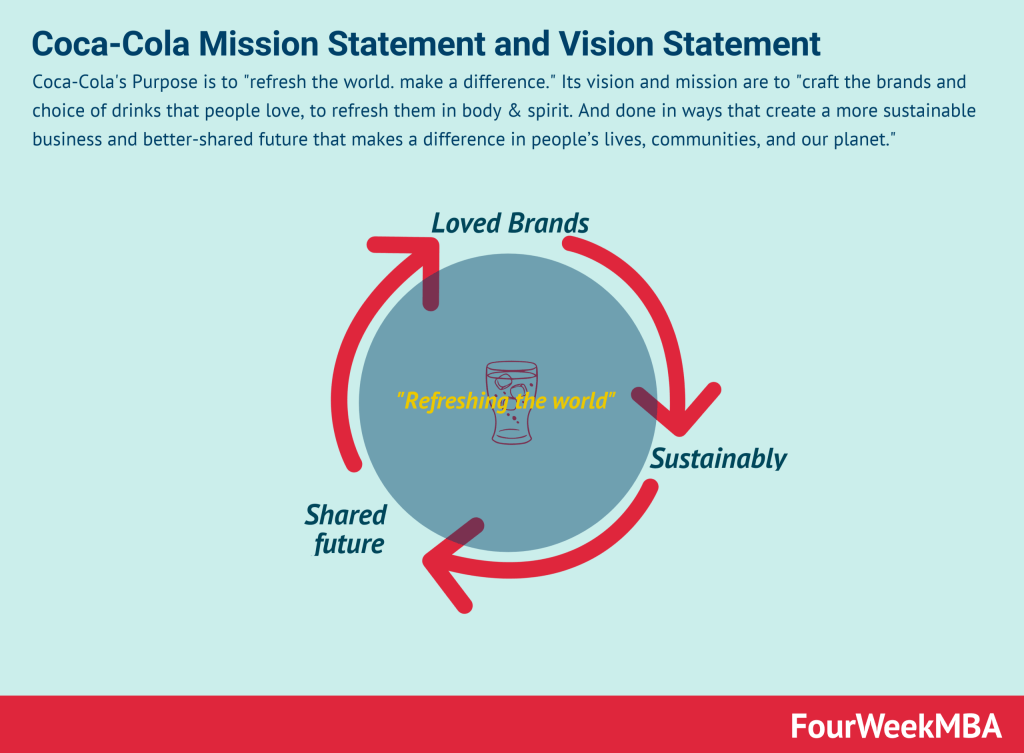
Coca-Cola’s Purpose is to “refresh the world. make a difference.” Its vision and mission are to “craft the brands and choice of drinks that people love, to refresh them in body & spirit. And done in ways that create a more sustainable business and better-shared future that makes a difference in people’s lives, communities, and our planet.”
Coca-Cola is the market leader of the soft drink industry. It is also the most widely recognized brand, with a Business Insider study revealing that a staggering 94% of the world population recognizes the red and white logo. However, Coca-Cola faces significant challenges with increasingly health-conscious consumers and less access to water resources.
The Coca-Cola Company is an American multinational beverage corporation founded in 1892 by pharmacist Asa Griggs Candler. Many consumers associate the company with its signature soda in a red can or bottle. In truth, however, The Coca-Cola Company owns a plethora of soft drink, juice, tea, coffee, and other beverage brands.
The Coca-Cola Company has 21 different billion-dollar brands or brands that generate more than $1 billion or more in revenue each year. The company also sells its products in nearly every country in the world, with Cuba and North Korea the only two countries where it is not sold officially. What’s more, the Coca-Cola brand is worth $87.6 billion, making it one of the most valuable among all companies. Though these figures allow Coca-Cola to enjoy market dominance in many countries, the company is nevertheless subject to intense competition.
Pepsi is owned by PepsiCo, the holding company which owns many brands spanning from drinks to food & snacks and more. PepsiCo generated $91.47 billion in revenue in 2023, and $9.07 billion in profits for the same period. PepsiCo is primarily owned by institutional investors like The Vanguard Group (8.9%) and BlackRock (7.6%). Top individual investors comprise Robert Pohlad, the company’s board member; and the company’s CEO, Ramon Laguarta.
PepsiCo was founded in 1902 by American pharmacist and businessman Caleb Bradham as the Pepsi-Cola Company. Bradham, who hoped to emulate the success of Coca-Cola, marketed the beverage from his pharmacy and registered a patent for its recipe the following year. Today, Pepsi is a global company with a portfolio of 23 billion-dollar brands, or brands earning more than $1 billion in annual revenue. Sixteen of these brands are beverage-related, while the remaining seven are associated with snacks and other food products.
In 1965, PepsiCo acquired Frito-Lay in what the chairmen of both companies called a “marriage made in heaven”. The resultant company transformed PepsiCo from a soft drink organization and set it on a path to becoming one of the world’s leading food and beverage companies. Today, PepsiCo claims to operate in more than 200 countries and territories around the world with seven distinct divisions and many successful brands.
PepsiCo generated $91.47 billion in revenue in 2023, over $86 billion in revenue in 2022, over $79 billion in revenue in 2021, and over $70 billion in 2020.
PepsiCo generated $9.07 billion in profits in 2023, compared to nearly $9 billion in profits in 2022, over $7.6 billion in profits in 2021 and over $7 billion in 2020.
Airbnb follows a holacracy model, or a sort of flat organizational structure, where teams are organized for projects, to move quickly and iterate fast, thus keeping a lean and flexible approach. Airbnb also moved to a hybrid model where employees can work from anywhere and meet on a quarterly basis to plan ahead, and connect to each other.
eBay was until recently a multi-divisional (M-form) organization with semi-autonomous units grouped according to the services they provided. Today, eBay has a single division called Marketplace, which includes eBay and its international iterations.
IBM has an organizational structure characterized by product-based divisions, enabling its strategy to develop innovative and competitive products in multiple markets. IBM is also characterized by function-based segments that support product development and innovation for each product-based division, which include Global Markets, Integrated Supply Chain, Research, Development, and Intellectual Property.
Sony has a matrix organizational structure primarily based on function-based groups and product/business divisions. The structure also incorporates geographical divisions. In 2021, Sony announced the overhauling of its organizational structure, changing its name from Sony Corporation to Sony Group Corporation to better identify itself as the headquarters of the Sony group of companies skewing the company toward product divisions.
Facebook is characterized by a multi-faceted matrix organizational structure. The company utilizes a flat organizational structure in combination with corporate function-based teams and product-based or geographic divisions. The flat organization structure is organized around the leadership of Mark Zuckerberg, and the key executives around him. On the other hand, the function-based teams based on the main corporate functions (like HR, product management, investor relations, and so on).
Google (Alphabet) has a cross-functional (team-based) organizational structure known as a matrix structure with some degree of flatness. Over the years, as the company scaled and it became a tech giant, its organizational structure is morphing more into a centralized organization.
Tesla is characterized by a functional organizational structure with aspects of a hierarchical structure. Tesla does employ functional centers that cover all business activities, including finance, sales, marketing, technology, engineering, design, and the offices of the CEO and chairperson. Tesla’s headquarters in Austin, Texas, decide the strategic direction of the company, with international operations given little autonomy.
McDonald’s has a divisional organizational structure where each division – based on geographical location – is assigned operational responsibilities and strategic objectives. The main geographical divisions are the US, internationally operated markets, and international developmental licensed markets. And on the other hand, the hierarchical leadership structure is organized around regional and functional divisions.
Walmart has a hybrid hierarchical-functional organizational structure, otherwise referred to as a matrix structure that combines multiple approaches. On the one hand, Walmart follows a hierarchical structure, where the current CEO Doug McMillon is the only employee without a direct superior, and directives are sent from top-level management. On the other hand, the function-based structure of Walmart is used to categorize employees according to their particular skills and experience.
Microsoft has a product-type divisional organizational structure based on functions and engineering groups. As the company scaled over time it also became more hierarchical, however still keeping its hybrid approach between functions, engineering groups, and management.
Gennaro is the creator of FourWeekMBA, which reached about four million business people, comprising C-level executives, investors, analysts, product managers, and aspiring digital entrepreneurs in 2022 alone | He is also Director of Sales for a high-tech scaleup in the AI Industry | In 2012, Gennaro earned an International MBA with emphasis on Corporate Finance and Business Strategy.