PepsiCo delivered strong financial performance in 2023 with nearly double-digit revenue growth driven by pricing actions and resilient demand across snacks and beverages. The company's diversified portfolio showed particular strength in Frito-Lay and international markets, while margins expanded significantly despite inflationary pressures.
PepsiCo revenue refers to the total annual income generated by PepsiCo Inc. from its global operations including beverages, snacks, and food products. The company reported $86 billion in net revenue for 2023, with projections reaching $91.5 billion by 2026 driven by strong snack division growth.
While most people might recognize PepsiCo for its homonymous drink, in reality, the company follows a multi-brand strategy, as the company owns a plethora of brands, from food to drinks and much much more.
PepsiCo was founded in 1902 by American pharmacist and businessman Caleb Bradham as the Pepsi-Cola Company. Bradham, who hoped to emulate the success of Coca-Cola, marketed the beverage from his pharmacy and registered a patent for its recipe the following year. Today, Pepsi is a global company with a portfolio of 23 billion-dollar brands, or brands earning more than $1 billion in annual revenue. Sixteen of these brands are beverage-related, while the remaining seven are associated with snacks and other food products.
For that reason, the company’s competitors span from drinks like Pepsi (Coca-Cola) to various snacks and food brands (like Kellog’s).
In 1965, PepsiCo acquired Frito-Lay in what the chairmen of both companies called a “marriage made in heaven”. The resultant company transformed PepsiCo from a soft drink organization and set it on a path to becoming one of the world’s leading food and beverage companies. Today, PepsiCo claims to operate in more than 200 countries and territories around the world, with seven distinct divisions and many successful brands.
For some context, Coca-Cola, one of the direct competitors, generated nearly $80 billion in revenue, whereas PepsiCo generated nearly $39 billion in revenue in 2021.
Coca-Cola generated $45.75 in revenue, compared to PepsiCo’s $91.47 billion in 2023.
Coca-Cola follows a business strategy (implemented since 2006) where through its operating arm – the Bottling Investment Group – it invests initially in bottling partners operations. As they take off, Coca-Cola divests its equity stakes, and it establishes a franchising model, as long-term growth and distributionstrategy.
Coca-Cola’s top investors include Warren Buffet’s company, Berkshire Hathaway, with 9.25% of shares, and other mutual funds like The Vanguard Group, holding 8.51% of shares, and BlackRock owning over 7.19% of shares of the company. Other individual investors like Herbert A. Allen, director of The Coca-Cola Company since 1982, and Barry Diller, Chairman of the Coca-Cola board since 2002. And former CEO Muhtar Kent.
Coca-Cola generated $45.75 billion in revenue in 2023, compared to over $43 billion in revenue in 2022, and $10.7 billion in profits in 2023, compared to over $9.5 billion in net profits in 2022.
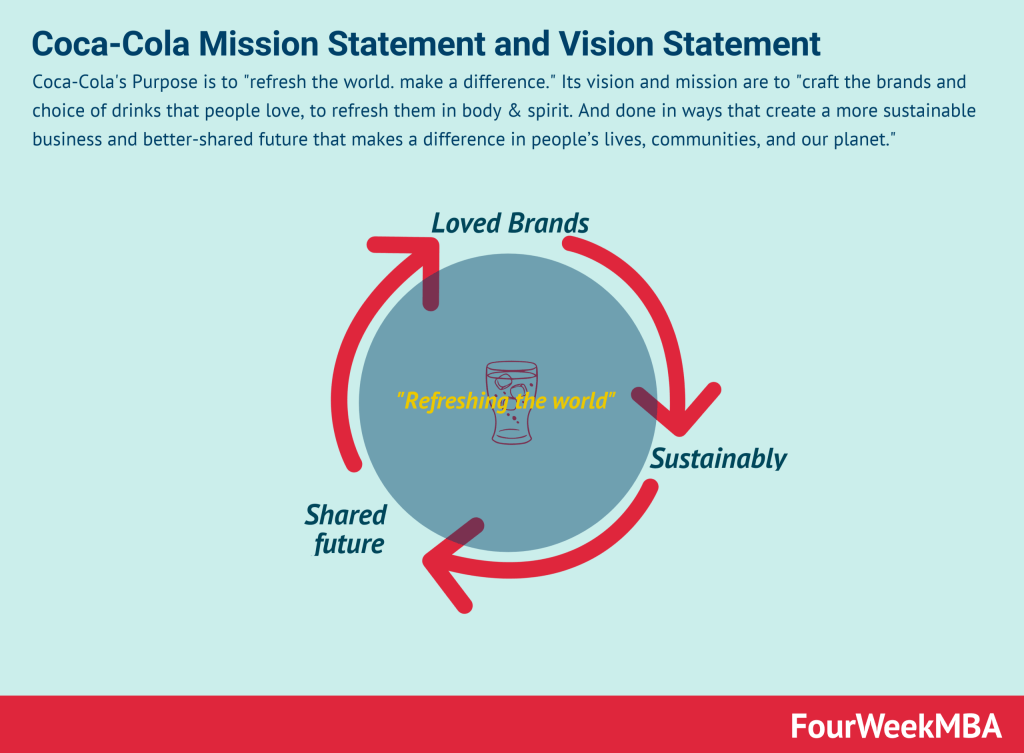
Coca-Cola’s Purpose is to “refresh the world. make a difference.” Its vision and mission are to “craft the brands and choice of drinks that people love, to refresh them in body & spirit. And done in ways that create a more sustainable business and better-shared future that makes a difference in people’s lives, communities, and our planet.”
Coca-Cola is the market leader of the soft drink industry. It is also the most widely recognized brand, with a Business Insider study revealing that a staggering 94% of the world population recognizes the red and white logo. However, Coca-Cola faces significant challenges with increasingly health-conscious consumers and less access to water resources.
The Coca-Cola Company is an American multinational beverage corporation founded in 1892 by pharmacist Asa Griggs Candler. Many consumers associate the company with its signature soda in a red can or bottle. In truth, however, The Coca-Cola Company owns a plethora of soft drink, juice, tea, coffee, and other beverage brands.
The Coca-Cola Company has 21 different billion-dollar brands or brands that generate more than $1 billion or more in revenue each year. The company also sells its products in nearly every country in the world, with Cuba and North Korea the only two countries where it is not sold officially. What’s more, the Coca-Cola brand is worth $87.6 billion, making it one of the most valuable among all companies. Though these figures allow Coca-Cola to enjoy market dominance in many countries, the company is nevertheless subject to intense competition.
Pepsi is owned by PepsiCo, the holding company which owns many brands spanning from drinks to food & snacks and more. PepsiCo generated $91.47 billion in revenue in 2023, and $9.07 billion in profits for the same period. PepsiCo is primarily owned by institutional investors like The Vanguard Group (8.9%) and BlackRock (7.6%). Top individual investors comprise Robert Pohlad, the company’s board member; and the company’s CEO, Ramon Laguarta.
PepsiCo's annual revenue was $86 billion in 2023, making it one of the world's largest food and beverage companies. The company is projected to reach $91.5 billion in revenue by 2026.
Q. How much money does Pepsi make from snacks?
PepsiCo's Frito-Lay North America division generates approximately $23-25 billion annually, representing about 28% of total company revenue. This snack segment shows consistent growth year-over-year with strong profit margins.
PepsiCo's revenue growth is primarily driven by its snack foods division, international expansion, premium product innovations, and strategic acquisitions. The company focuses on convenient foods and beverages across global markets.
PepsiCo was founded in 1902 by American pharmacist and businessman Caleb Bradham as the Pepsi-Cola Company. Bradham, who hoped to emulate the success of Coca-Cola, marketed the beverage from his pharmacy and registered a patent for its recipe the following year. Today, Pepsi is a global company with a portfolio of 23 billion-dollar brands, or brands earning more than $1 billion in annual revenue. Sixteen of these brands are beverage-related, while the remaining seven are associated with snacks and other food products.
In 1965, PepsiCo acquired Frito-Lay in what the chairmen of both companies called a “marriage made in heaven”. The resultant company transformed PepsiCo from a soft drink organization and set it on a path to becoming one of the world’s leading food and beverage companies. Today, PepsiCo claims to operate in more than 200 countries and territories around the world with seven distinct divisions and many successful brands.
PepsiCo generated $91.47 billion in revenue in 2023, over $86 billion in revenue in 2022, over $79 billion in revenue in 2021, and over $70 billion in 2020.
PepsiCo generated $9.07 billion in profits in 2023, compared to nearly $9 billion in profits in 2022, over $7.6 billion in profits in 2021 and over $7 billion in 2020.
PepsiCo has leveraged artificial intelligence to significantly boost revenue through its precision marketing and demand forecasting initiatives. A concrete example is the company’s AI-powered “Smart Inventory” system, which uses machine learning algorithms to analyze real-time sales data, weather patterns, local events, and consumer behavior to optimize product placement and inventory levels across retail locations. This system helped PepsiCo reduce out-of-stock situations by 15% while decreasing excess inventory by 20%, directly translating to increased sales and reduced waste costs. In one notable implementation across convenience stores in major U.S. cities, the AI system predicted increased demand for Gatorade during heat waves 48-72 hours in advance, enabling strategic restocking that resulted in a 12% revenue increase for sports drinks during peak summer months. This predictive capability has become a key driver of PepsiCo’s consistent revenue growth.
Gennaro is the creator of FourWeekMBA, which reached about four million business people, comprising C-level executives, investors, analysts, product managers, and aspiring digital entrepreneurs in 2022 alone | He is also Director of Sales for a high-tech scaleup in the AI Industry | In 2012, Gennaro earned an International MBA with emphasis on Corporate Finance and Business Strategy.
Scroll to Top
Discover more from FourWeekMBA
Subscribe now to keep reading and get access to the full archive.