Correction (11 Oct 2026): an earlier section on this page, “Coca-Cola Competitors in the AI Era”, made unsourced claims and predictions; it has been removed.
The Coca-Cola Company has 21 different billion-dollar brands or brands that generate more than $1 billion or more in revenue each year. The company also sells its products in nearly every country in the world, with Cuba and North Korea the only two countries where it is not sold officially. What’s more, the Coca-Cola brand is worth $87.6 billion, making it one of the most valuable among all companies. Though these figures allow Coca-Cola to enjoy market dominance in many countries, the company is nevertheless subject to intense competition.
Coca-Cola competitors refers to beverage companies that directly compete with The Coca-Cola Company in the global soft drink market. The top 7 competitors include PepsiCo, Dr Pepper Snapple Group, Monster Beverage, Red Bull, Nestlé, Danone, and Keurig Dr Pepper, with PepsiCo being Coca-Cola's primary rival.
VISUAL FRAMEWORK
Explore This Framework Interactively
Access 110+ visual strategy frameworks, competitive maps, and AI-era business model analyses.
Based on net revenue, profit, and market capitalization, PepsiCo is the second-largest food and beverage business globally behind Nestlé. Indeed, PepsiCo’s diversified portfolio enables it to earn more revenue in North America than Coca-Cola despite not selling as many beverages.
Coca-Cola and Pepsi compete in several categories, including soda beverages, health and energy drinks, bottled water, and juices. The rivalry between these two companies has been labeled the Cola Wars, characterized by mutually targeted marketing campaigns and several public and protracted legal battles.
Red Bull
Red Bull is an energy drink manufactured by Red Bull GmbH, an Austrian company founded in 1987 by Dietrich Mateschitz and Chaleo Yoovidhya.
Despite a somewhat limited product portfolio, Red Bull has a significant following in North America, Europe, Australia, and parts of Asia.
This following is the result of targeted marketing campaigns aimed at young men where the drink is associated with extreme sports such as mountain biking, parkour, Formula 1 racing, NASCAR racing, freestyle motocross, and air racing.
Keurig Dr Pepper is an American conglomerate selling beverages such as coffee, hot cocoa, tea, water, fruit juice, and mixers.
While the company does not enjoy the global reach of Coca-Cola, it does have a diverse product range allowing it to cater to a large audience in the North American market. Some of the most popular products under the Keurig Dr Pepper umbrella include RC Cola, Schweppes, 7 Up, Snapple — as explored in the interface layer wars reshaping consumer tech — , and of course Dr Pepper itself.
Nestlé
Nestlé is a Swiss multinational food and drink conglomerate headquartered in Switzerland.
Though the company does not compete with Coca-Cola in the soft drink market, Nestlé owns several popular bottled water brands, including Vittel, Perrier, S. Pellegrino, and Acqua Panna. It also owns Nespresso pre-packaged coffee and Nescafé instant coffee and has partnered with Starbucks to offer Starbucks Coffee at Home.
Furthermore, the Swiss giant owns a range of tea and other beverage brands including Nestea, Milo, Sweet Leaf Tea, and Peace Iced Tea.
Key takeaways:
The Coca-Cola Company is one of the most recognizable and valuable brands in the world, operating in all but two of the world’s countries. PepsiCo is arguably the company’s largest competitor because of its comparable global reach and a more diversified product portfolio.
In the energy drink market, Red Bull enjoys a large following with its clever and targeted marketing campaigns. Intense competition in North American resulted in Coca-Cola announcing plans to stop selling its energy drinks there.
Nestle is also a Coca-Cola competitor. While it does not sell soft drinks, Nestlé is a vast and successful company with a sizeable collection of successful beverage brands.
Key Competitors of The Coca-Cola Company:
PepsiCo:
Competitor with a diversified portfolio of brands, including soda, snacks, and beverages.
Has 23 brands with over $1 billion in sales, more than Coca-Cola’s 21 billion-dollar brands.
Second-largest food and beverage business globally behind Nestlé.
Engages in the Cola Wars rivalry with Coca-Cola.
Red Bull:
Known for its energy drink products, marketed with extreme sports associations.
Has a significant following in North America, Europe, Australia, and parts of Asia.
Coca-Cola announced plans to stop selling its energy drinks in the United States and Canada by the end of 2021.
Keurig Dr Pepper:
Offers a diverse range of beverages, including coffee, hot cocoa, tea, water, and mixers.
Focuses on the North American market with popular products like RC Cola, Schweppes, 7 Up, Snapple, and Dr Pepper.
Nestlé:
Swiss multinational food and drink conglomerate.
Competitor with a broad range of products, including bottled water (Vittel, Perrier, S. Pellegrino), coffee (Nespresso, Nescafé), tea (Nestea), and more.
Largest food company in the world by revenue, significant competitive threat to Coca-Cola.
PepsiCo is leveraging artificial intelligence to revolutionize its operations and directly compete with Coca-Cola’s market dominance. The company has implemented AI-powered demand forecasting systems that analyze real-time data from social media, weather patterns, and local events to predict beverage consumption with remarkable accuracy. For example, PepsiCo’s AI algorithms can detect when a major sporting event or heat wave is approaching a specific region and automatically adjust production and distribution schedules to ensure optimal inventory levels. This technology helped PepsiCo reduce waste by 15% while improving product availability during peak demand periods. Additionally, the company uses machine learning to personalize marketing campaigns, creating targeted advertisements that adapt to individual consumer preferences across digital platforms. By harnessing AI for supply chain optimization and customer engagement, PepsiCo has strengthened its competitive position against Coca-Cola, demonstrating how artificial intelligence is reshaping the beverage industry landscape.
Coca-Cola follows a business strategy (implemented since 2006) where through its operating arm – the Bottling Investment Group – it invests initially in bottling partners operations. As they take off, Coca-Cola divests its equity stakes, and it establishes a franchising model, as long-term growth and distributionstrategy.
Coca-Cola’s top investors include Warren Buffet’s company, Berkshire Hathaway, with 9.25% of shares, and other mutual funds like The Vanguard Group, holding 8.51% of shares, and BlackRock owning over 7.19% of shares of the company. Other individual investors like Herbert A. Allen, director of The Coca-Cola Company since 1982, and Barry Diller, Chairman of the Coca-Cola board since 2002. And former CEO Muhtar Kent.
Coca-Cola generated $45.75 billion in revenue in 2023, compared to over $43 billion in revenue in 2022, and $10.7 billion in profits in 2023, compared to over $9.5 billion in net profits in 2022.
PepsiCo is Coca-Cola's biggest competitor, holding approximately 8.8% of the global beverage market compared to Coca-Cola's 20.6% market share. The rivalry between these two companies is known as the "Cola Wars."
Q. What are Coca-Cola's main competitive advantages?
Coca-Cola's competitive advantages include its global brand recognition, extensive distributionnetwork in over 200 countries, diverse product portfolio, strong marketing capabilities, and established relationships with retailers and suppliers worldwide.
Q. How does Coca-Cola compete with other beverage brands?
Coca-Cola competes through continuous productinnovation, strategic acquisitions, premium marketing campaigns, competitive pricing strategies, and expanding into health-conscious beverage categories like water, tea, and low-sugar options.
Coca-Cola generated $578,432 revenue per employee in 2023, compared to $521,261 in 2022, and $489,304 in 2021.
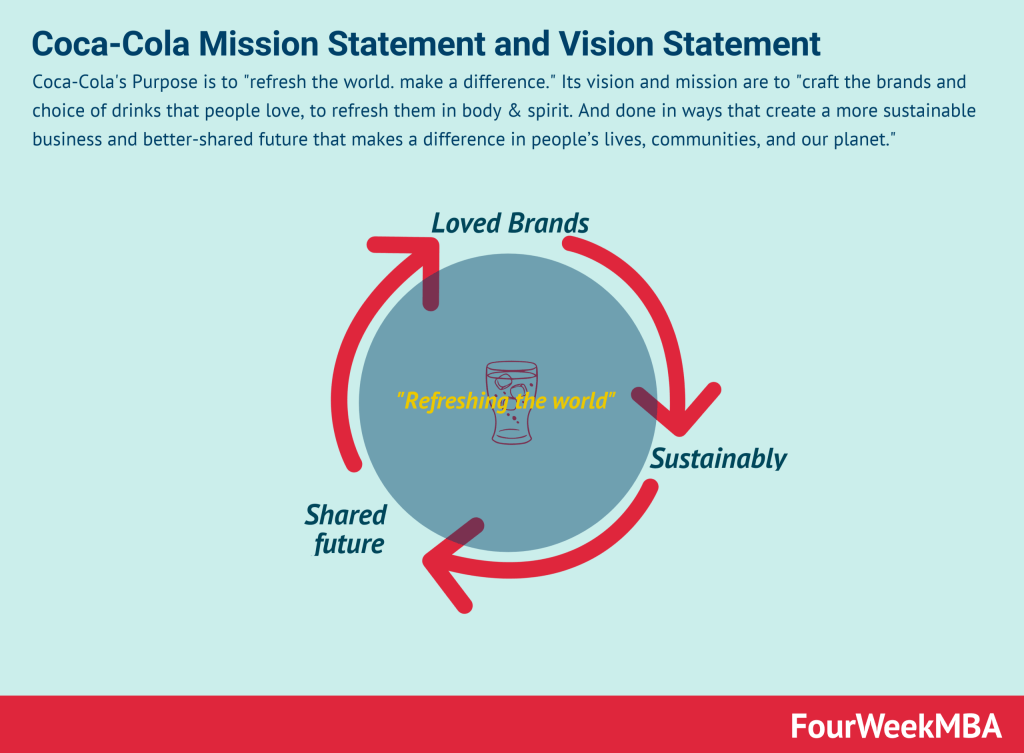
Coca-Cola’s Purpose is to “refresh the world. make a difference.” Its vision and mission are to “craft the brands and choice of drinks that people love, to refresh them in body & spirit. And done in ways that create a more sustainable business and better-shared future that makes a difference in people’s lives, communities, and our planet.”
Coca-Cola is the market leader of the soft drink industry. It is also the most widely recognized brand, with a Business Insider study revealing that a staggering 94% of the world population recognizes the red and white logo. However, Coca-Cola faces significant challenges with increasingly health-conscious consumers and less access to water resources.
The Coca-Cola Company is an American multinational beverage corporation founded in 1892 by pharmacist Asa Griggs Candler. Many consumers associate the company with its signature soda in a red can or bottle. In truth, however, The Coca-Cola Company owns a plethora of soft drink, juice, tea, coffee, and other beverage brands.
The Coca-Cola Company has 21 different billion-dollar brands or brands that generate more than $1 billion or more in revenue each year. The company also sells its products in nearly every country in the world, with Cuba and North Korea the only two countries where it is not sold officially. What’s more, the Coca-Cola brand is worth $87.6 billion, making it one of the most valuable among all companies. Though these figures allow Coca-Cola to enjoy market dominance in many countries, the company is nevertheless subject to intense competition.
Pepsi is owned by PepsiCo, the holding company which owns many brands spanning from drinks to food & snacks and more. PepsiCo generated $91.47 billion in revenue in 2023, and $9.07 billion in profits for the same period. PepsiCo is primarily owned by institutional investors like The Vanguard Group (8.9%) and BlackRock (7.6%). Top individual investors comprise Robert Pohlad, the company’s board member; and the company’s CEO, Ramon Laguarta.
PepsiCo was founded in 1902 by American pharmacist and businessman Caleb Bradham as the Pepsi-Cola Company. Bradham, who hoped to emulate the success of Coca-Cola, marketed the beverage from his pharmacy and registered a patent for its recipe the following year. Today, Pepsi is a global company with a portfolio of 23 billion-dollar brands, or brands earning more than $1 billion in annual revenue. Sixteen of these brands are beverage-related, while the remaining seven are associated with snacks and other food products.
In 1965, PepsiCo acquired Frito-Lay in what the chairmen of both companies called a “marriage made in heaven”. The resultant company transformed PepsiCo from a soft drink organization and set it on a path to becoming one of the world’s leading food and beverage companies. Today, PepsiCo claims to operate in more than 200 countries and territories around the world with seven distinct divisions and many successful brands.
PepsiCo generated $91.47 billion in revenue in 2023, over $86 billion in revenue in 2022, over $79 billion in revenue in 2021, and over $70 billion in 2020.
PepsiCo generated $9.07 billion in profits in 2023, compared to nearly $9 billion in profits in 2022, over $7.6 billion in profits in 2021 and over $7 billion in 2020.
Gennaro Cuofano is a CRO and tech executive who has worked in AI since late 2015, starting with bringing NLP, natural-language generation, voice and chatbot products to the marketing industry. His background is in law and finance: he holds a Master's degree in Law and an International MBA with an emphasis on corporate finance (LUISS Business School and the University of San Diego, 2012), and worked as a financial analyst at a real-estate investment firm in San Diego and as an assistant controller. His work focuses on business model strategy, business engineering and, more broadly, structural analysis: how companies make money, read from their own filings. He created FourWeekMBA and leads research there and at The Business Engineer, his newsletter on AI and business strategy, with over 95,000 subscribers and more than 1,000 published analyses. His writing has also appeared on Entrepreneur, HackerNoon and Search Engine People. Find him on LinkedIn and Substack. See how we source.
Scroll to Top
Discover more from FourWeekMBA
Subscribe now to keep reading and get access to the full archive.