Correction (10 Oct 2026): an earlier section on this page showed unsourced figures; it has been removed.
Chanel delivered exceptional performance in 2022 with revenue reaching $17.2 billion, driven by strong demand across all categories despite global economic uncertainties. The luxury house maintained its pricing power and exclusivity strategy, resulting in robust margin expansion and record profitability of $5.7 billion in net income.
Chanel is leveraging AI for personalized customer experiences in digital channels and supply chain — as explored in how AI is restructuring the traditional value chain — optimization, though the brand maintains its artisanal heritage approach. The company is cautiously adopting AI technologies for inventorymanagement and customer relationshipmanagement while preserving its human-centered luxury craftsmanship philosophy.
Slow fashion is a movement in contraposition with fast fashion. Where in fast fashion, it’s all about speed from design to manufacturing and distribution, in slow fashion, quality and sustainability of the supply chain are the key elements.
Patagonia is an American clothing retailer founded by climbing enthusiast Yvon Chouinard in 1973 who saw initial success by selling reusable climbing pitons and Scottish rugby shirts. Over time Patagonia also became a fashionable brand also for its focus on slow fashion. Indeed, the company sells high-priced clothing items built to last which it will repair for free.
Patagonia has a particular organizational structure, where its founder, Chouinard, disposed of the company’s ownership in the hands of two non-profits. The Patagonia Purpose Trust, holding 100% of the voting stocks, is in charge of defining the company’s strategic direction. And the Holdfast Collective, a non-profit, holds 100% of non-voting stocks, aiming to re-invest the brand’s dividends into environmental causes.
Fash fashion has been a phenomenon that became popular in the late 1990s and early 2000s, as players like Zara and H&M took over the fashion industry by leveraging on shorter and shorter design-manufacturing-distribution cycles. Reducing these cycles from months to a few weeks. With just-in-time logistics and flagship stores in iconic places in the largest cities in the world, these brands offered cheap, fashionable clothes and a wide variety of designs.
With nearly €36 billion in sales in 2023, the Spanish Fast Fashion Empire Inditex, which comprises eight sister brands, has grown thanks to a strategy of expanding its flagship stores in exclusive locations around the globe. Its largest brand, Zara, contributed over 70% of the group’s revenue. Spain contributed the most to the fast fashion Empire sales, with nearly 15% of its revenues.
LVMH is a global luxury empire with over €86 billion ($93 billion) in revenues for 2023, spanning several industries: wines and spirits, fashion and leather goods, perfumes and cosmetics, watches and jewelry, and selective retailing. It comprises brands like Louis Vuitton, Christian Dior Couture, Fendi, Loro Piana, and many others.
Kering Group follows a multi-brand business model strategy. The central holding helps the brands and Houses part of its portfolio leverage economies of scale while creating synergies. At the same time, those brands are run independently. Based on this multi-brand strategy, Kering is a global luxury brand that made nearly €20 billion in revenue in 2023. Within Kering Group are brands like Gucci, Bottega Veneta, Saint Laurent, and many more—the primary operating segments based on luxury and lifestyle.
Kering is a luxury goods multinational founded in France by François Pinault in 1963. The company, which initially specialized in timber trading, grew via acquisitions and was listed on the Paris Stock Exchange in 1988. Two years later, Kering merged with a French conglomerate interested in furniture, department stores, and bookstores.
The Ultra Fashion business model is an evolution of fast fashion with a strong online twist. Indeed, where the fast-fashion retailer invests massively in logistics and warehousing, its costs are still skewed toward operating physical retail stores. While the ultra-fast fashion retailer mainly moves its operations online, thus focusing its cost centers on logistics, warehousing, and a mobile-based digital presence.
ASOS is a British online fashion retailer founded in 2000 by Nick Robertson, Andrew Regan, Quentin Griffiths, and Deborah Thorpe. As an online fashion retailer, ASOS makes money by purchasing clothes from wholesalers and then selling them for a profit. This includes the sale of private label or own-brand products. ASOS further expanded on the fast fashion business model to create an ultra-fast fashion model driven by short sales cycles and online mobile e-commerce as the main drivers.
Real-time retail involves the instantaneous collection, analysis, and distribution of data to give consumers an integrated and personalized shopping experience. This represents a strong new trend, as a further evolution of fast fashion first (who turned the design into manufacturing in a few weeks), ultra-fast fashion later (which further shortened the cycle of design-manufacturing). Real-time retail turns fashion trends into clothes collections in a few days or a maximum of one week.
SHEIN is an international B2C fast fashion eCommerce platform founded in 2008 by Chris Xu. The company improved the ultra-fast fashion model by leveraging real-time retail, quickly turning fashion trends in clothes collections through its strong digital presence and successful branding campaigns.
Zara is part of the retail empire Inditex. It is the leading brand in what has been defined as “fast fashion.” Zara had over €26 billion in sales in 2023 (comprising Zara Home) and followed an integrated retail format with quick sales cycles. Customers can move from a physical to a digital experience.
Wish is a mobile-first e-commerce platform in which users’ experience is based on discovery and customized product feed. Wish makes money from merchants’ fees and advertising on the platform, and logistic services. The mobile platform also leverages an asset-light business model based on a positive cash conversion cycle where users pay in advance as they order goods, and merchants are paid in weeks.
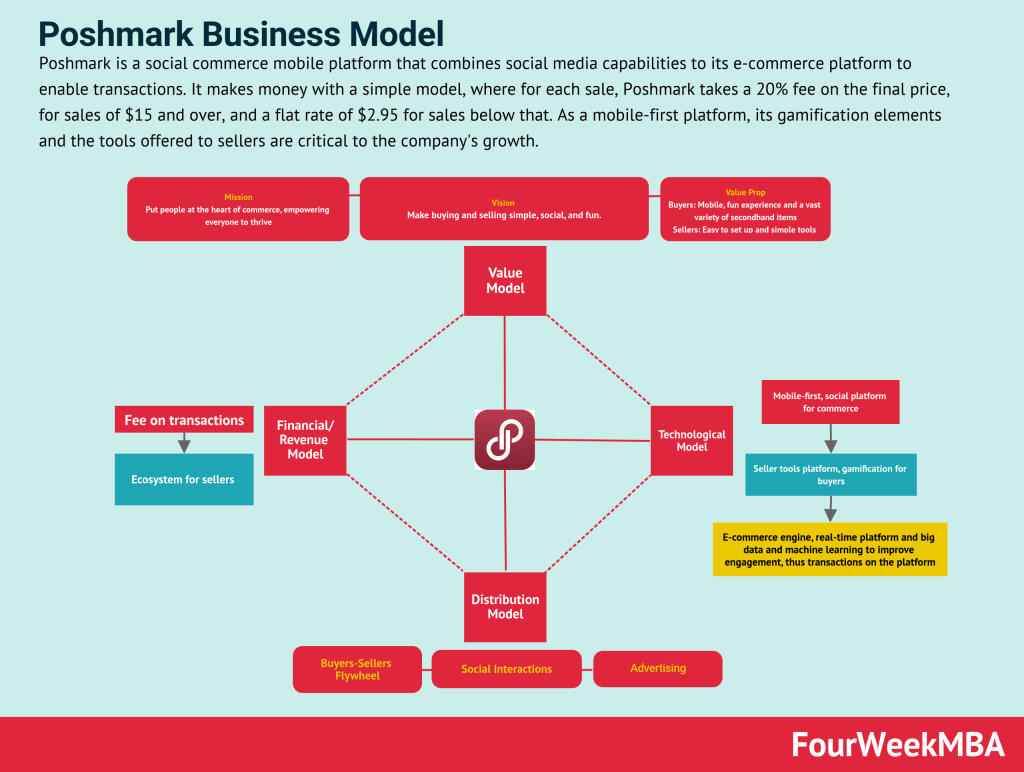
Poshmark is a social commerce mobile platform that combines social media capabilities with its e-commerce platform to enable transactions. It makes money with a simple model, where for each sale, Poshmark takes a 20% fee on the final price for sales of $15 and over and a flat rate of $2.95 for sales below that. Its gamification elements and the tools offered to sellers are critical to the company’s growth as a mobile-first platform.
Chanel has leveraged AI to significantly boost revenue through its innovative virtual try-on technology for beauty products, particularly lipstick and eyeshadow. The luxury brand’s AI-powered augmented reality feature, integrated into its mobile app and website, allows customers to virtually test products using their smartphone cameras before purchasing. This technology has increased online conversion rates by approximately 200% for featured products, as customers gain confidence in color matching and product selection without visiting physical stores. The AI system analyzes facial features, skin tone, and lighting conditions to provide realistic product visualization, reducing return rates by 64% while expanding Chanel’s reach to customers in markets without nearby boutiques. During the pandemic, when physical store visits declined by 40%, this AI-driven solution helped Chanel maintain beauty segment revenue growth of 15% year-over-year, demonstrating how artificial intelligence can transform traditional luxury retail models and create new revenue streams through enhanced digital customer experiences.
Hermès revenue grew from €5.96 billion in 2018 to €13.43 billion in 2023. The company generated €6.88 billion in 2019, €6.39 billion in 2020, €8.98 billion in 2021, and €11.6 billion in 2022.
Prada generated €4.72 billion in revenue in 2023, compared to €4.2 billion in revenue in 2022, primarily from its leading brand, Prada, which generated €3.49 billion in 2023. This was followed by Miu Miu, which generated €649 million, and Church’s, which generated €28.5 million.
Massimo Dutti generated €1.84 billion in revenue in 2023, €1.59 billion in 2022, €1.65 billion in 2021, €1.27 billion in 2020, and €1.9 billion in 2019.
Bershka generated €2.62 billion in revenue in 2023, €2.38 billion in 2022, and €2.18 billion in revenue in 2021, compared to €1.77 billion in 2020 and €2.38 in 2019.Pull&Bear generated €2.36 billion in revenue in 2023, €2.15 billion in 2022, and €1.87 billion in revenue in 2021, compared to €1.42 billion in 2020 and €1.97 billion in 2019.
In 2020, the revenue was $555 million.
The revenue decreased in 2021 to $418 million.
However, in 2022, Jimmy Choo’s revenue increased significantly to $613 million.
Miu Miu is a crucial brand part of the Prada Group. Miu Miu generated €648 million for 2023, compared to €431 million in revenue in 2022, €346 million in 2021 and €329 in 2020.
Curch’s footwear is a brand part of the Prada Group. The company generated over €28 million for 2023, compared to €29 million in revenue in 2022 and 2021, and nearly €37 million in revenue in 2020.
Gennaro Cuofano is a CRO and tech executive who has worked in AI since late 2015, starting with bringing NLP, natural-language generation, voice and chatbot products to the marketing industry. His background is in law and finance: he holds a Master's degree in Law and an International MBA with an emphasis on corporate finance (LUISS Business School and the University of San Diego, 2012), and worked as a financial analyst at a real-estate investment firm in San Diego and as an assistant controller. His work focuses on business model strategy, business engineering and, more broadly, structural analysis: how companies make money, read from their own filings. He created FourWeekMBA and leads research there and at The Business Engineer, his newsletter on AI and business strategy, with over 95,000 subscribers and more than 1,000 published analyses. His writing has also appeared on Entrepreneur, HackerNoon and Search Engine People. Find him on LinkedIn and Substack. See how we source.
Scroll to Top
Discover more from FourWeekMBA
Subscribe now to keep reading and get access to the full archive.