Businesses employing the brokerage business model make money via brokerage services. This means they are involved with the facilitation, negotiation, or arbitration of a…
Key Components
Brokerage Business Model
A Brokerage Business Model is a type of business model where a company or individual acts as an intermediary or broker between buyers and sellers of goods, serv
Key Concepts
– Intermediary Role: Brokers play a crucial intermediary role, connecting buyers and sellers who may not have direct access to each other. – Commission or Fee:
Examples
– Real Estate Brokerage: Real estate agents and brokers connect property buyers and sellers, earning a commission on the sale. – Stockbrokerage: Stockbrokers fa
Applications
– Financial Services: Brokerages are integral to financial markets, enabling individuals and institutions to trade stocks, bonds, commodities, and currencies. –
Challenges
– Competition: Brokerage industries can be highly competitive, with many players vying for clients. – Regulation: Some brokerage sectors, like finance, are subj
Mitigation
– Specialization: Specializing in a niche market can help brokers stand out and attract clients looking for expertise. – Technology: Embracing technology can im
Key Insight
Understanding the brokerage business model Brokerage businesses usually charge a commission or fee to one or both parties in exchange for services rendered.
Exec Package + Claude OS Master Skill | Business Engineer Founding Plan
FourWeekMBA x Business Engineer | Updated 2026
Businesses employing the brokerage business model make money via brokerage services. This means they are involved with the facilitation, negotiation, or arbitration of a transaction between a buyer and a seller. The brokerage business model involves a business connecting buyers with sellers to collect a commission on the resultant transaction. Therefore, acting as a middleman within a transaction.
Aspect
Explanation
Brokerage Business Model
A Brokerage Business Model is a type of business model where a company or individual acts as an intermediary or broker between buyers and sellers of goods, services, or assets. Brokers facilitate transactions and earn a fee, commission, or spread for their services. This model is prevalent in various industries, including real estate, finance, e-commerce, and more.
Key Concepts
– Intermediary Role: Brokers play a crucial intermediary role, connecting buyers and sellers who may not have direct access to each other. – Commission or Fee: Brokers earn revenue through commissions, fees, or spreads on transactions they facilitate. – Market Expertise: Successful brokers often have deep market knowledge and expertise in their respective industries. – Trust and Reputation: Building trust and a positive reputation are vital for attracting clients in the brokerage business.
Examples
– Real Estate Brokerage: Real estate agents and brokers connect property buyers and sellers, earning a commission on the sale. – Stockbrokerage: Stockbrokers facilitate the buying and selling of stocks and securities for investors, charging a commission per trade. – Insurance Brokerage: Insurance brokers help individuals and businesses find suitable insurance coverage and earn a commission from insurers. – Freight Brokerage: Freight brokers match shippers with carriers and charge a fee for arranging transportation. – Art Brokerage: Art brokers connect art buyers and sellers, earning a commission on art sales.
Applications
– Financial Services: Brokerages are integral to financial markets, enabling individuals and institutions to trade stocks, bonds, commodities, and currencies. – Real Estate: Real estate brokerages assist in buying, selling, and renting properties. – E-commerce: Online marketplaces often operate on a brokerage model, connecting buyers and sellers of various products. – Import and Export: Import/export brokers facilitate international trade by connecting buyers and sellers across borders.
Challenges
– Competition: Brokerage industries can be highly competitive, with many players vying for clients. – Regulation: Some brokerage sectors, like finance, are subject to strict regulatory frameworks. Compliance is essential. – Market Fluctuations: Economic and market fluctuations can impact brokerage businesses, affecting transaction volumes and revenue. – Trust: Establishing trust and credibility with clients is crucial in the brokerage business.
Mitigation
– Specialization: Specializing in a niche market can help brokers stand out and attract clients looking for expertise. – Technology: Embracing technology can improve efficiency, reduce costs, and enhance the client experience. – Compliance: Staying informed about industry regulations and complying with them is essential. – Customer Service: Providing exceptional customer service can build trust and loyalty.
Scientific Significance
Brokerage business models illustrate the significance of intermediaries in facilitating trade and transactions in various industries. They also highlight the role of trust and expertise in these relationships.
Conclusion
Brokerage business models serve as essential intermediaries, connecting buyers and sellers across diverse industries. They thrive on market expertise, trust, and the ability to efficiently match parties to transactions. While competitive and subject to challenges, brokerages continue to play a vital role in global commerce.
Understanding the brokerage business model
Brokerage businesses usually charge a commission or fee to one or both parties in exchange for services rendered.
Many such companies have also adopted a zero-commission policy, instead of making money from investments and the difference in price between what they charge buyers and what they charge sellers.
Advances in eCommerce have allowed the brokerage business model to thrive since virtually any product or service can now be ordered online.
Brokerage businesses are common in the real estate, finance, retail, travel, and online marketplace industries, to name a few.
B2B, which stands for business-to-business, is a process of selling products or services to other businesses. On the other hand, a B2C sells directly to its consumers.
With that said, we have taken the liberty to list seven of the most common below:
Buy/sell match model
Where brokers concentrate on the fulfillment of buy/sell transactions.
This model is routinely used by financial brokers, insurance brokers, travel agents, and brick-and-mortar businesses with an online presence.
A retail business model follows a direct-to-consumer approach, also called B2C, where the company sells directly to final customers a processed/finished product. This implies a business model that is mostly local-based, it carries higher margins, but also higher costs and distribution risks.
Buyer-aggregator model
Here, brokers bring together a group of buyers who share the common goal of receiving discounts on goods and services.
Merchants pay the broker a small percentage for each sale, which is often percentage-based.
Classified-advertiser model
These brokers charge a fee to an advertiser based on the time, location, size, or nature of an advertisement.
They may also offer search and rating services.
For example, the online classified platform Craigslist charges users for brokering sales of apartments, commercial real estate, cars, trucks, and furniture.
Craiglist is a local posting website that enables people to post any sort of classifieds on the platform, mostly for free, except for some categories of ads and the advertising of vehicles on the website. Therefore, craigslist monetizes based on some premium categories of listings (like job postings or apartment rentals).
Virtual mall model
In this case, the broker creates a website and rents out virtual space to online retailers.
The broker may also offer advertising, marketing, search facilities, and business advice.
A marketplace is a platform where buyers and sellers interact and transact. The platform acts as a marketplace that will generate revenues in fees from one or all the parties involved in the transaction. Usually, marketplaces can be classified in several ways, like those selling services vs. products or those connecting buyers and sellers at B2B, B2C, or C2C level. And those marketplaces connecting two core players, or more.
Virtual mall intermediary model
A more bespoke version of the virtual mall model, where the broker locates multiple product suppliers and sells their products in a single online store sorted by department.
The broker also acts as an intermediary by taking care of billing, shipping, order tracking, and credit card authorization.
Brokers charge product suppliers a fee for setting up and maintaining their storefronts.
Chinese B2C platform Tmall is one example of a virtual mall intermediary broker.
Auction and reverse auction model
An auction broker offers goods and services from multiple resellers and receives a fee for every successful sale.
In a reverse auction, buyers name their price and the broker secures a seller who can facilitate a sale.
Directory and evaluator model
These brokers offer a directory listing for goods and services, evaluate relevant businesses, and offer value awards to companies based on consumer feedback.
Consumers themselves may also be rewarded with certain incentives for purchasing from broker recommendations.
For example, Nerdwallet is a consumer finance platform reviewing credit cards, bank accounts, personal loans, insurance, mortgages, and investment products.
NerdWallet is an online platform providing tools and tips on all matters related to personal finance. The company gained traction as a simple web application comparing credit cards. NerdWallet makes money via affiliate commissions determined according to the affiliate agreements.
Case studies
Example 1: Job Recruitment Agencies
Brokerage Mechanism: Recruitment agencies connect job seekers with companies looking to hire. They earn a commission either from the company once a candidate is placed or sometimes from the candidate’s first salary.
Example 2: Online Dating Platforms
Brokerage Mechanism: Platforms like Match.com or eHarmony connect individuals looking for romantic relationships. They might earn revenue through subscription fees or from premium features that enhance users’ chances of finding a match.
Example 3: Real Estate Rental Platforms
Brokerage Mechanism: Websites like Airbnb or Vrbo connect property owners with travelers looking for short-term rentals. The platforms earn a commission from each booking.
Example 4: Ticket Reselling Platforms
Brokerage Mechanism: Websites like StubHub or Ticketmaster Resale connect ticket sellers with buyers, charging a fee on each transaction.
Example 5: Peer-to-Peer Lending Platforms
Brokerage Mechanism: Platforms like Prosper or LendingClub connect individuals who want to lend money with those who want to borrow, earning a fee on each loan facilitated.
Example 6: Stock Photo Websites
Brokerage Mechanism: Websites like Shutterstock or Getty Images connect photographers with businesses or individuals looking to purchase stock photos. Photographers earn royalties, and the platform takes a commission.
Example 7: Online Art Marketplaces
Brokerage Mechanism: Platforms like Artfinder or Saatchi Art connect artists with art enthusiasts and collectors. Artists get a platform to showcase and sell their work, while the platform earns a commission on each sale.
Example 8: Freight Brokers
Brokerage Mechanism: These brokers connect shippers with transportation services. They negotiate rates with both parties and earn a fee for facilitating the shipment of goods.
Example 9: Business Brokers
Brokerage Mechanism: These brokers assist in the buying and selling of businesses. They help evaluate the value of a business, find buyers or sellers, and earn a commission once the business is sold.
Example 10: Insurance Brokers
Brokerage Mechanism: Insurance brokers help individuals or businesses find the best insurance policies for their needs. They earn a commission from insurance companies for each policy sold.
Key takeaways
The brokerage business model involves a business connecting buyers with sellers to collect a commission on the resultant transaction.
Advances in eCommerce have allowed the brokerage business model to thrive since virtually any product or service can now be ordered online. The model is common in the real estate, travel, finance, and retail industries.
There are many brokerage business model types in the B2B and B2C space. Some of the more common include the buy/sell match model, buyer-aggregator model, classified-advertiser model, virtual mall model, auction and reverse auction model, and directory and evaluator model.
Key Highlights
The Brokerage Business Model: Businesses employing the brokerage business model generate revenue by facilitating, negotiating, or arbitrating transactions between buyers and sellers. Acting as intermediaries, brokerage companies connect buyers with sellers and earn a commission on the resulting transactions.
Commission-based Revenue: Brokerage businesses typically charge a commission or fee to one or both parties involved in the transaction in exchange for their services. Some brokerage companies have adopted a zero-commission policy and instead earn revenue from investments and price differences between buyers and sellers.
Thriving in eCommerce: With the advancement of eCommerce, the brokerage business model has flourished as virtually any product or service can be ordered online. Brokerage businesses are common in various industries, including real estate, finance, retail, travel, and online marketplaces.
Seven Types of Brokerage Business Models:
Buy/Sell Match Model: Brokers focus on facilitating buy/sell transactions. This model is used by financial brokers, insurance brokers, travel agents, and brick-and-mortar businesses with an online presence.
Buyer-Aggregator Model: Brokers bring together a group of buyers seeking discounts on goods and services. Merchants pay a percentage-based fee for each sale.
Classified-Advertiser Model: Brokers charge advertisers based on advertisement attributes, such as time, location, size, or nature. Some may offer search and rating services.
Virtual Mall Model: Brokers create a website and rent virtual space to online retailers. They may provide advertising, marketing, search facilities, and business advice. Examples include Amazon and eBay.
Virtual Mall Intermediary Model: A bespoke version of the virtual mall model where the broker locates multiple product suppliers and sells their products in a single online store. The broker handles billing, shipping, order tracking, and credit card authorization, charging product suppliers for storefront setup and maintenance. Chinese B2C platform Tmall is an example.
Auction and Reverse Auction Model: An auction broker offers goods and services from multiple resellers and receives a fee for successful sales. In reverse auctions, buyers name their price, and the broker finds a seller to facilitate the sale.
Directory and Evaluator Model: Brokers offer directory listings for goods and services, evaluate businesses, and give value awards based on consumer feedback. Consumers may also be rewarded for purchasing from broker-recommended companies. Nerdwallet is an example in the consumer finance sector.
Related Concepts
Description
When to Apply
Brokerage Business Model
The Brokerage Business Model is a business model where a company acts as an intermediary or middleman between buyers and sellers, facilitating transactions or interactions in exchange for a fee, commission, or other form of compensation. Brokers provide value by connecting parties, providing market insights or expertise, and managing transaction logistics, enabling efficient and secure exchanges in various industries, such as real estate, finance, insurance, and e-commerce. The brokerage business model relies on network effects, trust, and reputation to attract clients and generate revenue through transaction fees, subscriptions, or commissions.
– When facilitating transactions or connecting parties in markets with asymmetric information or complex transactions. – Particularly in understanding the dynamics of the brokerage business model, such as value proposition, revenue streams, and market positioning, and in exploring techniques to optimize brokerage operations, such as market segmentation, network effects, and digital platforms, to enhance transaction efficiency, mitigate conflicts of interest, and drive revenue growth in brokerage businesses or intermediary services.
Intermediary Services
Intermediary Services refer to activities or functions performed by intermediaries, such as brokers, agents, or middlemen, to facilitate transactions, negotiations, or exchanges between parties. Intermediaries add value by reducing search costs, providing market information, and managing transactional risks, enabling efficient and reliable interactions in complex or fragmented markets. Intermediary services play a crucial role in various industries, including finance, real estate, logistics, and digital platforms, where trust, expertise, and coordination are essential for successful transactions.
– When streamlining transactions or managing market interactions in industries with multiple stakeholders or complex value chains. – Particularly in understanding the role of intermediary services in value creation, risk mitigation, and market efficiency, and in exploring techniques to enhance intermediary services, such as digital platforms, smart contracts, and ecosystem partnerships, to optimize transactional processes, improve customer experiences, and capture value in intermediary businesses or platform-based ecosystems.
Marketplace Model
The Marketplace Model is a business model where a platform or intermediary facilitates transactions between multiple buyers and sellers, creating a virtual marketplace for goods, services, or information exchange. Marketplaces provide a centralized platform for participants to discover, transact, and interact with each other, offering benefits such as increased market reach, transparency, and efficiency. Marketplace models can be found in various sectors, including e-commerce, sharing economy, gig economy, and digital platforms, where network effects, reputation systems, and trust mechanisms are critical for fostering peer-to-peer transactions and ecosystem growth.
– When building digital platforms or launching online marketplaces to connect buyers and sellers across multiple sectors or industries. – Particularly in understanding the dynamics of the marketplace model, such as platform governance, network effects, and monetization strategies, and in exploring techniques to develop successful marketplaces, such as user segmentation, community building, and platform scalability, to foster trust, stimulate transactions, and drive ecosystem growth in platform-based businesses or online marketplaces.
Real Estate Brokerage
Real Estate Brokerage is a specialized brokerage business model focused on facilitating transactions related to buying, selling, or leasing real property. Real estate brokers act as intermediaries between property owners and prospective buyers or tenants, providing services such as property valuation, market analysis, negotiation, and transaction management. Real estate brokerage firms earn commissions or fees based on the value of transactions, typically calculated as a percentage of the property’s sale or lease price, and may specialize in residential, commercial, or investment properties.
– When engaging in real estate transactions or seeking professional representation in property transactions. – Particularly in understanding the role of real estate brokerage in property markets, such as market dynamics, legal regulations, and industry trends, and in exploring techniques to optimize real estate brokerage services, such as client acquisition, listing optimization, and transaction coordination, to maximize property value, minimize transaction risks, and achieve successful outcomes in real estate transactions or property investments.
Financial Brokerage
Financial Brokerage is a type of brokerage business model focused on facilitating transactions or providing advisory services in financial markets, such as stocks, bonds, commodities, currencies, or derivatives. Financial brokers act as intermediaries between investors and financial markets, executing trades, managing investment portfolios, and offering financial advice or analysis. Financial brokerage firms may operate as full-service brokers, discount brokers, or online trading platforms, catering to different investor needs and preferences. Financial brokers generate revenue through transaction fees, asset management fees, or advisory fees, depending on the services offered and the client’s investment objectives.
– When investing in financial markets or seeking investment advice from financial professionals. – Particularly in understanding the role of financial brokerage in investment management, such as portfolio diversification, risk mitigation, and wealth preservation, and in exploring techniques to optimize financial brokerage services, such as asset allocation, risk assessment, and investment strategy, to achieve financial goals, maximize returns, and minimize investment risks in securities trading or wealth management.
Insurance Brokerage
Insurance Brokerage is a brokerage business model focused on facilitating insurance transactions between policyholders and insurance companies. Insurance brokers act as intermediaries, helping individuals, businesses, or organizations find suitable insurance coverage, compare policies, and negotiate terms and premiums with insurance providers. Insurance brokerage firms provide expertise in risk assessment, policy selection, and claims management, assisting clients in securing adequate insurance protection for their needs and circumstances. Insurance brokers earn commissions or fees from insurance companies based on the volume or value of insurance policies sold, representing the interests of policyholders in the insurance marketplace.
– When purchasing insurance or managing insurance portfolios for personal or business risk management. – Particularly in understanding the role of insurance brokerage in insurance markets, such as underwriting processes, coverage options, and claims settlement, and in exploring techniques to optimize insurance brokerage services, such as risk analysis, coverage customization, and claims advocacy, to mitigate insurance risks, optimize coverage, and enhance financial resilience in insurance planning or risk management strategies.
Travel Agency Model
The Travel Agency Model is a brokerage business model focused on facilitating travel-related transactions, such as booking flights, accommodations, transportation, or activities, for individuals or groups. Travel agencies act as intermediaries between travelers and travel suppliers, offering services such as itinerary planning, reservation management, and travel assistance. Travel agency business models may vary from traditional brick-and-mortar agencies to online travel agencies (OTAs) or hybrid models, catering to different customer segments and travel preferences. Travel agencies earn commissions, service fees, or markups from travel suppliers based on the volume or value of travel bookings, providing convenience, expertise, and personalized service to travelers.
– When planning travel or booking travel services for personal or business trips. – Particularly in understanding the role of travel agencies in the travel industry, such as supplier relationships, distribution channels, and customer experiences, and in exploring techniques to optimize travel agency services, such as destination expertise, package customization, and customer support, to enhance travel experiences, streamline booking processes, and maximize value for travelers in leisure travel, corporate travel, or group tours.
Commodity Brokerage
Commodity Brokerage is a brokerage business model focused on facilitating transactions or trades in commodity markets, such as agricultural products, energy resources, metals, or financial instruments. Commodity brokers act as intermediaries between buyers and sellers of commodities, providing services such as market analysis, price hedging, and trade execution. Commodity brokerage firms may specialize in specific commodity categories or offer diversified brokerage services across multiple markets, catering to commodity producers, consumers, traders, and investors. Commodity brokers earn commissions or fees from clients based on the volume or value of commodity transactions, helping participants manage price risks, optimize supply chains, and access global commodity markets.
– When trading commodities or managing commodity price risks in agricultural, energy, or financial markets. – Particularly in understanding the role of commodity brokerage in commodity trading, such as market dynamics, price discovery, and contract negotiation, and in exploring techniques to optimize commodity brokerage services, such as risk management, market intelligence, and trading strategies, to capture value, mitigate risks, and achieve trading objectives in commodity markets or supply chain management.
Online Brokerage Platform
An Online Brokerage Platform is a digital platform or application that enables individuals or institutions to trade securities, commodities, currencies, or other financial instruments online. Online brokerage platforms provide user-friendly interfaces, real-time market data, and self-service tools for executing trades, managing investment portfolios, and accessing financial markets from anywhere with internet connectivity. Online brokerage platforms may offer various features, such as commission-free trading, research tools, educational resources, and customer support, catering to different investor preferences and trading styles. Online brokerage platforms generate revenue through commission fees, account fees, margin interest, or premium services, attracting investors with competitive pricing, convenience, and accessibility.
– When investing in financial markets or trading securities through online platforms or mobile apps. – Particularly in understanding the features of online brokerage platforms, such as trading functionality, account types, and pricing models, and in exploring techniques to optimize online brokerage experiences, such as user interface design, mobile optimization, and security measures, to attract investors, enhance user engagement, and differentiate platform offerings in the competitive online brokerage industry or fintech ecosystem.
Freight Brokerage
Freight Brokerage is a brokerage business model focused on facilitating freight transportation services between shippers and carriers. Freight brokers act as intermediaries, matching freight shipments with available transportation capacity, negotiating rates, and managing logistics for moving goods from origin to destination. Freight brokerage firms provide services such as freight booking, load optimization, carrier selection, and shipment tracking, offering efficiency, flexibility, and cost savings to shippers and carriers. Freight brokers earn commissions, service fees, or markups from shippers or carriers based on the volume or value of freight transactions, helping participants optimize supply chain operations, reduce transportation costs, and improve freight efficiency.
– When arranging freight transportation or sourcing freight services for shipping goods or cargo. – Particularly in understanding the role of freight brokerage in logistics management, such as freight matching, capacity optimization, and route planning, and in exploring techniques to optimize freight brokerage services, such as load consolidation, carrier vetting, and shipment visibility, to streamline supply chain operations, reduce shipping costs, and enhance freight efficiency in transportation management or logistics outsourcing.
A great example is Craigslist, which charges users for brokering sales of apartments, commercial real estate, cars, trucks, and furniture. Craigslist is a local posting website that enables people to post classifieds on the platform, primarily for free, except for some categories of ads and vehicle advertising on the website. Therefore, craigslist monetizes based on some premium categories of listings (like job postings or apartment rentals).
What's an example of Virtual mall model?
Examples of virtual mall models comprise marketplaces such as Amazon and eBay, with various goods in many categories, convenient pricing, and many offerings throughout the year. They replicate a real-world mall in the digital world.
An effective business model has to focus on two dimensions: the people dimension and the financial dimension. The people dimension will allow you to build a product or service that is 10X better than existing ones and a solid brand. The financial dimension will help you develop proper distribution channels by identifying the people that are willing to pay for your product or service and make it financially sustainable in the long run.
Business model innovation is about increasing the success of an organization with existing products and technologies by crafting a compelling value proposition able to propel a new business model to scale up customers and create a lasting competitive advantage. And it all starts by mastering the key customers.
Digital and tech business models can be classified according to four levels of transformation into digitally-enabled, digitally-enhanced, tech or platform business models, and business platforms/ecosystems.
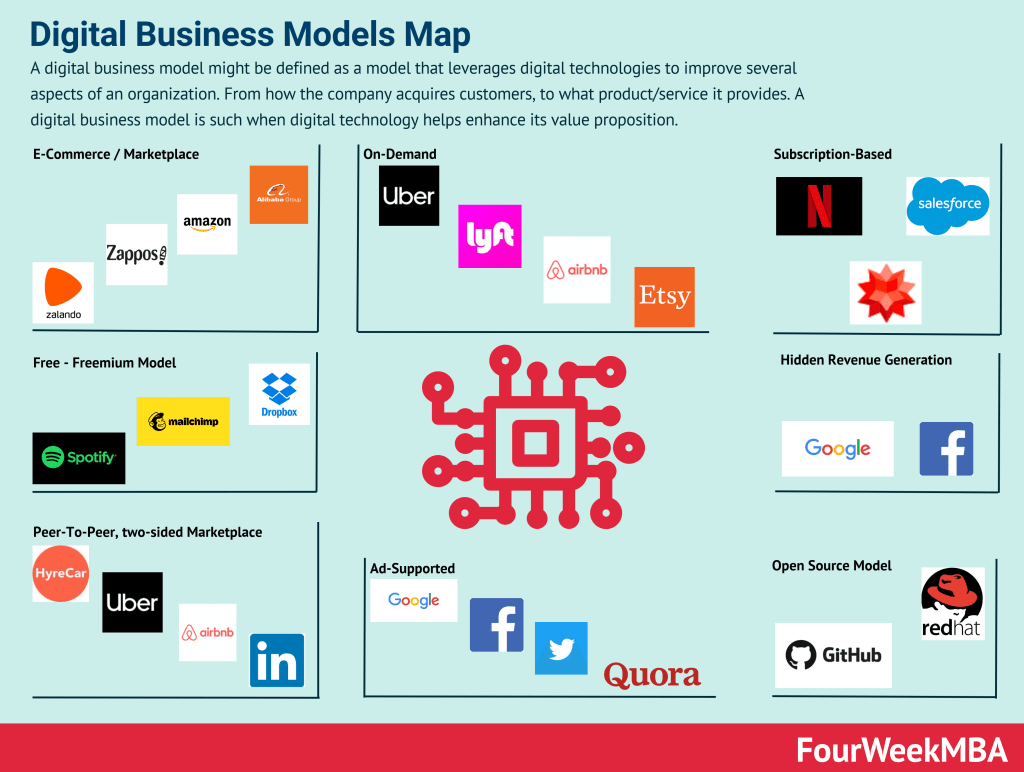
A digital business model might be defined as a model that leverages digital technologies to improve several aspects of an organization. From how the company acquires customers, to what product/service it provides. A digital business model is such when digital technology helps enhance its value proposition.
A tech business model is made of four main components: value model (value propositions, mission, vision), technological model (R&D management), distribution model (sales and marketing organizational structure), and financial model (revenue modeling, cost structure, profitability and cash generation/management). Those elements coming together can serve as the basis to build a solid tech business model.
A platform business model generates value by enabling interactions between people, groups, and users by leveraging network effects. Platform business models usually comprise two sides: supply and demand. Kicking off the interactions between those two sides is one of the crucial elements for a platform business model success.
A Blockchain Business Model is made of four main components: Value Model (Core Philosophy, Core Value and Value Propositions for the key stakeholders), Blockchain Model (Protocol Rules, Network Shape and Applications Layer/Ecosystem), Distribution Model (the key channels amplifying the protocol and its communities), and the Economic Model (the dynamics through which protocol players make money). Those elements coming together can serve as the basis to build and analyze a solid Blockchain Business Model.
In an asymmetric businessmodel, the organization doesn’t monetize the user directly, but it leverages the data users provide coupled with technology, thus have a key customer pay to sustain the core asset. For example, Google makes money by leveraging users’ data, combined with its algorithms sold to advertisers for visibility.
In an asymmetric businessmodel, the organization doesn’t monetize the user directly, but it leverages the data users provide coupled with technology, thus having a key customer pay to sustain the core asset. For example, Google makes money by leveraging users’ data, combined with its algorithms sold to advertisers for visibility. This is how attention merchants make monetize their business models.
While the term has been coined by Andrew Lampitt, open-core is an evolution of open-source. Where a core part of the software/platform is offered for free, while on top of it are built premium features or add-ons, which get monetized by the corporation who developed the software/platform. An example of the GitLab open core model, where the hosted service is free and open, while the software is closed.
Cloud business models are all built on top of cloud computing, a concept that took over around 2006 when former Google’s CEO Eric Schmit mentioned it. Most cloud-based business models can be classified as IaaS (Infrastructure as a Service), PaaS (Platform as a Service), or SaaS (Software as a Service). While those models are primarily monetized via subscriptions, they are monetized via pay-as-you-go revenue models and hybrid models (subscriptions + pay-as-you-go).
Open source is licensed and usually developed and maintained by a community of independent developers. While the freemium is developed in-house. Thus the freemium give the company that developed it, full control over its distribution. In an open-source model, the for-profit company has to distribute its premium version per its open-source licensing model.
The freemium – unless the whole organization is aligned around it – is a growth strategy rather than a business model. A free service is provided to a majority of users, while a small percentage of those users convert into paying customers through the sales funnel. Free users will help spread the brand through word of mouth.
A freeterprise is a combination of free and enterprise where free professional accounts are driven into the funnel through the free product. As the opportunity is identified the company assigns the free account to a salesperson within the organization (inside sales or fields sales) to convert that into a B2B/enterprise account.
A marketplace is a platform where buyers and sellers interact and transact. The platform acts as a marketplace that will generate revenues in fees from one or all the parties involved in the transaction. Usually, marketplaces can be classified in several ways, like those selling services vs. products or those connecting buyers and sellers at B2B, B2C, or C2C level. And those marketplaces connecting two core players, or more.
B2B, which stands for business-to-business, is a process for selling products or services to other businesses. On the other hand, a B2C sells directly to its consumers.
A B2B2C is a particular kind of business model where a company, rather than accessing the consumer market directly, it does that via another business. Yet the final consumers will recognize the brand or the service provided by the B2B2C. The company offering the service might gain direct access to consumers over time.
Direct-to-consumer (D2C) is a business model where companies sell their products directly to the consumer without the assistance of a third-party wholesaler or retailer. In this way, the company can cut through intermediaries and increase its margins. However, to be successful the direct-to-consumers company needs to build its own distribution, which in the short term can be more expensive. Yet in the long-term creates a competitive advantage.
The C2C business model describes a market environment where one customer purchases from another on a third-party platform that may also handle the transaction. Under the C2C model, both the seller and the buyer are considered consumers. Customer to customer (C2C) is, therefore, a business model where consumers buy and sell directly between themselves. Consumer-to-consumer has become a prevalent business model especially as the web helped disintermediate various industries.
A retail business model follows a direct-to-consumer approach, also called B2C, where the company sells directly to final customers a processed/finished product. This implies a business model that is mostly local-based, it carries higher margins, but also higher costs and distribution risks.
The wholesale model is a selling model where wholesalers sell their products in bulk to a retailer at a discounted price. The retailer then on-sells the products to consumers at a higher price. In the wholesale model, a wholesaler sells products in bulk to retail outlets for onward sale. Occasionally, the wholesaler sells direct to the consumer, with supermarket giant Costco the most obvious example.
The term “crowdsourcing” was first coined by Wired Magazine editor Jeff Howe in a 2006 article titled Rise of Crowdsourcing. Though the practice has existed in some form or another for centuries, it rose to prominence when eCommerce, social media, and smartphone culture began to emerge. Crowdsourcing is the act of obtaining knowledge, goods, services, or opinions from a group of people. These people submit information via social media, smartphone apps, or dedicated crowdsourcing platforms.
In a franchained business model (a short-term chain, long-term franchise) model, the company deliberately launched its operations by keeping tight ownership on the main assets, while those are established, thus choosing a chain model. Once operations are running and established, the company divests its ownership and opts instead for a franchising model.
Businesses employing the brokerage business model make money via brokerage services. This means they are involved with the facilitation, negotiation, or arbitration of a transaction between a buyer and a seller. The brokerage business model involves a business connecting buyers with sellers to collect a commission on the resultant transaction. Therefore, acting as a middleman within a transaction.
Dropshipping is a retail business model where the dropshipper externalizes the manufacturing and logistics and focuses only on distribution and customer acquisition. Therefore, the dropshipper collects final customers’ sales orders, sending them over to third-party suppliers, who ship directly to those customers. In this way, through dropshipping, it is possible to run a business without operational costs and logistics management.
Businesses employing the brokerage business model make money via brokerage services. This means they are involved with the facilitation, negotiation, or arbitration of a transaction between a buyer and a seller. The brokerage business model involves a business connecting buyers with sellers to collect a commission on the resultant transaction. Therefore, acting as a middleman within a transaction.
What are the key components of The Brokerage Business Model?
The key components of The Brokerage Business Model include Brokerage Business Model, Key Concepts, Examples, Applications, Challenges. Brokerage Business Model: A Brokerage Business Model is a type of business model where a company or individual acts as an intermediary or broker… Key Concepts: – Intermediary Role: Brokers play a crucial intermediary role, connecting buyers and sellers who may not have direct…
Why is The Brokerage Business Model important for business strategy?
Understanding the brokerage business model Brokerage businesses usually charge a commission or fee to one or both parties in exchange for services rendered.
How do you apply The Brokerage Business Model in practice?
Many such companies have also adopted a zero-commission policy, instead of making money from investments and the difference in price between what they charge buyers and what they charge sellers.
What are the advantages and limitations of The Brokerage Business Model?
Advances in eCommerce have allowed the brokerage business model to thrive since virtually any product or service can now be ordered online.
Gennaro is the creator of FourWeekMBA, which reached about four million business people, comprising C-level executives, investors, analysts, product managers, and aspiring digital entrepreneurs in 2022 alone | He is also Director of Sales for a high-tech scaleup in the AI Industry | In 2012, Gennaro earned an International MBA with emphasis on Corporate Finance and Business Strategy.