An angel investor is usually a high net-worth individual who invests in early-stage start-ups in exchange for equity in the company. Angel investors are wealthy private investors focused on financing small business ventures in exchange for an equity stake. Unlike a venture capital firm, an angel investor invests their own capital during the early stages of a start-up when the risk of failure is relatively high, yet it might in the long-term unlock higher rates of return.
Aspect
Explanation
Definition
An Angel Investor, often referred to as an angel, is an individual who provides financial backing to startups or early-stage companies in exchange for equity in the company. Angels typically invest their own funds, offering entrepreneurs not only capital but also valuable mentoring and business expertise. They play a crucial role in the early financing stages of startups, bridging the gap between initial seed funding and more substantial venture capital investments.
Key Characteristics
Angel investors exhibit several key characteristics: 1. High Net Worth: They are typically individuals with a significant net worth and financial resources to invest. 2. Risk Tolerance: Angels are willing to take on higher levels of risk associated with early-stage ventures. 3. Industry Experience: Many angels have industry-specific knowledge and expertise, which they leverage to support startups. 4. Long-Term Perspective: They often have a long-term investment perspective, understanding that startup success may take time. 5. Mentorship: Angels frequently provide mentorship and strategic guidance to the startups they invest in.
Investment Stage
Angel investors primarily focus on the seed and early-stage phases of a company’s development. They are among the first outside investors to provide capital to startups, helping entrepreneurs turn their innovative ideas into viable businesses. Angels may also participate in later funding rounds, especially if they see substantial growth potential in the startups they initially supported.
Motivations
Angel investors are motivated by various factors, including: 1. Potential Returns: Angels seek the opportunity for substantial financial gains if the startup succeeds. 2. Passion for Innovation: They often have a passion for innovation and enjoy supporting entrepreneurs in bringing new ideas to market. 3. Portfolio Diversification: Investing in startups can be a way to diversify their investment portfolios. 4. Mentorship and Involvement: Angels may enjoy the hands-on experience of mentoring and contributing to a startup’s growth.
Role and Involvement
Angels typically play an active role in the startups they invest in. This involvement can take several forms: 1. Mentoring: They offer guidance, share industry insights, and help entrepreneurs navigate challenges. 2. Networking: Angels often provide valuable connections to other investors, mentors, and potential customers or partners. 3. Strategic Advice: They assist with business strategy, fundraising, and decision-making. 4. Board Seats: In some cases, angels may secure board seats to have a more direct influence on the company’s direction.
Deal Structures
Angel investments are structured in various ways, including: 1. Equity Financing: Angels receive ownership stakes in the company in exchange for their investment. 2. Convertible Notes: They may provide funds as loans that can convert into equity in future funding rounds. 3. SAFEs (Simple Agreement for Future Equity): A newer financing instrument that allows for future equity conversion, often with certain conditions. 4. Royalties: Some angels opt for royalty agreements, where they receive a percentage of the company’s revenue for a specified period.
Exit Strategies
Angels anticipate returns on their investments through exit strategies such as: 1. IPO (Initial Public Offering): The company goes public, and angels can sell their shares on the stock market. 2. Acquisition: The startup is acquired by a larger company, providing a liquidity event for investors. 3. Buyback: In some cases, startups buy back equity from angels at a negotiated price. 4. Secondary Market: Angels may sell their shares on secondary markets designed for private company stock trading. 5. Dividends: If the startup generates profits, angels may receive dividends.
Benefits to Startups
Angel investors offer numerous benefits to startups: 1. Capital Injection: They provide vital early-stage funding for product development, marketing, and growth. 2. Expertise: Angels bring industry-specific knowledge and experience. 3. Networking: Startups gain access to valuable networks and connections. 4. Validation: Angel investments can signal confidence in the startup to other investors. 5. Mentorship: Entrepreneurs benefit from mentorship and guidance from experienced angels. Startups should carefully consider their fit with potential angel investors and align their goals and expectations.
Challenges and Risks
Angel investing comes with its own set of challenges and risks: 1. High Risk: Startups have a high failure rate, leading to potential loss of invested capital. 2. Lack of Liquidity: Investments may take years to generate returns, and exits can be uncertain. 3. Portfolio Diversification: Angels must carefully manage their portfolio to mitigate risk. 4. Due Diligence: Evaluating startups and making informed investment decisions requires significant effort. 5. Operational Involvement: Hands-on involvement in startups can be time-consuming.
Regulations
Regulations governing angel investing vary by jurisdiction. In some regions, there are limitations on the number of investors in a startup, and companies may need to comply with securities laws when seeking angel investments. Entrepreneurs and angels should be aware of relevant regulations to ensure compliance.
Angel Groups and Networks
Angel investors often join groups or networks to collectively evaluate and invest in startups. These groups facilitate collaboration, due diligence, and shared expertise. Examples include the Angel Capital Association (ACA) in the United States and various regional and industry-specific angel networks.
Conclusion
Angel investors play a vital role in fostering innovation and entrepreneurship. Their financial support, mentorship, and industry expertise help startups navigate the challenging early stages of development. While angel investing offers significant potential rewards, it is not without risks, and both entrepreneurs and angels should approach these investments with careful consideration and due diligence.
Many angel investors have excess available funds and are looking for investment opportunities delivering a higher rate of return.
They tend to provide more favorable terms than other lenders because they invest in the person starting the business and not in the viability of the business itself.
Indeed, the angel investor may be a close friend or family member of the entrepreneur(s).
While the angel investor does want to make a profit, this outcome is secondary to helping the start-up transition through the difficult early stages of growth.
Essentially, they want to see the company survive long enough for a brilliant idea to come to fruition.
There are no formal requirements to becoming an angel investor, though many have gained accredited investor status from the Securities and Exchange Commission (SEC).
Why do entrepreneurs prefer angel investment funding?
To say that entrepreneurs require angel investment funding to keep the lights on would be too simplistic.
Many often require guidance on the most optimum way to spend the money to give the business the best chance of succeeding.
Entrepreneurs prefer to work with angel investors because they:
Offer wealth and knowledge
Angel investors have previous, first-hand experience of running successful enterprises.
Aside from their financial contribution, they mentor the entrepreneur to help them realize growth and higher rates of return.
Connect them with industry experts
Entrepreneurs can also gain access to the wide professional network of the angel investor.
These networks provide opportunities for further mentorship, but more importantly, can also provide the basis for subsequent rounds of investment funding.
Accept inherent risks
Most successful angel investments yield an internal rate of return (IRR) of 20-40% over a five to seven-year period.
While angel investing is inherently risky, angel investors seek to minimize risk by evaluating the idea against predetermined criteria.
These criteria may be based on industry knowledge, business model viability, the ability of the entrepreneur, and the time required to realize profit.
Angel investing vs venture capital
A venture capitalist generally invests in companies and startups which are still in a stage where their business model needs to be proved viable, or they need resources to scale up. Thus, those companies present high risks, but the potential for exponential growth. Therefore, venture capitalists look for startups that can bring a high ROI and high valuation multiples.
However, in angel investing, the angel usually invests in a very early stage, where there is no business model yet, traction, and revenue.
This of course will depend on the kind of investments the angel gets into, yet in general, angel investors try to look for those entrepreneurs with high potential.
The angel investor knows that many of her/his bets will go to zero, yet if they turn to work out, they might turn into 1000x winning bets.
That is why the angel investor looks more like a sports scout, finding talents very early on, than traditional investors.
The most successful angel investors today
Who are the individuals at the forefront of angel investing today? We have compiled a list of five of the most prominent below:
Fabrice Grinda
A French angel investor based in New York City who prefers to invest in marketplaces connecting buyers with sellers.
Grinda and a panel of experts are known to analyze approximately 100 companies every week. Some of his notable investments include Flexport, Betterment, and Alibaba.
Naval Ravikant
An Indian-American entrepreneur who began his angel investing journey with AngelList, a website connecting start-ups, angel investors, and job-seekers.
An American computer engineer and entrepreneur who is best known for creating Gmail and the original prototype of Google Adsense.
Buchheit is a partner in investment firm Y Combinator and manages his own angel investments in the media, information technology, health, and enterprise software industries.
Esther Dyson
A Swiss-born American investor, journalist, author, commentator, and philanthropist.
Dyson is a leading angel investor in the space, biotechnology, government, and healthcare industries.
She was an early investor in Facebook, Flickr, Space Adventures, Omada Health MeetUp, and Square.
Alexis Ohanian
An Armenian-American entrepreneur, investor, activist, and author who is passionate about the open internet, STEM education, and paid family leave.
Ohanian is best known for co-founding Reddit and was also a former partner of Y Combinator.
An American venture investor, entrepreneur, and former lawyer.
Sacca founded Lowercase Capital, which has made investments in Twitter, Instagram, Twilio, and Kickstarter.
His early bets on companies like Twitter and Instagram resulted in massive payoffs.
Gil Penchina
A widely respected angel investor known for his investments in LinkedIn, Cruise Automation, Dollar Shave Club, and many others.
He has been involved in over 100 startups and has led the largest syndicate on AngelList.
Tim Ferriss
An American author, podcaster, and entrepreneur.
Ferriss is best known for his book “The 4-Hour Workweek.”
He has made several angel investments, including Twitter, Evernote, Shopify, and Uber.
Kevin Rose
Founder of Digg and the podcast “The Kevin Rose Show.”
Rose is also a partner at True Ventures.
His angel investments include Twitter, Facebook, Square, and Nextdoor.
Joanne Wilson
Also known as the “Gotham Gal,” Wilson is a prolific angel investor based in New York City.
Her investment focus is primarily on female-led companies.
She has invested in over 130 companies including Curbed (acquired by Vox Media) and DailyWorth.
Jason Calacanis
An American entrepreneur, author, and podcaster.
He’s known for his early investment in Uber, which turned out to be one of the biggest wins in angel investing history.
Calacanis also hosts “This Week in Startups,” a popular podcast in the entrepreneurial community.
Robert Scoble
A technologist, author, and entrepreneur.
Scoble’s investments are primarily in the tech space, with a focus on AR, VR, and mixed reality startups.
Shervin Pishevar
Co-founder of Hyperloop One and Sherpa Capital.
Pishevar has made several prominent investments including in Uber, Airbnb, Munchery, and Machine Zone.
Dave Morin
Former co-founder and CEO of the social network Path.
Morin’s investments include Slack, Pinterest, Quora, and Dwell.
Ben Horowitz
Co-founder of Andreessen Horowitz, a private venture capital firm.
While his firm manages large investments, Horowitz himself has been known to make angel investments in early-stage startups. He’s backed a range of successful companies from its early days, including Okta and PagerDuty.
Key takeaways
An angel investor is usually a high net-worth individual who invests in early-stage start-ups in exchange for equity in the company.
In addition to investment funding, angel investors provide expert guidance on how that funding should be optimized. Entrepreneurs value angel investors for their industry knowledge, professional networks, and high-risk tolerance.
Some of the notable angel investors today include Fabrice Grinda, Naval Ravikant, Paul Buchheit, Esther Dyson, and Alexis Ohanian.
Key Highlights
Angel Investors: Angel investors are high net-worth individuals who invest in early-stage startups in exchange for equity. They provide funding, mentorship, and industry expertise to help startups succeed.
Investment Motivation: Angel investors often have excess funds and seek higher rates of return. They may invest in entrepreneurs they know personally and prioritize helping startups through their early growth stages.
Accredited Investors: Many angel investors gain accredited investor status by meeting specific net worth and income criteria set by the Securities and Exchange Commission (SEC).
Benefits for Entrepreneurs: Entrepreneurs prefer angel investment funding for the wealth, knowledge, and guidance angel investors bring. They also gain access to the investors’ professional networks, which can lead to further funding opportunities.
Risk and Returns: Angel investing is inherently risky, but successful investments can yield high returns of 20-40% over a five to seven-year period.
Angel Investing vs. Venture Capital: Angel investing is a form of venture capital, but angels typically invest in very early-stage startups, often before they have a business model, traction, or revenue. They take higher risks in search of potentially high returns.
Prominent Angel Investors: Some of the notable angel investors today include Fabrice Grinda, Naval Ravikant, Paul Buchheit, Esther Dyson, and Alexis Ohanian. These investors have made significant contributions to the startup ecosystem and have successful investment portfolios.
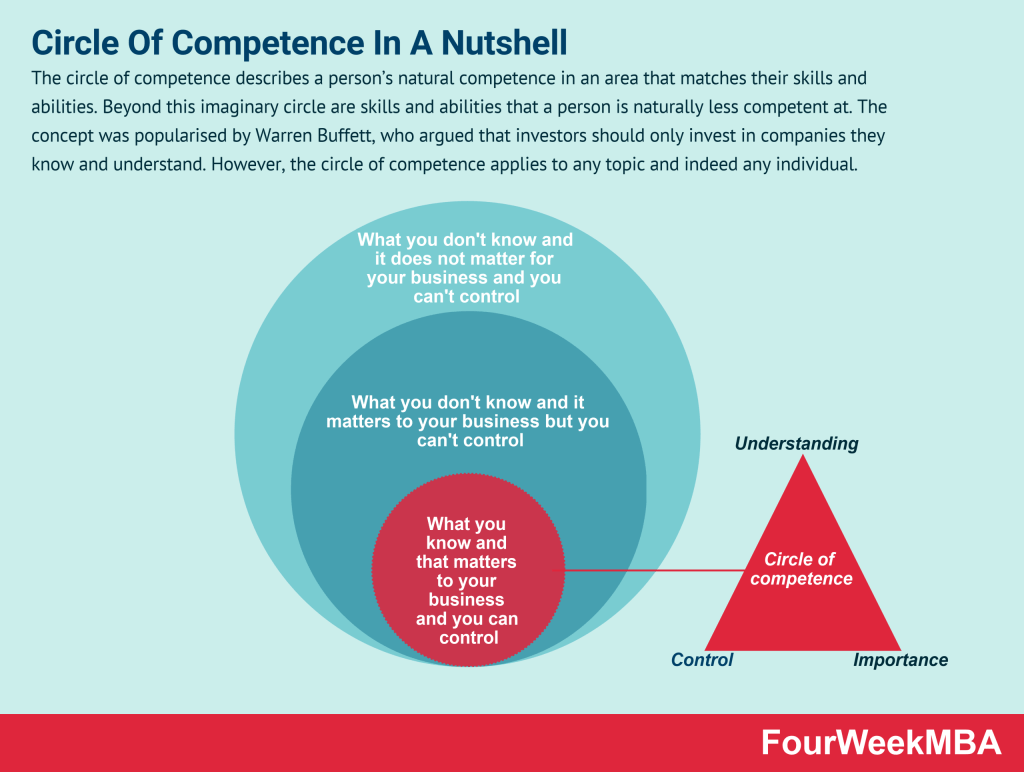
The circle of competence describes a person’s natural competence in an area that matches their skills and abilities. Beyond this imaginary circle are skills and abilities that a person is naturally less competent at. The concept was popularised by Warren Buffett, who argued that investors should only invest in companies they know and understand. However, the circle of competence applies to any topic and indeed any individual.
Economic or market moats represent the long-term business defensibility. Or how long a business can retain its competitive advantage in the marketplace over the years. Warren Buffet who popularized the term “moat” referred to it as a share of mind, opposite to market share, as such it is the characteristic that all valuable brands have.
The Buffet Indicator is a measure of the total value of all publicly-traded stocks in a country divided by that country’s GDP. It’s a measure and ratio to evaluate whether a market is undervalued or overvalued. It’s one of Warren Buffet’s favorite measures as a warning that financial markets might be overvalued and riskier.
Venture capital is a form of investing skewed toward high-risk bets, that are likely to fail. Therefore venture capitalists look for higher returns. Indeed, venture capital is based on the power law, or the law for which a small number of bets will pay off big time for the larger numbers of low-return or investments that will go to zero. That is the whole premise of venture capital.
Foreign direct investment occurs when an individual or business purchases an interest of 10% or more in a company that operates in a different country. According to the International Monetary Fund (IMF), this percentage implies that the investor can influence or participate in the management of an enterprise. When the interest is less than 10%, on the other hand, the IMF simply defines it as a security that is part of a stock portfolio. Foreign direct investment (FDI), therefore, involves the purchase of an interest in a company by an entity that is located in another country.
Micro-investing is the process of investing small amounts of money regularly. The process of micro-investing involves small and sometimes irregular investments where the individual can set up recurring payments or invest a lump sum as cash becomes available.
Meme stocks are securities that go viral online and attract the attention of the younger generation of retail investors. Meme investing, therefore, is a bottom-up, community-driven approach to investing that positions itself as the antonym to Wall Street investing. Also, meme investing often looks at attractive opportunities with lower liquidity that might be easier to overtake, thus enabling wide speculation, as “meme investors” often look for disproportionate short-term returns.
Retail investing is the act of non-professional investors buying and selling securities for their own purposes. Retail investing has become popular with the rise of zero commissions digital platforms enabling anyone with small portfolio to trade.
Accredited investors are individuals or entities deemed sophisticated enough to purchase securities that are not bound by the laws that protect normal investors. These may encompass venture capital, angel investments, private equity funds, hedge funds, real estate investment funds, and specialty investment funds such as those related to cryptocurrency. Accredited investors, therefore, are individuals or entities permitted to invest in securities that are complex, opaque, loosely regulated, or otherwise unregistered with a financial authority.
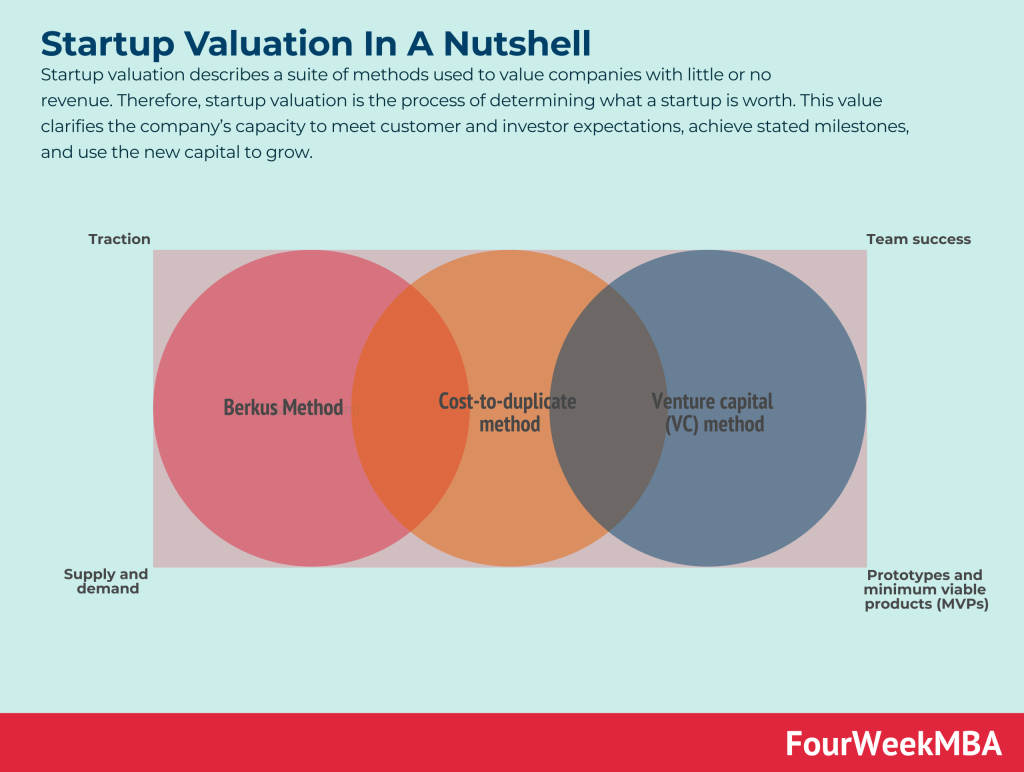
Startup valuation describes a suite of methods used to value companies with little or no revenue. Therefore, startup valuation is the process of determining what a startup is worth. This value clarifies the company’s capacity to meet customer and investor expectations, achieve stated milestones, and use the new capital to grow.
Profit is the total income that a company generates from its operations. This includes money from sales, investments, and other income sources. In contrast, cash flow is the money that flows in and out of a company. This distinction is critical to understand as a profitable company might be short of cash and have liquidity crises.
Double-entry accounting is the foundation of modern financial accounting. It’s based on the accounting equation, where assets equal liabilities plus equity. That is the fundamental unit to build financial statements (balance sheet, income statement, and cash flow statement). The basic concept of double-entry is that a single transaction, to be recorded, will hit two accounts.
The purpose of the balance sheet is to report how the resources to run the operations of the business were acquired. The Balance Sheet helps to assess the financial risk of a business and the simplest way to describe it is given by the accounting equation (assets = liability + equity).
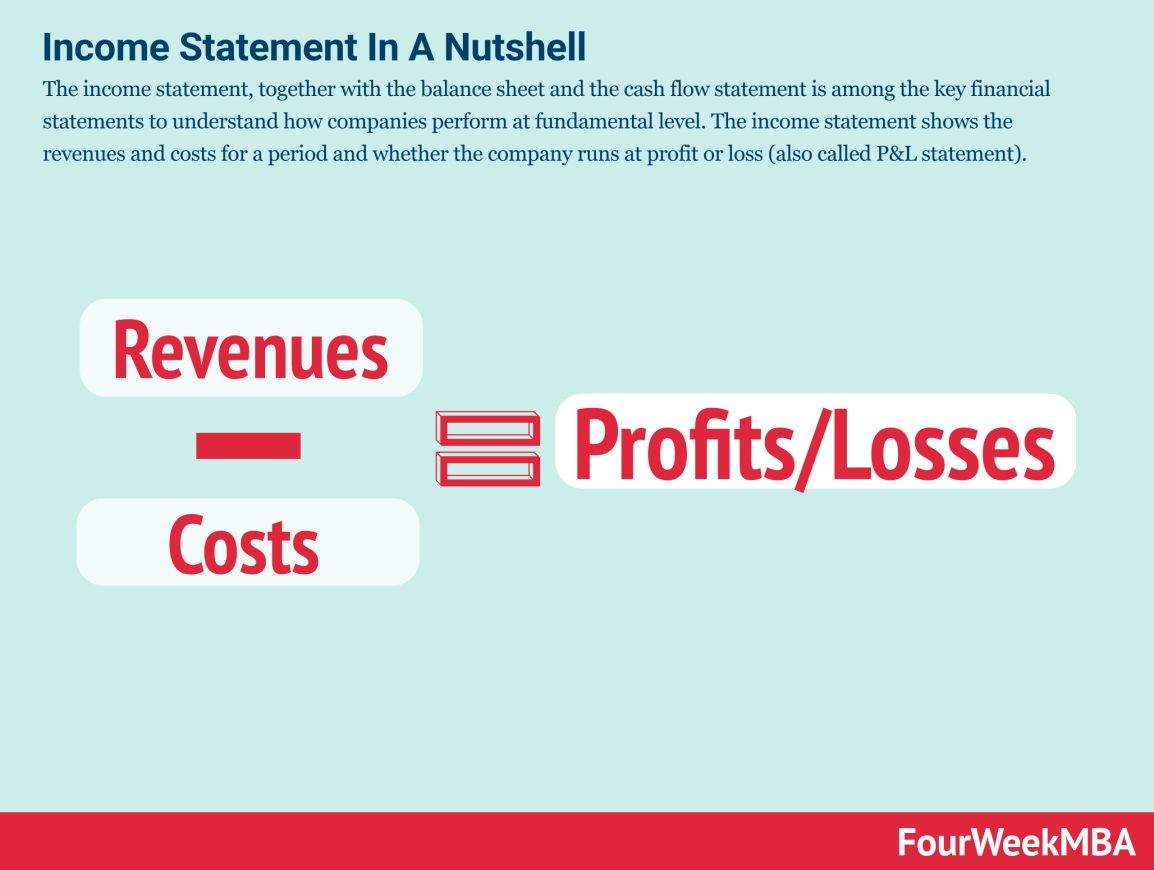
The income statement, together with the balance sheet and the cash flow statement is among the key financial statements to understand how companies perform at fundamental level. The income statement shows the revenues and costs for a period and whether the company runs at profit or loss (also called P&L statement).
The cash flow statement is the third main financial statement, together with income statement and the balance sheet. It helps to assess the liquidity of an organization by showing the cash balances coming from operations, investing and financing. The cash flow statement can be prepared with two separate methods: direct or indirect.
The capital structure shows how an organization financed its operations. Following the balance sheet structure, usually, assets of an organization can be built either by using equity or liability. Equity usually comprises endowment from shareholders and profit reserves. Where instead, liabilities can comprise either current (short-term debt) or non-current (long-term obligations).
Capital expenditure or capital expense represents the money spent toward things that can be classified as fixed asset, with a longer term value. As such they will be recorded under non-current assets, on the balance sheet, and they will be amortized over the years. The reduced value on the balance sheet is expensed through the profit and loss.
Financial statements help companies assess several aspects of the business, from profitability (income statement) to how assets are sourced (balance sheet), and cash inflows and outflows (cash flow statement). Financial statements are also mandatory to companies for tax purposes. They are also used by managers to assess the performance of the business.
Financial modeling involves the analysis of accounting, finance, and business data to predict future financial performance. Financial modeling is often used in valuation, which consists of estimating the value in dollar terms of a company based on several parameters. Some of the most common financial models comprise discounted cash flows, the M&A model, and the CCA model.
Business valuations involve a formal analysis of the key operational aspects of a business. A business valuation is an analysis used to determine the economic value of a business or company unit. It’s important to note that valuations are one part science and one part art. Analysts use professional judgment to consider the financial performance of a business with respect to local, national, or global economic conditions. They will also consider the total value of assets and liabilities, in addition to patented or proprietary technology.
A financial option is a contract, defined as a derivative drawing its value on a set of underlying variables (perhaps the volatility of the stock underlying the option). It comprises two parties (option writer and option buyer). This contract offers the right of the option holder to purchase the underlying asset at an agreed price.
Gennaro is the creator of FourWeekMBA, which reached about four million business people, comprising C-level executives, investors, analysts, product managers, and aspiring digital entrepreneurs in 2022 alone | He is also Director of Sales for a high-tech scaleup in the AI Industry | In 2012, Gennaro earned an International MBA with emphasis on Corporate Finance and Business Strategy.