The 5P Model encompasses Product, Price, Place, Promotion, and People as key elements of marketingstrategy. It offers a holistic approach, prioritizing customer-centric marketing and targeted campaigns. Used in product launches and marketing efforts, it’s adaptable for diverse industries, as seen in consumer electronics and hospitality marketing.
5P Model
Description
Implications
Examples
Applications
Purpose
The “Purpose” element focuses on defining the clear and specific purpose or goal of a project, initiative, or task. It involves answering questions like “Why are we doing this?” and “What do we aim to achieve?”
– Provides clarity and direction for the project. – Aligns team members with a common objective. – Guides decision-making and prioritization. – Motivates and inspires team members.
– Setting a goal to increase customer satisfaction by 20% within the next year. – Defining the purpose of a marketing campaign as promoting a new product launch. – Establishing the purpose of a research project as understanding consumer behavior in a specific market segment. – Clarifying the purpose of a team-building workshop as improving collaboration and communication among team members.
– Project Initiation: Clearly define the project’s purpose and objectives. – Strategic Planning: Establish a clear purpose for strategic initiatives. – Goal Setting: Set specific and measurable goals for individuals or teams. – Communication: Communicate the purpose effectively to team members and stakeholders.
Plan
The “Plan” element involves creating a well-structured and organized plan to achieve the defined purpose or goal. It includes outlining the steps, resources, timelines, and responsibilities required for successful execution.
– Provides a roadmap for achieving the purpose. – Ensures efficient resource allocation. – Facilitates coordination among team members. – Identifies potential risks and challenges.
– Developing a project plan with detailed tasks, milestones, and timelines. – Creating a marketing plan that outlines advertising strategies, budget allocation, and target audience. – Drafting a research plan specifying data collection methods, sample size, and analysis techniques. – Designing a workshop agenda with activities and timeframes.
– Project Management: Develop comprehensive project plans for effective execution. – Strategic Planning: Create strategic plans with actionable steps. – Risk Management: Identify and mitigate potential risks in the planning phase. – Team Collaboration: Assign roles and responsibilities to team members based on the plan.
People
The “People” element focuses on assembling the right team with the necessary skills, expertise, and roles to execute the plan and achieve the purpose. It includes recruiting, training, and organizing team members effectively.
– Ensures that the team possesses the required skills and capabilities. – Promotes collaboration and synergy among team members. – Encourages continuous learning and development. – Establishes clear roles and responsibilities.
– Hiring individuals with marketing expertise for a marketing campaign team. – Training team members on data analysis tools and techniques for a research project. – Appointing a project manager, team leads, and specialists for a complex project. – Encouraging cross-functional training and skill-sharing among team members.
– Talent Acquisition: Recruit and select team members with the necessary skills. – Team Development: Provide training and development opportunities to enhance capabilities. – Role Definition: Clearly define roles and responsibilities within the team. – Collaboration: Foster a collaborative and inclusive team culture.
Process
The “Process” element involves designing and implementing efficient and effective processes or workflows to execute the plan systematically. It focuses on optimizing the way tasks are carried out to achieve the purpose with maximum efficiency and quality.
– Enhances workflow efficiency and reduces bottlenecks. – Ensures consistency and quality in task execution. – Identifies opportunities for process improvement. – Streamlines resource utilization.
– Developing standardized procedures for product manufacturing in a factory. – Implementing an agile software development process to deliver software products efficiently. – Creating a research methodology for data collection and analysis. – Establishing customer support processes to handle inquiries and issues effectively.
– Process Optimization: Continuously improve processes for better efficiency. – Quality Management: Implement quality control measures in process execution. – Lean Principles: Apply lean principles to eliminate waste and improve flow. – Workflow Design: Design and document workflows to ensure clarity and consistency.
Performance
The “Performance” element involves monitoring, measuring, and evaluating the outcomes and results of the execution process. It includes assessing progress, identifying areas of improvement, and ensuring that performance aligns with the defined purpose and goals.
– Provides data-driven insights into progress and outcomes. – Enables informed decision-making and adjustments. – Recognizes achievements and identifies areas for enhancement. – Ensures alignment with the purpose and desired outcomes.
– Tracking key performance indicators (KPIs) to measure campaign effectiveness in marketing. – Analyzing project milestones and deliverables to assess progress. – Conducting regular reviews of research findings and data quality. – Monitoring customer satisfaction ratings and response times in customer support.
– Performance Metrics: Define and track relevant performance metrics and KPIs. – Continuous Improvement: Identify areas for improvement based on performance data. – Data Analysis: Analyze performance data to make informed decisions. – Reporting and Communication: Share performance insights with stakeholders and team members.
The 5P Model is a strategic planning framework that assists organizations in defining and executing their strategies effectively. It encompasses five key elements that are crucial for strategic success, including Purpose, Principles, Priorities, People, and Performance.
Key Elements of the 5P Model:
Purpose: Clarifying the organization’s mission, vision, and values to establish a clear direction and purpose.
Principles: Defining the guiding principles and ethical standards that will drive decision-making and behavior within the organization.
Priorities: Identifying strategic priorities and goals that need to be achieved to fulfill the organization’s purpose and principles.
People: Aligning the right people, skills, and resources to execute the strategy effectively.
Performance: Establishing performance metrics and measures to track progress and ensure accountability.
Why the 5P Model Matters:
Understanding the significance of the 5P Model is essential for organizations looking to enhance their strategic planning processes and achieve their long-term objectives.
The Impact of the 5P Model:
Strategic Clarity: The 5P Model provides a structured approach to defining and communicating an organization’s strategic direction, fostering clarity among stakeholders.
Alignment: It helps align the organization’s actions and decisions with its purpose, principles, and priorities.
Performance Improvement: By emphasizing performance measurement and accountability, the 5P Model contributes to continuous improvement and goal achievement.
Benefits of Using the 5P Model:
Holistic Approach: It ensures that all aspects of strategic planning are considered, promoting a well-rounded strategy.
Alignment: The 5P Model facilitates alignment at all levels of the organization, from leadership to front-line employees.
Challenges of Using the 5P Model:
Implementation Complexity: Executing the 5P Model effectively requires a commitment to change and may encounter resistance within the organization.
Resource Intensive: The process can be resource-intensive, requiring time and effort to gather data, analyze performance, and track progress.
Challenges in Using the 5P Model:
Understanding the challenges and limitations associated with the 5P Model is crucial for organizations seeking to implement it successfully.
Implementation Complexity:
Change Management: Introducing the 5P Model may require significant changes in organizational culture and processes, which can be met with resistance.
Solution: Effective change management strategies and communication plans can help address this challenge.
Resource Intensive:
Data Gathering: Collecting and analyzing data to inform the 5P Model’s components can be resource-intensive.
Solution: Leveraging technology and automation can streamline data collection and analysis processes.
The 5P Model in Action:
To better understand the 5P Model, let’s explore how it functions in various organizational scenarios and what it reveals about the effectiveness of strategic planning.
Corporate Strategy Development:
Scenario: A multinational corporation is formulating its corporate strategy for the next five years.
The 5P Model in Action:
Purpose: The organization defines its mission, vision, and values, clarifying its strategic direction.
Principles: Ethical standards and guiding principles are established to ensure ethical behavior in all operations.
Priorities: Strategic priorities are identified, such as market expansion and product diversification.
People: The right talent and resources are aligned with strategic priorities.
Performance: Key performance indicators (KPIs) are established to monitor progress and ensure accountability.
Nonprofit Organizational Planning:
Scenario: A nonprofit organization is developing a strategic plan to address pressing societal issues.
The 5P Model in Action:
Purpose: The organization articulates its mission and vision, focusing on social impact.
Principles: Ethical principles guide decision-making and partnerships.
Priorities: Strategic goals, such as fundraising and program expansion, are identified.
People: Skilled volunteers and staff are engaged to execute programs effectively.
Performance: Outcome metrics are established to measure the organization’s social impact.
Examples and Applications:
Corporate Social Responsibility (CSR):
Organizations use the 5P Model to develop CSR initiatives aligned with their mission and values.
Example: A company may define its purpose as environmental stewardship and prioritize initiatives to reduce carbon emissions and promote sustainability.
Startup Business Strategy:
Startups apply the 5P Model to define their vision, principles, and priorities as they seek growth and market penetration.
Example: A tech startup may establish its purpose as disrupting an industry, with principles centered on innovation, and priorities focused on product development and market expansion.
Educational Institution Planning:
Educational institutions use the 5P Model to create strategic plans that align with their educational mission.
Example: A university may define its purpose as providing affordable education, with principles emphasizing inclusivity, and priorities centered on scholarship programs.
Applications and Use Cases:
Strategic Planning:
Organizations use the 5P Model to guide their strategic planning processes, ensuring a comprehensive and aligned approach.
Change Management:
During times of change, the 5P Model helps organizations align their actions with new strategic priorities and principles.
Performance Management:
The 5P Model supports performance measurement and accountability, helping organizations track progress toward their goals.
Decision-Making:
Decision-makers use the 5P Model to evaluate options and select strategies that align with the organization’s purpose and principles.
Conclusion:
In conclusion, the 5P Model is a powerful strategic planning framework that offers organizations a structured and comprehensive approach to defining and executing their strategies effectively.
The applications of the 5P Model are diverse, spanning various industries and organizational contexts. While it presents challenges related to implementation complexity and resource requirements, its ability to foster strategic clarity, alignment, and performance improvement makes it a valuable tool for organizations seeking to achieve their long-term objectives. By acknowledging the significance of the 5P Model and dedicating the necessary resources and commitment to change, organizations can enhance their strategic planning processes and make informed decisions that drive success and sustainability.
Key Highlights
Marketing Framework: The 5P Model is a comprehensive marketing mix framework.
Key Elements: It focuses on Product, Price, Place, Promotion, and People.
Benefits: Provides a holistic approach, customer-centricity, and effective marketingstrategy.
Challenges: Addresses coordination and adaptation challenges in implementing the model.
Applications: Used for product launches and strategic marketing campaigns.
Use Cases: Illustrated in consumer electronics and hospitality industry marketing.
A Blockchain Business Model according to the FourWeekMBA framework is made of four main components: Value Model (Core Philosophy, Core Values and Value Propositions for the key stakeholders), Blockchain Model (Protocol Rules, Network Shape and Applications Layer/Ecosystem), Distribution Model (the key channels amplifying the protocol and its communities), and the Economic Model (the dynamics/incentives through which protocol players make money). Those elements coming together can serve as the basis to build and analyze a solid Blockchain Business Model.
In a business world driven by technology and digitalization, competition is much more fluid, as innovation becomes a bottom-up approach that can come from anywhere. Thus, making it much harder to define the boundaries of existing markets. Therefore, a proper business competition analysis looks at customer, technology, distribution, and financial model overlaps. While at the same time looking at future potential intersections among industries that in the short-term seem unrelated.
Technological modeling is a discipline to provide the basis for companies to sustain innovation, thus developing incremental products. While also looking at breakthrough innovative products that can pave the way for long-term success. In a sort of Barbell Strategy, technological modeling suggests having a two-sided approach, on the one hand, to keep sustaining continuous innovation as a core part of the business model. On the other hand, it places bets on future developments that have the potential to break through and take a leap forward.
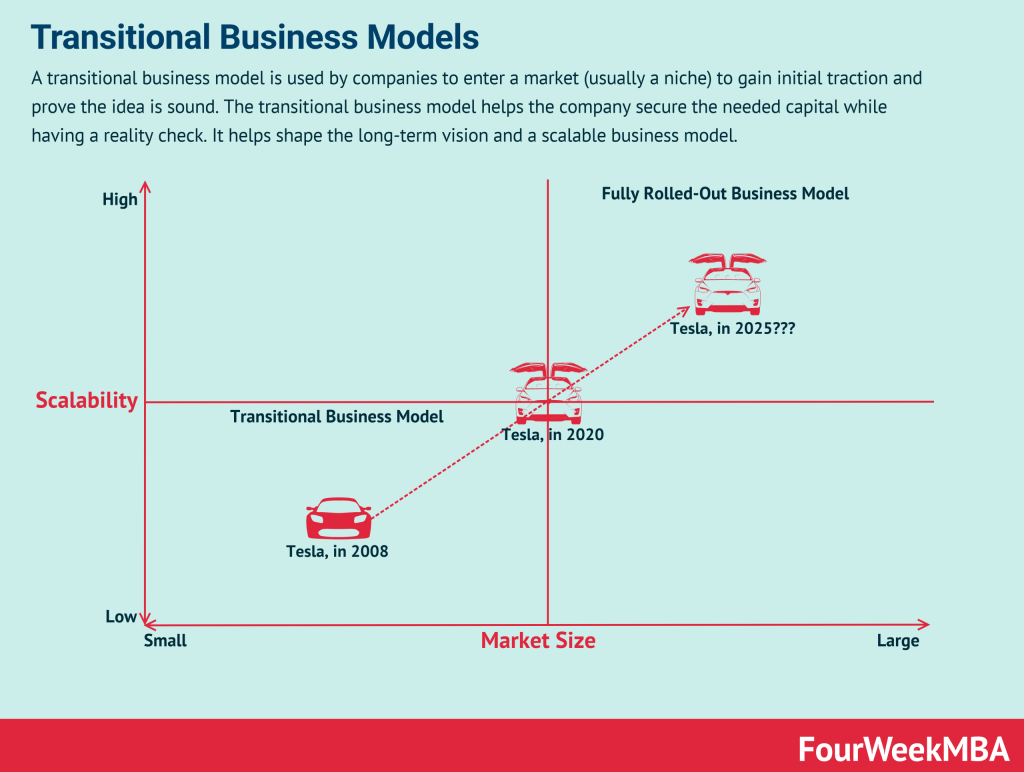
A transitional business model is used by companies to enter a market (usually a niche) to gain initial traction and prove the idea is sound. The transitional business model helps the company secure the needed capital while having a reality check. It helps shape the long-term vision and a scalable business model.
The minimum viable audience (MVA) represents the smallest possible audience that can sustain your business as you get it started from a microniche (the smallest subset of a market). The main aspect of the MVA is to zoom into existing markets to find those people which needs are unmet by existing players.
Business scaling is the process of transformation of a business as the product is validated by wider and wider market segments. Business scaling is about creating traction for a product that fits a small market segment. As the product is validated it becomes critical to build a viable business model. And as the product is offered at wider and wider market segments, it’s important to align product, business model, and organizational design, to enable wider and wider scale.
The market expansion consists in providing a product or service to a broader portion of an existing market or perhaps expanding that market. Or yet, market expansions can be about creating a whole new market. At each step, as a result, a company scales together with the market covered.
In the FourWeekMBA growth matrix, you can apply growth for existing customers by tackling the same problems (gain mode). Or by tackling existing problems, for new customers (expand mode). Or by tackling new problems for existing customers (extend mode). Or perhaps by tackling whole new problems for new customers (reinvent mode).
In the FourWeekMBA Revenue Streams Matrix, revenue streams are classified according to the kind of interactions the business has with its key customers. The first dimension is the “Frequency” of interaction with the key customer. As the second dimension, there is the “Ownership” of the interaction with the key customer.
Revenue model patterns are a way for companies to monetize their business models. A revenue model pattern is a crucial building block of a business model because it informs how the company will generate short-term financial resources to invest back into the business. Thus, the way a company makes money will also influence its overall business model.
The Cynefin Framework gives context to decision making and problem-solving by providing context and guiding an appropriate response. The five domains of the Cynefin Framework comprise obvious, complicated, complex, chaotic domains and disorder if a domain has not been determined at all.
A SWOT Analysis is a framework used for evaluating the business’s Strengths, Weaknesses, Opportunities, and Threats. It can aid in identifying the problematic areas of your business so that you can maximize your opportunities. It will also alert you to the challenges your organization might face in the future.
The SWOT analysis is commonly used as a strategic planning tool in business. However, it is also well suited for personal use in addressing a specific goal or problem. A personal SWOT analysis helps individuals identify their strengths, weaknesses, opportunities, and threats.
The Pareto Analysis is a statistical analysis used in business decision making that identifies a certain number of input factors that have the greatest impact on income. It is based on the similarly named Pareto Principle, which states that 80% of the effect of something can be attributed to just 20% of the drivers.
A failure mode and effects analysis (FMEA) is a structured approach to identifying design failures in a product or process. Developed in the 1950s, the failure mode and effects analysis is one the earliest methodologies of its kind. It enables organizations to anticipate a range of potential failures during the design stage.
A Blindspot Analysis is a means of unearthing incorrect or outdated assumptions that can harm decision making in an organization. The term “blindspot analysis” was first coined by American economist Michael Porter. Porter argued that in business, outdated ideas or strategies had the potential to stifle modern ideas and prevent them from succeeding. Furthermore, decisions a business thought were made with care caused projects to fail because major factors had not been duly considered.
A comparable company analysis is a process that enables the identification of similar organizations to be used as a comparison to understand the business and financial performance of the target company. To find comparables you can look at two key profiles: the business and financial profile. From the comparable company analysis it is possible to understand the competitive landscape of the target organization.
A cost-benefit analysis is a process a business can use to analyze decisions according to the costs associated with making that decision. For a cost analysis to be effective it’s important to articulate the project in the simplest terms possible, identify the costs, determine the benefits of project implementation, assess the alternatives.
Agile Business Analysis (AgileBA) is certification in the form of guidance and training for business analysts seeking to work in agile environments. To support this shift, AgileBA also helps the business analyst relate Agile projects to a wider organizational mission or strategy. To ensure that analysts have the necessary skills and expertise, AgileBA certification was developed.
A SOAR analysis is a technique that helps businesses at a strategic planning level to:
Focus on what they are doing right.
Determine which skills could be enhanced.
Understand the desires and motivations of their stakeholders.
The STEEPLE analysis is a variation of the STEEP analysis. Where the step analysis comprises socio-cultural, technological, economic, environmental/ecological, and political factors as the base of the analysis. The STEEPLE analysis adds other two factors such as Legal and Ethical.
The PESTEL analysis is a framework that can help marketers assess whether macro-economic factors are affecting an organization. This is a critical step that helps organizations identify potential threats and weaknesses that can be used in other frameworks such as SWOT or to gain a broader and better understanding of the overall marketing environment.
A DESTEP analysis is a framework used by businesses to understand their external environment and the issues which may impact them. The DESTEP analysis is an extension of the popular PEST analysis created by Harvard Business School professor Francis J. Aguilar. The DESTEP analysis groups external factors into six categories: demographic, economic, socio-cultural, technological, ecological, and political.
A paired comparison analysis is used to rate or rank options where evaluation criteria are subjective by nature. The analysis is particularly useful when there is a lack of clear priorities or objective data to base decisions on. A paired comparison analysis evaluates a range of options by comparing them against each other.
Gennaro is the creator of FourWeekMBA, which reached about four million business people, comprising C-level executives, investors, analysts, product managers, and aspiring digital entrepreneurs in 2022 alone | He is also Director of Sales for a high-tech scaleup in the AI Industry | In 2012, Gennaro earned an International MBA with emphasis on Corporate Finance and Business Strategy.