Target Account Selling (TAS) is a strategic sales methodology that focuses on identifying and prioritizing high-value accounts and developing tailored sales strategies to win and retain them. This approach involves a proactive and systematic approach to targeting key accounts, understanding their unique needs and challenges, and delivering personalized solutions to drive revenue growth.
Target Account Selling begins with the selection of target accounts based on criteria such as revenue potential, strategic fit, market opportunity, and customer profile. These target accounts are typically identified through market research, segmentation analysis, and collaboration between sales and marketing teams.
2. Account Planning
Once target accounts are identified, sales professionals develop comprehensive account plans that outline the strategies and tactics for engaging with key stakeholders, understanding their business objectives, and addressing their specific needs and challenges. Account plans typically include goals, timelines, key contacts, competitive insights, and value propositions tailored to each account.
3. Relationship Building
Target Account Selling emphasizes building strong relationships with key stakeholders within target accounts, including decision-makers, influencers, and users. Sales professionals engage in proactive outreach, networking, and relationship-building activities to establish trust, credibility, and rapport with customers.
4. Value Proposition Development
Central to Target Account Selling is the development of compelling value propositions that resonate with the unique needs and priorities of each target account. Sales professionals articulate the value of their products or services in addressing the specific challenges and opportunities facing the customer, highlighting key differentiators and benefits.
Application of Target Account Selling
1. Strategic Account Management
Target Account Selling aligns closely with strategic account management principles, where sales professionals take a proactive and strategic approach to managing key accounts. By understanding the strategic importance of each account and developing customized strategies, sales professionals can maximize revenue opportunities and strengthen customer relationships.
2. Consultative Selling
Target Account Selling emphasizes a consultative approach to sales, where sales professionals act as trusted advisors and problem solvers for their customers. By understanding the unique needs and challenges of each target account, sales professionals can offer tailored solutions and recommendations that deliver value and drive business outcomes.
3. Cross-Selling and Upselling
Target Account Selling presents opportunities for cross-selling and upselling additional products or services to existing customers. By deepening their understanding of customer needs and expanding their relationships within target accounts, sales professionals can identify opportunities to introduce complementary offerings and increase revenue per account.
Significance of Target Account Selling
1. Revenue Growth
Target Account Selling is a key driver of revenue growth for businesses by focusing resources and efforts on high-potential accounts. By prioritizing strategic accounts and developing customized sales strategies, businesses can maximize revenue opportunities and achieve sustainable growth.
2. Customer Retention
Target Account Selling helps businesses strengthen customer relationships and improve customer retention rates. By providing personalized solutions and delivering value to key accounts, businesses can enhance customer satisfaction, loyalty, and advocacy, reducing the risk of customer churn.
3. Competitive Advantage
Target Account Selling provides a competitive advantage by enabling businesses to differentiate themselves in the market. By demonstrating a deep understanding of customer needs, delivering tailored solutions, and building strong relationships, businesses can position themselves as trusted partners and preferred vendors for their target accounts.
Implementation and Considerations
1. Sales Team Training
Successful implementation of Target Account Selling requires training and development for sales teams on account selection, planning, relationship-building, and value proposition development. Sales professionals need the skills, knowledge, and tools to effectively execute Target Account Selling strategies.
2. Collaboration Across Departments
Target Account Selling involves collaboration and alignment between sales, marketing, customer success, and other departments within the organization. Cross-functional teamwork is essential for identifying target accounts, developing account plans, and delivering value to customers.
3. Performance Measurement
Businesses should establish key performance indicators (KPIs) and metrics to track the effectiveness of Target Account Selling efforts. These metrics may include revenue growth, customer retention rates, win rates, customer satisfaction scores, and account penetration levels.
Conclusion
Target Account Selling is a strategic sales methodology that enables businesses to identify, engage, and win high-value target accounts. By focusing resources and efforts on key strategic accounts, understanding their unique needs, and delivering personalized solutions, businesses can drive revenue growth, improve customer retention, and gain a competitive advantage in the market. As businesses strive to build stronger relationships with customers and maximize revenue opportunities, Target Account Selling remains a valuable approach for sales teams seeking to achieve their growth objectives and drive long-term success. Through its emphasis on account selection, planning, relationship-building, and value proposition development, Target Account Selling empowers sales professionals to win and retain high-value customers and maximize their impact on business performance.
Business development comprises a set of strategies and actions to grow a business via a mixture of sales, marketing, and distribution. While marketing usually relies on automation to reach a wider audience, and sales typically leverage a one-to-one approach. The business development’s role is that of generating distribution.
The more you move from consumers to enterprise clients, the more you’ll need a sales force able to manage complex sales. As a rule of thumb, a more expensive product, in B2B or Enterprise, will require an organizational structure around sales. An inexpensive product to be offered to consumers will leverage on marketing.
A sales cycle is the process that your company takes to sell your services and products. In simple words, it’s a series of steps that your sales reps need to go through with prospects that lead up to a closed sale.
RevOps – short for Revenue Operations – is a framework that aims to maximize the revenue potential of an organization. RevOps seeks to align these departments by giving them access to the same data and tools. With shared information, each then understands their role in the sales funnel and can work collaboratively to increase revenue.
In negotiation theory, BATNA stands for “Best Alternative To a Negotiated Agreement,” and it’s one of the key tenets of negotiation theory. Indeed, it describes the best course of action a party can take if negotiations fail to reach an agreement. This simple strategy can help improve the negotiation as each party is (in theory) willing to take the best course of action, as otherwise, an agreement won’t be reached.
In negotiation, WATNA stands for “worst alternative to a negotiated agreement,” representing one of several alternative options if a resolution cannot be reached. This is a useful technique to help understand what might be a negotiation outcome, that even if negative is still better than a WATNA, making the deal still feasible.
The ZOPA (zone of possible agreement) describes an area in which two negotiation parties may find common ground. Indeed, ZOPA is critical to explore the deals where the parties get a mutually beneficial outcome to prevent the risk of a win-lose, or lose-win scenario. And therefore get to the point of a win-win negotiation outcome.
Revenue modeling is a process of incorporating a sustainable financial model for revenue generation within a business model design. Revenue modeling can help to understand what options make more sense in creating a digital business from scratch; alternatively, it can help in analyzing existing digital businesses and reverse engineer them.
Customer experience maps are visual representations of every encounter a customer has with a brand. On a customer experience map, interactions called touchpoints visually denote each interaction that a business has with its consumers. Typically, these include every interaction from the first contact to marketing, branding, sales, and customer support.
AIDA stands for attention, interest, desire, and action. That is a model that is used in marketing to describe the potential journey a customer might go through before purchasing a product or service. The AIDA model helps organizations focus their efforts when optimizing their marketing activities based on the customers’ journeys.
Social selling is a process of developing trust, rapport, and a relationship with a prospect to enhance the sales cycle. It usually happens through tech platforms (like LinkedIn, Twitter, Facebook, and more), which enable salespeople to engage with potential prospects before closing the sale, thus becoming more effective.
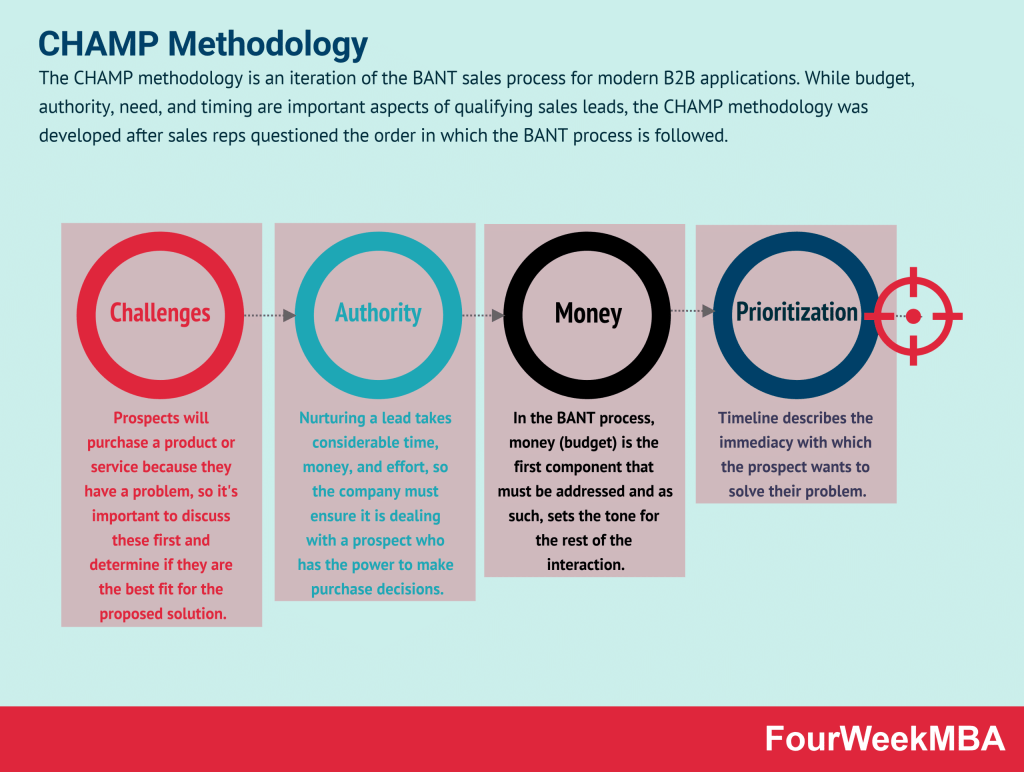
The CHAMP methodology is an iteration of the BANT sales process for modern B2B applications. While budget, authority, need, and timing are important aspects of qualifying sales leads, the CHAMP methodology was developed after sales reps questioned the order in which the BANT process is followed.
The BANT process was conceived at IBM in the 1950s as a way to quickly identify prospects most likely to make a purchase. Despite its introduction around 70 years ago, the BANT process remains relevant today and was formally adopted into IBM’s Business Agility Solution Identification Guide.
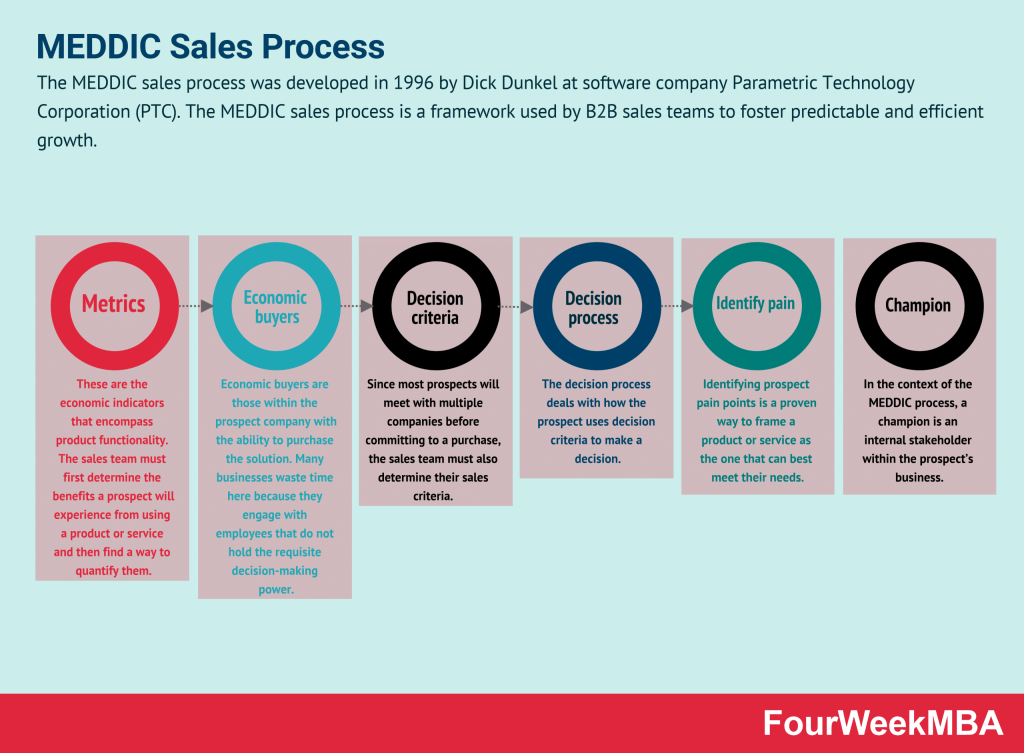
The MEDDIC sales process was developed in 1996 by Dick Dunkel at software company Parametric Technology Corporation (PTC). The MEDDIC sales process is a framework used by B2B sales teams to foster predictable and efficient growth.
STP marketing simplifies the market segmentation process and is one of the most commonly used approaches in modern marketing. The core focus of STP marketing is commercial effectiveness. Marketers use the approach to select the most valuable segments from a target audience and develop a product positioning strategy and marketing mix for each.
The sales funnel is a model used in marketing to represent an ideal, potential journey that potential customers go through before becoming actual customers. As a representation, it is also often an approximation, that helps marketing and sales teams structure their processes at scale, thus building repeatable sales and marketing tactics to convert customers.
Venture capitalist, Dave McClure, coined the acronym AARRR which is a simplified model that enables to understand what metrics and channels to look at, at each stage for the users’ path toward becoming customers and referrers of a brand.
The general concept of Bootstrapping connects to “a self-starting process that is supposed to proceed without external input.” In business, Bootstrapping means financing the growth of the company from the available cash flows produced by a viable business model. Bootstrapping requires the mastery of the key customers driving growth.
The virtuous cycle is a positive loop or a set of positive loops that trigger a non-linear growth. Indeed, in the context of digital platforms, virtuous cycles – also defined as flywheel models – help companies capture more market shares by accelerating growth. The classic example is Amazon’s lower prices driving more consumers, driving more sellers, thus improving variety and convenience, thus accelerating growth.
Business storytelling is a critical part of developing a business model. Indeed, the way you frame the story of your organization will influence its brand in the long-term. That’s because your brand story is tied to your brand identity, and it enables people to identify with a company.
Enterprise sales describes the procurement of large contracts that tend to be characterized by multiple decision-makers, complicated implementation, higher risk levels, or longer sales cycles.
Outside sales occur when a salesperson meets with prospects or customers in the field. This sort of sales function is critical to acquire larger accounts, like enterprise customers, for which the acquisition process is usually longer, more complex and it requires the understanding of the target organization. Thus the outside sales will cut through the noise to acquire a large enterprise account for the organization.
A freeterprise is a combination of free and enterprise where free professional accounts are driven into the funnel through the free product. As the opportunity is identified the company assigns the free account to a salesperson within the organization (inside sales or fields sales) to convert that into a B2B/enterprise account.
Zero to One is a book by Peter Thiel. But it also represents a business mindset, more typical of tech, where building something wholly new is the default mode, rather than building something incrementally better. The core premise of Zero to One then is that it’s much more valuable to create a whole new market/product rather than starting from existing markets.
Palantir is a software company offering intelligence services from governments and institutions to large commercial organizations. The company’s two main platforms Gotham and Foundry, are integrated at enterprise-level. Its business model follows three phases: Acquire, Expand, and Scale. The company bears the pilot costs in the acquire and expand phases, and it runs at a loss. Where in the scale phase, the customers’ contribution margins become positive.
Consultative selling is a sales approach favoring relationship building and open dialogue to adequately meet the needs of a prospective customer. By building trust quickly a consultative selling approach can help the customer better meet her/his expectations and the salesperson hit her/his targets more effectively.
A unique selling proposition (USP) enables a business to differentiate itself from its competitors. Importantly, a USP enables a business to stand for something that they, in turn, become known among consumers. A strong and recognizable USP is crucial to operating successfully in competitive markets.
A Blockchain Business Model according to the FourWeekMBA framework is made of four main components: Value Model (Core Philosophy, Core Values and Value Propositions for the key stakeholders), Blockchain Model (Protocol Rules, Network Shape and Applications Layer/Ecosystem), Distribution Model (the key channels amplifying the protocol and its communities), and the Economic Model (the dynamics/incentives through which protocol players make money). Those elements coming together can serve as the basis to build and analyze a solid Blockchain Business Model.
In an asymmetric business model, the organization doesn’t monetize the user directly, but it leverages the data users provide coupled with technology, thus have a key customer pay to sustain the core asset. For example, Google makes money by leveraging users’ data, combined with its algorithms sold to advertisers for visibility.
In a business world driven by technology and digitalization, competition is much more fluid, as innovation becomes a bottom-up approach that can come from anywhere. Thus, making it much harder to define the boundaries of existing markets. Therefore, a proper business competition analysis looks at customer, technology, distribution, and financial model overlaps. While at the same time looking at future potential intersections among industries that, in the short-term, seem unrelated.
Technological modeling is a discipline to provide the basis for companies to sustain innovation, thus developing incremental products. While also looking at breakthrough innovative products that can pave the way for long-term success. In a sort of Barbell Strategy, technological modeling suggests having a two-sided approach, on the one hand, to keep sustaining continuous innovation as a core part of the business model. On the other hand, it places bets on future developments that have the potential to break through and take a leap forward.
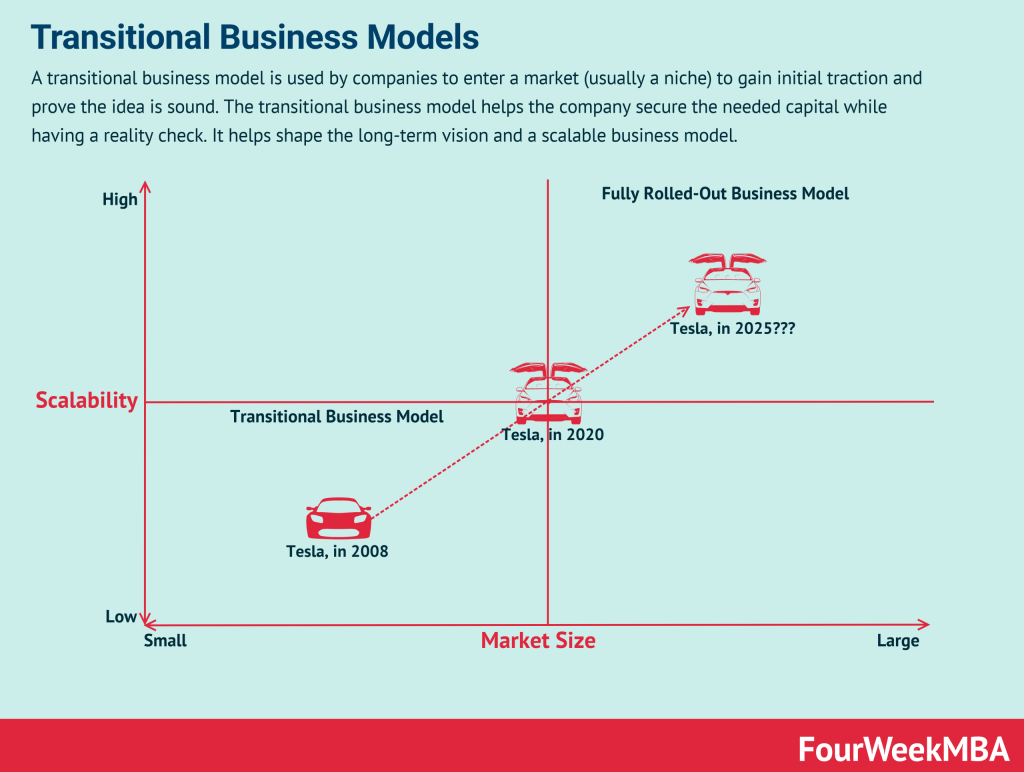
A transitional business model is used by companies to enter a market (usually a niche) to gain initial traction and prove the idea is sound. The transitional business model helps the company secure the needed capital while having a reality check. It helps shape the long-term vision and a scalable business model.
The minimum viable audience (MVA) represents the smallest possible audience that can sustain your business as you get it started from a microniche (the smallest subset of a market). The main aspect of the MVA is to zoom into existing markets to find those people which needs are unmet by existing players.
Business scaling is the process of transformation of a business as the product is validated by wider and wider market segments. Business scaling is about creating traction for a product that fits a small market segment. As the product is validated it becomes critical to build a viable business model. And as the product is offered at wider and wider market segments, it’s important to align product, business model, and organizational design, to enable wider and wider scale.
The market expansion consists in providing a product or service to a broader portion of an existing market or perhaps expanding that market. Or yet, market expansions can be about creating a whole new market. At each step, as a result, a company scales together with the market covered.
In the FourWeekMBA growth matrix, you can apply growth for existing customers by tackling the same problems (gain mode). Or by tackling existing problems, for new customers (expand mode). Or by tackling new problems for existing customers (extend mode). Or perhaps by tackling whole new problems for new customers (reinvent mode).
In the FourWeekMBA Revenue Streams Matrix, revenue streams are classified according to the kind of interactions the business has with its key customers. The first dimension is the “Frequency” of interaction with the key customer. As the second dimension, there is the “Ownership” of the interaction with the key customer.
Revenue model patterns are a way for companies to monetize their business models. A revenue model pattern is a crucial building block of a business model because it informs how the company will generate short-term financial resources to invest back into the business. Thus, the way a company makes money will also influence its overall business model.
A pricing strategy or model helps companies find the pricing formula in fit with their business models. Thus aligning the customer needs with the product type while trying to enable profitability for the company. A good pricing strategy aligns the customer with the company’s long term financial sustainability to build a solid business model.
Gennaro is the creator of FourWeekMBA, which reached about four million business people, comprising C-level executives, investors, analysts, product managers, and aspiring digital entrepreneurs in 2022 alone | He is also Director of Sales for a high-tech scaleup in the AI Industry | In 2012, Gennaro earned an International MBA with emphasis on Corporate Finance and Business Strategy.