The Social Enterprise Business Model is a business approach that combines profit generation with a primary focus on addressing social or environmental issues. U
Key Concepts
– Dual Mission: Social enterprises have a dual mission of financial sustainability and social impact. – Triple Bottom Line: Focus on the three P's: People (soci
Characteristics
– Social Impact Focus: Social enterprises prioritize addressing social or environmental issues. – Financial Sustainability: They aim to generate revenue to sust
Implications
– Positive Impact: Social enterprises contribute to positive social or environmental change. – Financial Sustainability: The model aims to generate revenue to s
Advantages
– Social Impact: Creates positive social or environmental change. – Financial Sustainability: Generates revenue for long-term viability. – Innovation: Encourage
Drawbacks
– Resource Challenges: Balancing financial sustainability with impact goals can be challenging. – Impact Measurement Complexity: Accurately measuring social or
Applications
Social enterprises can operate in a wide range of sectors, including education, healthcare, renewable energy, fair trade, microfinance, agriculture, and technol
Use Cases
– TOMS Shoes: Known for its "One for One" model, TOMS donates a pair of shoes to a child in need for every pair sold. – Grameen Bank: Provides microloans to emp
The social enterprise business model combines the commercial logic of the corporate sector and the social impact of the charity sector. Thus, it’s a hybrid model that serves to create companies able to create a social impact, at scale.
Aspect
Explanation
Definition
The Social Enterprise Business Model is a business approach that combines profit generation with a primary focus on addressing social or environmental issues. Unlike traditional businesses, social enterprises prioritize creating positive social impact alongside financial sustainability. These organizations leverage their core activities, products, or services to contribute to social causes, such as poverty alleviation, environmental conservation, education, healthcare, or community development. Social enterprises operate in various sectors and use a range of revenue models, including earned income, donations, grants, impact investments, and partnerships. Their success is measured not only by financial performance but also by the positive change they bring to society or the environment.
Key Concepts
– Dual Mission: Social enterprises have a dual mission of financial sustainability and social impact. – Triple Bottom Line: Focus on the three P’s: People (social), Planet (environmental), and Profit (financial). – Impact Measurement: Measuring and reporting social or environmental outcomes is integral. – Hybrid Legal Structures: Some social enterprises adopt hybrid legal structures, such as Benefit Corporations (B Corps) or Community Interest Companies (CICs), to legally embed their social mission. – Revenue Diversification: Utilizing various income sources, including sales, grants, donations, and impact investments. – Stakeholder Engagement: Engaging a wide range of stakeholders, including customers, beneficiaries, investors, and the community.
Characteristics
– Social Impact Focus: Social enterprises prioritize addressing social or environmental issues. – Financial Sustainability: They aim to generate revenue to sustain their operations. – Measurable Impact: These organizations measure and report their social or environmental impact. – Innovative Solutions: Often, social enterprises employ innovative approaches to tackle complex issues. – Stakeholder Involvement: Engage a diverse set of stakeholders to support their mission. – Legal Structure: Some adopt specific legal structures to embed their social mission.
Implications
– Positive Impact: Social enterprises contribute to positive social or environmental change. – Financial Sustainability: The model aims to generate revenue to support its mission sustainably. – Community Engagement: Engaging with the community and beneficiaries is crucial. – Investor Expectations: Investors may prioritize both financial returns and impact. – Innovation: The model often fosters innovative solutions to address societal challenges. – Impact Measurement: Transparency in measuring and reporting impact is essential.
Advantages
– Social Impact: Creates positive social or environmental change. – Financial Sustainability: Generates revenue for long-term viability. – Innovation: Encourages innovative approaches to address societal issues. – Stakeholder Engagement: Engages a wide range of stakeholders, including customers, beneficiaries, and investors. – Purpose-Driven: Appeals to individuals and investors seeking purpose alongside profit.
Drawbacks
– Resource Challenges: Balancing financial sustainability with impact goals can be challenging. – Impact Measurement Complexity: Accurately measuring social or environmental impact can be complex. – Limited Scale: Some social enterprises may face limitations in scaling their impact. – Market Competition: Competing with traditional businesses in the market can be tough. – Mission Drift: Maintaining focus on the social mission amid financial pressures is essential.
Applications
Social enterprises can operate in a wide range of sectors, including education, healthcare, renewable energy, fair trade, microfinance, agriculture, and technology. They address issues such as poverty, healthcare access, environmental conservation, gender equality, and more.
Use Cases
– TOMS Shoes: Known for its “One for One” model, TOMS donates a pair of shoes to a child in need for every pair sold. – Grameen Bank: Provides microloans to empower low-income individuals and alleviate poverty. – Patagonia: A sustainable outdoor clothing company that supports environmental causes. – Kiva: A platform that connects lenders with entrepreneurs in need of microloans. – Goodwill Industries: Offers job training and employment opportunities to people with disabilities and other barriers to employment. – Ben & Jerry’s: The ice cream company supports various social and environmental causes. – Apothekari: A skincare brand that donates a portion of profits to charity. – The Body Shop: Promotes ethically sourced beauty and skincare products. – Ashoka: A global network that identifies and supports social entrepreneurs. – SolarCity (now Tesla Energy): Focuses on solar energy solutions to combat climate change. – Fair Trade Certified Products: A wide range of products, from coffee to clothing, adhering to fair trade principles.
Understanding social enterprise business models
In essence, the success of the social enterprise business model relies on a company’s ability to balance profit with positive social impact.
Unlike a corporate business model comprised of the product, operational model, and revenue model, social enterprise models take a fundamentally different approach.
For one, there is a clear focus on social purposes as the beneficiaries of business activities.
This means enterprises strive to make a social impact and care less about creating and sustaining a competitive advantage.
To put it another way, social enterprises create value outside the business while corporate enterprises capture value internally.
As a result, social enterprise business models have an extra component – otherwise known as the “social impact model” – which drives all business decisions and explains how the social impact is generated.
Five social enterprise business model types
Despite the underlying framework of a social enterprise, there do exist a number of specific business models to choose from.
We have chosen five of them to briefly describe below:
Entrepreneur support model
These social enterprises provide support to entrepreneurs looking to establish their businesses.
Support may consist of training, microfinancing, consulting, or technical assistance.
Examples include economic development organizations and microfinanciers.
Market intermediary model
Under this model, the enterprise assists a client to help them develop, market, or sell their products and services.
Agricultural, fair trade, and handicraft organizations commonly use the market intermediary model.
Low-income client model
This model involves the social enterprise selling various social services to low-income clientele.
Hospitals and other organizations that offer healthcare services use this model.
Employment model
Where clients are provided with job training and employment opportunities.
Social enterprises collect revenue from employee salaries and reinvest it to help those still requiring assistance.
Many organizations that deal with disability, homelessness, and youth disadvantage use this model.
The cooperative model
The last social enterprise business model on our list is one of the most recognized.
Cooperatives are fee-based membership organizations that provide services to individuals with the same needs.
Collectively, these individuals own and operate the organization and benefit if it succeeds.
American employee-owned supermarket Publix is one of many examples.
Key takeaways:
The social enterprise business model combines the commercial logic of the corporate sector and the social impact of the charity sector.
Unlike a corporate business model comprised of the product, operational model, and revenue model, the beneficiary of a social enterprise’s business activities is society itself.
Despite the common purpose of all social enterprises, several different business models have been developed to help them achieve their goals. These include the entrepreneur support model, cooperative model, market intermediary model, low-income client model, and the employment model.
Key Highlights:
Definition of Social Enterprise: Social Enterprise Business Model combines profit generation with a primary focus on addressing social or environmental issues, prioritizing positive impact alongside financial sustainability. These organizations leverage core activities, products, or services to contribute to causes like poverty alleviation, healthcare, education, and environmental conservation.
Concepts and Characteristics: Social enterprises operate with a dual mission of financial sustainability and social impact, often measured through a triple bottom line approach focusing on People, Planet, and Profit. They employ diverse revenue models, engage stakeholders, and may adopt specific legal structures to embed their social mission.
Implications and Advantages: Social enterprises contribute to positive social or environmental change while aiming for financial sustainability. They foster innovation, stakeholder engagement, and purpose-driven initiatives, appealing to individuals and investors seeking both profit and purpose.
Drawbacks and Challenges: Challenges include balancing financial sustainability with impact goals, navigating complex impact measurement, scaling impact, competing with traditional businesses, and maintaining focus on the social mission amid financial pressures.
Applications and Use Cases: Social enterprises operate across various sectors, including education, healthcare, renewable energy, fair trade, microfinance, agriculture, and technology. Examples include TOMS Shoes, Grameen Bank, Patagonia, Kiva, and Goodwill Industries, among others.
Five Social Enterprise Business Model Types: Different models include the Entrepreneur Support Model, Market Intermediary Model, Low-Income Client Model, Employment Model, and Cooperative Model. Each model serves a specific purpose, such as providing support to entrepreneurs, assisting clients in product development, offering social services to low-income clientele, providing job training and employment opportunities, or operating as fee-based membership organizations.
Key Takeaways: The social enterprise business model combines profit with social impact, aiming to address societal challenges while ensuring financial sustainability. Despite variations in business models, all social enterprises strive to create positive change, engaging stakeholders and fostering innovation to achieve their goals.
An effective business model has to focus on two dimensions: the people dimension and the financial dimension. The people dimension will allow you to build a product or service that is 10X better than existing ones and a solid brand. The financial dimension will help you develop proper distribution channels by identifying the people that are willing to pay for your product or service and make it financially sustainable in the long run.
Business model innovation is about increasing the success of an organization with existing products and technologies by crafting a compelling value proposition able to propel a new business model to scale up customers and create a lasting competitive advantage. And it all starts by mastering the key customers.
Digital and tech business models can be classified according to four levels of transformation into digitally-enabled, digitally-enhanced, tech or platform business models, and business platforms/ecosystems.
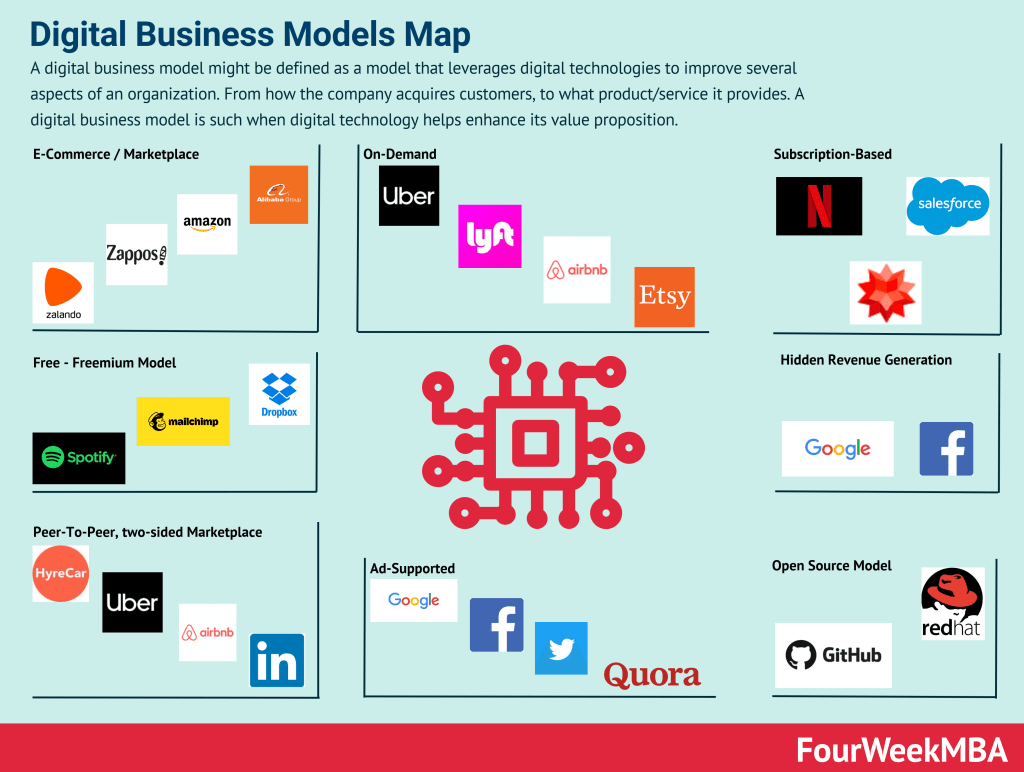
A digital business model might be defined as a model that leverages digital technologies to improve several aspects of an organization. From how the company acquires customers, to what product/service it provides. A digital business model is such when digital technology helps enhance its value proposition.
A tech business model is made of four main components: value model (value propositions, mission, vision), technological model (R&D management), distribution model (sales and marketing organizational structure), and financial model (revenue modeling, cost structure, profitability and cash generation/management). Those elements coming together can serve as the basis to build a solid tech business model.
A platform business model generates value by enabling interactions between people, groups, and users by leveraging network effects. Platform business models usually comprise two sides: supply and demand. Kicking off the interactions between those two sides is one of the crucial elements for a platform business model success.
A Blockchain Business Model is made of four main components: Value Model (Core Philosophy, Core Value and Value Propositions for the key stakeholders), Blockchain Model (Protocol Rules, Network Shape and Applications Layer/Ecosystem), Distribution Model (the key channels amplifying the protocol and its communities), and the Economic Model (the dynamics through which protocol players make money). Those elements coming together can serve as the basis to build and analyze a solid Blockchain Business Model.
In an asymmetric businessmodel, the organization doesn’t monetize the user directly, but it leverages the data users provide coupled with technology, thus have a key customer pay to sustain the core asset. For example, Google makes money by leveraging users’ data, combined with its algorithms sold to advertisers for visibility.
In an asymmetric businessmodel, the organization doesn’t monetize the user directly, but it leverages the data users provide coupled with technology, thus having a key customer pay to sustain the core asset. For example, Google makes money by leveraging users’ data, combined with its algorithms sold to advertisers for visibility. This is how attention merchants make monetize their business models.
While the term has been coined by Andrew Lampitt, open-core is an evolution of open-source. Where a core part of the software/platform is offered for free, while on top of it are built premium features or add-ons, which get monetized by the corporation who developed the software/platform. An example of the GitLab open core model, where the hosted service is free and open, while the software is closed.
Cloud business models are all built on top of cloud computing, a concept that took over around 2006 when former Google’s CEO Eric Schmit mentioned it. Most cloud-based business models can be classified as IaaS (Infrastructure as a Service), PaaS (Platform as a Service), or SaaS (Software as a Service). While those models are primarily monetized via subscriptions, they are monetized via pay-as-you-go revenue models and hybrid models (subscriptions + pay-as-you-go).
Open source is licensed and usually developed and maintained by a community of independent developers. While the freemium is developed in-house. Thus the freemium give the company that developed it, full control over its distribution. In an open-source model, the for-profit company has to distribute its premium version per its open-source licensing model.
The freemium – unless the whole organization is aligned around it – is a growth strategy rather than a business model. A free service is provided to a majority of users, while a small percentage of those users convert into paying customers through the sales funnel. Free users will help spread the brand through word of mouth.
A freeterprise is a combination of free and enterprise where free professional accounts are driven into the funnel through the free product. As the opportunity is identified the company assigns the free account to a salesperson within the organization (inside sales or fields sales) to convert that into a B2B/enterprise account.
A marketplace is a platform where buyers and sellers interact and transact. The platform acts as a marketplace that will generate revenues in fees from one or all the parties involved in the transaction. Usually, marketplaces can be classified in several ways, like those selling services vs. products or those connecting buyers and sellers at B2B, B2C, or C2C level. And those marketplaces connecting two core players, or more.
B2B, which stands for business-to-business, is a process for selling products or services to other businesses. On the other hand, a B2C sells directly to its consumers.
A B2B2C is a particular kind of business model where a company, rather than accessing the consumer market directly, it does that via another business. Yet the final consumers will recognize the brand or the service provided by the B2B2C. The company offering the service might gain direct access to consumers over time.
Direct-to-consumer (D2C) is a business model where companies sell their products directly to the consumer without the assistance of a third-party wholesaler or retailer. In this way, the company can cut through intermediaries and increase its margins. However, to be successful the direct-to-consumers company needs to build its own distribution, which in the short term can be more expensive. Yet in the long-term creates a competitive advantage.
The C2C business model describes a market environment where one customer purchases from another on a third-party platform that may also handle the transaction. Under the C2C model, both the seller and the buyer are considered consumers. Customer to customer (C2C) is, therefore, a business model where consumers buy and sell directly between themselves. Consumer-to-consumer has become a prevalent business model especially as the web helped disintermediate various industries.
A retail business model follows a direct-to-consumer approach, also called B2C, where the company sells directly to final customers a processed/finished product. This implies a business model that is mostly local-based, it carries higher margins, but also higher costs and distribution risks.
The wholesale model is a selling model where wholesalers sell their products in bulk to a retailer at a discounted price. The retailer then on-sells the products to consumers at a higher price. In the wholesale model, a wholesaler sells products in bulk to retail outlets for onward sale. Occasionally, the wholesaler sells direct to the consumer, with supermarket giant Costco the most obvious example.
The term “crowdsourcing” was first coined by Wired Magazine editor Jeff Howe in a 2006 article titled Rise of Crowdsourcing. Though the practice has existed in some form or another for centuries, it rose to prominence when eCommerce, social media, and smartphone culture began to emerge. Crowdsourcing is the act of obtaining knowledge, goods, services, or opinions from a group of people. These people submit information via social media, smartphone apps, or dedicated crowdsourcing platforms.
In a franchained business model (a short-term chain, long-term franchise) model, the company deliberately launched its operations by keeping tight ownership on the main assets, while those are established, thus choosing a chain model. Once operations are running and established, the company divests its ownership and opts instead for a franchising model.
Businesses employing the brokerage business model make money via brokerage services. This means they are involved with the facilitation, negotiation, or arbitration of a transaction between a buyer and a seller. The brokerage business model involves a business connecting buyers with sellers to collect a commission on the resultant transaction. Therefore, acting as a middleman within a transaction.
Dropshipping is a retail business model where the dropshipper externalizes the manufacturing and logistics and focuses only on distribution and customer acquisition. Therefore, the dropshipper collects final customers’ sales orders, sending them over to third-party suppliers, who ship directly to those customers. In this way, through dropshipping, it is possible to run a business without operational costs and logistics management.
Gennaro is the creator of FourWeekMBA, which reached about four million business people, comprising C-level executives, investors, analysts, product managers, and aspiring digital entrepreneurs in 2022 alone | He is also Director of Sales for a high-tech scaleup in the AI Industry | In 2012, Gennaro earned an International MBA with emphasis on Corporate Finance and Business Strategy.