The PIE framework is an idea prioritization tool used in A/B testing. The PIE framework was created by WiderFunnel founder Chris Goward to help businesses identify which idea they should test first. The framework is one of several prioritization frameworks, but it is most associated with A/B testing to monitor conversion rates on websites.
Aspect
Explanation
Concept Overview
– The PIE Framework is a strategic model used by businesses and organizations to evaluate and enhance their overall market position and competitiveness. It consists of three key components: Performance, Image, and Exposure. By assessing and optimizing these elements, companies can better understand their strengths and weaknesses, make informed decisions, and improve their market positioning. The PIE Framework provides a comprehensive view of an organization’s market dynamics.
Key Components
– The PIE Framework consists of the following three components: – Performance: This aspect focuses on how well an organization delivers on its core functions, products, or services. It includes factors like product quality, efficiency, customer satisfaction, and operational effectiveness. – Image: Image refers to the perception and reputation of the organization among its target audience and stakeholders. It encompasses branding, customer trust, corporate values, and how the organization is perceived in the market. – Exposure: Exposure relates to the visibility and reach of the organization in the marketplace. It involves factors like marketing efforts, market presence, and the ability to capture the attention of the target audience through various channels.
Applications
– The PIE Framework has various applications in strategic planning and management: – Market Analysis: Organizations use the framework to analyze their position within the market compared to competitors and identify areas for improvement. – Strategic Planning: It informs strategic decision-making by highlighting which aspects (Performance, Image, or Exposure) require attention or investment. – Reputation Management: The Image component helps in managing and enhancing the organization’s reputation, trustworthiness, and credibility. – Marketing Strategy: Exposure considerations guide marketing strategies to increase brand visibility and engage with the target audience effectively. – Performance Improvement: Organizations can identify performance gaps and work on improving product quality, customer service, and operational efficiency.
Benefits
– Employing the PIE Framework offers several advantages: – Holistic Assessment: It provides a holistic view of an organization’s market position, ensuring a balanced focus on performance, image, and exposure. – Data-Driven Decision-Making: The framework encourages data-driven decision-making by quantifying and assessing key metrics within each component. – Competitive Advantage: Optimizing Performance, Image, and Exposure can lead to a competitive advantage in the marketplace. – Risk Mitigation: Identifying weaknesses in any of the three components allows organizations to mitigate risks and challenges proactively. – Alignment: The framework aligns various departments and functions within an organization toward common objectives.
Measurement
– Measuring Performance, Image, and Exposure involves key performance indicators (KPIs) and metrics specific to each component: – Performance: Metrics may include customer satisfaction scores, product defect rates, delivery times, and cost-efficiency ratios. – Image: Image can be assessed through surveys, brand recognition studies, online reputation analysis, and stakeholder feedback. – Exposure: Exposure is quantified using metrics such as website traffic, social media engagement, marketing ROI, and market share.
Challenges
– Challenges in using the PIE Framework include the need for accurate data collection and analysis, potential biases in perception studies, and the dynamic nature of market conditions that require ongoing monitoring and adjustments. Additionally, organizations may face resource constraints when trying to improve all three components simultaneously.
The business must understand where to focus its time and effort because it cannot test every idea at the same time.
In other words, the PIE framework helps key decision-makers determine which website features should be tested now and which can be tested at a later juncture.
Without a proper prioritization framework in place, businesses become overwhelmed by the sheer number of choices and suffer from analysis paralysis.
What’s more, they may end up focusing their efforts in the wrong areas which leads to significant opportunity costs.
The three components of the PIE framework
The PIE framework considers three factors that make up the PIE acronym: potential, importance, and ease.
When moving through the framework, the business can score each factor in a matrix according to how significant the impact of a proposed change may be. A scale of 1 to 5 or 1 to 10 is commonly used.
Let’s now take a look at each of three factors:
P is for Potential
How much improvement can be made on a page as a result of a specific idea?
Here, the worst-performing pages should be given a higher score since they have the most room for improvement.
Consider customer data, web analytics data, and heuristic analysis of user scenarios.
I is for Importance
How important is the page? Does it receive a high volume of traffic? Will the change impact a visitor’s ability to complete a transaction?
Note that some of the worst-performing pages identified in the previous section may be a low priority because they receive comparatively little traffic, so score accordingly.
Web analytics can help identify important pages such as landing pages with high bounce rates. It’s also helpful to consider the financial cost of bringing visitors to a page.
Indeed, pages with high-cost traffic sources are more important because conversion improvements have the potential to deliver a better return on investment.
E is for Ease
How complex is the task, project, or idea? In other words, how easily will it be completed and how long will it take?
Barriers to implementation include technical, organizational, or even political issues.
Tasks deemed as easier to implement should be given a higher score.
To determine which tasks should be prioritized, add the scores for each factor and divide by three to get the PIE value.
For example, a task with a score of 7 for potential, 8 for importance, and 5 for ease receives a PIE value of 6.67.
Examples of PIE Framework in A/B Testing
E-commerce Website Optimization: An e-commerce company wants to improve its product pages to increase conversions. Using the PIE framework, they analyze potential changes such as adding customer reviews, optimizing product images, and simplifying the checkout process. The team assigns scores based on potential improvements, the importance of each page (e.g., high-traffic vs. low-traffic pages), and the ease of implementation. Based on the PIE values, they decide to prioritize optimizing the high-traffic product pages with the most potential for improvement.
Lead Generation Website: A B2B lead generation company aims to optimize its lead generation form to increase the number of qualified leads. They use the PIE framework to evaluate potential changes, such as reducing the number of form fields, adding trust badges, and improving the form’s usability. The team assigns scores based on potential improvements in lead generation, the importance of the lead generation form in the conversion funnel, and the ease of making changes to the form. Based on the PIE values, they prioritize implementing the changes that offer the highest potential for increasing qualified leads.
Mobile App User Onboarding: A mobile app company wants to improve user onboarding to reduce user drop-off during the registration process. They use the PIE framework to assess potential changes, such as simplifying the registration form, providing interactive tutorials, and offering incentives for completing registration. The team assigns scores based on the potential impact on user retention, the importance of user onboarding in the app’s success, and the ease of implementing each change. Based on the PIE values, they prioritize implementing the changes that offer the highest potential for improving user retention during onboarding.
Subscription-Based Service: A subscription-based service wants to increase user engagement and reduce churn on its platform. Using the PIE framework, they evaluate potential changes, such as personalized content recommendations, gamification elements, and a more intuitive user interface. The team assigns scores based on potential improvements in user engagement and retention, the importance of the platform’s key features, and the ease of implementing each change. Based on the PIE values, they prioritize implementing the changes that offer the highest potential for increasing user engagement and reducing churn.
Content Publishing Website: A content publishing website aims to optimize its article pages to increase reader engagement and ad revenue. They use the PIE framework to assess potential changes, such as adding related articles, improving page load speed, and optimizing ad placements. The team assigns scores based on potential improvements in page views and ad revenue, the importance of article pages in driving website traffic, and the ease of implementing each change. Based on the PIE values, they prioritize implementing the changes that offer the highest potential for increasing page views and ad revenue.
Software as a Service (SaaS) Platform: A SaaS platform wants to improve user onboarding and reduce customer churn. Using the PIE framework, they evaluate potential changes, such as simplifying the setup process, offering interactive tutorials, and providing personalized onboarding assistance. The team assigns scores based on potential improvements in user activation and retention, the importance of onboarding in the customer journey, and the ease of implementing each change. Based on the PIE values, they prioritize implementing the changes that offer the highest potential for improving user activation and reducing churn.
Online Course Platform: An online course platform aims to optimize its course landing pages to increase course enrollment. They use the PIE framework to assess potential changes, such as improving course descriptions, adding student testimonials, and optimizing the enrollment process. The team assigns scores based on potential improvements in course enrollment, the importance of course landing pages in driving conversions, and the ease of making changes to the landing pages. Based on the PIE values, they prioritize implementing the changes that offer the highest potential for increasing course enrollment.
Subscription Box Service: A subscription box service wants to improve its website’s checkout process to reduce cart abandonment. Using the PIE framework, they evaluate potential changes, such as simplifying the checkout form, offering guest checkout options, and providing clear shipping information. The team assigns scores based on potential improvements in checkout conversion rates, the importance of a smooth checkout process in driving subscriptions, and the ease of implementing each change. Based on the PIE values, they prioritize implementing the changes that offer the highest potential for increasing checkout conversions and reducing cart abandonment.
Key takeaways
The PIE framework is an idea prioritization tool used in A/B website or page testing.
The PIE framework helps businesses assign resources to initiatives with the most potential to positively impact their bottom line.
The PIE framework is an acronym of three factors: potential, importance, and ease. Decision-makers must assign weighted scores to each factor and then sum each score to determine task priority.
Key Highlights
Definition: The PIE framework is an idea prioritization tool used in A/B testing, specifically in website optimization. It helps businesses determine which ideas to test first and allocate resources effectively.
Purpose: The framework assists businesses in focusing their efforts on the most impactful changes to their website, avoiding analysis paralysis and optimizing resource allocation.
Components of the PIE Framework:
Potential (P): Measures the potential improvement that can be achieved through a specific idea. Pages with more room for improvement receive higher scores.
Importance (I): Evaluates the importance of the page, considering factors like traffic volume and impact on visitor actions.
Ease (E): Gauges the complexity and effort required to implement the idea, including technical, organizational, and political barriers.
Prioritization Process:
Decision-makers assign scores to each factor using a scale (e.g., 1 to 5 or 1 to 10) for proposed changes.
The scores for potential, importance, and ease are summed and then divided by three to calculate the PIE value for each idea.
Higher PIE values indicate higher priority for testing and implementation.
Examples of PIE Framework Implementation:
E-commerce Website Optimization: Prioritizing changes for high-traffic product pages.
Lead Generation Website: Focusing on improving the most critical parts of the conversion funnel.
Mobile App User Onboarding: Enhancing the user experience during app registration.
Subscription-Based Service: Increasing engagement and reducing churn on a platform.
Content Publishing Website: Optimizing article pages to enhance reader engagement and revenue.
Software as a Service (SaaS) Platform: Improving user onboarding to reduce churn.
Online Course Platform: Enhancing course landing pages to boost enrollment.
Subscription Box Service: Improving the checkout process to reduce cart abandonment.
Related Concepts
Description
When to Apply
Brand Equity
Brand Equity refers to the value and strength of a brand as perceived by consumers. It encompasses factors such as brand awareness, loyalty, associations, and perceived quality. By measuring and managing brand equity, businesses can enhance customer preference, command premium pricing, and achieve sustainable competitive advantage.
– Brand Management: Assess brand equity to track the effectiveness of brand-building efforts, identify areas for improvement, and devise strategies to enhance brand perception and loyalty among target consumers.
Market Segmentation
Market Segmentation involves dividing a heterogeneous market into distinct segments based on common characteristics, needs, or behaviors. By segmenting markets using demographic, psychographic, or behavioral criteria, businesses can tailor their marketing strategies, product offerings, and messaging to better meet the needs and preferences of specific customer groups, driving sales and customer satisfaction.
– Targeted Marketing: Use market segmentation to identify high-potential customer segments and tailor marketing campaigns, promotions, and product features to resonate with the unique preferences and characteristics of each segment.
Brand Differentiation
Brand Differentiation focuses on creating distinctiveness and uniqueness in the minds of consumers compared to competitors. It involves highlighting unique selling propositions, brand attributes, and benefits that set a brand apart in the marketplace. By differentiating their brand, businesses can attract attention, build preference, and foster customer loyalty in competitive markets.
– Brand Positioning: Use brand differentiation strategies to position your brand as offering superior value, benefits, or experiences compared to competitors. Emphasize unique features, qualities, or attributes that resonate with your target audience and differentiate your brand in crowded markets.
Customer Experience
Customer Experience (CX) encompasses all interactions and touchpoints that a customer has with a brand throughout their journey. It includes pre-purchase, purchase, and post-purchase experiences, as well as customer service and support interactions. By delivering exceptional customer experiences, businesses can build loyalty, foster advocacy, and drive repeat business and referrals.
– Service Design: Design customer-centric experiences across all touchpoints, channels, and interactions to delight customers, exceed expectations, and build long-term relationships. Leverage insights from customer feedback and journey mapping to identify pain points and opportunities for improvement in the customer experience.
Brand Identity
Brand Identity represents the visual and verbal elements that convey the essence, personality, and values of a brand to consumers. It includes elements such as logos, colors, fonts, slogans, and brand voice. By crafting a strong and consistent brand identity, businesses can create recognition, evoke emotions, and establish a cohesive brand image that resonates with their target audience.
– Brand Communication: Ensure consistency in brand identity across all communication channels, marketing materials, and touchpoints to reinforce brand recognition and recall among consumers. Use brand guidelines and standards to maintain visual and verbal coherence and strengthen the overall brand identity.
Brand Loyalty
Brand Loyalty refers to the degree of attachment, preference, and repeat purchase behavior exhibited by customers towards a particular brand. It reflects the strength of the relationship between consumers and the brand, often resulting in higher customer retention, lifetime value, and resistance to competitive offerings. By fostering brand loyalty, businesses can secure a stable customer base and achieve sustainable revenue growth.
– Customer Relationship Management (CRM): Implement loyalty programs, rewards, and incentives to encourage repeat purchases, referrals, and engagement with the brand. Leverage customer data and insights to personalize marketing efforts and enhance the overall customer experience, fostering deeper connections and loyalty among customers.
Brand Perception
Brand Perception encompasses the beliefs, attitudes, and opinions that consumers hold about a brand. It is shaped by various factors, including brand messaging, experiences, associations, and reputation. By managing and influencing brand perception, businesses can shape consumer perceptions, mitigate negative sentiments, and strengthen brand reputation and trustworthiness in the marketplace.
– Reputation Management: Monitor online and offline channels for brand mentions, reviews, and sentiment analysis to gauge public perception and sentiment towards the brand. Address negative feedback and issues promptly, and communicate transparently to maintain and enhance brand reputation and trust among consumers.
Brand Extension
Brand Extension involves leveraging an existing brand name and equity to introduce new products or enter new market segments. It allows businesses to capitalize on the trust, recognition, and loyalty associated with the parent brand to facilitate the acceptance and adoption of new offerings. By strategically extending the brand, businesses can diversify their product portfolio, reach new customers, and capture additional market share.
– Product Strategy: Explore opportunities for brand extension by identifying complementary product categories, market gaps, or consumer needs that align with the existing brand’s positioning and equity. Conduct market research and test market viability to ensure brand extensions resonate with target consumers and support long-term brand growth and relevance.
Brand Reputation
Brand Reputation reflects the overall perception and esteem that stakeholders, including customers, employees, investors, and the public, hold towards a brand. It is influenced by factors such as product quality, customer service, corporate behavior, and public relations. By managing brand reputation proactively, businesses can build credibility, earn trust, and enhance their competitive advantage in the market.
– Crisis Management: Develop robust crisis communication plans and protocols to effectively address and mitigate reputation risks, negative publicity, and brand damage in the event of crises, scandals, or controversies. Prioritize transparency, honesty, and accountability in all communications to rebuild trust and credibility with stakeholders and restore brand reputation.
Brand Communication
Brand Communication involves the strategic messaging and storytelling used to convey a brand’s value proposition, personality, and benefits to target audiences. It includes advertising, public relations, content marketing, social media, and other promotional efforts aimed at building awareness, engagement, and affinity for the brand. By crafting compelling brand communication, businesses can capture attention, evoke emotions, and influence consumer perceptions positively.
– Integrated Marketing Campaigns: Develop cohesive and coordinated marketing campaigns that leverage multiple channels and platforms to deliver consistent brand messages and narratives to target audiences. Tailor communication strategies and content formats to resonate with the preferences, behaviors, and interests of different audience segments, maximizing reach and impact across diverse touchpoints.
Competitive Positioning
Competitive Positioning involves defining and establishing a distinct market position relative to competitors. It requires identifying competitive advantages, strengths, and weaknesses and communicating them effectively to target audiences. By positioning the brand effectively, businesses can differentiate themselves, appeal to specific customer segments, and carve out a unique and defensible space in the market.
– Market Analysis: Conduct thorough competitor analysis to identify gaps, opportunities, and threats in the market landscape. Develop positioning strategies that capitalize on unique selling propositions, strengths, or areas of differentiation to stand out from competitors and resonate with target customers. Leverage market research and consumer insights to refine and validate competitive positioning strategies for maximum effectiveness and relevance.
A Blockchain Business Model according to the FourWeekMBA framework is made of four main components: Value Model (Core Philosophy, Core Values and Value Propositions for the key stakeholders), Blockchain Model (Protocol Rules, Network Shape and Applications Layer/Ecosystem), Distribution Model (the key channels amplifying the protocol and its communities), and the Economic Model (the dynamics/incentives through which protocol players make money). Those elements coming together can serve as the basis to build and analyze a solid Blockchain Business Model.
In an asymmetric businessmodel, the organization doesn’t monetize the user directly, but it leverages the data users provide coupled with technology, thus have a key customer pay to sustain the core asset. For example, Google makes money by leveraging users’ data, combined with its algorithms sold to advertisers for visibility.
In a business world driven by technology and digitalization, competition is much more fluid, as innovation becomes a bottom-up approach that can come from anywhere. Thus, making it much harder to define the boundaries of existing markets. Therefore, a proper business competition analysis looks at customer, technology, distribution, and financial model overlaps. While at the same time looking at future potential intersections among industries that in the short-term seem unrelated.
Technological modeling is a discipline to provide the basis for companies to sustain innovation, thus developing incremental products. While also looking at breakthrough innovative products that can pave the way for long-term success. In a sort of Barbell Strategy, technological modeling suggests having a two-sided approach, on the one hand, to keep sustaining continuous innovation as a core part of the businessmodel. On the other hand, it places bets on future developments that have the potential to break through and take a leap forward.
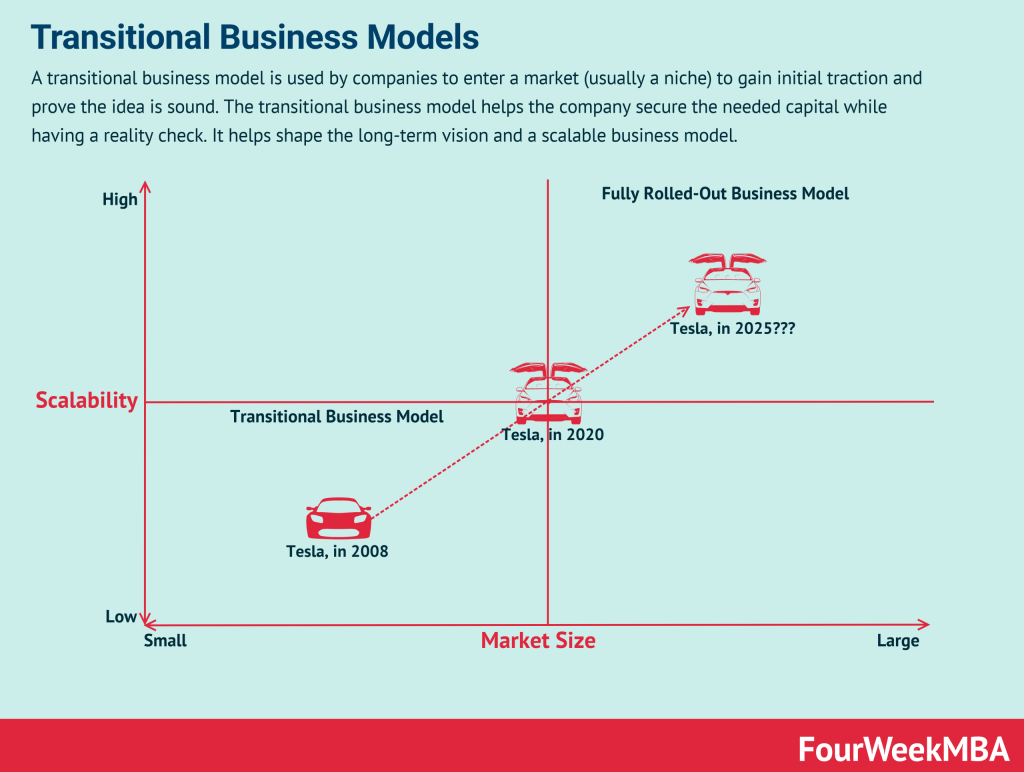
A transitional business model is used by companies to enter a market (usually a niche) to gain initial traction and prove the idea is sound. The transitional business model helps the company secure the needed capital while having a reality check. It helps shape the long-term vision and a scalable businessmodel.
The minimum viable audience (MVA) represents the smallest possible audience that can sustain your business as you get it started from a microniche (the smallest subset of a market). The main aspect of the MVA is to zoom into existing markets to find those people which needs are unmet by existing players.
Business scaling is the process of transformation of a business as the product is validated by wider and wider market segments. Business scaling is about creating traction for a product that fits a small market segment. As the product is validated it becomes critical to build a viable businessmodel. And as the product is offered at wider and wider market segments, it’s important to align product, businessmodel, and organizational design, to enable wider and wider scale.
The market expansion consists in providing a product or service to a broader portion of an existing market or perhaps expanding that market. Or yet, market expansions can be about creating a whole new market. At each step, as a result, a company scales together with the market covered.
In the FourWeekMBA growth matrix, you can apply growth for existing customers by tackling the same problems (gain mode). Or by tackling existing problems, for new customers (expand mode). Or by tackling new problems for existing customers (extend mode). Or perhaps by tackling whole new problems for new customers (reinvent mode).
In the FourWeekMBA Revenue Streams Matrix, revenue streams are classified according to the kind of interactions the business has with its key customers. The first dimension is the “Frequency” of interaction with the key customer. As the second dimension, there is the “Ownership” of the interaction with the key customer.
Revenue model patterns are a way for companies to monetize their business models. A revenue model pattern is a crucial building block of a business model because it informs how the company will generate short-term financial resources to invest back into the business. Thus, the way a company makes money will also influence its overall businessmodel.
A pricingstrategy or model helps companies find the pricing formula in fit with their business models. Thus aligning the customer needs with the product type while trying to enable profitability for the company. A good pricingstrategy aligns the customer with the company’s long term financial sustainability to build a solid businessmodel.
Gennaro is the creator of FourWeekMBA, which reached about four million business people, comprising C-level executives, investors, analysts, product managers, and aspiring digital entrepreneurs in 2022 alone | He is also Director of Sales for a high-tech scaleup in the AI Industry | In 2012, Gennaro earned an International MBA with emphasis on Corporate Finance and Business Strategy.