Taobao is a Chinese eCommerce website, and it is among the most visited websites in the world. Within it also comprises its payment arm, Alipay. Taobao is part of the Alibaba Group, founded by Chinese tech entrepreneur Jack Ma. The company makes money via its Tmalls (e-commerce platform), and through Alipay, mostly via its Escrow service fees.
Taobao is a Chinese eCommerce website and it is among the most visited websites in the world.
The platform was founded by Alibaba Group in 2003 as a marketplace to facilitate consumer-to-consumer (C2C) transactions for small businesses and entrepreneurs.
Alibaba is a Chinese multinational company with a focus on eCommerce, retail, Internet, and technology services across C2C, B2C, and B2B contexts. It was founded in 1999 by Chinese business magnate, investor, and philanthropist Jack Ma.
Initially, Taobao offered free listings to sellers and increased buyer-seller trust by incorporating Alipay – an escrow-based payment facilitation service. This saw the platform gain significant market share from eBay which was seen as a major competitor at the time.
In 2008, Taobao introduced the B2C platform Taobao Mall (Tmall) to complement its existing C2C offering. Two years later, the online shopping search engine eTao was introduced.
Taobao reacheda a billion product listings by 2016 and on the platform, most products are new and sold at a fixed price, but it does offer eBay-style auctions for some listings.
Taobao revenue generation
Considering how many transactions Taobao handles on an annual basis, the platform does not charge sellers or buyers a transaction fee.
Instead, it makes money by offering SEO-like advertising to sellers in much the same way that Google does. With more than 1 billion product listings spread across 8 million sellers, there is high competition between merchants to get the attention of buyers.
Merchants can choose between pay-for-performance or display marketing ads.
Tmall
As noted earlier, Tmall is the B2C arm of Taobao. With over 500 million active users, the platform allows Chinese and international businesses to sell brand-name goods to Chinese citizens.
Taobao makes money here by charging businesses to open a store on the Tmall platform. They must pass a stringent verification process and then pay a commission to Taobao for every subsequent sale. Typically this fee is around 5%.
As a real-world example, sunglasses retailer Lemon Optics paid a fee of around $25,000 to become verified and establish a shopfront on Tmall.
Alipay
Alipay is a Chinese mobile and online payment platform created in 2004 by entrepreneur Jack Ma as the payment arm of Taobao, a major Chinese eCommerce site. Alipay, therefore, is the B2C component of Alibaba Group. Alipay makes money via escrows transaction fees, a range of value-added ancillary services, and through its Credit Pay Instalment fees.
Escrow provider Alipay also charges for its services on Taobao. Merchants are charged a 0.55% fee for every successful sale. The system is free to use for withdrawals under RMB 20,000 – or approximately 3,000 USD. Above this threshold, users are charged a 0.1% fee.
Compared to rates offered by traditional credit card companies and payment facilitators, Alipay is an extremely attractive option for merchants. At least theoretically, this increases ad revenue for Taobao as sellers compete for that buyer visibility.
Key takeaways:
Taobao is a Chinese eCommerce site founded by the Alibaba Group in 2003. It was initially created to counter the dominance of eBay in the Chinese market and increase trust between the buyer and the seller.
Taobao sells advertising placements to more than 8 million sellers on its platform. With high competition for visibility, advertising represents a lucrative source of income.
Taobao also charges Chinese and international businesses to open on B2C arm Tmall. After the initial setup fee, Taobao also charges a commission for every sale. Usually, this commission is around 5%. Escrow provider Alipay also charges users for its service. Here, low service fees are in part compensated by the huge volume of transactions on the Taobao platform.
Key Highlights
Origin and Founding: Taobao was founded in 2003 by Alibaba Group as a Chinese eCommerce website to facilitate consumer-to-consumer (C2C) transactions for small businesses and entrepreneurs. It aimed to counter the dominance of eBay in the Chinese market.
Alipay Integration: Taobao incorporated Alipay, an escrow-based payment facilitation service, to build trust between buyers and sellers. This move helped Taobao gain significant market share from eBay.
Tmall Introduction: In 2008, Taobao introduced Tmall (Taobao Mall), its business-to-consumer (B2C) arm. Tmall allows Chinese and international businesses to sell brand-name goods to Chinese citizens. Businesses pay an initial fee and subsequent commissions to Taobao for sales.
eTao and Expansion: Taobao introduced eTao, an online shopping search engine, in 2010. This helped users search for products across various eCommerce platforms. Taobao continued to expand its offerings and services.
Product Listings and Auctions: By 2016, Taobao had over a billion product listings. While most products were sold at fixed prices, it also offered eBay-style auctions for some listings, providing buyers with options.
Revenue Generation: Taobao doesn’t charge transaction fees to sellers or buyers. Instead, it generates revenue through advertising. Sellers can purchase advertising placements to increase visibility, similar to how Google offers advertising services.
Tmall Store Fees: Tmall, the B2C arm of Taobao, charges businesses to open a store on its platform. Businesses need to pass verification and pay an initial fee. Subsequent sales on Tmall incur a commission fee, usually around 5%.
Alipay Services: Alipay, Taobao’s payment arm, makes money through escrow transaction fees, value-added services, and Credit Pay Instalment fees. It offers an attractive option for merchants due to its low service fees.
Competition and Growth: Taobao’s competitive landscape includes eBay and other eCommerce platforms. It continued to grow in popularity, becoming one of the most visited websites globally.
Alibaba Group: Taobao is part of the Alibaba Group, founded by Jack Ma in 1999. Alibaba Group expanded its services beyond Taobao, encompassing various eCommerce, retail, and technology-related ventures.
Market Impact: Taobao’s innovative approach to eCommerce, integration of payment services like Alipay, and focus on building trust between buyers and sellers helped it thrive in the competitive Chinese market.
Digital Economy Influence: Taobao’s success contributed to the growth of China’s digital economy, reshaping how businesses and consumers engage in online commerce.
Business Model Element
Analysis
Implications
Examples
Value Proposition
Taobao’s value proposition centers on offering a vast selection of products at competitive prices, a vibrant online marketplace, and a convenient shopping experience. For Buyers, Taobao provides: – Extensive Product Variety: Access to a wide range of products from clothing to electronics. – Competitive Prices: Competitive pricing due to numerous sellers. – User Reviews: User-generated reviews for informed purchasing decisions. – Convenience: Convenient online shopping experience with delivery options. For Sellers, Taobao offers: – Access to a Large Customer Base: A platform with millions of active users. – E-commerce Tools: Tools for listing, promotion, and sales management. – Payment Processing: Secure payment processing through Alipay. Taobao’s value proposition appeals to both buyers and sellers by offering an extensive marketplace with competitive prices and user-friendly features.
Offers an extensive marketplace with a wide range of products. Provides competitive pricing due to a large seller base. Empowers buyers with user-generated reviews for informed decisions. Ensures a convenient online shopping experience with various delivery options. Offers sellers access to a vast customer base and e-commerce tools. Provides secure payment processing through Alipay. Attracts users looking for a diverse product selection and sellers seeking access to a large customer base.
– The vast product variety caters to diverse consumer needs and preferences. – Competitive pricing attracts budget-conscious shoppers. – User reviews build trust and help buyers make informed decisions. – Access to a large customer base and e-commerce tools supports sellers’ business growth.
Customer Segments
Taobao serves two primary customer segments: 1. Buyers: Individuals and businesses looking to purchase a wide range of products online. 2. Sellers: Individuals and businesses seeking to list and sell products on the platform. Buyers benefit from a diverse product selection and competitive prices, while Sellers gain access to a large customer base and e-commerce tools. Taobao customizes its platform to cater to the needs of both segments, ensuring a seamless shopping experience for buyers and effective selling tools for sellers.
Serves two main customer segments: 1. Buyers: Individuals and businesses looking for online shopping options. 2. Sellers: Individuals and businesses aiming to list and sell products. Customizes the platform to meet the specific needs of each segment. Provides a seamless shopping experience for buyers. Offers effective listing and sales tools for sellers.
– Catering to two customer segments creates a balanced ecosystem and ensures a wide product selection. – Tailoring the platform enhances user satisfaction and engagement.
Distribution Strategy
Taobao’s distribution strategy is primarily digital and internet-based. Users access the platform through the Taobao website and mobile app, available on smartphones and tablets. Buyers can easily browse products, place orders, and make payments through the app. Sellers utilize the platform to list products, manage sales, and interact with buyers. Taobao also employs data analytics to personalize product recommendations and promotions, enhancing user engagement. Additionally, it collaborates with various logistics and delivery partners to ensure efficient order fulfillment and delivery.
Relies on a digital and internet-based distribution strategy. Offers access through the Taobao website and mobile app. Buyers can browse, order, and pay for products through the app. Sellers list products and manage sales through the platform. Utilizes data analytics for personalized recommendations and promotions. Collaborates with logistics partners for efficient order fulfillment and delivery.
– Digital and internet-based distribution aligns with the widespread use of smartphones and online shopping. – Data analytics enhances user engagement through personalized recommendations. – Collaborations with logistics partners ensure efficient order delivery.
Revenue Streams
Taobao generates revenue through various streams: 1. Commissions: Taobao charges sellers a commission fee based on the transaction value. 2. Advertising: Sellers can pay for advertising and promotion services to enhance product visibility. 3. Membership Fees: Taobao offers premium memberships with additional benefits, generating subscription-based revenue. 4. Value-Added Services: Additional services, such as store customization, may come with associated fees. 5. Transaction Fees: Taobao earns fees from payment processing services through Alipay. These revenue streams contribute to the platform’s income.
Relies on revenue streams from: 1. Commissions charged to sellers based on transaction value. 2. Advertising and promotion services for enhanced product visibility. 3. Membership fees from premium memberships. 4. Value-added services like store customization. 5. Transaction fees earned from payment processing services through Alipay. Diversifies income sources through commissions, advertising, memberships, and transaction fees.
– Commissions provide a reliable source of revenue tied to transaction activity. – Advertising and promotions offer additional revenue opportunities. – Membership fees generate recurring income from premium services. – Value-added services enhance customization options for sellers.
Marketing Strategy
Taobao’s marketing strategy includes digital advertising, search engine optimization (SEO), and promotions. The platform employs targeted digital advertising to reach potential buyers and sellers, promoting its vast product selection and competitive prices. SEO efforts ensure that Taobao’s website ranks well in search engine results, enhancing its online visibility. Periodic promotions, such as discounts, flash sales, and special events, attract users and boost sales. Taobao also engages with users on social media platforms like Weibo and WeChat to maintain a strong online presence and foster community engagement.
Utilizes digital advertising, SEO, and promotions for marketing. Uses targeted digital advertising to reach potential buyers and sellers. Invests in SEO efforts to enhance online visibility in search engine results. Conducts periodic promotions, discounts, and special events to attract users and boost sales. Engages with users on social media platforms to foster community engagement.
– Online advertising and SEO efforts increase platform visibility and attract users. – Promotions drive user engagement and boost sales during specific periods. – Social media engagement helps build a strong online community and maintain an active user base.
Organization Structure
Taobao’s organizational structure includes teams dedicated to product development, technology, marketing, customer support, and logistics. Product development and technology teams focus on enhancing the platform’s features and user experience. Marketing teams promote Taobao’s services and engage with the community. Customer support teams assist users with inquiries and issues. Logistics teams collaborate with delivery partners to ensure efficient order fulfillment. Taobao’s structure supports innovation, user satisfaction, and effective logistics management.
Employs specialized teams for product development, technology, marketing, customer support, and logistics. Enhances platform features and user experience through product development and technology teams. Promotes services and community engagement through marketing teams. Assists users with inquiries and issues via customer support teams. Collaborates with delivery partners for efficient order fulfillment through logistics teams. Supports innovation, user satisfaction, and effective logistics management.
– Specialized teams ensure a user-friendly platform with evolving features. – Marketing teams drive user engagement and community growth. – Customer support enhances the user experience and trust in the platform. – Collaboration with logistics partners ensures efficient order delivery.
Competitive Advantage
Taobao’s competitive advantage lies in its extensive product variety, competitive pricing, user-generated reviews, and robust ecosystem. The platform’s vast selection of products caters to diverse consumer needs. Competitive pricing due to numerous sellers attracts budget-conscious shoppers. User-generated reviews build trust and assist buyers in making informed decisions. Taobao’s robust ecosystem, including Alipay for secure payments and various logistics partners, ensures a seamless shopping experience. Additionally, its strong presence in the Chinese market gives it a significant competitive edge.
Derives a competitive advantage from: – Vast product variety addressing diverse consumer needs. – Competitive pricing due to a large seller base. – User-generated reviews building trust and assisting buyers. – A robust ecosystem with secure payments and efficient logistics. – Strong presence and recognition in the Chinese market. Appeals to a wide range of consumers seeking diverse products and competitive prices. Builds trust and confidence through user reviews and a secure ecosystem. Maintains a strong position in the competitive Chinese e-commerce market.
– The extensive product variety caters to diverse consumer preferences. – Competitive pricing attracts cost-conscious shoppers. – User-generated reviews enhance trust and inform purchase decisions. – A robust ecosystem ensures a seamless shopping experience. – Strong market presence establishes brand recognition and trust.
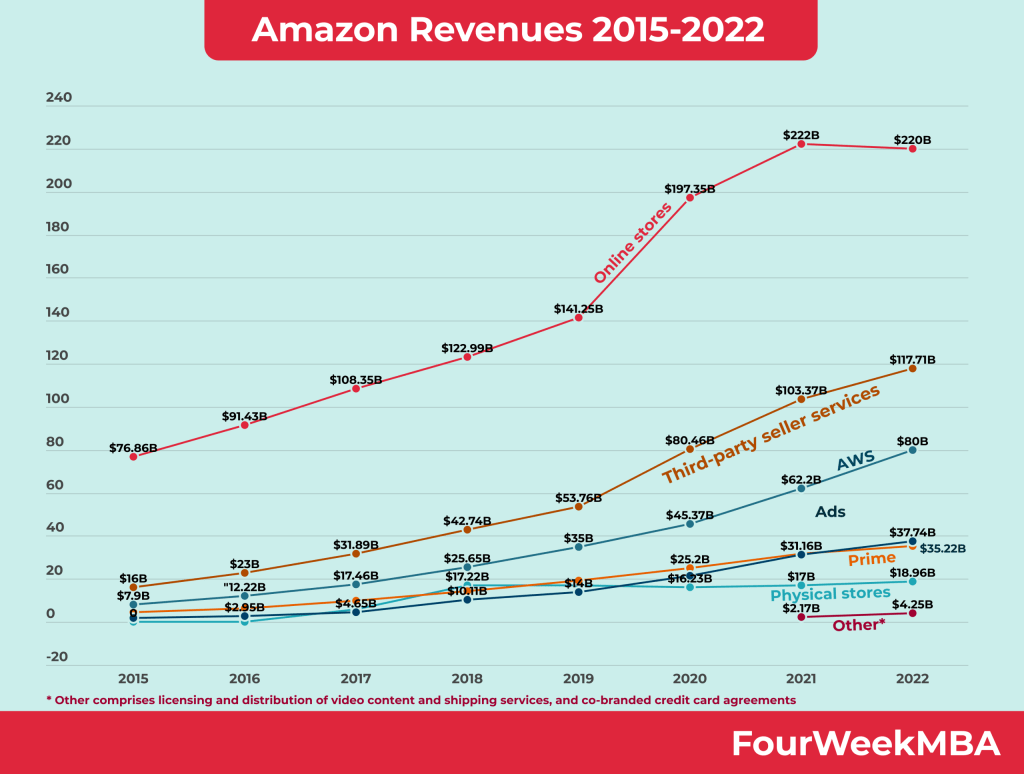
Amazon has a diversified business model. In 2022 Amazon posted over $514 billion in revenues, while it posted a net loss of over $2.7 billion. Online stores contributed almost 43% of Amazon revenues. The remaining was generated by Third-party Seller Services, and Physical Stores. While Amazon AWS, Subscription Services, and Advertising revenues play a significant role within Amazon as fast-growing segments.
In 2022, most of Amazon’s revenue came from the US, with over $356 billion in revenue, followed by Germany with $33.6 billion, the UK with $30 billion, Japan with $24.4 billion, and the rest of the world generated almost $70 billion in net sales.
Both the North American and International segment of Amazon are running at negative margins. Indeed, in 2022, for the North American segments, of almost $316 billion in revenue, Amazon spent almost $319 billion in operating costs to run it, thus it generated $2 billion in operating losses in 2022.
For its International segment, of $118 billion in revenue, Amazon spent almost $126 billion to operate it. Thus, it reported a $7.7 billion operating loss.
While for AWS, with $80 billion in revenue, Amazon spent $57 billion to operate it, thus generating almost $23 billion in operating income.
The high operating costs are primarily due to the high cost of running Amazon’s inventory and fulfillment infrastructure behind its e-commerce operations. Indeed, Amazon is as much as a physical player as a digital one.
Amazon was not profitable once AWS was removed in 2022. In fact, Amazon, without AWS generated $10.6 billion in operating losses. While Amazon, without AWS, generated $12.2. billion operating income.
Amazon is subdivided into three operating profit segments: North America, International, and AWS. Amazon AWS is the most profitable segment, with almost $23 billion in operating profit in 2022. While Both the North American and International segments run at negative operating losses, with $2 billion and $7.74 billion in operating losses, respectively, in 2022.
In 2021, Amazon generated almost $470 billion in revenue, vs. eBay’s over $10.4 billion. In comparison, looking at revenues, Amazon was 45x times larger than eBay.
Amazon’s mission statement is to “serve consumers through online and physical stores and focus on selection, price, and convenience.” Amazon’s vision statement is “to be Earth’s most customer-centric company, where customers can find and discover anything they might want to buy online, and endeavors to offer its customers the lowest possible prices.”
In the Amazon Shareholders’ Letter for 2018, Jeff Bezos analyzed the Amazon business model, and it also focused on a few key lessons that Amazon as a company has learned over the years. These lessons are fundamental for any entrepreneur, of small or large organization to understand the pitfalls to avoid to run a successful company!
Amazon has a business model with many moving parts. The e-commerce platform generated $220 billion in 2022, followed by third-party stores services which generated over $117 billion; Amazon AWS, which generated over $80 billion; Amazon advertising which generated almost $38 billion and Amazon Prime, which generated over $35 billion, and physical stores which generated almost $19 billion.
The Amazon Working Backwards Method is a product development methodology that advocates building a product based on customer needs. The Amazon Working Backwards Method gained traction after notable Amazon employee Ian McAllister shared the company’s product development approach on Quora. McAllister noted that the method seeks “to work backwards from the customer, rather than starting with an idea for a product and trying to bolt customers onto it.”
The Amazon Flywheel or Amazon Virtuous Cycle is a strategy that leverages on customer experience to drive traffic to the platform and third-party sellers. That improves the selections of goods, and Amazon further improves its cost structure so it can decrease prices which spins the flywheel.
In the letter to shareholders in 2016, Jeff Bezos addressed a topic he had been thinking quite profoundly in the last decades as he led Amazon: Day 1. As Jeff Bezos put it “Day 2 is stasis. Followed by irrelevance. Followed by excruciating, painful decline. Followed by death. And that is why it is always Day 1.”
Gennaro is the creator of FourWeekMBA, which reached about four million business people, comprising C-level executives, investors, analysts, product managers, and aspiring digital entrepreneurs in 2022 alone | He is also Director of Sales for a high-tech scaleup in the AI Industry | In 2012, Gennaro earned an International MBA with emphasis on Corporate Finance and Business Strategy.