Brex is a technology and financial services company founded by Brazilian entrepreneurs Henrique Dubugras and Pedro Franceschi in 2017 to solve debt and corporate expenditure problems in early-stage tech companies. It makes money with Brex Premium, an expansive suite of spend management and bill pay software tools, via interchange fees like most other financial technology companies and rewards schemes.
Brex is a technology and financial services company founded by Brazilian entrepreneurs Henrique Dubugras and Pedro Franceschi in 2017.
The pair met on Twitter as teenage boys and came together to win a local hackathon with something called AskMeOut – a Tinder-style app for matching Facebook friends.
Like many similar ventures of the time, however, the pair could not develop an efficient payment processing system.
Undeterred, Dubugras and Franceschi then founded Pagar.me – or the Brazilian version of Stripe.
The company was an instant success and was sold two years later in 2016 shortly before both enrolled in Computer Science at Stanford University.
There, they founded virtual reality gaming company Beyond, which gave them access to start-up accelerator Y Combinator.
However, both founders realized their interests lied elsewhere. Brex was founded soon after, ostensibly to solve problems around debt and corporate expenditure in early state tech companies.
The company was able to raise a significant amount of funding in the ensuing years. It became FDIC insured in 2020 and achieved integration with enterprise expense management platforms SAP and Xero.
In February 2021, Brex Bank was established allowing the company to offer loan products to individuals and businesses.
Tailored Financial Solutions: Brex offers customized financial solutions and products designed specifically for startups and SMBs, addressing their unique needs, challenges, and priorities, such as access to credit, expense management, and rewards programs.
Streamlined Application Process: With a user-friendly online platform and streamlined application process, Brex makes it easy for businesses to apply for financial products and services, eliminating the need for extensive paperwork, collateral, and credit checks typically associated with traditional banking institutions.
Fast Access to Capital: Brex provides fast access to capital and credit lines without personal guarantees or credit history requirements, enabling startups and SMBs to secure funding quickly and efficiently, accelerating growth initiatives, and capitalizing on emerging opportunities.
Enhanced Rewards and Benefits: Brex offers enhanced rewards, benefits, and incentives for business spending, including cashback, points, and discounts on select purchases and categories, providing businesses with additional value and savings on essential expenses and operational costs.
Intuitive Financial Management Tools: Brex provides intuitive financial management tools, reporting dashboards, and expense tracking features, allowing businesses to monitor spending, analyze trends, and make informed financial decisions in real-time, improving transparency, accountability, and control over their finances.
Brex revenue generation
Although Brex started as a humble credit service for tech start-ups, it now offers a host of other services. It now monetizes its business model in a few ways.
Brex Premium
Brex Premium is an expansive suite of spend management and bill pay software tools.
It is ideally suited to administrators who need to create expense policies, receive spending alerts, automate receipt and memo reminders, and incorporate employee request approval workflows.
The service is free for the first 30 days, after which the company charges $49/month for unlimited users.
Interchange fees
Brex also collects money via interchange fees like most other financial technology companies.
When a customer makes a credit card payment, the card issuer – in this case Mastercard – collects an interchange fee and shares a portion of it with Brex.
Cashback
Brex also a rewards scheme, allowing participating businesses to maximize returns on spending and offset their expenses.
Points rewards are categorized in the following way:
Rideshare services – businesses receive 8 times the total purchase price in points.
Brex Travel – 5 times the total purchase price in points.
Restaurants – 4 times.
Recurring software – 3 times.
Everything else – double the total purchase price in points.
Customers earn points later redeemable at companies that create complementary products and services. These include Amazon AWS, Slack, Hubspot, Emirates, Singapore Airlines, and Zoom.
In all likelihood, Brex makes a commission for referring business to these companies.
Brex Cash
Brex Cash is an integrated cash management account for businesses linked with the Brex Card. This account links directly to Brex corporate credit card accounts.
Brex makes money sitting in its user’s cash accounts by lending it out to other financial institutions, otherwise known as net interest margin.
To recap, its Revenue Streams comprise:
Interchange Fees: Brex generates revenue primarily through interchange fees charged on transactions processed through its financial products, including credit cards, corporate cards, and payment processing services, earning a percentage of each transaction as a fee.
Subscription Fees: Brex may charge subscription fees or membership dues for access to premium features, benefits, and services associated with its financial products, offering different tiers of pricing and customization options for businesses with varying needs and preferences.
Interest Income: Brex earns interest income on outstanding balances, revolving credit lines, and financing facilities extended to customers, charging interest rates on borrowed funds and credit facilities based on predetermined terms and agreements.
Foreign Exchange Fees: Brex may generate revenue through foreign exchange fees and currency conversion charges applied to international transactions processed through its financial products, providing businesses with currency conversion services and hedging solutions for global transactions.
Value-Added Services: Brex offers value-added services, premium features, and add-on products such as expense management tools, travel benefits, insurance coverage, and concierge services, generating additional revenue through upselling and cross-selling opportunities to existing customers.
Marketing Strategy:
Digital Advertising: Brex invests in digital advertising campaigns across online platforms such as search engines, social media, and display networks to raise brand awareness, target startups and SMBs, and drive website traffic, leveraging targeted ads, keywords, and audience segmentation to reach potential customers.
Content Marketing: Brex produces educational content, blog posts, articles, and guides on topics related to startup finance, business management, and entrepreneurial success, sharing insights, tips, and industry expertise to engage and educate its target audience, positioning itself as a thought leader and trusted advisor.
Influencer Partnerships: Brex collaborates with industry influencers, thought leaders, and entrepreneurs to create sponsored content, webinars, and events, sharing success stories, case studies, and testimonials featuring Brex’s financial products and services, leveraging their credibility and audience reach to drive brand advocacy and customer acquisition.
Community Engagement: Brex fosters a sense of community and engagement among startups and SMBs through online forums, social media groups, and networking events, providing opportunities for members to connect, share insights, and exchange ideas, building brand loyalty, and fostering customer relationships.
Referral Program: Brex incentivizes existing customers, partners, and advocates to refer startups and SMBs to the platform through its referral program, offering rewards, discounts, or credits for successful referrals, encouraging word-of-mouth marketing and customer acquisition through trusted recommendations and endorsements.
Distribution Channels:
Online Platform: Brex distributes its financial products and services primarily through its user-friendly online platform and website, allowing startups and SMBs to research, apply for, and manage their accounts entirely online, providing a convenient and accessible experience for customers.
Direct Sales: Brex employs a direct sales team and customer support representatives to engage with potential customers, provide personalized guidance, and facilitate the application and onboarding process for its financial products and services, offering tailored solutions and assistance to meet individual business needs.
Partnership Collaborations: Brex partners with business networks, accelerators, incubators, and industry associations to promote its financial products and services to their members, leveraging existing relationships and networks to reach startups and SMBs within specific industries, verticals, and geographic regions.
Affiliate Programs: Brex may leverage affiliate marketing programs and networks to distribute its financial products and services through affiliate partners, influencers, and business networks, providing them with unique tracking links, referral commissions, and promotional incentives for driving sign-ups and activations.
Event Sponsorships: Brex sponsors industry events, conferences, and trade shows targeted at startups and SMBs to raise brand awareness, showcase its products and services, and engage with potential customers in-person, leveraging event marketing and networking opportunities to expand its reach and customer base.
Key takeaways
Brex is a Brazilian fintech company founded by entrepreneurs Henrique Dubugras and Pedro Franceschi in 2017. It was created to give early-stage tech companies better access to credit.
Brex revenue generation has since expanded from the early days of the company as a credit provider. Brex Premium is a monthly subscription service giving businesses access to spend management and bill pay tools. The company also earns money from an extensive cashback rewards scheme.
As an FDIC-insured banking institution, Brex can also collect net interest margin income from the funds sitting in user accounts.
Key Highlights of Brex’s Business Model:
Value Proposition:
Brex’s value proposition includes corporate credit cards tailored for startups and businesses, a streamlined application process based on company financials, rewards and perks designed for businesses, and integrations with financial software for streamlined expense tracking. This caters to the unique needs of startups and SMBs, providing accessibility to credit, rewards, and efficient financial management tools.
Customer Segments:
Brex targets startups, early-stage companies, e-commerce, and technology firms, venture-backed companies, and small to medium enterprises (SMEs), offering credit solutions tailored to their specific financial needs and growth stages. This diverse customer base allows Brex to address a wide range of business profiles within the fintech sector.
Distribution Strategy:
Brex employs an online platform, partner ecosystem, referral programs, and digital marketing to distribute its financial products, providing convenient access to credit solutions, leveraging partnerships and referrals to reach potential customers, and utilizing digital channels for customer acquisition.
Revenue Streams:
Brex generates revenue through card usage fees, interest on balances, subscription fees for premium plans, and partnerships, diversifying its income sources within the fintech industry. This allows Brex to monetize its financial products and services while providing credit solutions to businesses.
Marketing Strategy:
Brex focuses on targeted marketing, content marketing, partnership collaborations, referral programs, and community engagement to attract businesses to its financial services, leveraging digital advertising, educational content, influencer partnerships, and customer referrals for brandgrowth.
Organization Structure:
Brex maintains a structured organization with leadership, product and technology teams, sales and marketing teams, and customer support, aligning its operations with its mission of providing financial solutions to businesses. This ensures efficient product development, customer acquisition, and support services.
Origin Story:
Founded by Henrique Dubugras and Pedro Franceschi in 2017, Brex emerged from their previous ventures in payment processing and virtual reality gaming, aiming to solve debt and corporate expenditure problems in early-stage tech companies. The company achieved significant growth and valuation through strategic fundraising and expansion efforts.
Revenue Generation:
Brex generates revenue through Brex Premium subscription fees, interchange fees, cashback rewards schemes, and interest income from cash management accounts, diversifying its revenue streams and monetizing its financial products and services for startups and SMBs.
Marketing Strategy:
Brex’s marketingstrategy involves digital advertising, content marketing, influencer partnerships, community engagement, and referral programs to attract startups and SMBs, leveraging targeted campaigns, educational content, partnerships, and customer referrals for brand awareness and customer acquisition.
Key Takeaways:
Brex offers tailored financial solutions, streamlined application processes, fast access to capital, enhanced rewards, and intuitive financial management tools for startups and SMBs. With diverse revenue streams, strategic partnerships, and a comprehensive marketingstrategy, Brex aims to provide accessible and efficient credit solutions for businesses while driving growth and profitability in the fintech sector.
Business Model Element
Analysis
Implications
Examples
Value Proposition
Brex’s value proposition includes: – Corporate Credit Cards: Offering credit cards tailored for startups and businesses, providing access to credit without a personal guarantee or credit history. – Streamlined Application: Simplifying the application process for businesses, with approvals based on the company’s financials and performance. – Rewards and Perks: Providing rewards, benefits, and expense management tools designed for businesses. – Integration: Offering integrations with financial and accounting software for streamlined expense tracking. Brex delivers financial solutions tailored to the needs of startups and businesses, with a focus on credit accessibility and rewards.
Attracts startups and businesses in need of credit solutions. Simplifies the credit card application process for businesses. Offers rewards and expense management features aligned with business needs. Enhances efficiency through integrations with financial software. Establishes a compelling value proposition in the fintech space.
– Corporate credit cards for startups and businesses. – Streamlined application process based on company performance. – Rewards and expense management tools for businesses. – Integrations with financial and accounting software.
Customer Segments
Brex serves the following customer segments: 1. Startups and Early-Stage Companies: Providing financial solutions for businesses in their early growth stages. 2. E-commerce and Technology Companies: Addressing the unique financial needs of online businesses and tech startups. 3. Venture-Backed Companies: Catering to companies with venture capital backing. 4. Small to Medium Enterprises (SMEs): Offering credit solutions for established SMEs. Brex targets a diverse range of businesses, particularly those in the startup and tech sectors.
Attracts startups seeking credit without a personal guarantee. Addresses the financial needs of e-commerce and tech businesses. Serves venture-backed companies with specialized financial solutions. Extends services to SMEs requiring corporate credit cards. Targets a broad customer base with varied business profiles.
– Early-stage startups in need of credit. – E-commerce and tech companies with specific financial needs. – Venture-backed companies with unique requirements. – SMEs seeking corporate credit card solutions.
Distribution Strategy
Brex’s distribution strategy includes: – Online Platform: Offering an online application process for businesses to apply for Brex corporate credit cards. – Partner Ecosystem: Collaborating with various partners, such as venture capital firms and startup accelerators, to reach potential customers. – Referral Programs: Implementing referral programs that incentivize existing customers and partners to refer new business clients. – Marketing and Advertising: Utilizing digital marketing channels and targeted advertising to attract businesses. Brex employs an online platform, partnerships, referrals, and digital marketing to distribute its financial products.
Provides an online platform for easy credit card applications. Leverages partnerships to extend its reach among startups and businesses. Encourages customer and partner referrals through incentive programs. Utilizes digital marketing for customer acquisition. Implements a multi-faceted distribution strategy in the fintech sector.
– Online platform for corporate credit card applications. – Partnerships with venture capital firms and accelerators. – Referral programs for customer and partner referrals. – Digital marketing and targeted advertising efforts.
Revenue Streams
Brex generates revenue through various channels: 1. Card Usage Fees: Earning fees from transactions made using Brex corporate credit cards. 2. Interest on Balances: Charging interest on outstanding card balances. 3. Subscription Fees: Offering premium plans with enhanced features for a monthly fee. 4. Partnerships: Receiving referral fees or revenue-sharing arrangements with partners. Brex derives income from card usage, interest, premium plans, and partnership arrangements while providing credit solutions to businesses.
Earns income from transaction fees on card usage. Collects interest on outstanding card balances. Generates revenue from subscription fees for premium plans. Benefits from referral fees and partnerships with collaborators. Diversifies its revenue streams within the fintech industry.
– Earnings from transaction fees on card usage. – Interest income from outstanding card balances. – Revenue from subscription fees for premium plans. – Referral fees and revenue-sharing from partnerships.
Marketing Strategy
Brex’s marketing strategy involves: – Targeted Marketing: Using data-driven approaches to identify and target potential customers within specific industries and segments. – Content Marketing: Creating educational content, webinars, and resources to assist startups and businesses. – Partnership Marketing: Collaborating with venture capital firms, accelerators, and other industry players to reach startups. – Referral Programs: Incentivizing existing customers and partners to refer new business clients. Brex focuses on data-driven targeting, content, partnerships, and referrals to attract businesses to its financial services.
Utilizes data-driven targeting to reach businesses within specific niches. Offers educational content and resources to assist startups and businesses. Collaborates with industry players to extend its reach and credibility. Encourages customer and partner referrals through incentive programs. Implements a comprehensive marketing strategy tailored to its target audience.
– Targeted marketing campaigns for specific industries. – Educational content and resources for businesses. – Partnerships with venture capital firms and accelerators. – Referral programs for customer and partner referrals.
Organization Structure
Brex’s organizational structure includes: – Leadership Team: Executives responsible for strategic decisions, product development, and overall management. – Product and Technology Team: Engineers, designers, and developers working on product enhancements and features. – Sales and Marketing Team: Focusing on customer acquisition, marketing campaigns, and partnerships. – Customer Support Team: Providing assistance and support to cardholders and business clients. Brex maintains a structured organization to support its mission of providing financial solutions to businesses.
Led by an executive team responsible for strategic leadership. Employs technology experts to enhance products and features. Utilizes sales and marketing teams for customer acquisition. Provides customer support to enhance the customer experience. Maintains an organized structure aligned with its business model and mission.
– Executive team for strategic leadership. – Product and tech team for product development. – Sales and marketing team for customer acquisition. – Customer support team for assistance and support.
Acorns is a fintech platform providing services related to Robo-investing and micro-investing. The company makes money primarily through three subscription tiers: Lite – ($1/month), which gives users access to Acorns Invest, Personal ($3/month) that includes Invest plus the Later (retirement) and Spend (personal checking account) suite of products, Family ($5/month) with features from both the Lite and Personal plans with the addition of Early.
Starting as a pay-later solution integrated into merchants’ checkouts, Affirm makes money from merchants’ fees as consumers pick up the pay-later solution. Affirm also makes money through interest earned from the consumer loans when those are repurchased from the originating bank. In 2020 Affirm made 50% of its revenues from merchants’ fees, about 37% from interests, and the remaining from virtual cards and servicing fees.
Alipay is a Chinese mobile and online payment platform created in 2004 by entrepreneur Jack Ma as the payment arm of Taobao, a major Chinese eCommerce site. Alipay, therefore, is the B2C component of Alibaba Group. Alipay makes money via escrow transaction fees, various value-added ancillary services, and its Credit Pay Instalment fees.
Betterment is an American financial advisory company founded in 2008 by MBA graduate Jon Stein and lawyer Eli Broverman. Betterment makes money via investment plans, financial advice packages, betterment for advisors, betterment for business, cash reserve, and checking accounts.
Chime is an American neobank (internet-only bank) company, providing fee-free financial services through its mobile banking app, thus providing personal finance services free of charge while making the majority of its money via interchange fees (paid by merchants when consumers use their debit cards) and ATM fees.
Coinbase is among the most popular platforms for trading and storing crypto-assets, whose mission is “to create an open financial system for the world” by enabling customers to trade cryptocurrencies. Its platform serves both as a search and discovery engine for crypto assets. The company makes money primarily through fees earned for the transactions processed through the platform, custodial services offered, interest, and subscriptions.
Compass is a licensed American real-estate broker incorporating online real estate technology as a marketing medium. The company makes money via sales commissions (collected whenever a sale is facilitated or tenants are found for a rental property) and bridge loans (a service allowing the seller to purchase a home before the revenue from the sale of their previous home is available).
Dosh is a Fintech platform that enables automatic cash backs for consumers. Its business model connects major card providers with online and offline local businesses to develop automatic cash back programs. The company makes money by earning an affiliate commission on each eligible sale from consumers.
E-Trade is a trading platform allowing investors to trade common and preferred stocks, exchange-traded funds (ETFs), options, bonds, mutual funds, and futures contracts; acquired by Morgan Stanley in 2020 for $13 billion. E-Trade makes money through interest income, order flow, margin interests, options, future and bonds trading, and other fees and service charges.
Klarna is a financial technology company allowing consumers to shop with a temporary Visa card. Thus it then performs a soft credit check and pays the merchant. Klarna makes money by charging merchants. Klarna also earns a percentage of interchange fees as a commission and for interests earned on customers’ accounts.
Lemonade is an insurance tech company using behavioral economics and artificial intelligence to process claims efficiently. The company leverages technology to streamline onboarding customers while also applying a financial model to reduce conflicts of interest with customers (perhaps by donating the variable premiums to charity). The company makes money by selling its core insurance products, and via its tech platform, it tries to enhance its sales.
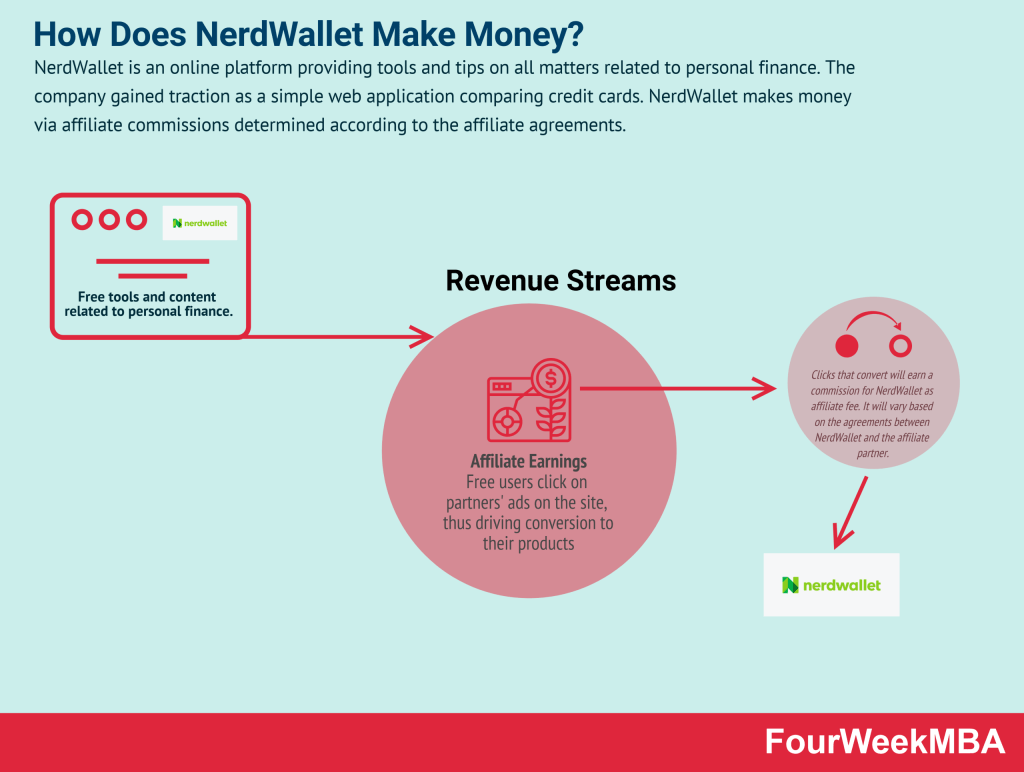
NerdWallet is an online platform providing tools and tips on all matters related to personal finance. The company gained traction as a simple web application comparing credit cards. NerdWallet makes money via affiliate commissions determined according to the affiliate agreements.
Robinhood is an app that helps to invest in stocks, ETFs, options, and cryptocurrencies, all commission-free. Robinhood earns money by offering: Robinhood Gold, a margin trading service, which starts at $6 a month, earns interests from customer cash and stocks, and rebates from market makers and trading venues.
SoFi is an online lending platform that provides affordable education loans to students, and it expanded into financial services, including loans, credit cards, investment services, and insurance. It makes money primarily via payment processing fees and loan securitization.
Stash is a FinTech platform offering a suite of financial tools for young investors, personalized investment advice, and life insurance. The company primarily makes money via subscriptions, cashback, payment for order flows, and interest for cash sitting on members’ accounts.
Wealthfront is an automated Fintech investment platform providing investment, retirement, and cash management products to retail investors, mostly making money on the annual 0.25% advisory fee the company charges for assets under management. It also makes money via a line of credits and interests on the cash accounts.
Zelle is a peer-to-peer payment network that indirectly benefits the banks’ consortium that backs it. Zelle also enables users to pay businesses for goods and services free for users. Merchants pay a 1% fee to Visa or Mastercard, who share it with the bank that issued the card.
Gennaro is the creator of FourWeekMBA, which reached about four million business people, comprising C-level executives, investors, analysts, product managers, and aspiring digital entrepreneurs in 2022 alone | He is also Director of Sales for a high-tech scaleup in the AI Industry | In 2012, Gennaro earned an International MBA with emphasis on Corporate Finance and Business Strategy.