BeReal’s business model revolves around providing an authentic and clutter-free social media experience. Users can view their friends’ daily posts without ads or distractions. BeReal does not make money, as it operates via funding. But similar to other social media platforms it could make money by incorporating advertising on the home feed, offering paid subscriptions with enhanced features, or monetizing user data by selling it to third parties.
BeReal’s business model is centered around authenticity and spontaneity. Unlike traditional social media platforms that focus on curated content and aesthetics, BeReal encourages users to share real, unfiltered moments of their daily lives. This approach has resonated with users seeking genuine interactions over the highly polished content typical of other platforms.
Key Characteristics of BeReal’s Business Model
Authenticity Over Aesthetics: Emphasizes real, unedited moments instead of carefully crafted posts.
Daily Notification: Users receive a daily notification at a random time, prompting them to share a photo within a two-minute window.
No Filters or Editing: Content is posted without filters or editing options, promoting genuine expression.
User Engagement: Focuses on building a community through real interactions rather than follower counts or likes.
Importance of Understanding BeReal’s Business Model
Understanding BeReal’s business model is crucial for several reasons:
1. Shifting Social Media Trends
Authenticity Appeal: Highlights a growing trend towards authenticity and transparency in social media.
User-Centric Approach: Demonstrates a shift from algorithm-driven content to user-driven experiences.
2. Innovative User Engagement
Engagement Strategies: Provides insights into innovative ways to boost user engagement without relying on traditional metrics like likes and followers.
Community Building: Shows how building a community around genuine interactions can enhance user loyalty and satisfaction.
3. New Revenue Opportunities
Monetization Models: Offers a glimpse into potential revenue models that align with the platform’s core values, such as in-app purchases and partnerships.
Components of BeReal’s Business Model
BeReal’s success is driven by several key components that distinguish it from other social media platforms.
1. Daily Posting Prompt
Random Notification: Users receive a daily notification at a random time, encouraging them to take and post a photo within two minutes.
Time-Limited Posts: This feature ensures that content is timely and spontaneous, fostering a sense of urgency and authenticity.
2. No Filters or Editing
Unfiltered Content: Users cannot edit or filter their photos, promoting genuine, unfiltered expression.
Focus on Realism: This approach aims to reduce the pressure of maintaining a perfect online image, encouraging more authentic content.
3. Dual Camera Feature
Front and Back Camera: The app uses both the front and back cameras simultaneously, capturing what the user sees and their reaction, enhancing the authenticity of the shared moments.
Enhanced Engagement: This feature allows users to share their immediate reactions, making interactions more relatable and engaging.
4. Social Interaction
Commenting System: Users can comment on their friends’ posts, fostering interaction and conversation.
Friends’ Feed: The feed is limited to friends, reducing the pressure of public scrutiny and enhancing trust within the community.
5. User-Centric Design
Minimalist Interface: The app features a simple, user-friendly interface that focuses on the core experience without distractions.
Privacy Focus: BeReal prioritizes user privacy, with no ads and minimal personal data collection.
Implications of BeReal’s Business Model
BeReal’s business model has several important implications for the future of social media and online interaction.
1. Redefining Social Media Standards
Authenticity Over Perfection: Challenges the notion that social media success is measured by the number of followers or likes.
Focus on Real Moments: Encourages users to share real, everyday moments, moving away from the curated content trend.
2. Impact on User Engagement
Increased Engagement: The daily prompt and real-time posting feature enhance user engagement by making content creation a spontaneous, interactive activity.
Community Building: By limiting the feed to friends, BeReal fosters a close-knit community, enhancing user trust and interaction.
3. Potential for New Revenue Streams
In-App Purchases: Could explore monetization through features like premium filters or additional photo storage.
Partnerships and Collaborations: Potential for partnerships with brands that align with the platform’s values, such as those promoting authenticity and real-life experiences.
Examples of BeReal’s Business Model in Practice
Several aspects of BeReal’s business model are exemplified by its features and user engagement strategies.
1. Daily Prompt System
Random Notification: This feature creates a unique user experience, ensuring that content is timely and spontaneous.
Engagement Boost: Encourages users to engage with the app daily, maintaining consistent interaction and activity.
2. Unfiltered Content
Real-Time Posting: Users share photos without filters or edits, promoting genuine content.
Community Interaction: The lack of editing options fosters more authentic interactions and discussions.
3. Dual Camera Functionality
Simultaneous Capture: Captures both the user’s perspective and their reaction, enhancing the authenticity of shared moments.
Interactive Content: This feature makes content more engaging and relatable, encouraging users to share their true reactions.
4. Friend-Centric Feed
Limited Visibility: The feed is restricted to friends, creating a safe space for sharing and interaction.
Privacy and Trust: Enhances user privacy and trust, reducing the fear of judgment or public scrutiny.
Challenges of Implementing BeReal’s Business Model
While BeReal’s model has many strengths, it also faces several challenges that need careful consideration.
1. Maintaining User Engagement
Consistent User Activity: Ensuring users continue to engage with the app daily can be challenging, especially as trends evolve.
Balancing Authenticity and Privacy: Maintaining a balance between authentic content and user privacy is crucial to avoid overexposure.
2. Scaling the Platform
User Growth: Scaling the app while maintaining its core values and user experience can be challenging.
Technical Infrastructure: Ensuring a robust technical infrastructure to support a growing user base is essential.
3. Monetization Challenges
Finding the Right Model: Identifying revenue streams that align with the app’s values without compromising user experience.
Adversarial Monetization: Avoiding intrusive ads and maintaining the app’s minimalist, user-focused design.
Best Practices for Implementing BeReal’s Business Model
Organizations looking to adopt elements of BeReal’s model can benefit from the following best practices:
1. Foster Authentic Engagement
Encourage Real Moments: Design features that prompt users to share genuine, unfiltered content.
Build a Supportive Community: Create a platform that fosters trust and interaction among users, emphasizing privacy and respect.
2. Implement Innovative Features
Daily Prompts: Use random notifications to encourage spontaneous content creation.
Dual Camera Functionality: Enhance user experience with features that capture real-time reactions and perspectives.
3. Prioritize User Privacy
Minimize Data Collection: Limit data collection to essential information, ensuring user privacy.
Offer Privacy Controls: Provide users with robust privacy settings and controls over their content.
4. Explore Sustainable Monetization
In-App Purchases: Consider offering non-intrusive premium features or enhancements.
Partnerships and Sponsorships: Develop partnerships with brands that share the platform’s values, focusing on authenticity and real experiences.
Future Trends in Social Media and Authentic Interaction
BeReal’s approach reflects several emerging trends in social media and online interaction. These trends are likely to shape the future of social media platforms.
1. Emphasis on Authenticity
Move Towards Realism: A growing trend towards promoting authenticity over polished content.
User-Generated Content: Increased focus on user-generated content that reflects real-life experiences.
2. Technological Innovations
Enhanced User Experience: Advances in technology, such as AI and machine learning, to enhance user engagement and content personalization.
Augmented Reality (AR): Integration of AR to create immersive, real-time experiences.
3. Privacy and Security
Enhanced Privacy Measures: Greater emphasis on user privacy, with stricter data protection regulations and user-centric privacy features.
Secure Platforms: Development of secure platforms that prioritize user safety and data protection.
4. Community and Social Impact
Building Strong Communities: Focusing on building communities that support mental health, well-being, and positive interactions.
Social Responsibility: Encouraging platforms to adopt social responsibility practices, promoting positive social impact.
Conclusion
BeReal’s businessmodel, characterized by its focus on authenticity, spontaneous content sharing, and user-centric design, represents a significant shift in the social media landscape. By prioritizing real, unfiltered moments and fostering genuine interactions, BeReal has created a platform that resonates with users seeking more authentic online experiences.
Mark Zuckerberg is the principal shareholder of the company. Not only he retains ownership and control of the company. Facebook, like Google, has issued two kinds of common stocks, Class A and Class B. Where the holders of Class B common stocks are entitled to ten votes per share, and holders of our Class A common stocks are entitled to one vote per share. Mark Zuckerberg has a total voting power of 57.9%.
In an asymmetric businessmodel, the organization doesn’t monetize the user directly. Still, it leverages the data users provide and technology, thus having a key customer pay to sustain the core asset. For example, Google makes money by leveraging users’ data and its algorithms sold to advertisers for visibility. This is how attention merchants make monetize their business models.
In an asymmetric businessmodel, the organization doesn’t monetize the user directly. Still, it leverages the data users provide and technology, thus having a key customer pay to sustain the core asset. For example, Google makes money by leveraging users’ data and its algorithms sold to advertisers for visibility.
Facebook, the main product of Meta, is an attention merchant. As such, its algorithms condense the attention of over 2.91 billion monthly active users as of June 2021. Meta generated $117.9 billion in revenues, in 2021, of which $114.9 billion was from advertising (97.4% of the total revenues) and over $2.2 billion from Reality Labs (the augmented and virtual reality products arm).
The ARPU, or average revenue per user, is a key metric to track the success of Facebook – now Meta – family of products. For instance, by the end of 2021, Meta’s ARPU worldwide was $11.57. While in US & Canada, it was $60.57, in Europe, it was $19.68, in Asia $4.89, and in the rest of the world, it was $3.43.
Facebook is characterized by a multi-faceted matrix organizational structure. The company utilizes a flat organizational structure in combination with corporate function-based teams and product-based or geographic divisions. The flat organizational structure is organized around the leadership of Mark Zuckerberg and the key executives around him. On the other hand, the function-based teams are based on the main corporate functions (like HR, productmanagement, investor relations, and so on).
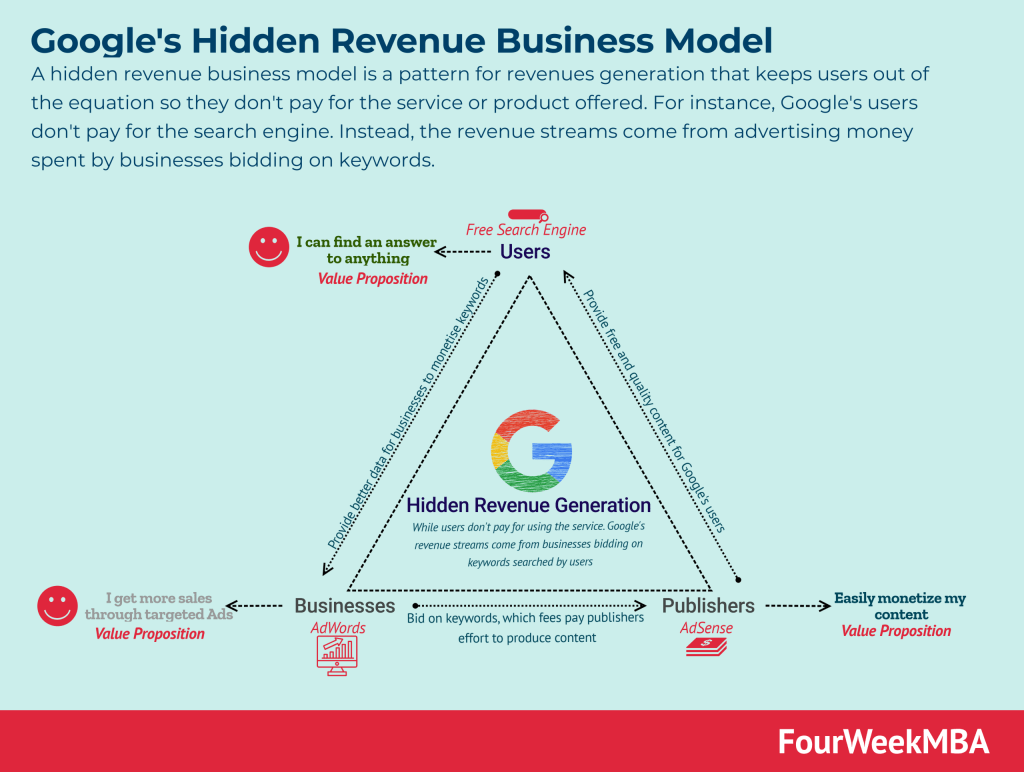
A hidden revenuebusiness model is a pattern for revenue generation that keeps users out of the equation, so they don’t pay for the service or product offered. For instance, Google’s users don’t pay for the search engine. Instead, the revenue streams come from advertising money spent by businesses bidding on keywords.
TikTok is a Chinese creative social media platform driven by short-form video content enabling users to interact and generate content at scale. TikTok primarily makes money through advertising, and it generated $4.6 billion in advertising revenues in 2021, thus making it among the most popular attention-based business models or attention merchants.
Instagram makes money via visual advertising. As part of Facebook products, the company generates revenues for Facebook Inc.’s overall businessmodel. Acquired by Facebook for a billion dollars in 2012, today Instagram is integrated into the overall Facebook business strategy. In 2018, Instagram founders, Kevin Systrom and Mike Krieger left the company, as Facebook pushed toward tighter integration of the two platforms.
YouTube was acquired for almost $1.7 billion in 2006 by Google. It makes money through advertising and subscription revenues. YouTube advertising network is part of Google Ads, and it generated more than $28B in revenue by 2021. YouTube also makes money with its paid memberships and premium content.
Twitter makes money in two ways: advertising and data licensing. In 2021, Twitter generated $4.5 billion from advertising and $570 million from data licensing. While Twitter generated $5 billion in total revenues, it lost 221 million.
Gennaro is the creator of FourWeekMBA, which reached about four million business people, comprising C-level executives, investors, analysts, product managers, and aspiring digital entrepreneurs in 2022 alone | He is also Director of Sales for a high-tech scaleup in the AI Industry | In 2012, Gennaro earned an International MBA with emphasis on Corporate Finance and Business Strategy.