Financial advisors charge clients a fee for their services, typically based on a percentage of the client’s assets under management (AUM). This fee can be ongoing, providing recurring income.
– Steady and predictable income. – Aligns the advisor’s interests with the client’s financial goals. – Encourages a long-term relationship with clients.
– Clients may feel the fees are too high. – Potential conflicts of interest if advisors prioritize higher-fee products. – Regulatory scrutiny regarding fee transparency.
Commission-Based
Advisors earn commissions by selling financial products, such as mutual funds, insurance policies, or annuities. They receive a one-time payment or ongoing commissions based on product sales.
– Opportunity for significant upfront income. – Advisors can offer a wide range of financial products. – Some clients prefer commission-based models, as they may not pay direct fees.
– Potential for conflicts of interest if commissions influence product recommendations. – May not align with the client’s best interests. – Regulatory requirements for disclosure.
Hourly or Flat Fees
Advisors charge clients based on the time spent providing advice or a flat fee for specific services, such as financial planning or retirement planning. This model is fee-only, and advisors do not earn commissions from product sales.
– Transparency in pricing and services. – Advisors are not influenced by product commissions. – Clients know exactly what they are paying for.
– Income may be less predictable than AUM or commission-based models. – Limited scalability for advisors. – May not suit all clients’ needs or preferences.
Hybrid Model
Some advisors combine fee-based and commission-based models. They charge fees for financial planning and also earn commissions for certain product sales. This approach offers flexibility and multiple revenue streams.
– Diversifies income sources. – Can cater to a broader range of clients with varying needs. – Allows advisors to work with both fee-based and commission-based products.
– Potential for conflicts of interest, depending on how commissions are managed. – Regulatory compliance challenges in disclosure. – Requires careful management of compensation structures.
Retainer Fees
Advisors charge clients an ongoing retainer fee for access to financial planning and advisory services. This model may be similar to a subscription service, where clients pay regularly for ongoing support and advice.
– Predictable and recurring income. – Encourages regular communication and engagement with clients. – Can serve as a long-term revenue model.
– Clients may question the value if they don’t regularly use advisory services. – Advisors must consistently deliver value to justify the retainer fee. – May require marketing efforts to attract clients.
Referral Fees
Advisors may receive referral fees or compensation for referring clients to other financial professionals or services, such as attorneys, tax specialists, or insurance agents. This can be an additional source of income.
– Supplemental income source. – Can strengthen relationships with other professionals in the industry. – May enhance the overall client experience by connecting clients with needed services.
– Potential conflicts of interest if referrals are based on financial incentives. – Must adhere to regulatory guidelines on fee disclosure and referral practices. – May not be a primary income source.
Acorns is a fintech platform providing services related to Robo-investing and micro-investing. The company makes money primarily through three subscription tiers: Lite – ($1/month), which gives users access to Acorns Invest, Personal ($3/month) that includes Invest plus the Later (retirement) and Spend (personal checking account) suite of products, Family ($5/month) with features from both the Lite and Personal plans with the addition of Early.
Starting as a pay-later solution integrated into merchants’ checkouts, Affirm makes money from merchants’ fees as consumers pick up the pay-later solution. Affirm also makes money through interest earned from the consumer loans when those are repurchased from the originating bank. In 2020 Affirm made 50% of its revenues from merchants’ fees, about 37% from interests, and the remaining from virtual cards and servicing fees.
Alipay is a Chinese mobile and online payment platform created in 2004 by entrepreneur Jack Ma as the payment arm of Taobao, a major Chinese eCommerce site. Alipay, therefore, is the B2C component of Alibaba Group. Alipay makes money via escrow transaction fees, various value-added ancillary services, and its Credit Pay Instalment fees.
Betterment is an American financial advisory company founded in 2008 by MBA graduate Jon Stein and lawyer Eli Broverman. Betterment makes money via investment plans, financial advice packages, betterment for advisors, betterment for business, cash reserve, and checking accounts.
Chime is an American neobank (internet-only bank) company, providing fee-free financial services through its mobile banking app, thus providing personal finance services free of charge while making the majority of its money via interchange fees (paid by merchants when consumers use their debit cards) and ATM fees.
Coinbase is among the most popular platforms for trading and storing crypto-assets, whose mission is “to create an open financial system for the world” by enabling customers to trade cryptocurrencies. Its platform serves both as a search and discovery engine for crypto assets. The company makes money primarily through fees earned for the transactions processed through the platform, custodial services offered, interest, and subscriptions.
Compass is a licensed American real-estate broker incorporating online real estate technology as a marketing medium. The company makes money via sales commissions (collected whenever a sale is facilitated or tenants are found for a rental property) and bridge loans (a service allowing the seller to purchase a home before the revenue from the sale of their previous home is available).
Dosh is a Fintech platform that enables automatic cash backs for consumers. Its business model connects major card providers with online and offline local businesses to develop automatic cash back programs. The company makes money by earning an affiliate commission on each eligible sale from consumers.
E-Trade is a trading platform allowing investors to trade common and preferred stocks, exchange-traded funds (ETFs), options, bonds, mutual funds, and futures contracts; acquired by Morgan Stanley in 2020 for $13 billion. E-Trade makes money through interest income, order flow, margin interests, options, future and bonds trading, and other fees and service charges.
Klarna is a financial technology company allowing consumers to shop with a temporary Visa card. Thus it then performs a soft credit check and pays the merchant. Klarna makes money by charging merchants. Klarna also earns a percentage of interchange fees as a commission and for interests earned on customers’ accounts.
Lemonade is an insurance tech company using behavioral economics and artificial intelligence to process claims efficiently. The company leverages technology to streamline onboarding customers while also applying a financialmodel to reduce conflicts of interest with customers (perhaps by donating the variable premiums to charity). The company makes money by selling its core insurance products, and via its tech platform, it tries to enhance its sales.
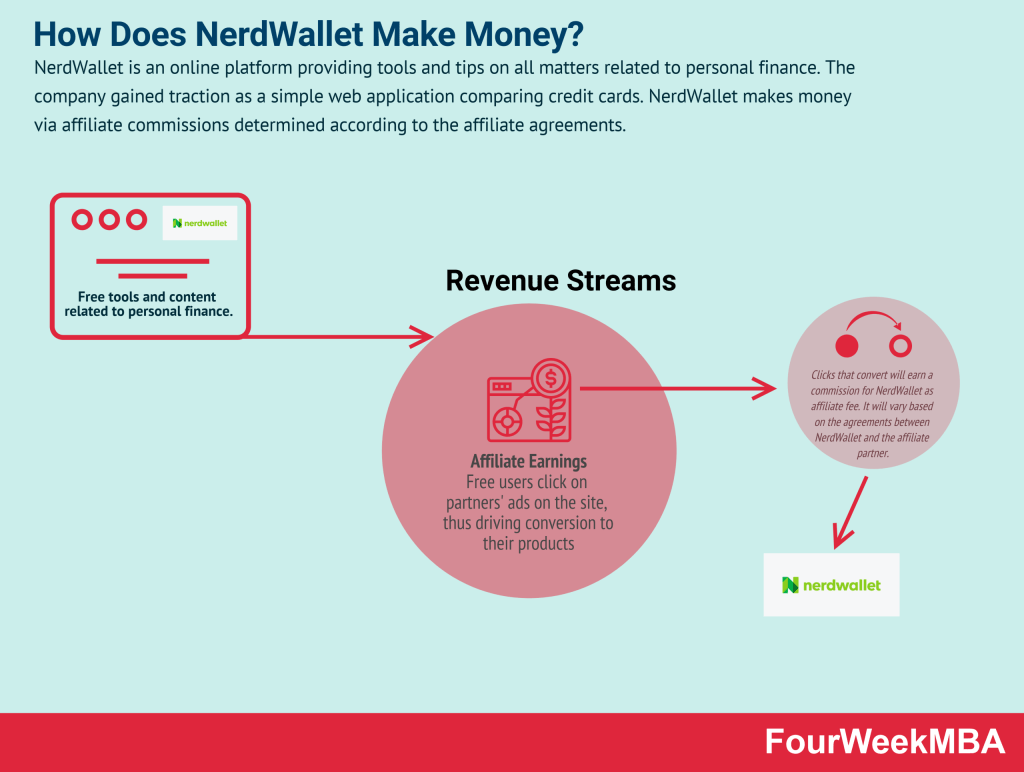
NerdWallet is an online platform providing tools and tips on all matters related to personal finance. The company gained traction as a simple web application comparing credit cards. NerdWallet makes money via affiliate commissions determined according to the affiliate agreements.
Robinhood is an app that helps to invest in stocks, ETFs, options, and cryptocurrencies, all commission-free. Robinhood earns money by offering: Robinhood Gold, a margin trading service, which starts at $6 a month, earns interests from customer cash and stocks, and rebates from market makers and trading venues.
SoFi is an online lending platform that provides affordable education loans to students, and it expanded into financial services, including loans, credit cards, investment services, and insurance. It makes money primarily via payment processing fees and loan securitization.
Stash is a FinTech platform offering a suite of financial tools for young investors, personalized investment advice, and life insurance. The company primarily makes money via subscriptions, cashback, payment for order flows, and interest for cash sitting on members’ accounts.
Wealthfront is an automated Fintech investment platform providing investment, retirement, and cashmanagement products to retail investors, mostly making money on the annual 0.25% advisory fee the company charges for assets under management. It also makes money via a line of credits and interests on the cash accounts.
Zelle is a peer-to-peer payment network that indirectly benefits the banks’ consortium that backs it. Zelle also enables users to pay businesses for goods and services free for users. Merchants pay a 1% fee to Visa or Mastercard, who share it with the bank that issued the card.
Gennaro is the creator of FourWeekMBA, which reached about four million business people, comprising C-level executives, investors, analysts, product managers, and aspiring digital entrepreneurs in 2022 alone | He is also Director of Sales for a high-tech scaleup in the AI Industry | In 2012, Gennaro earned an International MBA with emphasis on Corporate Finance and Business Strategy.