

The Golden Circle attempts to explain how certain businesses can inspire others and differentiate themselves in the market. Originally developed by author Simon Sinek, the concept helps businesses identify their purpose and then communicate that purpose to consumers in a meaningful way so that the brand can be highly differentiated in the marketplace.
| Aspect | Explanation |
|---|---|
| Definition | The Golden Circle is a strategic framework developed by Simon Sinek that emphasizes the importance of starting with “why” before addressing “how” and “what” in business and communication strategies. |
| Key Concepts | – Why: The core purpose, beliefs, and values that drive an organization or individual. – How: The strategies and methods employed to fulfill the “why.” – What: The products, services, or offerings that result from the “how” and “why” components. |
| Characteristics | – Purpose-Driven: A focus on a clear and inspiring sense of purpose as the foundation for decision-making. – Values-Centric: Emphasis on aligning actions and strategies with deeply-held values. – Communication Priority: Advocates that “why” should be communicated before “how” and “what” to inspire and connect with audiences. – Long-Term Orientation: Encourages long-term thinking and consistency in actions and messaging. |
| Examples | – Apple Inc.: Apple’s “why” is to challenge the status quo and think differently, which is reflected in their innovative products (the “what“) and design philosophy (the “how“). – Martin Luther King Jr.: His “why” was the dream of equality and justice, which he communicated through speeches and nonviolent protests (the “how“) to advocate for civil rights (the “what“). – The Red Cross: Their “why” is to alleviate human suffering, which they achieve through humanitarian efforts and disaster relief (the “how“). – SpaceX: Founded by Elon Musk, SpaceX’s “why” is to enable human colonization of other planets, and they pursue this through groundbreaking space exploration (the “how“). |
| Advantages | – Inspires Loyalty: Starting with “why” connects with people on a deeper level, fostering loyalty and dedication. – Clarity of Purpose: Helps organizations stay focused on their core mission and values. – Differentiation: Can set organizations apart from competitors by emphasizing their unique purpose and values. – Motivation: Inspires employees and stakeholders to align with a shared vision and mission. |
| Challenges | – Articulating “Why”: Identifying and clearly articulating the “why” can be challenging for some organizations. – Consistency: Maintaining consistency in actions and messaging over time can be difficult. – Resistance to Change: Some individuals and organizations may resist adopting a “why“-centered approach if they are accustomed to focusing on the “how” and “what.” |
| Adoption Trends | The Golden Circle framework has gained popularity in various industries as organizations recognize the importance of purpose-driven strategies and storytelling. In an era where consumers seek authenticity and meaning, the “why” has become a powerful tool for building trust and engagement. |
| Conclusion | The Golden Circle framework underscores the significance of starting with “why” as the foundation for effective communication, decision-making, and differentiation in business and leadership. By understanding and communicating their core purpose and values, organizations and leaders can inspire loyalty, clarity, and motivation while navigating the challenges of articulating and maintaining their “why” over time. |
Understanding The Golden Circle
The Golden Circle is represented by three concentric circles, with each circle, in turn, representing a particular facet of market differentiation.
The outermost circle denotes the “what” or the particular product or service a business offers.
Next is the “how,” or the steps involved in delivering that product or service.
At the center of the three concentric circles is the “why,” which is the most important part.
This circle describes the purpose, cause, or belief of a business. It is the very reason that a business exists – aside from profit generation.
In his book Start With Why: How Great Leaders Inspire Everyone to Take Action, Sinek notes that too many businesses start with product creation and then determine their purpose afterward.
To differentiate themselves, he instead argues that they start with “why” and then move through to the “how” and “what” of product creation.
When a business starts by identifying its purpose, it can inspire consumers to take action and align with their brands.
This is primarily achieved by tapping into certain parts of the human brain that govern trust, loyalty, and decision-making.
The Golden Circle in digital marketing
Since purpose is closely related to branding in digital marketing, it is helpful to look at The Golden Circle in the context of three brand characteristics.
Brand mission (Why)
The brand mission describes the reason that a brand exists.
Again, this does not include making money or generating profits.
For businesses hoping to reach consumers on a personal level, the brand mission should at least strive to improve their lives.
More often than not, this means solving a problem that they or wider society are experiencing.
For example, Elon Musk founded SpaceX with the mission of reducing the costs associated with traveling in space.
Apple’s brand mission is to deliver unrivaled user experiences through innovative technology.
Brand character (How)
Once a business has determined its purpose through a brand mission, it’s time to focus on the behaviors that will exemplify this purpose in practice.
To be effective, behavior must be aligned with the purpose and brand mission across all business operations.
Indeed, only businesses that communicate in alignment with their mission are seen to be authentic by their target audience.
Authenticity then creates the right positive emotions in consumers, who are then more motivated to buy.
Apple’s aesthetically pleasing and functional products are very much in alignment with its mission to deliver high-quality user experiences.
Brand identity (What)
Brand identity is the physical manifestation of a company’s mission and character.
In addition to products and services, brand identity includes company logos and the language and visual elements used in promotional materials.
Apple CEO Steve Jobs was, in some respects, the physical manifestation of his own company.
His interest in Japanese Zen and minimalist design became Apple’s purpose.
His signature outfit of a turtleneck sweater and jeans was also specifically worn to convey the company’s mission of simplicity and functionality.
Additional Golden Circle examples
Let’s conclude by taking a look at some additional Golden Circle examples.
Tesla

Brand mission (Why)
Tesla’s brand mission is to accelerate the transition to sustainable transport and energy.
Transportation accounts for around 20% of global carbon dioxide emissions of which road transportation accounts for 75%.
CEO Elon Musk reiterates the importance of revolutionizing vehicles and the impact of global warming on the world’s citizens: “If a car emits toxic gas, it’s bad for your health.”
Brand character (How)
Tesla has the unenviable job of producing electric vehicles at prices that appeal to the mass consumer market.
The company also needs to counter stereotypes that EVs are slow, aesthetically dull, lack performance, and cannot be driven far without requiring a recharge.
Before the Model 3 reached mass uptake, Tesla started with the low volume/high price Roadster and mid-volume/lower-priced Model S and Model X.
This produced enough sales volume that other car makers were inspired to establish their electric vehicle departments and generate buzz around the industry.
Brand identity (What)
Tesla’s brand identity is personified in the Model S more than any other vehicle in its range.
The car offers faster acceleration than some expensive petrol models, which validates Musk’s comment that “At Tesla, we don’t do slow cars.”
The Model S also offers a 5-star safety rating and has a range of 215 miles on a single charge.
This exceeds the range of competitor EVs from Nissan, Mercedes, Fiat, and BMW.
Home Depot
Brand mission (Why)
Home Depot’s brand mission in the home improvement industry is to provide “the highest level of service, the broadest selection of products and the most competitive prices.”
The company also adheres to eight core values with most centered around people.
These include building strong relationships, creating shareholder value, taking care of our people, excelling in customer service, and respect for everyone.
Brand character (How)
In response to the COVID-19 pandemic, Home Depot spent $850 million to support its employees during a difficult time.
It expanded paid leave for hourly employees and provided additional paid time off for those over 65 who were deemed a higher risk of contracting the disease.
The company also distributed weekly bonuses, doubled overtime rates, and extended dependent care benefits schemes.
Home Depot’s culture is based on an inverted leadership pyramid where employees and customers come first.
The company’s commitment to the latter has also seen employees trained in construction skills so that the advice they offer in-store is as detailed, accurate, and helpful as possible.
Brand identity (What)
One physical manifestation of the Home Depot brand is the Home Depot Foundation.
This organization improves the lives and homes of returned servicemen and offers support to communities impacted by natural disasters.
Home Depot has pledged to invest $500 million in veteran causes by 2025 with a further $50 million to train the next generation of tradespeople.
The company’s consistent ability to put people, customers, and communities first has established it as one of America’s most trusted and profitable home improvement chains.
Key takeaways
- The Golden Circle is a concept that explains how a business might provide maximum value to consumers by changing the way it thinks.
- The Golden Circle advocates businesses starting with why they are in existence and then developing a product to suit – as opposed to the reverse.
- The Golden Circle is useful in branding because it is closely related to purpose and the story or message that a business wants to tell.
Key Highlights of The Golden Circle:
- Definition:
- The Golden Circle is a concept developed by author Simon Sinek to help businesses identify their purpose and communicate it effectively to inspire consumers and differentiate themselves in the market.
- Three Circles:
- The Golden Circle consists of three concentric circles:
- The outermost circle represents “What,” denoting the specific product or service a business offers.
- The middle circle represents “How,” signifying the processes and methods used to deliver the product or service.
- The innermost circle represents “Why,” which is the core purpose, cause, or belief that drives the business beyond profit generation.
- The Golden Circle consists of three concentric circles:
- Starting with Why:
- Sinek argues that businesses should start with “why” and then move outward to “how” and “what.” By identifying their purpose first, businesses can inspire consumers and create strong differentiation.
- Role in Digital Marketing:
- In digital marketing, the Golden Circle relates to brand characteristics:
- Brand Mission (Why): Describes the reason for the brand’s existence, often centered around improving lives or solving problems.
- Brand Character (How): Refers to the behaviors and actions that align with the brand’s mission, fostering authenticity.
- Brand Identity (What): Represents the physical manifestation of the brand, including products, logos, and promotional materials.
- In digital marketing, the Golden Circle relates to brand characteristics:
- Examples:
- Tesla’s brand mission is to accelerate the transition to sustainable transport and energy (Why). It achieves this through innovative electric vehicles with superior performance (How/What).
- Home Depot’s brand mission is to provide excellent service, a broad product selection, and competitive prices (Why). It demonstrates this through employee support and community initiatives (How/What).
| Related Framework | Description | When to Apply |
|---|---|---|
| Start with Why | The “Start with Why” framework, popularized by Simon Sinek, emphasizes the importance of starting with a clear understanding of the purpose or “why” behind any endeavor. It suggests that communicating the underlying motivation or belief that drives an organization’s actions inspires others to take action or support the cause. This framework helps businesses articulate their core values, mission, or vision to align with their target audience’s values and beliefs, fostering loyalty and engagement. | When developing a marketing strategy, crafting brand messaging, or communicating organizational goals, applying the Start with Why framework to articulate the underlying purpose or belief that motivates the organization, thus inspiring action, building trust, and fostering deeper connections with customers, employees, or stakeholders who resonate with the organization’s values and mission. |
| Circle of Safety | The Circle of Safety framework, also introduced by Simon Sinek, focuses on creating a sense of safety and trust within organizations by prioritizing the well-being and support of team members. It emphasizes the importance of fostering a culture of collaboration, empathy, and mutual support to enhance teamwork, innovation, and performance. This framework suggests that when individuals feel safe and supported within their team or organization, they are more likely to take risks, share ideas, and contribute to collective success. | When building high-performing teams, fostering a positive work culture, or improving organizational effectiveness, applying the Circle of Safety framework to prioritize psychological safety and trust among team members, thus creating an environment where individuals feel empowered, valued, and supported in taking risks, sharing ideas, and collaborating effectively to achieve shared goals and objectives. |
| Golden Circle | The Golden Circle framework, also introduced by Simon Sinek, explores the fundamental elements of effective communication and leadership by examining the “why,” “how,” and “what” of an organization’s actions or messages. It suggests that successful leaders and organizations start with why they do what they do, followed by how they do it, and finally what they do. By starting with the “why,” leaders can inspire action and build a sense of purpose that resonates with their audience or stakeholders. This framework helps businesses differentiate themselves, communicate their unique value proposition, and engage customers or employees on a deeper level. | When crafting brand messaging, developing marketing campaigns, or communicating organizational values, applying the Golden Circle framework to articulate the underlying purpose or motivation (why) behind the organization’s actions or messages, thus inspiring loyalty, engagement, and alignment with stakeholders who share similar values or beliefs. |
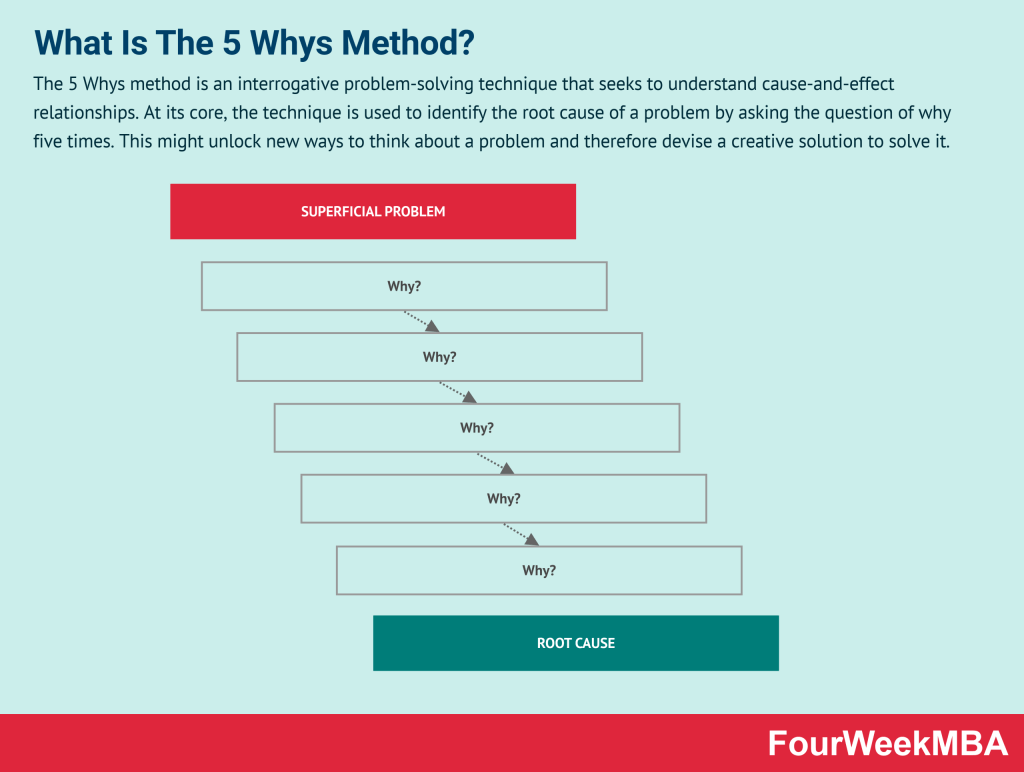
| Five Whys | The Five Whys framework is a problem-solving technique that involves repeatedly asking “why” to uncover the root cause of an issue or problem. It encourages teams to dig deeper beyond surface-level symptoms and identify underlying factors contributing to a problem. By asking “why” five times or until reaching the root cause, teams can address the underlying issues more effectively and implement lasting solutions. This framework helps teams improve processes, reduce errors, and prevent recurring problems by addressing root causes rather than just treating symptoms. | When troubleshooting issues, analyzing failures, or improving processes, applying the Five Whys framework to systematically identify the root cause of problems, thus enabling teams to implement targeted solutions, prevent recurring issues, and improve overall performance and efficiency in various areas of business operations. |
| SWOT Analysis | SWOT Analysis is a strategic planning tool that helps businesses identify internal strengths and weaknesses, as well as external opportunities and threats. It involves evaluating the organization’s internal capabilities and resources (strengths and weaknesses) and assessing the external market conditions and competitive landscape (opportunities and threats). SWOT Analysis provides valuable insights for strategic decision-making, business planning, and risk management by identifying areas of competitive advantage, potential risks, and opportunities for growth or improvement. | When developing business strategies, assessing market opportunities, or conducting strategic planning, applying SWOT Analysis to evaluate internal strengths and weaknesses, as well as external opportunities and threats, thus informing decision-making, resource allocation, and risk mitigation strategies to capitalize on strengths, minimize weaknesses, and seize opportunities while mitigating potential threats or challenges in the competitive landscape. |
| Blue Ocean Strategy | The Blue Ocean Strategy framework encourages businesses to seek uncontested market space or “blue oceans” where competition is low or nonexistent, rather than competing in overcrowded or competitive markets (red oceans). It involves creating new market segments, products, or services that offer innovative value propositions to attract new customers and differentiate from existing competitors. Blue Ocean Strategy focuses on value innovation, which involves simultaneously increasing value for customers while reducing costs. By creating blue oceans, businesses can unlock new growth opportunities, drive innovation, and escape competition-based pricing and commoditization. | When developing new products or entering new markets, applying the Blue Ocean Strategy framework to identify untapped market spaces or create innovative value propositions that differentiate from competitors, thus unlocking new growth opportunities, attracting new customers, and achieving sustainable competitive advantage by focusing on value innovation and market creation rather than competing solely on price or features in crowded market segments (red oceans). |
| Design Thinking | Design Thinking is a human-centered approach to innovation and problem-solving that emphasizes empathy, creativity, and iterative prototyping. It involves understanding user needs, brainstorming creative solutions, prototyping and testing ideas, and iterating based on user feedback. Design Thinking encourages interdisciplinary collaboration and iterative experimentation to develop innovative solutions that address user needs and create meaningful experiences. This framework is widely used in product development, service design, and organizational innovation to foster creativity, user-centricity, and continuous improvement. | When developing new products, services, or processes, applying Design Thinking to understand user needs, generate creative solutions, and iteratively prototype and refine ideas based on user feedback, thus fostering innovation, customer-centricity, and continuous improvement in various aspects of business operations and organizational culture. |
| Lean Startup | The Lean Startup methodology, popularized by Eric Ries, advocates for a systematic approach to launching and growing startups by applying principles of lean manufacturing and agile development. It involves building minimum viable products (MVPs), testing hypotheses through rapid experimentation, and iterating based on customer feedback. Lean Startup emphasizes validated learning, which focuses on quickly validating assumptions and learning from failures to pivot or persevere. This framework helps startups mitigate risks, conserve resources, and accelerate product-market fit by focusing on iterative learning and customer validation. | When launching new ventures or developing innovative products, applying the Lean Startup methodology to build minimum viable products, test hypotheses through rapid experimentation, and iterate based on customer feedback, thus accelerating the path to product-market fit, mitigating risks, and conserving resources by focusing on validated learning, iteration, and adaptation in response to market feedback and changing customer needs. |
| Value Proposition Canvas | The Value Proposition Canvas is a strategic tool that helps businesses design compelling value propositions by understanding customer needs and preferences. It consists of two main components: the customer profile and the value proposition. The customer profile identifies customer segments, their jobs to be done, pains, and gains, while the value proposition describes the products or services that address customer needs, pains, and gains. By mapping the fit between customer profiles and value propositions, businesses can design offerings that resonate with target customers and differentiate from competitors. | When developing or refining value propositions for products or services, applying the Value Proposition Canvas to understand customer needs, pains, and gains, and design offerings that address those needs effectively, thus enhancing customer satisfaction, differentiation, and competitive advantage in the market by aligning product or service features with customer preferences, challenges, and desired outcomes. |
| Theory of Constraints (TOC) | The Theory of Constraints (TOC) is a management philosophy that identifies the most significant limiting factor or constraint in a system and focuses on improving it to maximize overall performance. It involves identifying constraints, exploiting them to optimize performance, subordinating other activities to the constraint, elevating the constraint if necessary, and repeating the process iteratively. TOC helps businesses identify bottlenecks, streamline processes, and improve throughput by addressing the root causes of constraints. This framework is applicable across various industries and business functions to enhance efficiency, productivity, and profitability. | When optimizing business processes, improving productivity, or increasing throughput, applying the Theory of Constraints (TOC) to identify and address the most significant limiting factors or bottlenecks in the system, thus improving overall performance, streamlining operations, and maximizing throughput by focusing on continuous improvement and constraint management in various aspects of business operations and supply chain management. |
Connected Business Concepts




Related resources:
Handpicked business resources:
- Business Models
- Business Strategy
- Digital Business Models
- Distribution Channels
- Go-To-Market Strategy
- Marketing Strategy
- Network Effects
- Platform Business Models
- Revenue Models


