The Buyer Utility Map is a strategic tool used by businesses to understand and enhance the value proposition of their products or services from the perspective of the customer. Developed by W. Chan Kim and Renée Mauborgne, authors of the Blue Ocean Strategy framework, the Buyer Utility Map helps businesses identify opportunities to create innovative offerings that unlock new sources of value for customers.
Utility Levers: The Buyer Utility Map identifies six utility levers that businesses can use to create value for customers:
Customer Productivity: How effectively does the product or service help customers perform their tasks or achieve their goals?
Simplicity: How easy is it for customers to understand and use the product or service?
Convenience: How convenient is the product or service to purchase, use, and maintain?
Risk: How much risk is associated with using the product or service?
Fun and Image: Does the product or service provide enjoyment or enhance the customer’s image?
Environmental Friendliness: How environmentally friendly is the product or service?
Value Innovation: The Buyer Utility Map encourages businesses to pursue value innovation by simultaneously increasing value for customers and reducing costs. By focusing on areas of unmet customer needs and offering unique combinations of utility levers, businesses can create new market spaces and differentiate themselves from competitors.
Holistic Perspective: The Buyer Utility Map provides a holistic perspective on the customer experience by considering multiple dimensions of value beyond just the product or service itself. By understanding the full range of customer needs and preferences, businesses can design offerings that deliver superior value and drive customer satisfaction and loyalty.
Methodologies and Approaches
The Buyer Utility Map can be implemented through various methodologies and approaches to enhance the value proposition of products or services.
Customer Research
Customer research involves gathering insights into customer needs, preferences, and pain points through methods such as surveys, interviews, and observations. By understanding the specific challenges and aspirations of target customers, businesses can identify opportunities to enhance utility and differentiate their offerings.
Value Proposition Design
Value proposition design involves crafting compelling value propositions that resonate with target customers and address their most pressing needs and desires. By aligning the features, benefits, and positioning of products or services with customer preferences, businesses can create offerings that deliver meaningful value and drive purchase decisions.
Iterative Testing and Optimization
Iterative testing and optimization involve continuously refining and improving the value proposition based on feedback from customers and market testing. By experimenting with different combinations of utility levers and measuring their impact on customer satisfaction and engagement, businesses can optimize their offerings to maximize value creation and competitive advantage.
Benefits of Buyer Utility Map
The Buyer Utility Map offers several benefits for businesses seeking to enhance the value proposition of their products or services.
Customer-Centric Innovation: The Buyer Utility Map helps businesses adopt a customer-centric approach to innovation by focusing on addressing unmet customer needs and preferences. By understanding and fulfilling customer requirements across multiple dimensions of value, businesses can create offerings that resonate with target customers and drive demand.
Differentiation and Competitive Advantage: The Buyer Utility Map enables businesses to differentiate themselves from competitors by offering unique combinations of utility levers that deliver superior value to customers. By innovating beyond traditional product features and functionality, businesses can create new market spaces and capture untapped opportunities for growth.
Increased Customer Satisfaction and Loyalty: By enhancing the value proposition of products or services, businesses can increase customer satisfaction and loyalty. By delivering offerings that are more productive, convenient, enjoyable, and environmentally friendly, businesses can build stronger relationships with customers and drive repeat purchases and referrals.
Challenges in Implementing Buyer Utility Map
Despite its benefits, implementing the Buyer Utility Map in businesses can pose several challenges and considerations.
Complexity and Integration: The Buyer Utility Map requires businesses to consider multiple dimensions of value and balance competing priorities and trade-offs. Implementing the Buyer Utility Map effectively may require significant resources, expertise, and cross-functional collaboration to integrate insights from customer research into product development and marketing strategies.
Market Dynamics and Competitive Pressures: The success of the Buyer Utility Map depends on businesses’ ability to anticipate and respond to changing market dynamics and competitive pressures. Businesses must continuously monitor customer preferences, industry trends, and competitive actions to stay ahead of the curve and maintain relevance and differentiation in the market.
Execution and Implementation: Implementing the Buyer Utility Map requires disciplined execution and implementation to translate insights into action. Businesses must align internal processes, systems, and capabilities to deliver on the promise of the value proposition and ensure a seamless and consistent customer experience across all touchpoints.
Strategies for Implementing Buyer Utility Map
To address challenges and maximize the effectiveness of the Buyer Utility Map, businesses can employ various strategies and best practices.
Cross-Functional Collaboration: Foster cross-functional collaboration and alignment across departments, such as marketing, product development, sales, and customer service, to ensure a unified approach to value creation and delivery. By breaking down silos and sharing insights and expertise, businesses can leverage diverse perspectives and capabilities to innovate and execute effectively.
Agile and Iterative Approach: Adopt an agile and iterative approach to innovation and product development, allowing for rapid experimentation and adaptation based on customer feedback and market testing. By embracing a culture of learning and experimentation, businesses can quickly identify and capitalize on emerging opportunities and iterate on their value proposition to drive continuous improvement and innovation.
Customer Co-Creation: Engage customers as partners in the value creation process through co-creation initiatives, such as ideation workshops, focus groups, and beta testing programs. By involving customers in the design and development of products or services, businesses can gain valuable insights, validate assumptions, and ensure alignment with customer needs and preferences.
Real-World Examples
The Buyer Utility Map has been applied in various industries and sectors to enhance the value proposition of products or services.
Technology: In the technology industry, companies such as Apple have used the Buyer Utility Map to design products that offer seamless integration, intuitive user interfaces, and innovative features that enhance productivity, simplicity, and convenience. By focusing on customer-centric design principles, Apple has differentiated itself in the market and built a loyal customer base.
Retail: In the retail sector, companies like Amazon have leveraged the Buyer Utility Map to create a frictionless shopping experience that offers convenience, selection, and personalized recommendations. By investing in technologies such as machine learning and data analytics, Amazon has transformed the way people shop and set new standards for customer satisfaction and loyalty.
Hospitality: In the hospitality industry, companies such as Airbnb have used the Buyer Utility Map to reimagine the travel experience and offer unique accommodations that cater to diverse customer preferences and lifestyles. By empowering hosts to create personalized experiences and providing a platform for authentic connections, Airbnb has disrupted the traditional hospitality model and captured market share from established players.
Conclusion
The Buyer Utility Map is a powerful tool that enables businesses to understand and enhance the value proposition of their products or services from the perspective of the customer. By identifying opportunities to create innovative offerings that address unmet customer needs and preferences across multiple dimensions of value, businesses can differentiate themselves from competitors, drive customer satisfaction and loyalty, and unlock new sources of growth and profitability. Despite challenges such as complexity, market dynamics, and execution, the Buyer Utility Map offers significant benefits for businesses seeking to innovate and stay ahead in today’s competitive marketplace. As businesses continue to prioritize customer-centricity and value creation, the Buyer Utility Map will remain a valuable framework for guiding strategic decision-making and driving sustainable success.
Related Frameworks
Description
When to Apply
Value Proposition Canvas
– A tool for designing or refining value propositions by identifying customer jobs to be done, pains, and gains. The Value Proposition Canvas helps align product or service features with customer needs and priorities, enhancing value creation and differentiation.
– When developing or refining value propositions. – Utilizing the Value Proposition Canvas to map customer jobs, pains, and gains, and align product or service features with customer needs effectively, enhancing value proposition development and differentiation.
Customer Journey Mapping
– A process for visualizing and understanding the end-to-end customer experience across touchpoints and interactions. Customer Journey Mapping helps identify opportunities to improve customer satisfaction and engagement by addressing pain points and moments of truth.
– When optimizing the customer experience. – Employing Customer Journey Mapping techniques to analyze customer interactions, identify pain points, and optimize touchpoints to enhance satisfaction and engagement effectively.
Design Thinking
– A human-centered approach to innovation that emphasizes empathy, ideation, prototyping, and testing. Design Thinking fosters creativity and collaboration to solve complex problems and meet user needs.
– When developing customer-centric solutions or addressing unmet needs. – Applying Design Thinking methodologies to empathize with users, generate innovative ideas, prototype solutions, and iterate based on feedback effectively, ensuring customer-centricity and value creation.
Jobs-to-be-Done (JTBD)
– A framework for understanding customer needs and motivations by focusing on the functional and emotional “jobs” that customers are trying to accomplish. Jobs-to-be-Done (JTBD) helps uncover unmet needs and opportunities for innovation.
– When identifying customer needs or developing new products/services. – Utilizing Jobs-to-be-Done (JTBD) framework to uncover unmet customer needs, understand motivations, and design solutions that address specific jobs effectively, fostering innovation and differentiation.
Customer Segmentation
– The process of dividing customers into groups based on shared characteristics or behaviors to better understand their needs and preferences. Customer Segmentation enables targeted marketing and personalized experiences.
– When tailoring marketing strategies or product offerings. – Employing Customer Segmentation to identify distinct customer groups, analyze their unique needs and preferences, and tailor marketing messages or product/service features effectively, enhancing relevance and engagement.
Service Blueprinting
– A method for visualizing and designing service experiences by mapping customer interactions, front-stage activities, and back-stage processes. Service Blueprinting helps identify opportunities to improve service quality and efficiency.
– When designing or optimizing service experiences. – Creating Service Blueprinting diagrams to map customer journeys, service touchpoints, and internal processes, identifying pain points and opportunities for service improvement effectively.
Product Lifecycle Management (PLM)
– A system for managing the entire lifecycle of a product from ideation and design through manufacturing, distribution, and end-of-life. Product Lifecycle Management (PLM) facilitates collaboration, version control, and traceability across cross-functional teams.
– When managing product development processes or portfolios. – Implementing Product Lifecycle Management (PLM) systems to streamline product development workflows, track changes, and ensure alignment with customer needs and market demands effectively.
Lean Startup Methodology
– An approach to building and launching new products or services that emphasizes iterative experimentation, customer feedback, and rapid iteration. The Lean Startup Methodology minimizes risk and maximizes learning through validated learning and lean principles.
– When launching new products or ventures. – Applying Lean Startup Methodology principles to validate product ideas, gather customer feedback, and iterate on prototypes quickly and efficiently, minimizing risk and maximizing value creation.
User Experience (UX) Design
– The process of designing digital or physical products/services with a focus on usability, accessibility, and user satisfaction. User Experience (UX) Design incorporates user research, prototyping, and testing to create intuitive and engaging experiences.
– When designing digital interfaces or interactions. – Employing User Experience (UX) Design principles to understand user needs, prototype solutions, and conduct usability testing to create intuitive and engaging experiences that meet customer expectations effectively.
Agile Methodology
– A project management approach that emphasizes iterative development, collaboration, and adaptability. Agile Methodology enables teams to respond to change quickly and deliver incremental value.
– When developing software or digital products. – Implementing Agile Methodology practices to prioritize customer requirements, deliver value in short iterations, and incorporate feedback to continuously improve product features and functionality effectively.
AIOps is the application of artificial intelligence to IT operations. It has become particularly useful for modern IT management in hybridized, distributed, and dynamic environments. AIOps has become a key operational component of modern digital-based organizations, built around software and algorithms.
Agile started as a lightweight development method compared to heavyweight software development, which is the core paradigm of the previous decades of software development. By 2001 the Manifesto for Agile Software Development was born as a set of principles that defined the new paradigm for software development as a continuous iteration. This would also influence the way of doing business.
Agile Program Management is a means of managing, planning, and coordinating interrelated work in such a way that value delivery is emphasized for all key stakeholders. Agile Program Management (AgilePgM) is a disciplined yet flexible agile approach to managing transformational change within an organization.
Agile project management (APM) is a strategy that breaks large projects into smaller, more manageable tasks. In the APM methodology, each project is completed in small sections – often referred to as iterations. Each iteration is completed according to its project life cycle, beginning with the initial design and progressing to testing and then quality assurance.
Agile Modeling (AM) is a methodology for modeling and documenting software-based systems. Agile Modeling is critical to the rapid and continuous delivery of software. It is a collection of values, principles, and practices that guide effective, lightweight software modeling.
Agile Business Analysis (AgileBA) is certification in the form of guidance and training for business analysts seeking to work in agile environments. To support this shift, AgileBA also helps the business analyst relate Agile projects to a wider organizational mission or strategy. To ensure that analysts have the necessary skills and expertise, AgileBA certification was developed.
Agile leadership is the embodiment of agile manifesto principles by a manager or management team. Agile leadership impacts two important levels of a business. The structural level defines the roles, responsibilities, and key performance indicators. The behavioral level describes the actions leaders exhibit to others based on agile principles.
The andon system alerts managerial, maintenance, or other staff of a production process problem. The alert itself can be activated manually with a button or pull cord, but it can also be activated automatically by production equipment. Most Andon boards utilize three colored lights similar to a traffic signal: green (no errors), yellow or amber (problem identified, or quality check needed), and red (production stopped due to unidentified issue).
Bimodal Portfolio Management (BimodalPfM) helps an organization manage both agile and traditional portfolios concurrently. Bimodal Portfolio Management – sometimes referred to as bimodal development – was coined by research and advisory company Gartner. The firm argued that many agile organizations still needed to run some aspects of their operations using traditional delivery models.
Business innovation is about creating new opportunities for an organization to reinvent its core offerings, revenue streams, and enhance the value proposition for existing or new customers, thus renewing its whole business model. Business innovation springs by understanding the structure of the market, thus adapting or anticipating those changes.
Business model innovation is about increasing the success of an organization with existing products and technologies by crafting a compelling value proposition able to propel a new business model to scale up customers and create a lasting competitive advantage. And it all starts by mastering the key customers.
A consumer brand company like Procter & Gamble (P&G) defines “Constructive Disruption” as: a willingness to change, adapt, and create new trends and technologies that will shape our industry for the future. According to P&G, it moves around four pillars: lean innovation, brand building, supply chain, and digitalization & data analytics.
That is a process that requires a continuous feedback loop to develop a valuable product and build a viable business model. Continuous innovation is a mindset where products and services are designed and delivered to tune them around the customers’ problem and not the technical solution of its founders.
A design sprint is a proven five-day process where critical business questions are answered through speedy design and prototyping, focusing on the end-user. A design sprint starts with a weekly challenge that should finish with a prototype, test at the end, and therefore a lesson learned to be iterated.
Tim Brown, Executive Chair of IDEO, defined design thinking as “a human-centered approach to innovation that draws from the designer’s toolkit to integrate the needs of people, the possibilities of technology, and the requirements for business success.” Therefore, desirability, feasibility, and viability are balanced to solve critical problems.
DevOps refers to a series of practices performed to perform automated software development processes. It is a conjugation of the term “development” and “operations” to emphasize how functions integrate across IT teams. DevOps strategies promote seamless building, testing, and deployment of products. It aims to bridge a gap between development and operations teams to streamline the development altogether.
Product discovery is a critical part of agile methodologies, as its aim is to ensure that products customers love are built. Product discovery involves learning through a raft of methods, including design thinking, lean start-up, and A/B testing to name a few. Dual Track Agile is an agile methodology containing two separate tracks: the “discovery” track and the “delivery” track.
eXtreme Programming was developed in the late 1990s by Ken Beck, Ron Jeffries, and Ward Cunningham. During this time, the trio was working on the Chrysler Comprehensive Compensation System (C3) to help manage the company payroll system. eXtreme Programming (XP) is a software development methodology. It is designed to improve software quality and the ability of software to adapt to changing customer needs.
Feature-Driven Development is a pragmatic software process that is client and architecture-centric. Feature-Driven Development (FDD) is an agile software development model that organizes workflow according to which features need to be developed next.
A Gemba Walk is a fundamental component of lean management. It describes the personal observation of work to learn more about it. Gemba is a Japanese word that loosely translates as “the real place”, or in business, “the place where value is created”. The Gemba Walk as a concept was created by Taiichi Ohno, the father of the Toyota Production System of lean manufacturing. Ohno wanted to encourage management executives to leave their offices and see where the real work happened. This, he hoped, would build relationships between employees with vastly different skillsets and build trust.
GIST Planning is a relatively easy and lightweight agile approach to product planning that favors autonomous working. GIST Planning is a lean and agile methodology that was created by former Google product manager Itamar Gilad. GIST Planning seeks to address this situation by creating lightweight plans that are responsive and adaptable to change. GIST Planning also improves team velocity, autonomy, and alignment by reducing the pervasive influence of management. It consists of four blocks: goals, ideas, step-projects, and tasks.
The ICE Scoring Model is an agile methodology that prioritizes features using data according to three components: impact, confidence, and ease of implementation. The ICE Scoring Model was initially created by author and growth expert Sean Ellis to help companies expand. Today, the model is broadly used to prioritize projects, features, initiatives, and rollouts. It is ideally suited for early-stage product development where there is a continuous flow of ideas and momentum must be maintained.
An innovation funnel is a tool or process ensuring only the best ideas are executed. In a metaphorical sense, the funnel screens innovative ideas for viability so that only the best products, processes, or business models are launched to the market. An innovation funnel provides a framework for the screening and testing of innovative ideas for viability.
According to how well defined is the problem and how well defined the domain, we have four main types of innovations: basic research (problem and domain or not well defined); breakthrough innovation (domain is not well defined, the problem is well defined); sustaining innovation (both problem and domain are well defined); and disruptive innovation (domain is well defined, the problem is not well defined).
The innovation loop is a methodology/framework derived from the Bell Labs, which produced innovation at scale throughout the 20th century. They learned how to leverage a hybrid innovation management model based on science, invention, engineering, and manufacturing at scale. By leveraging individual genius, creativity, and small/large groups.
The Agile methodology has been primarily thought of for software development (and other business disciplines have also adopted it). Lean thinking is a process improvement technique where teams prioritize the value streams to improve it continuously. Both methodologies look at the customer as the key driver to improvement and waste reduction. Both methodologies look at improvement as something continuous.
A startup company is a high-tech business that tries to build a scalable business model in tech-driven industries. A startup company usually follows a lean methodology, where continuous innovation, driven by built-in viral loops is the rule. Thus, driving growth and building network effects as a consequence of this strategy.
As pointed out by Eric Ries, a minimum viable product is that version of a new product which allows a team to collect the maximum amount of validated learning about customers with the least effort through a cycle of build, measure, learn; that is the foundation of the lean startup methodology.
Kanban is a lean manufacturing framework first developed by Toyota in the late 1940s. The Kanban framework is a means of visualizing work as it moves through identifying potential bottlenecks. It does that through a process called just-in-time (JIT) manufacturing to optimize engineering processes, speed up manufacturing products, and improve the go-to-market strategy.
Jidoka was first used in 1896 by Sakichi Toyoda, who invented a textile loom that would stop automatically when it encountered a defective thread. Jidoka is a Japanese term used in lean manufacturing. The term describes a scenario where machines cease operating without human intervention when a problem or defect is discovered.
The PDCA (Plan-Do-Check-Act) cycle was first proposed by American physicist and engineer Walter A. Shewhart in the 1920s. The PDCA cycle is a continuous process and product improvement method and an essential component of the lean manufacturing philosophy.
RAD was first introduced by author and consultant James Martin in 1991. Martin recognized and then took advantage of the endless malleability of software in designing development models. Rapid Application Development (RAD) is a methodology focusing on delivering rapidly through continuous feedback and frequent iterations.
Retrospective analyses are held after a project to determine what worked well and what did not. They are also conducted at the end of an iteration in Agile project management. Agile practitioners call these meetings retrospectives or retros. They are an effective way to check the pulse of a project team, reflect on the work performed to date, and reach a consensus on how to tackle the next sprint cycle. These are the five stages of a retrospective analysis for effective Agile project management: set the stage, gather the data, generate insights, decide on the next steps, and close the retrospective.
Scaled Agile Lean Development (ScALeD) helps businesses discover a balanced approach to agile transition and scaling questions. The ScALed approach helps businesses successfully respond to change. Inspired by a combination of lean and agile values, ScALed is practitioner-based and can be completed through various agile frameworks and practices.
The SMED (single minute exchange of die) method is a lean production framework to reduce waste and increase production efficiency. The SMED method is a framework for reducing the time associated with completing an equipment changeover.
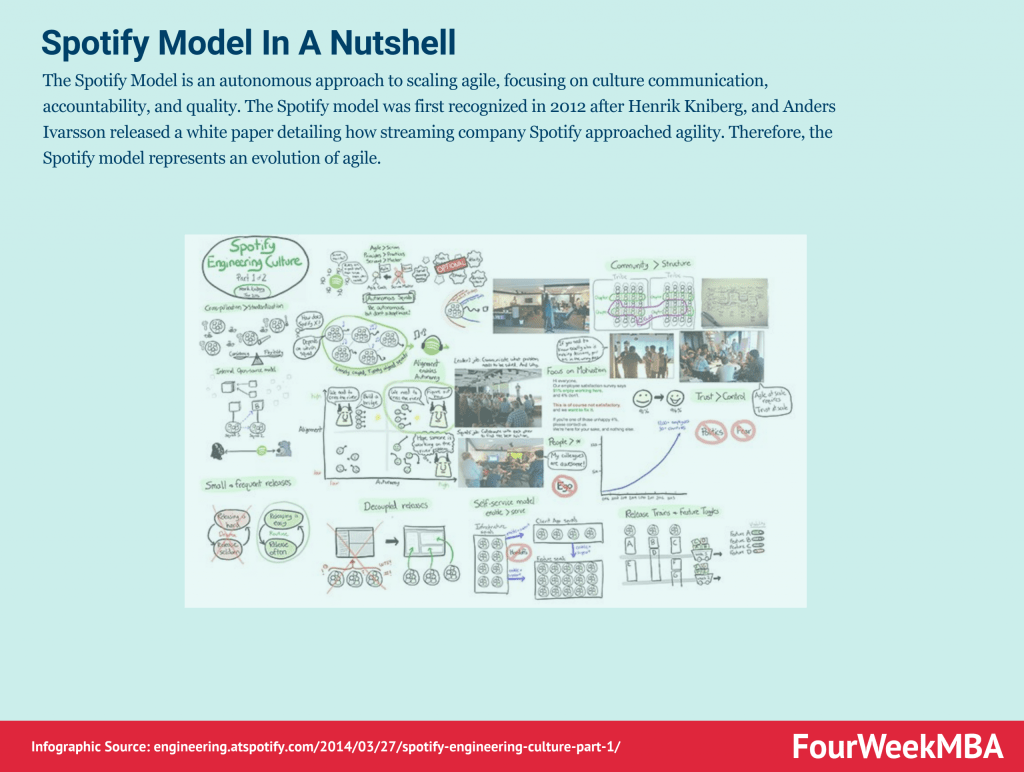
The Spotify Model is an autonomous approach to scaling agile, focusing on culture communication, accountability, and quality. The Spotify model was first recognized in 2012 after Henrik Kniberg, and Anders Ivarsson released a white paper detailing how streaming company Spotify approached agility. Therefore, the Spotify model represents an evolution of agile.
As the name suggests, TDD is a test-driven technique for delivering high-quality software rapidly and sustainably. It is an iterative approach based on the idea that a failing test should be written before any code for a feature or function is written. Test-Driven Development (TDD) is an approach to software development that relies on very short development cycles.
Timeboxing is a simple yet powerful time-management technique for improving productivity. Timeboxing describes the process of proactively scheduling a block of time to spend on a task in the future. It was first described by author James Martin in a book about agile software development.
Scrum is a methodology co-created by Ken Schwaber and Jeff Sutherland for effective team collaboration on complex products. Scrum was primarily thought for software development projects to deliver new software capability every 2-4 weeks. It is a sub-group of agile also used in project management to improve startups’ productivity.
Scrumban is a project management framework that is a hybrid of two popular agile methodologies: Scrum and Kanban. Scrumban is a popular approach to helping businesses focus on the right strategic tasks while simultaneously strengthening their processes.
Scrum anti-patterns describe any attractive, easy-to-implement solution that ultimately makes a problem worse. Therefore, these are the practice not to follow to prevent issues from emerging. Some classic examples of scrum anti-patterns comprise absent product owners, pre-assigned tickets (making individuals work in isolation), and discounting retrospectives (where review meetings are not useful to really make improvements).
Scrum at Scale (Scrum@Scale) is a framework that Scrum teams use to address complex problems and deliver high-value products. Scrum at Scale was created through a joint venture between the Scrum Alliance and Scrum Inc. The joint venture was overseen by Jeff Sutherland, a co-creator of Scrum and one of the principal authors of the Agile Manifesto.
Six Sigma is a data-driven approach and methodology for eliminating errors or defects in a product, service, or process. Six Sigma was developed by Motorola as a management approach based on quality fundamentals in the early 1980s. A decade later, it was popularized by General Electric who estimated that the methodology saved them $12 billion in the first five years of operation.
Stretch objectives describe any task an agile team plans to complete without expressly committing to do so. Teams incorporate stretch objectives during a Sprint or Program Increment (PI) as part of Scaled Agile. They are used when the agile team is unsure of its capacity to attain an objective. Therefore, stretch objectives are instead outcomes that, while extremely desirable, are not the difference between the success or failure of each sprint.
The Toyota Production System (TPS) is an early form of lean manufacturing created by auto-manufacturer Toyota. Created by the Toyota Motor Corporation in the 1940s and 50s, the Toyota Production System seeks to manufacture vehicles ordered by customers most quickly and efficiently possible.
The Total Quality Management (TQM) framework is a technique based on the premise that employees continuously work on their ability to provide value to customers. Importantly, the word “total” means that all employees are involved in the process – regardless of whether they work in development, production, or fulfillment.
The waterfall model was first described by Herbert D. Benington in 1956 during a presentation about the software used in radar imaging during the Cold War. Since there were no knowledge-based, creative software development strategies at the time, the waterfall method became standard practice. The waterfall model is a linear and sequential project management framework.
Gennaro is the creator of FourWeekMBA, which reached about four million business people, comprising C-level executives, investors, analysts, product managers, and aspiring digital entrepreneurs in 2022 alone | He is also Director of Sales for a high-tech scaleup in the AI Industry | In 2012, Gennaro earned an International MBA with emphasis on Corporate Finance and Business Strategy.