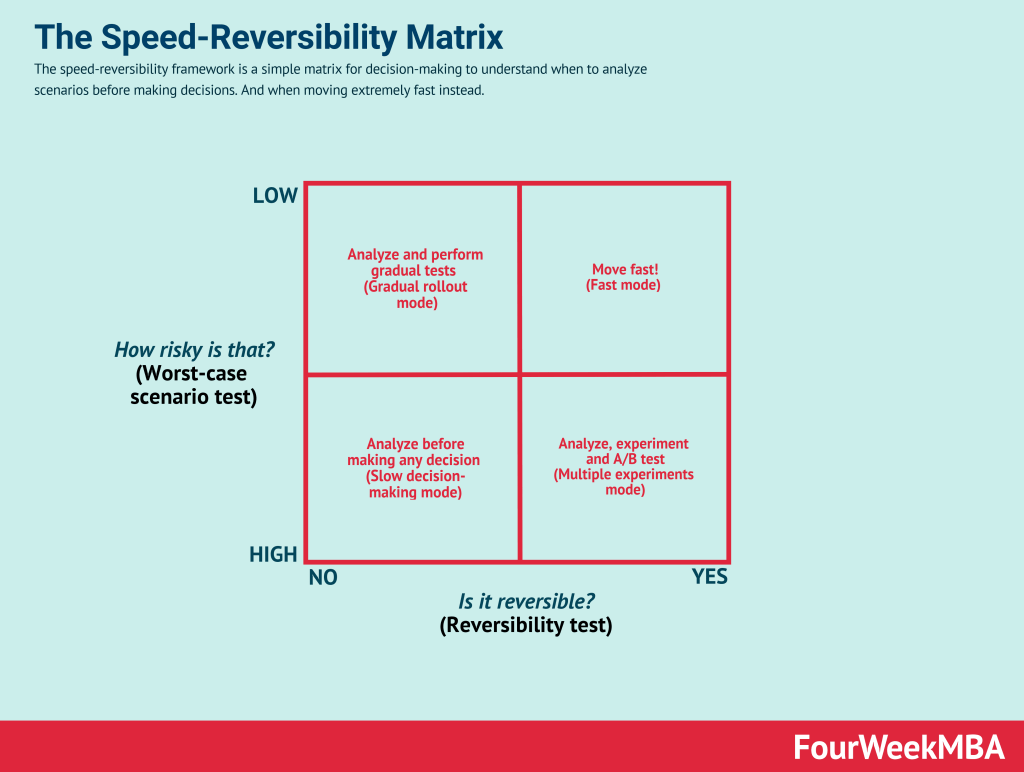
Another dimension of asymmetric betting is given by how impactful the idea can be to the business. When we have asymmetric bets that can have a high impact and are easy to reverse, we get to the “Jackpot” and go into an “All-In-Mode” of action! And how easy to reverse.
Business model innovation is about increasing the success of an organization with existing products and technologies by crafting a compelling value proposition able to propel a new business model to scale up customers and create a lasting competitive advantage. And it all starts by mastering the key customers.
A consumer brand company like Procter & Gamble (P&G) defines “Constructive Disruption” as: a willingness to change, adapt, and create new trends and technologies that will shape our industry for the future. According to P&G, it moves around four pillars: lean innovation, brand building, supply chain, and digitalization & data analytics.
You can use the Ansoff Matrix as a strategic framework to understand what growthstrategy is more suited based on the market context. Developed by mathematician and business manager Igor Ansoff, it assumes a growthstrategy can be derived by whether the market is new or existing, and the product is new or existing.
Disruptive innovation as a term was first described by Clayton M. Christensen, an American academic and business consultant whom The Economist called “the most influential management thinker of his time.” Disruptive innovation describes the process by which a product or service takes hold at the bottom of a market and eventually displaces established competitors, products, firms, or alliances.
An innovation funnel is a tool or process ensuring only the best ideas are executed. In a metaphorical sense, the funnel screens innovative ideas for viability so that only the best products, processes, or business models are launched to the market. An innovation funnel provides a framework for the screening and testing of innovative ideas for viability.
Digital and tech business models can be classified according to four levels of transformation into digitally-enabled, digitally-enhanced, tech or platform business models, and business platforms/ecosystems.
A blue ocean is a strategy where the boundaries of existing markets are redefined, and new uncontested markets are created. At its core, there is value innovation, for which uncontested markets are created, where competition is made irrelevant. And the cost-value trade-off is broken. Thus, companies following a blue ocean strategy offer much more value at a lower cost for the end customers.
The business model canvas is a framework proposed by Alexander Osterwalder and Yves Pigneur in Busines Model Generation enabling the design of business models through nine building blocks comprising: key partners, key activities, value propositions, customer relationships, customer segments, critical resources, channels, cost structure, and revenue streams.
The PESTEL analysis is a framework that can help marketers assess whether macro-economic factors are affecting an organization. This is a critical step that helps organizations identify potential threats and weaknesses that can be used in other frameworks such as SWOT or to gain a broader and better understanding of the overall marketing environment.
A SWOT Analysis is a framework used for evaluating the business’s Strengths, Weaknesses, Opportunities, and Threats. It can aid in identifying the problematic areas of your business so that you can maximize your opportunities. It will also alert you to the challenges your organization might face in the future.
A gap analysis helps an organization assess its alignment with strategic objectives to determine whether the current execution is in line with the company’s mission and long-term vision. Gap analyses then help reach a target performance by assisting organizations to use their resources better. A good gap analysis is a powerful tool to improve execution.
Porter’s Five Forces is a model that helps organizations to gain a better understanding of their industries and competition. Published for the first time by Professor Michael Porter in his book “Competitive Strategy” in the 1980s. The model breaks down industries and markets by analyzing them through five forces
A Blockchain Business Model according to the FourWeekMBA framework is made of four main components: Value Model (Core Philosophy, Core Values and Value Propositions for the key stakeholders), Blockchain Model (Protocol Rules, Network Shape and Applications Layer/Ecosystem), Distribution Model (the key channels amplifying the protocol and its communities), and the Economic Model (the dynamics/incentives through which protocol players make money). Those elements coming together can serve as the basis to build and analyze a solid Blockchain Business Model.
In a business world driven by technology and digitalization, competition is much more fluid, as innovation becomes a bottom-up approach that can come from anywhere. Thus, making it much harder to define the boundaries of existing markets. Therefore, a proper business competition analysis looks at customer, technology, distribution, and financial model overlaps. While at the same time looking at future potential intersections among industries that in the short-term seem unrelated.
Technological modeling is a discipline to provide the basis for companies to sustain innovation, thus developing incremental products. While also looking at breakthrough innovative products that can pave the way for long-term success. In a sort of Barbell Strategy, technological modeling suggests having a two-sided approach, on the one hand, to keep sustaining continuous innovation as a core part of the business model. On the other hand, it places bets on future developments that have the potential to break through and take a leap forward.
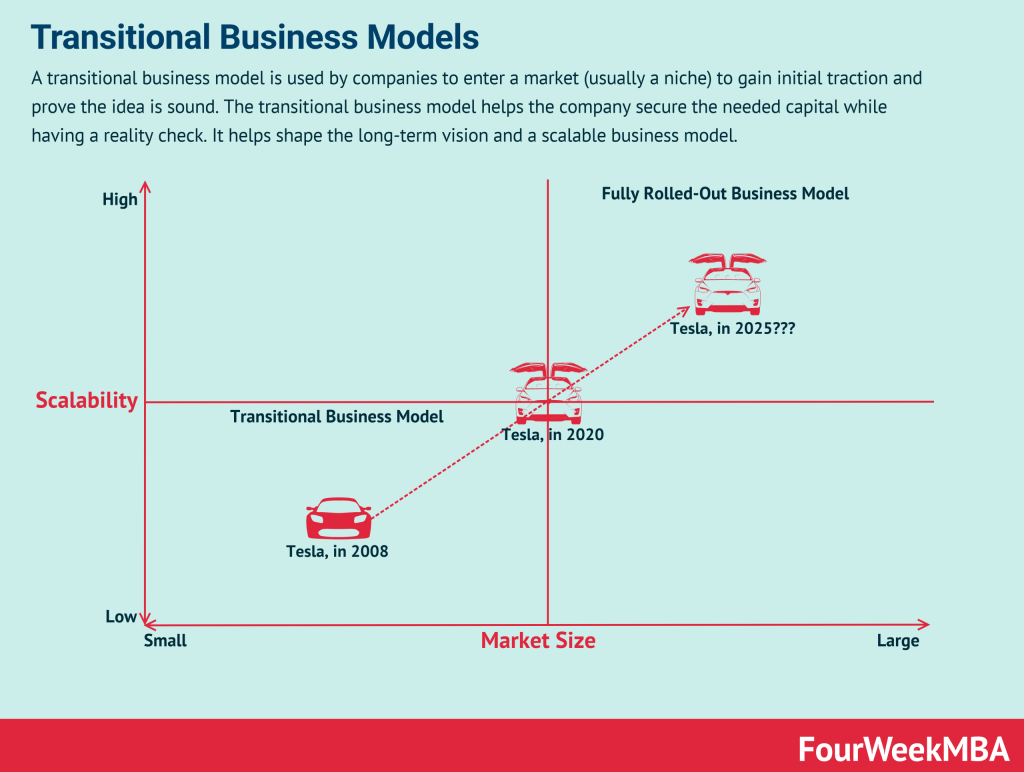
A transitional business model is used by companies to enter a market (usually a niche) to gain initial traction and prove the idea is sound. The transitional business model helps the company secure the needed capital while having a reality check. It helps shape the long-term vision and a scalable business model.
The minimum viable audience (MVA) represents the smallest possible audience that can sustain your business as you get it started from a microniche (the smallest subset of a market). The main aspect of the MVA is to zoom into existing markets to find those people which needs are unmet by existing players.
Business scaling is the process of transformation of a business as the product is validated by wider and wider market segments. Business scaling is about creating traction for a product that fits a small market segment. As the product is validated it becomes critical to build a viable business model. And as the product is offered at wider and wider market segments, it’s important to align product, business model, and organizational design, to enable wider and wider scale.
The market expansion consists in providing a product or service to a broader portion of an existing market or perhaps expanding that market. Or yet, market expansions can be about creating a whole new market. At each step, as a result, a company scales together with the market covered.
In the FourWeekMBA growth matrix, you can apply growth for existing customers by tackling the same problems (gain mode). Or by tackling existing problems, for new customers (expand mode). Or by tackling new problems for existing customers (extend mode). Or perhaps by tackling whole new problems for new customers (reinvent mode).
In the FourWeekMBA Revenue Streams Matrix, revenue streams are classified according to the kind of interactions the business has with its key customers. The first dimension is the “Frequency” of interaction with the key customer. As the second dimension, there is the “Ownership” of the interaction with the key customer.
Revenue model patterns are a way for companies to monetize their business models. A revenue model pattern is a crucial building block of a business model because it informs how the company will generate short-term financial resources to invest back into the business. Thus, the way a company makes money will also influence its overall business model.
The McKinsey Horizon Model helps a business focus on innovation and growth. The model is a strategy framework divided into three broad categories, otherwise known as horizons. Thus, the framework is sometimes referred to as McKinsey’s Three Horizons of Growth.
Sociologist E.M Rogers developed the Diffusion of Innovation Theory in 1962 with the premise that with enough time, tech products are adopted by wider society as a whole. People adopting those technologies are divided according to their psychologic profiles in five groups: innovators, early adopters, early majority, late majority, and laggards.
The four-step innovation process is a simple tool that businesses can use to drive consistent innovation. The four-step innovation process was created by David Weiss and Claude Legrand as a means of encouraging sustainable innovation within an organization. The process helps businesses solve complex problems with creative ideas instead of relying on low-impact, quick-fix solutions.
Business innovation is about creating new opportunities for an organization to reinvent its core offerings, revenue streams, and enhance the value proposition for existing or new customers, thus renewing its whole business model. Business innovation springs by understanding the structure of the market, thus adapting or anticipating those changes.
That is a process that requires a continuous feedback loop to develop a valuable product and build a viable business model. Continuous innovation is a mindset where products and services are designed and delivered to tune them around the customers’ problem and not the technical solution of its founders.
Digital transformation enables existing businesses to leverage digital technologies for business model innovation. The process of digital transformation is not just about new distribution channels. It starts by better serving key customers, and it completes by developing a new business mindset required to succeed in the digital era.
Moonshot thinking is an approach to innovation, and it can be applied to business or any other discipline where you target at least 10X goals. That shifts the mindset, and it empowers a team of people to look for unconventional solutions, thus starting from first principles, by leveraging on fast-paced experimentation.
Key Concepts in Business Strategy and Innovation:
Asymmetric Business Betting: Making bets with high potential impact and reversibility.
Business Engineering: Applying engineering principles to business processes.
Business Model Innovation: Crafting new value propositions for competitive advantage.
Constructive Disruption: Willingness to adapt and create trends in the industry.
Ansoff Matrix: Framework for growthstrategy based on market and product factors.
Innovation Matrix: Framework to categorize and prioritize innovation projects.
Disruptive Innovation: Process where a product displaces established competitors.
Idea Generation: Process of generating new and creative ideas.
Innovation Funnel: Tool to screen and test innovative ideas for viability.
Value Innovation: Strategy creating uncontested markets with higher value at lower cost.
Business Model Canvas: Framework for designing and understanding business models.
PESTEL Analysis: Framework for assessing macro-economic factors affecting a business.
SWOT Analysis: Framework for evaluating a business’s strengths, weaknesses, opportunities, and threats.
Gap Analysis: Assessment of alignment with strategic objectives for better resource utilization.
Porter’s Five Forces: Model to analyze industry competition and market dynamics.
Tech Business Model Framework: Components of a tech business model, including value, technology, distribution, and financial models.
Blockchain Business Model Framework: Components of a blockchain business model, including value, blockchain, distribution, and economic models.
Market Expansion: Strategy to provide products to broader markets or create new markets.
Minimum Viable Audience: Smallest audience to sustain a business at the start.
Business Scaling: Transformation of a business as the product gains traction in wider market segments.
Growth Matrix: Framework for growth strategies based on existing and new customers, products, and problems.
Revenue Streams: Matrix categorizing revenue streams based on interactions with key customers.
Revenue Model: Pattern for monetizing a business model.
McKinsey Horizon Model: Strategy framework with three horizons of growth.
Diffusion of Innovation: Theory of how tech products are adopted by society.
Four-Step Innovation Process: Tool to encourage sustainable innovation in organizations.
Business Innovation Matrix: Reinventing core offerings and business model for value enhancement.
Continuous Innovation Framework: Process of continuous feedback and customer-focused product development.
Digital Transformation: Leveraging digital technologies for business model innovation.
Moonshot Thinking: Pursuing unconventional solutions and 10X goals through experimentation.
Highlights
Framework
Description
When to Use
Advantages
Drawbacks
Asymmetric Business Betting
Involves making high-impact bets that are easy to reverse in the business context.
When there are high-impact business opportunities with easy reversibility.
Potential for high returns, adaptability.
High risk involved.
Business Engineering
Focuses on optimizing and engineering the components of a business model for maximum efficiency and effectiveness.
When aiming to improve and streamline business operations.
Enhances business processes, efficiency gains.
May require significant changes and adaptations.
Business Model Innovation
Seeks to improve the success of an organization by creating a compelling value proposition and a new business model.
When looking to create a competitive advantage and scale up by innovating the business model.
Drives competitiveness, sustainable advantage.
Requires a deep understanding of customer needs.
Constructive Disruption
Involves a willingness to change and create new trends and technologies to shape an industry’s future.
In industries where innovation and adaptability are crucial for long-term success.
Drives innovation, adaptability to market changes.
Can be resource-intensive and challenging to implement.
Ansoff Matrix
A strategic framework that helps determine the most suitable growth strategy based on market and product characteristics.
In strategic planning when considering market expansion or product development.
Provides clear growth strategy directions.
May oversimplify complex market dynamics.
Innovation Matrix
Offers a visual representation of innovation strategies by categorizing them based on novelty and technology adoption.
In strategic planning to assess and prioritize innovation initiatives.
Gennaro is the creator of FourWeekMBA, which reached about four million business people, comprising C-level executives, investors, analysts, product managers, and aspiring digital entrepreneurs in 2022 alone | He is also Director of Sales for a high-tech scaleup in the AI Industry | In 2012, Gennaro earned an International MBA with emphasis on Corporate Finance and Business Strategy.