Brian Chesky is an industrial designer and businessman who is Airbnb’s co-founder and CEO. Since the company was founded in 2007, Chesky has been in charge, amassing a net worth of about $10 billion thanks to his shares in it.
Category
Details
Full Name
Brian Joseph Chesky
Date of Birth
August 29, 1981
Place of Birth
Niskayuna, New York, USA
Nationality
American
Education
Bachelor of Fine Arts in Industrial Design from the Rhode Island School of Design (RISD)
Early Career
Worked as an industrial designer and strategist at 3DID, a design firm in Los Angeles
Major Companies Founded
Airbnb
Positions
Co-founder and CEO of Airbnb
Net Worth
Estimated around $10 billion
Business Milestones
– 2008: Co-founded Airbnb with Joe Gebbia and Nathan Blecharczyk, initially called “Air Bed & Breakfast.” – 2009: Secured seed funding from Y Combinator, which helped Airbnb expand and develop its platform. – 2011: Raised $112 million in a funding round led by Andreessen Horowitz, boosting Airbnb’s valuation and global expansion efforts. – 2013: Reached 10 million guest stays, marking significant growth and acceptance of the home-sharing model. – 2015: Expanded Airbnb’s offerings with “Airbnb Experiences,” allowing hosts to offer activities and tours. – 2017: Launched “Airbnb Plus,” a selection of verified, high-quality listings, and “Airbnb for Work,” targeting business travelers. – 2019: Announced plans to go public, later delayed due to the COVID-19 pandemic’s impact on the travel industry. – 2020: Successfully led Airbnb through its initial public offering (IPO) in December, with a valuation of $100 billion at the end of its first trading day. – 2021: Adapted to the changing travel landscape due to the pandemic, with a focus on long-term stays and remote work-friendly listings. – 2022: Continued to innovate with new features and services, enhancing the user experience and maintaining Airbnb’s leadership in the travel and hospitality industry.
Chesky had an interest in design from an early age and would often draw imaginary versions of Nike sneakers. He later attended the Rhode Island School of Design and received a bachelor in fine arts in 2004. Whilst there, he met Airbnb co-founder Joe Gebbia.
Before the pair graduated, Gebbia is reported to have told Chesky that they were going to start a company one day and that books would be written about it.
Chesky’s first job out of college was as an industrial designer and strategist at Los Angeles firm 3DID, Inc. He then quit, moved to San Francisco, and shared an apartment with Gebbia, and it was there that the idea for Airbnb was born.
Airbnb
Both unemployed, Chesky and Gebbia found it difficult to pay the rent on their apartment. On September 22, 2007, Gebbia sent the now oft-quoted email to Chesky with an idea to turn their place into a “designers bed and breakfast” replete with “wireless internet, a small desk space, sleeping mat, and breakfast each morning.”
The pair hosted three people that weekend after a designer’s conference in San Francisco meant hotel accommodation was in short supply. A few months later, the pair recruited engineer Nathan Blecharczyk and the site Airbedandbreakfast.com was launched in August 2008.
Today, Chesky’s creative roots have found their way into Airbnb’s culture, product, and community. This has resulted in a design-driven approach that increased trust between Airbnb hosts and the strangers staying in their homes.
Pandemic management and IPO
Chesky remains Airbnb CEO, he relinquished control of daily operations to Blecharczyk in 2014. Across the pandemic, Chesky was instrumental in managing the company as it burned through its cash reserves and was forced into mass layoffs.
While around 25% of all employees were terminated, Chesky was also praised for his generous severance packages and offer to help individuals find employment elsewhere
Chesky is also a philanthropist who, with fellow billionaires such as Bill Gates and Warren Buffet, has committed to donating the majority of his wealth to charity as part of The Giving Pledge campaign.
In 2022, he then announced a $100 million donation to The Obama Foundation to support students in pursuit of careers in public service. As part of the initiative, individuals would receive free Airbnb accommodation during their summer work-travel experiences.
Key takeaways
Brian Chesky is an industrial designer and businessman who is also the co-founder and current CEO of Airbnb. Chesky met Airbnb co-founder Joe Gebbia whilst studying design at the Rhode Island School of Design.
Chesky’s first job out of college was as an industrial designer and strategist at Los Angeles firm 3DID, Inc. He then quit, moved to San Francisco, and shared an apartment with Gebbia who suggested they offer accommodation to designs to help pay the rent.
While Chesky remains Airbnb CEO, he relinquished control of daily operations to Blecharczyk in 2014. Across the pandemic, he was instrumental in managing the company as it burned through its cash reserves and was forced into mass layoffs.
Airbnb’s founders primarily own Airbnb: Brian Chesky, with over 76 million Class B shares, which give him 33..4% of ownership and 30.6% of voting power; Nathan Blecharczyk, with over 64 million Class B shares, which give him 29.4% and 26.9% of voting power; and Joe Gebbia, which has nearly 47 million of Class B shares which give him 21..5% ownership and almost 27% of voting power. Other institutional investors comprise Sequoia Capital, Fidelity, and The Vanguard Group.
Airbnb is a platform business model making money by charging guests a service fee between 5% and 15% of the reservation, while the commission from hosts is generally 3%. For instance, on a $100 booking per night set by a host, Airbnb might make as much as $15, split between host and guest fees.
Airbnb was initially called Airbedandbreakfast, as the main idea behind the starting of the company was to rent air mattresses in their apartment, as San Francisco filled up due to various conferences, to make some money to pay back the rent.
The Aibnb’s founders noticed this as they were designers. And a design conference (IDSA / ICSID) was about to happen in 2007; they launched Airbedandbreakfast as a service offering “Air Bed and Breakfast” to other designers coming to town who could not find available rooms in a hotel.
Thus from there, the initial name.
Yet, as Airbnb joined the Winter 2009 batch of the popular accelerator, YC, Paul Graham, founder of YC, suggested the founders change the name from Airbedandbreakfast to Airbnb – before demo day – as the name sounded better.
Airbnb is a two-sided marketplace where hosts and guests transact via its booking platform. Thus, Airbnb makes money by charging a fee on top of hosts and guests when a transaction goes through. For instance, in 2023, Airbnb generated $ 9.92 billion in transaction rates, with an average take rate of 13.5%.
The Airbnb story began in 2008 when two friends shared their accommodation with three travelers looking for a place to stay. Just over a decade later, it is estimated that the company now accounts for over 20% of the vacation rental industry. As a travel platform, Airbnb competes with other brands like Booking.com, VRBO, FlipKey, and given its massive amount of traffic from Google. Also, platforms like Google Travel can be considered potential competitors able to cannibalize part of Airbnb’s market.
As a peer-to-peer platform, Airbnb will collect a fee from both key players once the transaction between host and guest goes through. For example, from a $100 booking per night set by the host, Airbnb might collect $3 as a hosting fee. At the same time, it might increase the price for the guest to $116 ($16 above the price set by the host) to collect its guest fees of $12 and taxes for the remaining amount.
In 2023, on $73.25 billion in gross bookings, the company reported revenues of $9.92 billion, a record of $4.79 billion in net income, and 13.5%, in take rates.
In 2023, Airbnb reported a 13.5% take rate (analysis by FourWeekMBA). Airbnb reported a 13.3% take rate in 2022 and 12.8% in 2021. The company’s take rate is a critical metric that Airbnb tracks to evaluate the financial health of its platform.
In 2023, Airbnb generated an average value per booking of $163.51, compared to 2022, when Airbnb generated an average value per booking of $161, compared to $156 in 2021 and $124 in 2020.
In 2023, Airbnb had over 5 million hosts on the platform, which generated 7.7 million listings in the same period; Airbnb had 6.6 million active listings, compared to 6 million in 2021.
A storyboard is a linear sequence of illustrations used in animation to develop a broader story. A storyboard process is now used also in business to understand and map customers’ experience and enable the growth of the company using that process.
Airbnb arbitrage is a business model where the renter of a house or apartment sub-lets the property to Airbnb users. This is a model where the Airbnb arbitrageur can transform a long-term rental, with the main property owner, into a short-term rental, with higher rates and margins.
An accessory dwelling unit (ADU) is a term used to describe a secondary house or apartment located on the same plot of land as a larger, primary place of residence. This has become an industry for its own sake, with the potential to become the next trillion-dollar industry.
Samara is a manufacturer of prefab accessory dwelling units (ADUs) that can be installed and operational in a matter of hours. It started as an R&D unit of Airbnb in 2016. And it eventually was spun off and run by Airbnb co-founder Joe Gebbia, who now runs it full-time.
Booking Holdings is the company the controls six main brands that comprise Booking.com, priceline.com, KAYAK, agoda.com, Rentalcars.com, and OpenTable. Over 76% of the company revenues in 2017 came primarily via travel reservations commisions and travel insurance fees. Almost 17% came from merchant fees, and the remaining revenues came from advertising earned via KAYAK. As distributionstrategy, the company spent over $4.5 billion in performance-based and brand advertising.
Trivago is a search and discovery travel platform part of Expedia Group. Trivago is widely known as a trusted hotel comparison service. Trivago doesn’t charge based on bookings but rather through a cost-per-click (CPC) model, monetized when a hotel searcher clicks one of its advertiser listings. This referral revenue comprises most of Trivago’s income. Trivago also has another minor revenue stream via subscriptions to its Business Studio, a tool that helps hoteliers track impression and click data associated with their properties.
Born in 1996 as a travel platform of Microsoft, it would be spun off later on. Expedia became among the largest online travel agencies (OTAs) which comprise a set of brands that go from Hotels.com, Vrbo, Orbits, CheapTickets, ebookers, Travelocity, Trivago, and others. The company follows a multi-brandstrategy.
Kayak is an online travel agency and search engine founded in 2004 by Steve Hafner and Paul M. English as a Travel Search Company and acquired by Booking Holdings in 2013 for $2.1 billion. The company makes money via an advertising model based on cost per click, cost per acquisition, and advertising placements.
OpenTable is an American online restaurant reservation system founded by Chuck Templeton. During the late 90s, it provided one of the first automated, real-time reservation systems. The company was acquired by Booking Holding back in 2014, for $2.6 billion. Today OpenTable makes money via subscription plans, referral fees, and in-dining with its first restaurant, as an experiment in Miami, Florida.
OYO’s business model is a mixture of platform and brand, where the company started primarily as an aggregator of homes across India, and it quickly moved to other verticals, from leisure to co-working and corporate travel. In a sort of octopus business strategy of expansion to cover the whole spectrum of short-term real estate.
TripAdvisor’s business model matches the demand for people looking for a travel experience with supply from travel partners around the world providing travel accommodations and experiences. When this match is created TripAdvisor collects commission from partners on a CPC and CPM basis. The non-hotel revenue comprises experiences, restaurants, and rentals.
Trivago is a search and discovery travel platform part of Expedia Group. Trivago is widely known as a trusted hotel comparison service. Trivago doesn’t charge based on bookings but rather through a cost-per-click (CPC) model, monetized when a hotel searcher clicks one of its advertiser listings. This referral revenue comprises most of Trivago’s income. Trivago also has another minor revenue stream via subscriptions to its Business Studio, a tool that helps hoteliers track impression and click data associated with their properties.
By 2022, most of Tesla’s shares are still owned by Elon Musk, among the company’s co-founders and the CEO. Elon Musk is the top individual investor, with a 23.5% stake in the company. At current rates, this is valued at around $145-50 billion, making Elon Musk one of the wealthiest men on earth. In addition, Musk also holds a significant stake in Twitter and SpaceX, which makes him worth anywhere between $180-90 billion.
Bernard Arnault’s wealth is around $203 billion. Indeed Arnault is the CEO and chairman of the luxury goods conglomerate LVMH Moët Hennessy Louis Vuitton, a massive luxury group that generated over €79 billion in revenue ($83 billion) in 2022, spanning across wines, fashion, cosmetics, and retail. The Arnault family group owns 48.18% of the capital for LVMH with 63.9% voting power, making Bernard Arnault the principal owner and decision-maker. His stake is worth over $203 billion.
Warren Buffett is an American investor, business tycoon, and philanthropist. Known as the “Oracle of Omaha,” Buffett is best known for his strict adherence to value investing and frugality despite his immense wealth. Warren Buffet owns an investment firm, Berkshire Hathaway. He owns 238,624 Class A shares which gives him control over the company. His stake in the company is valued at over $100 billion.
Jeff Bezos’ net worth is primarily based on his ownership stake in Amazon. Indeed, as of 2023, Bezos owned a 12.7% stake in Amazon, worth over $120 billion.
Tim Cook’s net worth is primarily comprised of his Apple stocks. As of 2023, he owned 3,279,898 worth about $480 million at the current rate. However, Tim Cook has sold part of his Apple stocks over the years for hundreds of millions of dollars, making him a billionaire.
Bill Gates was the co-founder and former CEO of Microsoft until 2000, and he was on the board of Microsoft until 2020. However, over the years, Gates sold various stakes in Microsoft and diversified away from it. As of 2019, Gates had a 1.34% stake in Microsoft, which he might still own, valued at about $25 billion.
As of 2022, Satya Nadella had 763,518, valued at $190 million at Microsoft’s current market value. Nadella also got a $2.5 million base salary in 2022, plus $42.27 million in stock awards and over $10 million in non-stock incentives. Nadella sold hundreds of millions of dollars of Microsoft stocks in the last ten years, making him a centi-millionaire. In 2022, 96% of Nadella’s salary was performance-based, whereas only 4% comprised a base salary.
Larry Page co-founded Google (now Alphabet) and Sergey Brin. He controls the company tightly via a dual share ownership structure (made of Class A and B stocks). Alphabet is worth over a trillion dollars, valuing Larry Page’s stake in the company at around $70 billion.
Sergey Brin co-founded Google (now Alphabet) together with Larry Page. He controls the company tightly via a dual share ownership structure (made of Class A and B stocks). Alphabet is worth over a trillion dollars, valuing Sergey Brin’s stake at around $66 billion.
Mark Zuckerberg is the co-founder and principal shareholder of Facebook (now Meta), in which he owns a controlling stake worth over $68 billion. Thus Mark Zucberkerbs’ net worth is around $68 billion in 2023.
Eduardo Luiz Saverin is a billionaire entrepreneur and angel investor. He co-founded Facebook with Mark Zuckerberg; he was later ousted. Yet later on, Facebook settled a lawsuit with Saverin giving him a good chunk of the company’s stock, now worth over ten billion dollars. Thus, Eduardo Saverin’s net worth is around $10.45 billion in 2023.
While Larry Ellison is a shareholder in various tech companies (such as Tesla), his primary wealth comes from his ownership stake in the company he founded, Oracle. He owns almost 43% of the company’s stock, valued at over $100 billion, making him among the wealthiest people on earth.
Howard Schultz’s net worth is over $2.2 billion. Indeed, he is the founder of Starbucks and a major institutional shareholder, with 1.88% ownership of the company, valued at over $2.2 billion at the current market value, making him a billionaire.
Daniel Ek is one of the founders and one of the principal shareholders of Spotify. Indeed, in 2023 with 16.5% of Spotify’s shares, he’s worth around $3.7 billion.
The Pinault family is the main shareholder behind the Kering Group luxury empire, with a stake of 41.7%, valued around €30 billion, thus $32-33 billion. The Kering Group owns iconic brands like Gucci, Yves Saint Laurent and Bottega Veneta.
Pierre Omidyar is a technology entrepreneur andPierre Omidyar is a technology entrepreneur and founder of eBay. As of 2020, before he stepped down from the company’s board of directors, he still owned 4.69% of the company’s stocks, valued at over one billion dollars. Yet, over the years, he sold a good chunk of his stocks, making him a billionaire. founder of eBay. As of 2020, before he stepped down from the company’s board of directors, he still owned 4.69% of the company’s stocks, valued at over one billion dollars. Yet, over the years, he sold a good chunk of his stocks, making him a billionaire.
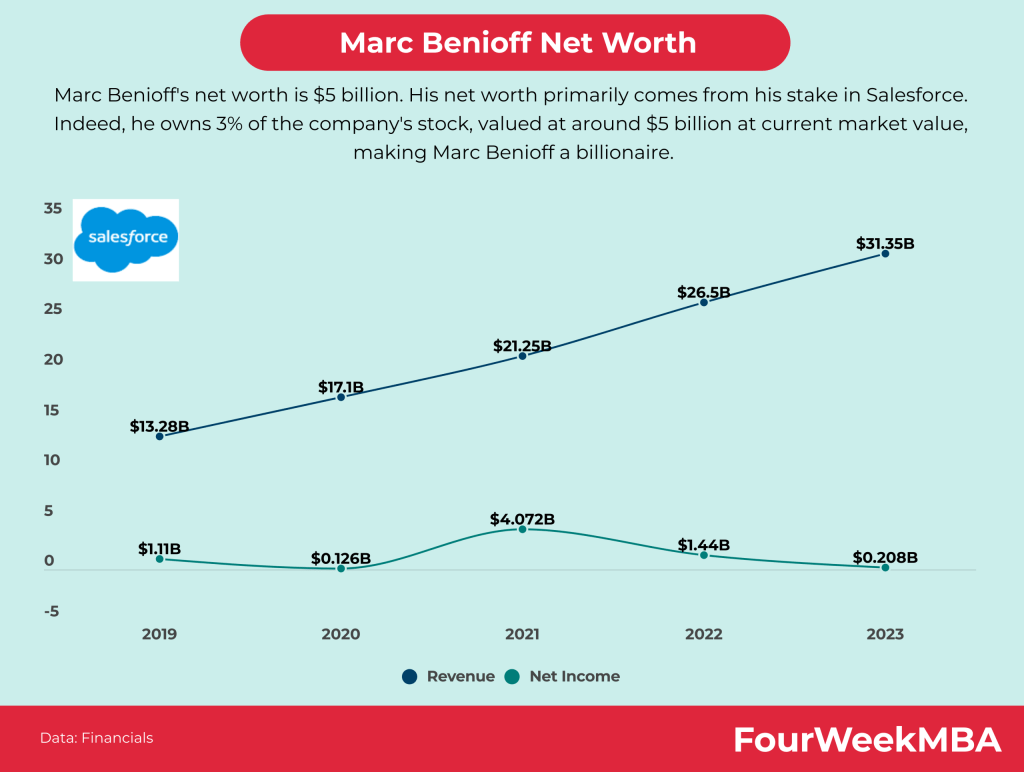
Marc Benioff’s net worth is $5 billion. His net worth primarily comes from his stake in Salesforce. Indeed, he owns 3% of the company’s stock, valued at around $5 billion at current market value, making Marc Benioff a billionaire.
Reed Hastings is the co-founder, former CEO, and now executive chairman of Netflix. He’s also one of the major shareholders, with 1.7% ownership in the company, valued at $2.4 billion at the current rate.
Evan Thomas Spiegel is the co-founder and CEO of Snapchat. He’s also the main shareholder. Indeed, he both owns and controls Snapchat, and his stake in the company is currently valued at around $3 billion.
Brian Chesky is an industrial designer and businessman who is also Airbnb’s co-founder and current CEO. Since the company was founded in 2007, Chesky has been in charge of it, amassing a net worth of about $10 billion, thanks to his shares in the company.
Phil Knight, the founder of Nike, controls the company via a personal stake of shares for 7% ownership, plus the shares held via the family’s owned Swoosh, LLC, in addition to the shares in possession of his son’s Trust. Phil Knight directly controls a significant stake in Nike’s Class A and B shares, valued at over $40 billion.
Michale Jordan is a billionaire but doesn’t own the Jordan brand, which is part of Nike. Yet, he gets 5% royalties on the sales of Jordan. For instance, as of May 31, 2022, Nike had endorsement contract obligations of $7.6 billion, of which over $250 million were to be paid out to Michael Jordan as royalties on the sales of Jordan in 2022 (the company made over 5$ billion in sales in that year). We estimated that between 2018-2022 alone, Nike paid (or is paying) Michael Jordan almost one billion dollars in royalties for Jordan’s brand sales.
Kevin Plank is Under Armour’s primary owner and founder, of which he’s also chairman. His stake in the company is worth over a billion dollars at current market value, making him a billionaire.
Gennaro is the creator of FourWeekMBA, which reached about four million business people, comprising C-level executives, investors, analysts, product managers, and aspiring digital entrepreneurs in 2022 alone | He is also Director of Sales for a high-tech scaleup in the AI Industry | In 2012, Gennaro earned an International MBA with emphasis on Corporate Finance and Business Strategy.