BlaBlaCar’s value proposition is to provide a cost-effective and sustainable mode of transportation for travelers. It offers a platform for drivers to share the
Customer Segments
BlaBlaCar serves a diverse customer base that includes both drivers and passengers. Passengers are typically individuals or groups looking for affordable and co
Distribution Strategy
BlaBlaCar operates as a digital platform accessible through its website and mobile apps. It provides user-friendly interfaces for both drivers and passengers to
Revenue Streams
BlaBlaCar generates revenue primarily through commission fees on booked rides. It charges passengers a fee, typically a percentage of the ride cost, for using t
Marketing Strategy
BlaBlaCar’s marketingstrategy includes digital advertising, referrals, word-of-mouth marketing, and community engagement. The platform promotes the benefits of
Organization Structure
BlaBlaCar operates with a centralized structure overseeing product development, marketing, customer support, and safety measures. The company collaborates with
Competitive Advantage
BlaBlaCar’s competitive advantage is derived from its large user base, extensive geographic coverage, trust-building mechanisms, and commitment to sustainabilit
BlaBlaCar is a French online carpooling marketplace connecting drivers and passengers willing to share the cost of a journey. BlaBlaCar makes money by charging its customers a service fee. The exact fee depends on the total amount the driver sets for the ride. The company also shares ride revenue with bus operators that adopt its branding in their fleet.
History of BlaBlaCar
The company was founded in 2006 by Frederic Mazzella, Francis Nappez, and Nicolas Brusson.
The idea for BlaBlaCar came after Mazella wanted to return to his family home in the French countryside for Christmas in 2003.
Finding that all the trains were booked out for the holiday season, he eventually secured a ride with his sister.
On the way home, he noticed that most of the cars on the highway had empty seats. This is when inspiration struck.
He thought,
“If I put all those cars with empty seats, in a search engine, such that people can search the available seats in those cars, just like they do while booking a train.”
BlaBlaCar was launched to the French public in 2004 as Covoiturage, but Mazella lacked the necessary business acumen to grow the company. To improve his skills in this area, he decided to complete his MBA.
While studying, he met fellow co-founder Brusson who had previously worked for several start-ups in Silicon Valley.
Together, they crafted a business plan and software engineer Nappez joined the pair two years later.
The turning point for Covoiturage came in 2007 after a French train strike caused commuters to look for alternative forms of transportation.
Many enjoyed their initial carpooling experience and became loyal members as a result.
Another surge of demand resulted in 2009 after a volcanic eruption in Iceland caused many flights to be canceled.
The public exposure from these two events allowed the co-founders to secure their first round of institutional funding, with the platform passing one million members in 2011.
Rapid expansion across Europe, India, Russia, and parts of South America took place in the following years, no doubt helped by the popularity of services like Uber and Airbnb that made interacting with strangers while traveling more commonplace.
After several more rounds of funding and multiple acquisitions, the platform now services more than 90 million people in 22 countries.
BlaBlaCar revenue generation
BlaBlaCar works on the marketplace businessmodel, matching the supply of drivers with the transportation demand of consumers.
The company employs multiple revenue streams, with each explained in detail below.
Service fees
Service fees are charged by the company to passengers based on the total amount the driver sets for the ride.
These fees vary according to country. In the United Kingdom, for example, the service fee is £3.00 when the driver offers a ride for £13.00 to £17.00.
For longer rides costing more than £79, there is a fixed charge of £0.89 plus 9.9% of the total amount the driver is asking.
Revenue sharing
Under the BlaBlaBus brand, the company partners with local bus operators to offer rides to those preferring a larger form of transport.
Through this partnership, BlaBlaCar and its partners share ride revenue. Though the specific amount is undisclosed, competitor services take between 25 and 30% of the total revenue and give the partner operator the remainder.
Referral fees
BlaBlaCar also sells insurance to its drivers to protect them against civil liability and damages related to theft, broken glass, and extreme weather.
Here, the company is paid a referral fee for every new sign-up it sends to the insurance provider it has partnered with.
In theory, the insurance risk is minimized since BlaBlaCar considers the distance a driver has traveled on its platform and their average review rating from consumers.
Subscriptions
The company also sells a platform called Octobus to various bus operators to help them digitize their operations.
The cloud-based service helps bus companies maintain sales and distribution, CRM, revenuemanagement, and fleet efficiency.
There are three subscriptions to choose from:
Base ($99/month) – offering inventorymanagement, discounts, ticket and order management, and a sales and booking module.
Smart ($149/month) – offering all Base features plus an express booking module, customer registration module, and aggregate and ticket sales from other systems.
Pro ($229/month) – offering all Smart features plus a distributed network, mailing list and newsletter functionality, analytics, and statistics.
Key takeaways:
BlaBlaCar is a French online carpooling marketplace founded in 2006 by Frederic Mazzella, Francis Nappez, and Nicolas Brusson. Mazzella came up with the idea for the company after failing to book a train ticket to his family home for Christmas.
BlaBlaCar makes money by charging a service fee to its customers. The exact fee depends on the total amount the driver sets for the ride. The company also shares ride revenue with bus operators that adopt its branding in their fleet.
BlaBlaCar sells insurance to drivers to protect them against a variety of potential damages. The company also offers a digital managementplatform for bus companies who wish to streamline their operations.
Key Highlights about BlaBlaCar Business Model
Founding and Inspiration: BlaBlaCar was founded in 2006 by Frederic Mazzella, Francis Nappez, and Nicolas Brusson. The inspiration for the company came from Mazzella’s experience of not being able to book a train ticket to his family home and noticing many empty car seats on the highway.
Early Challenges and Growth: Initially launched as Covoiturage in 2004, the company faced challenges in its early stages. However, a French train strike in 2007 and a volcanic eruption in 2009 led to increased demand for carpooling, marking a turning point for the company’s growth.
Expansion and Global Presence: BlaBlaCar rapidly expanded across Europe, India, Russia, and parts of South America. The popularity of ride-sharing services like Uber and Airbnb contributed to the acceptance of interacting with strangers while traveling.
Business Model: BlaBlaCar operates on a marketplace model, connecting drivers with available seats to passengers seeking rides. The company generates revenue through various methods:
Service Fees: Passengers are charged a service fee based on the driver’s set ride price. Fees vary by country and ride cost, helping the company earn a percentage of each transaction.
Revenue Sharing: BlaBlaCar partners with local bus operators under the BlaBlaBus brand, sharing ride revenue. The company takes a percentage, similar to competitor services in the industry.
Referral Fees: BlaBlaCar offers insurance to drivers and receives referral fees for sign-ups to its insurance partners. The company’s risk assessment considers factors like distance traveled and driver reviews.
Subscriptions: BlaBlaCar offers Octobus, a platform for bus operators to digitize their operations. Various subscription tiers provide features for managing sales, bookings, analytics, and more.
Insurance and Protection: BlaBlaCar provides insurance coverage to drivers to safeguard against civil liability, theft, broken glass, and extreme weather. The company’s involvement in insurance also contributes to its revenue.
Digital Platform for Bus Operators: Octobus, the digital managementplatform offered by BlaBlaCar, helps bus operators streamline their operations. The platform comes in different subscription tiers, offering features such as inventorymanagement, booking modules, analytics, and more.
Customer Reach and Impact: BlaBlaCar has grown to serve over 90 million people in 22 countries. The company’s innovative approach to carpooling has had a significant impact on travel options and encouraged the sharing economy.
Business Model Element
Analysis
Implications
Examples
Value Proposition
BlaBlaCar’s value proposition is to provide a cost-effective and sustainable mode of transportation for travelers. It offers a platform for drivers to share their car journeys, allowing passengers to travel affordably, reduce their carbon footprint, and socialize during the trip. BlaBlaCar emphasizes trust and safety through user profiles, ratings, and secure payments. It aims to make long-distance travel more accessible and enjoyable.
Offers a cost-effective and sustainable travel option for passengers. Provides drivers with cost-sharing opportunities. Emphasizes trust and safety through user profiles and ratings. Promotes social interaction during carpooling. Reduces the carbon footprint of travel. Attracts travelers looking for affordable and eco-friendly transportation options. Focuses on accessibility and convenience for long-distance travel.
– Passengers use BlaBlaCar to find rides at lower costs compared to other transportation modes, making travel more affordable. – Drivers share their car journeys and reduce their expenses by accepting passengers, creating a cost-sharing community. – User profiles, ratings, and secure payments build trust and safety in the BlaBlaCar platform. – Passengers and drivers enjoy social interactions during carpooling, making journeys more enjoyable. – BlaBlaCar’s eco-friendly approach appeals to travelers concerned about reducing their carbon footprint. – The platform focuses on making long-distance travel accessible and convenient for a wide range of travelers.
Customer Segments
BlaBlaCar serves a diverse customer base that includes both drivers and passengers. Passengers are typically individuals or groups looking for affordable and convenient long-distance travel options. Drivers are individuals with available seats in their vehicles who seek to share travel costs. BlaBlaCar’s services cater to both urban and rural areas, providing transportation solutions for various demographics.
Addresses the needs of passengers seeking affordable and convenient long-distance travel options. Caters to drivers with available seats looking to share travel costs. Provides services for both urban and rural areas, accommodating diverse demographics. Offers a cost-effective and social travel solution for individuals and groups.
– Passengers use BlaBlaCar to find rides for city-to-city or intercity travel, meeting fellow travelers with similar routes. – Drivers, whether commuting to work or taking a long-distance trip, offer available seats to share travel costs. – BlaBlaCar’s services are accessible in urban and rural areas, serving individuals and groups with varying travel needs. – The platform appeals to students, professionals, tourists, and anyone looking for cost-effective and social travel experiences.
Distribution Strategy
BlaBlaCar operates as a digital platform accessible through its website and mobile apps. It provides user-friendly interfaces for both drivers and passengers to create profiles, search for rides, and make bookings. The platform employs a comprehensive verification process for users, ensuring trust and safety. BlaBlaCar also uses digital marketing, referrals, and partnerships to grow its user base and promote carpooling.
Ensures accessibility through online platforms and mobile apps with user-friendly interfaces. Utilizes a comprehensive verification process for user trust and safety. Employs digital marketing, referrals, and partnerships for user acquisition and carpooling promotion. Focuses on a seamless and convenient booking experience for passengers and drivers. Attracts a wide range of users interested in cost-effective travel options.
– Users can access BlaBlaCar’s platform through web browsers and mobile apps, facilitating easy ride-sharing. – The verification process, including identity verification and ratings, builds trust among users, enhancing the safety of carpooling. – Digital marketing campaigns, referral programs, and partnerships with travel-related companies contribute to user growth and carpooling promotion. – A user-friendly interface allows passengers and drivers to create profiles, search for rides, and make bookings with ease. – BlaBlaCar’s approach appeals to travelers seeking affordable and convenient long-distance travel options.
Revenue Streams
BlaBlaCar generates revenue primarily through commission fees on booked rides. It charges passengers a fee, typically a percentage of the ride cost, for using the platform. Drivers receive the ride cost minus BlaBlaCar’s commission. Additionally, BlaBlaCar offers optional insurance coverage for rides, creating an additional revenue stream. The platform may also engage in advertising partnerships with relevant brands.
Relies on revenue from commission fees charged to passengers for booked rides. Passengers pay a fee, typically a percentage of the ride cost. Drivers receive the ride cost minus BlaBlaCar’s commission. Generates additional income through optional insurance coverage for rides. Explores advertising partnerships with relevant brands as an auxiliary revenue source. Diversifies income streams to support financial stability.
– Passengers are charged a fee when booking rides through BlaBlaCar, which contributes to the platform’s core revenue. – Drivers receive their share of the ride cost, with BlaBlaCar deducting a commission for its services. – Optional insurance coverage offers added protection and generates additional income for BlaBlaCar. – Advertising partnerships with relevant brands create supplementary revenue opportunities. – Diversified income streams help maintain financial stability, even during fluctuations in ride volume and user behavior.
Marketing Strategy
BlaBlaCar’s marketing strategy includes digital advertising, referrals, word-of-mouth marketing, and community engagement. The platform promotes the benefits of carpooling, such as cost savings and social interaction, through various channels. It encourages users to refer others to the platform, creating a network effect. BlaBlaCar actively engages with its community, recognizing and rewarding active members.
Utilizes digital advertising, referrals, and word-of-mouth marketing to promote carpooling benefits. Encourages users to refer others to the platform, fostering a network effect. Actively engages with the community to recognize and reward active members. Focuses on user-generated content and testimonials to build trust and credibility. Appeals to eco-conscious travelers and those seeking social travel experiences.
– Digital advertising campaigns highlight the cost savings and social benefits of carpooling, attracting users interested in these advantages. – The referral program incentivizes users to refer friends and family to BlaBlaCar, contributing to user growth. – Community engagement efforts involve recognizing and rewarding active members, fostering a sense of belonging and trust. – User-generated content and testimonials build credibility and trust in the platform. – BlaBlaCar appeals to eco-conscious travelers and those looking for social travel experiences, aligning with current travel trends.
Organization Structure
BlaBlaCar operates with a centralized structure overseeing product development, marketing, customer support, and safety measures. The company collaborates with insurance providers to offer optional coverage for rides. BlaBlaCar maintains a dedicated customer support team to assist users with inquiries and ensure a smooth carpooling experience. The platform actively engages with its user community and encourages carpooling best practices.
Employs a centralized structure to manage product development, marketing, customer support, and safety measures. Collaborates with insurance providers to offer optional ride coverage. Provides a customer support team for user inquiries and issue resolution. Actively engages with the user community to promote carpooling best practices. Focuses on safety, trust, and community-building to create a positive carpooling environment.
– BlaBlaCar’s product development team continually enhances the platform’s features, safety measures, and user experience. – Collaboration with insurance providers offers users the option of added coverage, enhancing safety during rides. – The customer support team assists users with inquiries, bookings, and issue resolution, ensuring a smooth carpooling experience. – Active engagement with the user community encourages carpooling best practices, fostering a sense of responsibility and trust among users. – Safety, trust, and community-building are foundational elements of BlaBlaCar’s approach to creating a positive carpooling environment.
Competitive Advantage
BlaBlaCar’s competitive advantage is derived from its large user base, extensive geographic coverage, trust-building mechanisms, and commitment to sustainability. It offers a vast network of potential rides, making it a go-to platform for carpooling. The emphasis on user profiles, ratings, and optional insurance builds trust. BlaBlaCar’s focus on sustainability appeals to eco-conscious travelers, setting it apart in the transportation industry.
Boasts a large user base and extensive geographic coverage, providing a vast network of potential rides. Prioritizes trust-building through user profiles, ratings, and optional insurance coverage. Commits to sustainability, appealing to eco-conscious travelers. Offers a cost-effective and social travel solution for a wide range of users. Sets itself apart in the transportation industry through its focus on carpooling and sustainability.
– BlaBlaCar’s extensive user base and geographic coverage ensure a wide range of ride options for travelers, making it a go-to platform for carpooling. – Trust-building mechanisms, including user profiles, ratings, and optional insurance, enhance safety and confidence among users. – The platform’s commitment to sustainability aligns with the values of eco-conscious travelers, distinguishing it from traditional transportation options. – BlaBlaCar’s competitive advantage is reinforced by its user-centric approach, emphasizing affordability, social interaction, and eco-friendliness. – The company’s leadership in the carpooling and ride-sharing industry is maintained through continuous innovation and community engagement.
DoorDash is a platform business model that enables restaurants to set up at no cost delivery operations. At the same time, customers get their food at home and dashers (delivery people) earn some extra money. DoorDash makes money by markup prices through delivery fees, memberships, and advertising for restaurants on the marketplace.
Glovo is a Spanish on-demand courier service that purchases and delivers products ordered through a mobile app. Founded in 2015 by Oscar Pierre and Sacha Michaud as a way to “uberize” local services. Glovo makes money via delivery fees, mini-supermarkets (fulfillment centers that Glovo operates in partnership with grocery store chains), and dark kitchens (enabling restaurants to increase their capacity).
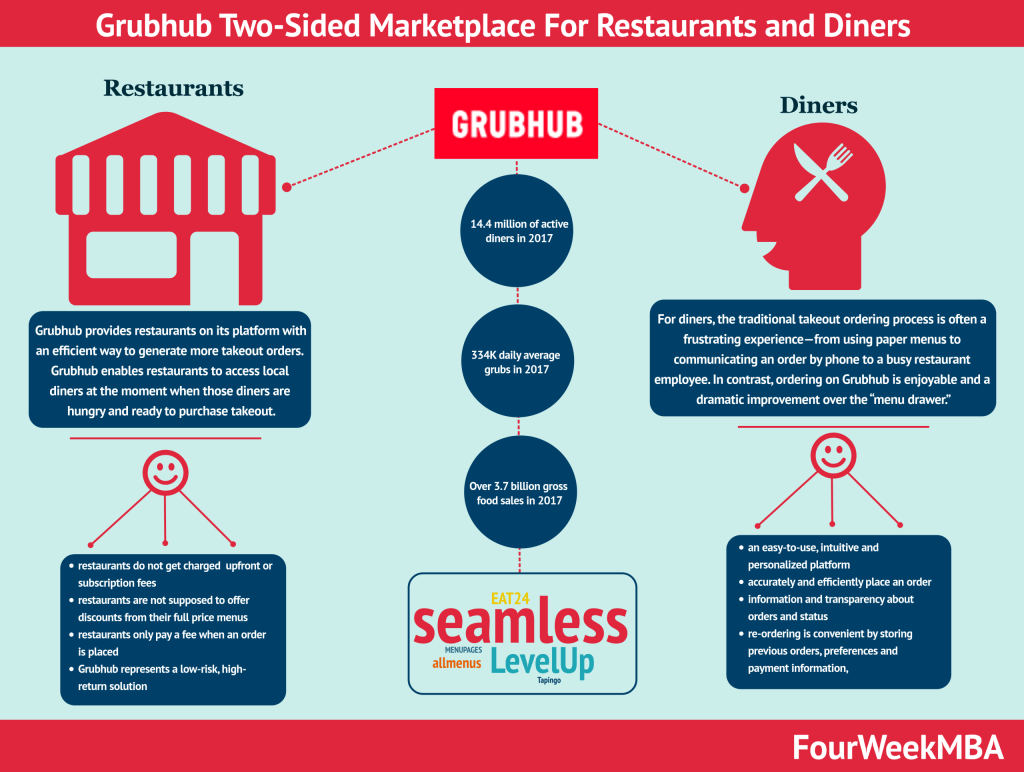
Grubhub is an online and mobile platform for restaurant pick-up and delivery orders. In 2018 the company connected 95,000 takeout restaurants in over 1,700 U.S. cities and London. The Grubhub portfolio of brands like Seamless, LevelUp, Eat24, AllMenus, MenuPages, andTapingo. The company makes money primarily by charging restaurants a pre-order commission and it generates revenues when diners place an order on its platform. Also, it charges restaurants that use Grubhub delivery services and when diners pay for those services.
Instacart’s business model relies on enabling an easy set up for grocery stores, the comfort for customers to get their shopping delivered at home, and an additional income stream for personal shoppers. Instacart makes money by charging service fees, via memberships, and by running performance advertising on its platform.
Lyft is a transportation-as-a-service marketplace allowing riders to find a driver for a ride. Lyft has also expanded with a multimodal platform that gives more options like bike-sharing or electric scooters. Lyft primary makes money by collecting fees from drivers that complete rides on the platform.
Uber is a is two-sided marketplace, a platform business model that connects drivers and riders, with an interface that has elements of gamification, that makes it easy for two sides to connect and transact. Uber makes money by collecting fees from the platform’s gross bookings.
Postmates is a food delivery service built as a last-mile delivery service platform connecting locals with shops. Postmates makes money by collecting fees (commission, delivery, service, cart, and cancellation fees). It also makes money via its subscription service (called Unlimted – $9.99/month or $99.99 annually) giving free delivery on every order of more than $12.
Uber Eats is a three-sided marketplace connecting a driver, a restaurant owner and a customer with Uber Eats platform at the center. The three-sided marketplace moves around three players: Restaurants pay commission on the orders to Uber Eats; Customers pay the small delivery charges, and at times, cancellation fee; Drivers earn through making reliable deliveries on time.
Gennaro is the creator of FourWeekMBA, which reached about four million business people, comprising C-level executives, investors, analysts, product managers, and aspiring digital entrepreneurs in 2022 alone | He is also Director of Sales for a high-tech scaleup in the AI Industry | In 2012, Gennaro earned an International MBA with emphasis on Corporate Finance and Business Strategy.