Affiliation business models are an evolution of advertising business models. Instead of making money based on a user action, like an impression or a click, they make money based on conversion. Under the affiliate business model, a business pays commissions to affiliates who promote and sell products on its behalf. Therefore, if the user converts through the link provided by the affiliate, it will generate a commission. That is why affiliate business models often have a completely different logic than advertising business models. Advertisers make money from bot impressions and clicks. The affiliate mostly makes money if there is a conversion (even though affiliate schemes also include pay-per-impression and pay-per-click campaigns).
Aspect
Explanation
Definition of Affiliate Business Model
The Affiliate Business Model is a performance-based marketing strategy in which individuals or entities (affiliates) earn commissions by promoting and driving sales or leads to a merchant’s products or services. Affiliates partner with merchants, typically through affiliate programs, and use various marketing methods, such as websites, blogs, social media, or email marketing, to promote the merchant’s offerings. When a referred customer makes a purchase or completes a specific action, the affiliate earns a commission, making it a mutually beneficial arrangement for both parties. The affiliate business model is characterized by its cost-effective and results-driven nature.
Key Concepts
Several key concepts define the Affiliate Business Model:
– Affiliate Programs
Affiliate programs are established by merchants to attract affiliates. These programs provide affiliates with unique tracking links or codes that record their referrals and track conversions. Affiliate programs are the infrastructure that facilitates partnerships between merchants and affiliates.
– Commission Structure
The commission structure outlines how affiliates are compensated for their efforts. Commissions can be based on various models, including pay-per-sale (PPS), pay-per-click (PPC), or pay-per-lead (PPL). The commission structure is a fundamental aspect of the affiliate business model, as it determines affiliate earnings.
– Affiliate Marketing Tactics
Affiliates employ various marketing tactics to promote products or services. These tactics include content marketing, search engine optimization (SEO), paid advertising, email marketing, and social media promotion. The choice of marketing tactics depends on the affiliate’s strategy and audience.
– Tracking and Analytics
Effective tracking and analytics tools are essential for both affiliates and merchants. Affiliates use tracking to monitor the performance of their marketing efforts and commissions earned. Merchants use analytics to assess the success of their affiliate programs and optimize them. Tracking and analytics are critical components for measuring the ROI of affiliate marketing.
Characteristics
The Affiliate Business Model is characterized by the following attributes:
– Performance-Based
The affiliate model is entirely performance-based. Affiliates are compensated only when they successfully drive a sale, lead, or other desired actions. This performance-based nature aligns the interests of affiliates and merchants.
– Scalability
The affiliate model can scale easily, as merchants can partner with numerous affiliates, and affiliates can promote multiple products or services. This scalability allows for a broader reach and potential for increased sales or leads.
– Diverse Affiliate Ecosystem
The affiliate ecosystem includes a diverse range of affiliates, from individuals and bloggers to large media companies. This diversity contributes to a wide variety of promotional strategies and audiences. The affiliate ecosystem is dynamic and adaptable.
– Low Barrier to Entry
The affiliate model has a relatively low barrier to entry. Affiliates can join affiliate programs without the need for significant upfront investment or product development. This accessibility makes it an attractive option for individuals looking to monetize their online presence.
Examples of Affiliate Business Model
The Affiliate Business Model is widely used across various industries:
– Amazon Associates
Amazon Associates is a well-known affiliate program where individuals and website owners promote Amazon products and earn commissions on sales generated through their referral links.
– ClickBank
ClickBank is a digital marketplace that connects vendors with affiliates. Affiliates can choose from a vast selection of digital products to promote and earn commissions on sales. It primarily focuses on e-books, software, and online courses.
– ShareASale
ShareASale is an affiliate marketing network that facilitates partnerships between affiliates and various merchants. It offers a wide range of affiliate programs across different industries, enabling affiliates to promote diverse products and services.
– CJ Affiliate
CJ Affiliate (formerly Commission Junction) is one of the largest affiliate marketing networks. It provides a platform for affiliates to partner with numerous well-known brands and earn commissions by driving sales or leads.
Benefits and Considerations
The Affiliate Business Model offers several benefits and considerations:
– Cost-Effective Marketing
Affiliates bear the marketing costs, as they invest time and resources in promotional efforts. Merchants pay commissions only for successful conversions, making it a cost-effective marketing strategy.
– Broad Reach and Audience
Affiliates can tap into their unique audiences and marketing channels, extending a merchant’s reach to diverse customer segments. This broad reach allows merchants to access new markets and demographics.
– Performance Tracking
The performance-based nature of the affiliate model enables precise tracking of marketing efforts. Merchants can measure the ROI of their affiliate programs accurately, while affiliates can optimize their strategies based on performance data.
– Competition and Quality Control
The affiliate model may lead to intense competition among affiliates, which can affect pricing and promotional strategies. Merchants need to establish quality control measures to ensure affiliates adhere to brand guidelines and maintain a positive customer experience.
While affiliate marketing and the concept of revenue sharing predates the internet, the strategy has become a staple for many online businesses and has played a significant part in the success of eCommerce itself.
Entrepreneur and inventor William J. Tobin was the first person to implement affiliate marketing in an online business. The online flower retailer was founded in 1994 and had amassed almost three thousand affiliate partners before it was sold to Federated Department Stores six years later. Tobin was encouraged to patent his technology in 1996, but the patent itself was not issued until 2000.
This opened the door for Amazon who, after witnessing Tobin’s success, launched its own affiliate program in 1996. The Amazon Associates affiliate program was the first such program made available to the general public. Webmasters could display custom banners that linked back to the Amazon website with a unique tracking ID and receive a percentage-based commission on any resultant sales.
The essential elements of the affiliate business model
The affiliate business model relies on the interaction between two or more of the following elements:
The affiliate (publisher)
The affiliate is the entity that promotes a third-party product to its target audience in exchange for a commission on every successful sale. The first affiliates promoted products by reviewing them in blog posts, but products are now promoted on social media accounts and in videos.
The merchant (advertiser)
The seller of the product who may also be the product manufacturer. The merchant can be a large retail conglomerate such as Amazon or an individual craftsperson on Etsy.
The network (middleman)
In some cases, there is also a network that connects merchants with affiliates and handles product payment and delivery for a fee. Many affiliate networks rely on the affiliate business model to generate all their revenue.
The customer
Or the individual who buys the product after being referred by the affiliate. Historically, the customer was unaware that their purchase was part of affiliate marketing. But recent legislative changes made by the Federal Trade Commission (FTC) now stipulate that the affiliate must disclose its relationship to the merchant when promoting products and services.
Payment methods under the affiliate business model
There are five main ways an affiliate can be paid under the affiliate business model, although usually affiliates are mostly paid through pay-per-sale:
Pay-per-click (PPC) – where the affiliate is paid whenever their links are clicked. Note that in most cases, the affiliate must create and manage ad campaigns at their own expense and are only paid once a conversion (sale) takes place.
Pay-per-impression (PPI) – where the affiliate is paid when a consumer visits the merchant’s site. In some cases, pay-per-impression also encompasses revenue based on how many times consumers view display or text ads.
Pay-per-lead (PPL) – here, the affiliate is paid when an individual clicks on an affiliate link and completes some desired action such as filling out an online form. Payroll software company Gusto pays $25 to affiliates for every lead that signs up for a free trial of its product.
Pay-per-call – where affiliates are paid for each call they make to a potential customer. This approach is favored by service companies such as home-improvement contractors and real estate agents.
Pay-per-sale (PPS) – the most common form of payment where the affiliate receives a percentage commission from every sale they facilitate. Merchants set the exact percentage, with rates varying according to the product category. For example, Amazon offers a 1% commission on baby products but 3% on headphones, musical instruments, pet products, and furniture.
Case Studies
Amazon Associates:
Company Overview: Amazon is the world’s largest online retailer, offering a wide range of products, including electronics, books, apparel, and household goods.
Affiliate Business Model Implementation: Amazon Associates is Amazon’s affiliate marketing program, allowing individuals and businesses to earn commissions by promoting Amazon products and driving traffic to the Amazon website through affiliate links. Affiliates can earn commissions ranging from 1% to 10% (depending on the product category) on qualifying purchases made by customers they refer.
Case Study: A lifestyle blogger creates content on fashion, home decor, and beauty tips. By joining the Amazon Associates program, the blogger includes affiliate links to products mentioned in their blog posts and social media content. When readers click on these links and make purchases on Amazon, the blogger earns commissions on those sales.
Bluehost Affiliate Program:
Company Overview: Bluehost is a leading web hosting provider, offering services such as shared hosting, WordPress hosting, and domain registration.
Affiliate Business Model Implementation: Bluehost operates an affiliate program that allows website owners, bloggers, and digital marketers to earn commissions by referring customers to Bluehost’s hosting services. Affiliates receive a flat fee or percentage-based commission for every successful hosting sign-up through their referral links.
Case Study: A technology blogger with a large following writes about website development, blogging tips, and online entrepreneurship. By joining the Bluehost affiliate program, the blogger promotes Bluehost’s hosting services to their audience through blog posts, tutorials, and email newsletters. When readers sign up for hosting plans using the affiliate links, the blogger earns commissions from Bluehost.
Airbnb Affiliate Program:
Company Overview: Airbnb is a popular online marketplace for lodging, offering vacation rentals, homestays, apartments, and unique accommodations worldwide.
Affiliate Business Model Implementation: Airbnb runs an affiliate program that enables affiliates to earn commissions by referring travelers to book accommodations on Airbnb’s platform. Affiliates receive commissions for every booking made by referred users, with commission rates varying based on the booking value and location.
Case Study: A travel blogger specializes in sharing travel guides, destination reviews, and budget travel tips. By participating in the Airbnb affiliate program, the blogger promotes Airbnb listings in their travel guides and blog posts. When readers click on the affiliate links and book accommodations on Airbnb, the blogger earns commissions from Airbnb.
Udemy Affiliate Program:
Company Overview: Udemy is an online learning platform offering a wide range of courses on various subjects, including technology, business, personal development, and arts.
Affiliate Business Model Implementation: Udemy operates an affiliate program that allows affiliates to earn commissions by promoting Udemy courses and driving course enrollments through their referral links. Affiliates receive commissions for every course purchase made by referred users.
Case Study: A professional development blogger focuses on career growth, skill development, and online learning resources. By joining the Udemy affiliate program, the blogger recommends Udemy courses to their audience through blog posts, email newsletters, and social media promotions. When readers enroll in Udemy courses using the affiliate links, the blogger earns commissions from Udemy.
Key takeaways:
Under the affiliate business model, a business pays commissions to affiliates who promote and sell products on its behalf. The Amazon Associates affiliate program was the first such program to be made available to the general public.
The affiliate business model may have up to four essential elements: the affiliate, the merchant, the network, and the customer. Many customers were unaware they were participating in the model until an FTC ruling forced affiliates to disclose their position.
The affiliate can earn money in five core ways: pay-per-click, pay-per-impression, pay-per-lead, pay-per-call, and pay-per-sale. In each case, the merchant dictates how much the affiliate will be paid for completing a certain action.
Key Highlights
Evolution from Advertising Models: Affiliate business models differ from traditional advertising models. Instead of revenue from user actions like impressions or clicks, affiliates earn money based on conversions generated through their promotions.
Conversion-Centric: Affiliates earn commissions when users convert through their referral links, setting it apart from advertising models that focus on impressions and clicks.
Affiliate Marketing Origins: Affiliate marketing’s history predates the internet, but it became prominent online. William J. Tobin implemented it in 1994, followed by Amazon’s launch of the Amazon Associates affiliate program in 1996.
Amazon Associates: Amazon’s affiliate program was the first available to the general public, enabling website owners to promote Amazon products and earn commissions on sales.
Popular and Passive Income: Around 2.3% of websites using advertising networks are Amazon Associates, showcasing the model’s popularity. It’s a relatively passive income source for merchants, and affiliates can earn without dealing with shipping and customer service.
Key Elements:
Affiliate: Promotes third-party products for commissions, using various platforms like blogs, social media, and videos.
Merchant: Seller or manufacturer of the product being promoted, such as Amazon or individual craftspersons.
Network: Acts as a middleman connecting affiliates and merchants, often handling payment and delivery for a fee.
Customer: Purchases the product referred by the affiliate, and recent regulations require disclosing the affiliate’s relationship to the merchant.
Payment Methods:
Pay-per-Click (PPC): Affiliates earn when their links are clicked, but actual earnings come from conversions (sales).
Pay-per-Impression (PPI): Payment when consumers visit the merchant’s site, potentially based on ad views.
Pay-per-Lead (PPL): Affiliates earn for each desired action, like filling out forms.
Pay-per-Call: Payment for each call made to potential customers, commonly used by service companies.
Pay-per-Sale (PPS): Most common method, affiliates earn a percentage commission from each facilitated sale, with rates varying based on product categories.
An effective business model has to focus on two dimensions: the people dimension and the financial dimension. The people dimension will allow you to build a product or service that is 10X better than existing ones and a solid brand. The financial dimension will help you develop proper distribution channels by identifying the people that are willing to pay for your product or service and make it financially sustainable in the long run.
Business model innovation is about increasing the success of an organization with existing products and technologies by crafting a compelling value proposition able to propel a new business model to scale up customers and create a lasting competitive advantage. And it all starts by mastering the key customers.
Digital and tech business models can be classified according to four levels of transformation into digitally-enabled, digitally-enhanced, tech or platform business models, and business platforms/ecosystems.
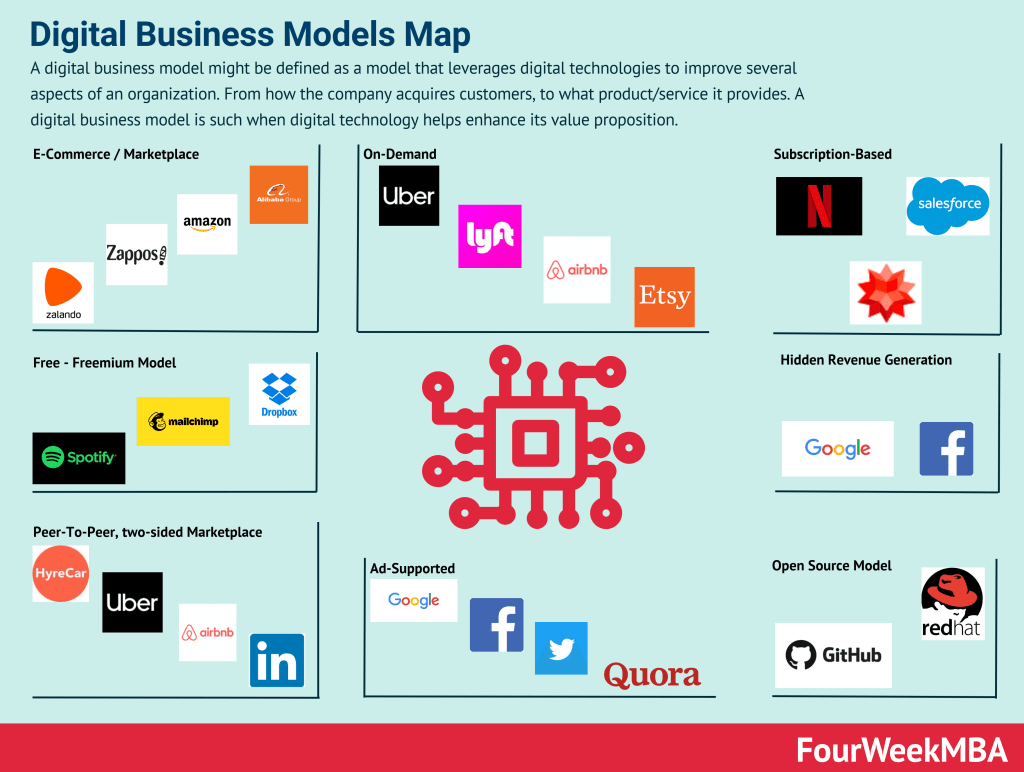
A digital business model might be defined as a model that leverages digital technologies to improve several aspects of an organization. From how the company acquires customers, to what product/service it provides. A digital business model is such when digital technology helps enhance its value proposition.
A tech business model is made of four main components: value model (value propositions, mission, vision), technological model (R&D management), distribution model (sales and marketing organizational structure), and financial model (revenue modeling, cost structure, profitability and cash generation/management). Those elements coming together can serve as the basis to build a solid tech business model.
A platform business model generates value by enabling interactions between people, groups, and users by leveraging network effects. Platform business models usually comprise two sides: supply and demand. Kicking off the interactions between those two sides is one of the crucial elements for a platform business model success.
A Blockchain Business Model is made of four main components: Value Model (Core Philosophy, Core Value and Value Propositions for the key stakeholders), Blockchain Model (Protocol Rules, Network Shape and Applications Layer/Ecosystem), Distribution Model (the key channels amplifying the protocol and its communities), and the Economic Model (the dynamics through which protocol players make money). Those elements coming together can serve as the basis to build and analyze a solid Blockchain Business Model.
In an asymmetric businessmodel, the organization doesn’t monetize the user directly, but it leverages the data users provide coupled with technology, thus have a key customer pay to sustain the core asset. For example, Google makes money by leveraging users’ data, combined with its algorithms sold to advertisers for visibility.
In an asymmetric businessmodel, the organization doesn’t monetize the user directly, but it leverages the data users provide coupled with technology, thus having a key customer pay to sustain the core asset. For example, Google makes money by leveraging users’ data, combined with its algorithms sold to advertisers for visibility. This is how attention merchants make monetize their business models.
While the term has been coined by Andrew Lampitt, open-core is an evolution of open-source. Where a core part of the software/platform is offered for free, while on top of it are built premium features or add-ons, which get monetized by the corporation who developed the software/platform. An example of the GitLab open core model, where the hosted service is free and open, while the software is closed.
Cloud business models are all built on top of cloud computing, a concept that took over around 2006 when former Google’s CEO Eric Schmit mentioned it. Most cloud-based business models can be classified as IaaS (Infrastructure as a Service), PaaS (Platform as a Service), or SaaS (Software as a Service). While those models are primarily monetized via subscriptions, they are monetized via pay-as-you-go revenue models and hybrid models (subscriptions + pay-as-you-go).
Open source is licensed and usually developed and maintained by a community of independent developers. While the freemium is developed in-house. Thus the freemium give the company that developed it, full control over its distribution. In an open-source model, the for-profit company has to distribute its premium version per its open-source licensing model.
The freemium – unless the whole organization is aligned around it – is a growth strategy rather than a business model. A free service is provided to a majority of users, while a small percentage of those users convert into paying customers through the sales funnel. Free users will help spread the brand through word of mouth.
A freeterprise is a combination of free and enterprise where free professional accounts are driven into the funnel through the free product. As the opportunity is identified the company assigns the free account to a salesperson within the organization (inside sales or fields sales) to convert that into a B2B/enterprise account.
A marketplace is a platform where buyers and sellers interact and transact. The platform acts as a marketplace that will generate revenues in fees from one or all the parties involved in the transaction. Usually, marketplaces can be classified in several ways, like those selling services vs. products or those connecting buyers and sellers at B2B, B2C, or C2C level. And those marketplaces connecting two core players, or more.
B2B, which stands for business-to-business, is a process for selling products or services to other businesses. On the other hand, a B2C sells directly to its consumers.
A B2B2C is a particular kind of business model where a company, rather than accessing the consumer market directly, it does that via another business. Yet the final consumers will recognize the brand or the service provided by the B2B2C. The company offering the service might gain direct access to consumers over time.
Direct-to-consumer (D2C) is a business model where companies sell their products directly to the consumer without the assistance of a third-party wholesaler or retailer. In this way, the company can cut through intermediaries and increase its margins. However, to be successful the direct-to-consumers company needs to build its own distribution, which in the short term can be more expensive. Yet in the long-term creates a competitive advantage.
The C2C business model describes a market environment where one customer purchases from another on a third-party platform that may also handle the transaction. Under the C2C model, both the seller and the buyer are considered consumers. Customer to customer (C2C) is, therefore, a business model where consumers buy and sell directly between themselves. Consumer-to-consumer has become a prevalent business model especially as the web helped disintermediate various industries.
A retail business model follows a direct-to-consumer approach, also called B2C, where the company sells directly to final customers a processed/finished product. This implies a business model that is mostly local-based, it carries higher margins, but also higher costs and distribution risks.
The wholesale model is a selling model where wholesalers sell their products in bulk to a retailer at a discounted price. The retailer then on-sells the products to consumers at a higher price. In the wholesale model, a wholesaler sells products in bulk to retail outlets for onward sale. Occasionally, the wholesaler sells direct to the consumer, with supermarket giant Costco the most obvious example.
The term “crowdsourcing” was first coined by Wired Magazine editor Jeff Howe in a 2006 article titled Rise of Crowdsourcing. Though the practice has existed in some form or another for centuries, it rose to prominence when eCommerce, social media, and smartphone culture began to emerge. Crowdsourcing is the act of obtaining knowledge, goods, services, or opinions from a group of people. These people submit information via social media, smartphone apps, or dedicated crowdsourcing platforms.
In a franchained business model (a short-term chain, long-term franchise) model, the company deliberately launched its operations by keeping tight ownership on the main assets, while those are established, thus choosing a chain model. Once operations are running and established, the company divests its ownership and opts instead for a franchising model.
Businesses employing the brokerage business model make money via brokerage services. This means they are involved with the facilitation, negotiation, or arbitration of a transaction between a buyer and a seller. The brokerage business model involves a business connecting buyers with sellers to collect a commission on the resultant transaction. Therefore, acting as a middleman within a transaction.
Dropshipping is a retail business model where the dropshipper externalizes the manufacturing and logistics and focuses only on distribution and customer acquisition. Therefore, the dropshipper collects final customers’ sales orders, sending them over to third-party suppliers, who ship directly to those customers. In this way, through dropshipping, it is possible to run a business without operational costs and logistics management.
Gennaro is the creator of FourWeekMBA, which reached about four million business people, comprising C-level executives, investors, analysts, product managers, and aspiring digital entrepreneurs in 2022 alone | He is also Director of Sales for a high-tech scaleup in the AI Industry | In 2012, Gennaro earned an International MBA with emphasis on Corporate Finance and Business Strategy.