Zara generated €26.05 billion in revenue in 2023, €23.76 billion in 2022, €19.58 billion in 2021, €14.23 billion in 2020, and €19.56 billion in 2019.
Zara is the most important brand of the Inditex Empire, created by Spanish billionaire Amancio Ortega.
With nearly €36 billion in sales in 2023, the Spanish Fast Fashion Empire Inditex, which comprises eight sister brands, has grown thanks to a strategy of expanding its flagship stores in exclusive locations around the globe. Its largest brand, Zara, contributed over 70% of the group’s revenue. Spain contributed the most to the fast fashion Empire sales, with nearly 15% of its revenues.
Other brands of the group comprise:
Zara
Bershka
Pull&Bear
Massimo Dutti
Stradivarius
Oysho
Inditex follows a company-managed store strategy. The most prominent brand is Zara, with 1846 company-managed stores vs. 375 franchised stores in 2023.
Most of the group’s sales happen via the managed stores.
Inditex follows a company-operated store strategy, generating most of its revenue from company-operated stores.
Inditex owns Zara, the Spanish fashion empire owned by Amancio Ortega. His net worth in 2024 stood at over $110 billion, making him the wealthiest man in Spain. Zara is Inditex’s most important asset, contributing over 70% of the group’s revenues. Inditex generated nearly €36 billion in 2023, and Zara generated over €26 billion in the same period.
Zara generated €5 billion in profit before tax in 2023, compared to €4 billion in 2022, nearly €3 billion in 2021, €971 million in 2020, and €3 billion in 2019.
Slow fashion is a movement in contraposition with fast fashion. Where in fast fashion, it’s all about speed from design to manufacturing and distribution, in slow fashion, quality and sustainability of the supply chain are the key elements.
Patagonia is an American clothing retailer founded by climbing enthusiast Yvon Chouinard in 1973 who saw initial success by selling reusable climbing pitons and Scottish rugby shirts. Over time Patagonia also became a fashionable brand also for its focus on slow fashion. Indeed, the company sells high-priced clothing items built to last which it will repair for free.
Patagonia has a particular organizational structure, where its founder, Chouinard, disposed of the company’s ownership in the hands of two non-profits. The Patagonia Purpose Trust, holding 100% of the voting stocks, is in charge of defining the company’s strategic direction. And the Holdfast Collective, a non-profit, holds 100% of non-voting stocks, aiming to re-invest the brand’s dividends into environmental causes.
Fash fashion has been a phenomenon that became popular in the late 1990s and early 2000s, as players like Zara and H&M took over the fashion industry by leveraging on shorter and shorter design-manufacturing-distribution cycles. Reducing these cycles from months to a few weeks. With just-in-time logistics and flagship stores in iconic places in the largest cities in the world, these brands offered cheap, fashionable clothes and a wide variety of designs.
With nearly €36 billion in sales in 2023, the Spanish Fast Fashion Empire Inditex, which comprises eight sister brands, has grown thanks to a strategy of expanding its flagship stores in exclusive locations around the globe. Its largest brand, Zara, contributed over 70% of the group’s revenue. Spain contributed the most to the fast fashion Empire sales, with nearly 15% of its revenues.
The Ultra Fashion business model is an evolution of fast fashion with a strong online twist. Indeed, where the fast-fashion retailer invests massively in logistics and warehousing, its costs are still skewed toward operating physical retail stores. While the ultra-fast fashion retailer mainly moves its operations online, thus focusing its cost centers on logistics, warehousing, and a mobile-based digital presence.
ASOS is a British online fashion retailer founded in 2000 by Nick Robertson, Andrew Regan, Quentin Griffiths, and Deborah Thorpe. As an online fashion retailer, ASOS makes money by purchasing clothes from wholesalers and then selling them for a profit. This includes the sale of private label or own-brand products. ASOS further expanded on the fast fashion business model to create an ultra-fast fashion model driven by short sales cycles and online mobile e-commerce as the main drivers.
Real-time retail involves the instantaneous collection, analysis, and distribution of data to give consumers an integrated and personalized shopping experience. This represents a strong new trend, as a further evolution of fast fashion first (who turned the design into manufacturing in a few weeks), ultra-fast fashion later (which further shortened the cycle of design-manufacturing). Real-time retail turns fashion trends into clothes collections in a few days or a maximum of one week.
SHEIN is an international B2C fast fashion eCommerce platform founded in 2008 by Chris Xu. The company improved the ultra-fast fashion model by leveraging real-time retail, quickly turning fashion trends in clothes collections through its strong digital presence and successful branding campaigns.
Zara is part of the retail empire Inditex. It is the leading brand in what has been defined as “fast fashion.” Zara had over €26 billion in sales in 2023 (comprising Zara Home) and followed an integrated retail format with quick sales cycles. Customers can move from a physical to a digital experience.
Wish is a mobile-first e-commerce platform in which users’ experience is based on discovery and customized product feed. Wish makes money from merchants’ fees and advertising on the platform, and logistic services. The mobile platform also leverages an asset-light business model based on a positive cash conversion cycle where users pay in advance as they order goods, and merchants are paid in weeks.
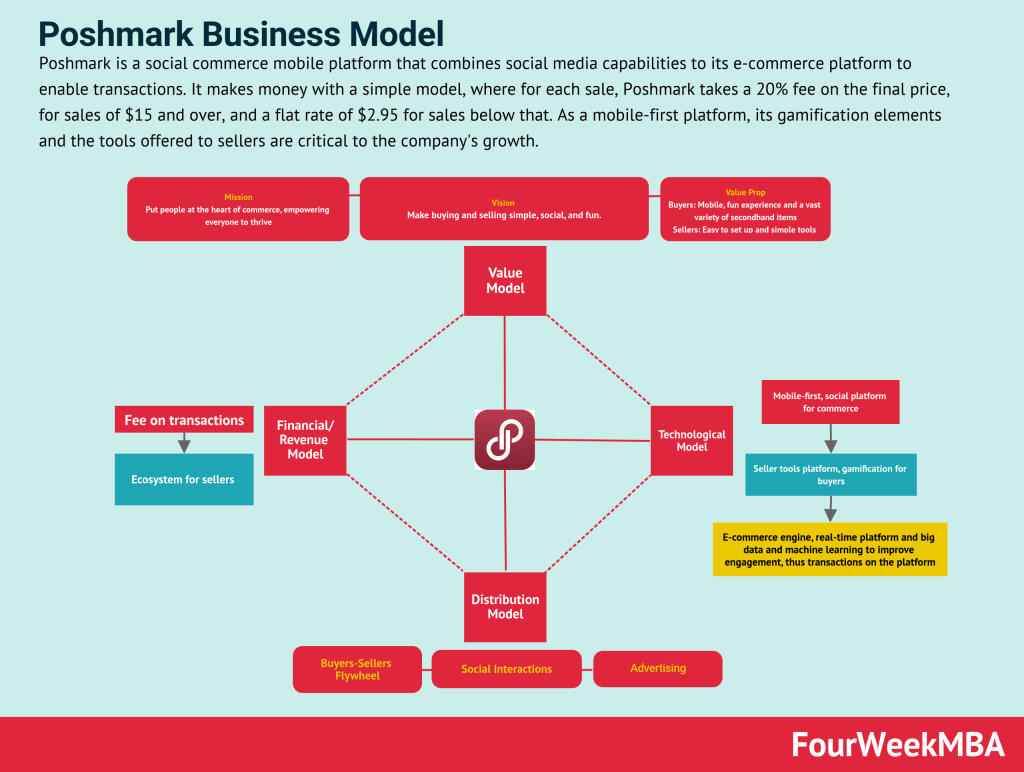
Poshmark is a social commerce mobile platform that combines social media capabilities with its e-commerce platform to enable transactions. It makes money with a simple model, where for each sale, Poshmark takes a 20% fee on the final price for sales of $15 and over and a flat rate of $2.95 for sales below that. Its gamification elements and the tools offered to sellers are critical to the company’s growth as a mobile-first platform.
Gennaro is the creator of FourWeekMBA, which reached about four million business people, comprising C-level executives, investors, analysts, product managers, and aspiring digital entrepreneurs in 2022 alone | He is also Director of Sales for a high-tech scaleup in the AI Industry | In 2012, Gennaro earned an International MBA with emphasis on Corporate Finance and Business Strategy.