VF Corporation, owner of The North Face, Vans and Timberland, has no controlling shareholder. Its 2026 proxy lists the Barbey family trusts (9.7%, co-trusteed by PNC Bank) and Todd Barbey (5.2%), plus funds: Vanguard (9.5%), Dodge & Cox (8.4%), BlackRock (7.4%), M&G (6.6%) and Northern Trust (5.1%).
Update (10 Oct 2026): the ownership figures at the top of this page now come from VF’s 2026 proxy. The original article below is kept as it was; where its older figures differ, the dated filing figures above apply.
How we source: figures on this page come from the company’s own filings (SEC 10-K, 10-Q, prospectus and earnings releases, or its annual report), with the period stated next to each number; outside estimates appear only labelled, with their source and date. Last refreshed October 2026. Our methodology.
VF’s 2026 proxy statement lists seven holders above 5% as of 31 December 2025: PNC Bank and affiliates (9.7%, almost all of it held in Barbey family trust accounts that PNC co-trustees with two VF directors), The Vanguard Group (9.5%), Dodge & Cox (8.4%), BlackRock (7.4%), M&G (6.6%), Todd Barbey (5.2%) and Northern Trust (5.1%). Together the Barbey trusts and Todd Barbey hold about 15%, the largest family position, but not control.
The Business Engineer view
VF is a classic portfolio of outdoor and lifestyle brands owned by a founding family that no longer runs it and a bench of active value investors. That mix explains the pressure for portfolio pruning: when no single owner controls, performance has to convince the funds.
The full story
Ownership
Who Owns Vf Corporation
Key elements and framework breakdown
Key Elements
Products and Services
VF Corporation offers a diverse range of apparel, footwear, and accessories across various lifestyle and outdoor brands. The company's portfolio includes well-k
Revenue Streams
VF Corporation generates revenue primarily from the sale of its apparel, footwear, and accessories to consumers through various channels, including company-owne
Customer Segments
VF Corporation serves a diverse customer base that includes individual consumers seeking apparel and footwear for various lifestyle preferences and outdoor acti
Distribution Channels
VF Corporation products reach consumers through various distribution channels. The company operates company-owned retail stores and outlets, offering a direct-t
Key Partnerships
VF Corporation collaborates with various stakeholders to enhance its product offerings and brand presence. Partnerships with retailers and distributors ensure t
Key Resources
Key resources for VF Corporation include its portfolio of lifestyle and outdoor brands, representing the core product offerings. The company's brand and reputat
Cost Structure
VF Corporation incurs costs related to the production and manufacturing of apparel, footwear, and accessories, including expenses for raw materials, labor, and
Competitive Advantage
VF Corporation's competitive advantage stems from its extensive portfolio of lifestyle and outdoor brands, offering high-quality apparel and footwear. Collabora
The primary individual shareholder of VF Corporation is Todd Barbey and the family – heirs of its founder, John Barbey – which holds a 5.2% ownership stake and other shares included in the family trust accounts, held through PNC Bank. Ownership is then distributed across institutional investors like The Vanguard Group (9.5%), Dodge & Cox (8.4%), BlackRock (7.4%), M&G Plc (6.6%) and Northern Trust Corporation (5.1%), according to VF's 2026 proxy statement. VF Corporation reported revenues of $9.6 billion in the year ended March 2026, comprising brands like Vans, The North Face, Timberland, and Dickies.
Updated 7 October 2026: we refreshed 10 figures on this page, now taken from SEC EDGAR filings. Anything we could not check against a current source keeps its original year, so you can see how old it is.
Latest figures · checked 7 October 2026
VF Corporation’s revenues increased 1% to $9.6 billion in the year ended March 2026. SEC EDGAR filings
In the first quarter of fiscal 2027, VF Corporation’s revenues decreased 5% to $1.7 billion, including a 6% unfavorable impact from the Dickies divestiture. SEC EDGAR filings
VF’s 2026 proxy statement lists PNC Bank, including Barbey Family trust accounts, at 9.7%, The Vanguard Group at 9.5% and Todd Barbey at 5.2% of VF common stock. SEC EDGAR filings
VF Corporation’s earnings per share was $0.64 in the year ended March 2026. SEC EDGAR filings
Aspect · Description · Analysis · Examples
Products and Services
Description. VF Corporation offers a diverse range of apparel, footwear, and accessories across various lifestyle and outdoor brands. The company’s portfolio includes well-known brands such as The North Face, Vans, Timberland, Wrangler, Lee, and many others. Their products cater to different consumer segments and market niches.
Analysis. VF Corporation’s core offerings revolve around apparel, footwear, and accessories, spanning a wide range of lifestyle and outdoor brands. The company serves various consumer preferences and segments, from outdoor enthusiasts to fashion-conscious individuals. The diverse portfolio enables VF Corporation to target multiple market niches effectively.
Examples. Apparel, footwear, and accessories across lifestyle and outdoor brands, diverse portfolio catering to different consumer preferences and segments, targeting multiple market niches effectively.
Revenue Streams
Description. VF Corporation generates revenue primarily from the sale of its apparel, footwear, and accessories to consumers through various channels, including company-owned retail stores, e-commerce websites, and third-party retailers. The company also earns income from licensing agreements and royalties for the use of its brands in various product categories.
Analysis. The primary source of revenue for VF Corporation is the sale of apparel, footwear, and accessories through its retail stores, e-commerce platforms, and third-party retailers, reflecting a direct-to-consumer and B2B approach. Income from licensing agreements and royalties extends brand presence into different product categories, contributing to revenue diversification. VF Corporation’s multiple revenue streams support financial stability.
Examples. Revenue from selling apparel, footwear, and accessories through retail stores, e-commerce websites, and third-party retailers, income from licensing agreements and royalties, diversified revenue streams ensuring financial stability.
Customer Segments
Description. VF Corporation serves a diverse customer base that includes individual consumers seeking apparel and footwear for various lifestyle preferences and outdoor activities. The company also caters to retailers, including department stores, sporting goods stores, and specialty shops, where consumers make their purchases. VF Corporation’s B2B customers include businesses looking for branded uniforms and workwear solutions.
Analysis. Customer segments for VF Corporation encompass individual consumers seeking apparel and footwear for lifestyle and outdoor activities, retailers (department stores, sporting goods stores, specialty shops) stocking and selling VF Corporation products, businesses requiring branded uniforms and workwear solutions. The company’s clientele spans individual consumers, retailers, and B2B customers.
Description. VF Corporation products reach consumers through various distribution channels. The company operates company-owned retail stores and outlets, offering a direct-to-consumer shopping experience for its brands. E-commerce websites facilitate online sales and accessibility. VF Corporation products are also available through a network of third-party retailers, including department stores, sporting goods stores, and specialty shops.
Analysis. Distribution channels for VF Corporation include company-owned retail stores and outlets, providing a branded shopping experience. E-commerce websites enable online sales and accessibility, reaching a broader customer base. Third-party retailers, including department stores and specialty shops, offer wide availability and convenience to consumers. The multi-channel approach ensures broad accessibility.
Examples. Company-owned retail stores and outlets providing a branded shopping experience, e-commerce websites for online sales and broader accessibility, third-party retailers including department stores and specialty shops offering wide availability and convenience, multi-channel approach ensuring broad accessibility.
Key Partnerships
Description. VF Corporation collaborates with various stakeholders to enhance its product offerings and brand presence. Partnerships with retailers and distributors ensure that VF Corporation products are readily available to consumers. Collaborations with professional athletes and outdoor enthusiasts provide endorsements and opportunities for customized gear. Licensing agreements expand brand visibility into different product categories. VF Corporation may also partner with organizations for sustainability initiatives.
Analysis. Collaborations with retailers and distributors ensure widespread availability of VF Corporation products to consumers. Partnerships with professional athletes and outdoor enthusiasts enhance brand visibility and provide endorsement opportunities, adding authenticity. Licensing agreements extend brand presence into various product categories, diversifying the product portfolio. Partnerships with organizations for sustainability initiatives align with corporate values and contribute to responsible business practices. Partnerships are instrumental in growth and innovation.
Examples. Collaborations with retailers and distributors ensuring widespread availability, partnerships with professional athletes and outdoor enthusiasts enhancing brand visibility and endorsements, licensing agreements diversifying the product portfolio, partnerships with organizations for sustainability initiatives aligning with corporate values, instrumental in growth and innovation.
Key Resources
Description. Key resources for VF Corporation include its portfolio of lifestyle and outdoor brands, representing the core product offerings. The company’s brand and reputation as a provider of high-quality apparel and footwear are valuable assets. Manufacturing and production facilities are crucial for product creation. Distribution networks and retail stores ensure product availability. Research and development capabilities drive innovation and product quality. A team of athletes and endorsers supports brand promotion.
Analysis. Resources for VF Corporation encompass a portfolio of lifestyle and outdoor brands, a reputation for providing high-quality apparel and footwear, manufacturing and production facilities for product creation, distribution networks and retail stores for product availability, research and development capabilities driving innovation and quality, a team of athletes and endorsers for brand promotion. These resources collectively contribute to VF Corporation’s success.
Examples. Portfolio of lifestyle and outdoor brands, reputation for high-quality apparel and footwear, manufacturing and production facilities, distribution networks and retail stores, research and development capabilities, team of athletes and endorsers, resources collectively contributing to success.
Cost Structure
Description. VF Corporation incurs costs related to the production and manufacturing of apparel, footwear, and accessories, including expenses for raw materials, labor, and factory operations. Marketing and advertising expenditures promote VF Corporation’s brands and products. Research and development investments drive product innovation and quality. Sales and customer support costs cover efforts to acquire and serve consumers and business clients. Administrative and operational expenses support daily business operations.
Analysis. Costs associated with VF Corporation’s operations include raw material procurement, labor, and factory operations for product production and manufacturing. Marketing and advertising expenses promote the company’s brands and products, enhancing market visibility. Research and development investments drive innovation and ensure product quality, aligning with VF Corporation’s reputation for quality. Sales and customer support costs facilitate consumer and business client acquisition and satisfaction. Administrative and operational expenses support daily business activities. Cost management is crucial in a competitive industry.
Examples. Raw material procurement, labor, and factory operations for production and manufacturing, marketing and advertising expenses for brand and product promotion, research and development investments driving innovation and quality, sales and customer support costs for consumer and business client acquisition and satisfaction, administrative and operational expenses for daily business activities, cost management crucial in a competitive industry.
Description. VF Corporation’s competitive advantage stems from its extensive portfolio of lifestyle and outdoor brands, offering high-quality apparel and footwear. Collaborations with professional athletes and outdoor enthusiasts enhance brand authenticity and visibility. Licensing agreements diversify the product portfolio and expand brand presence into different product categories. Innovation in product design and sustainability initiatives demonstrate adaptability and responsibility in a dynamic market. A strong distribution network ensures broad accessibility to consumers.
Analysis. VF Corporation’s competitive edge lies in its portfolio of lifestyle and outdoor brands, known for high-quality apparel and footwear. Collaborations with professional athletes and outdoor enthusiasts add authenticity and visibility. Licensing agreements broaden the product portfolio and brand presence into diverse categories. Innovation in product design and sustainability initiatives showcase adaptability and responsibility. A strong distribution network ensures broad accessibility to consumers, reinforcing VF Corporation’s competitive strength.
Examples. Extensive portfolio of lifestyle and outdoor brands, high-quality apparel and footwear, collaborations with professional athletes and outdoor enthusiasts enhancing authenticity and visibility, licensing agreements diversifying the product portfolio, innovation in product design and sustainability initiatives demonstrating adaptability and responsibility, strong distribution network ensuring broad accessibility, competitive strength built on quality, authenticity, diversification, and innovation.
Key Shareholders of VF Corporation
VF Corporation is primarily owned by the Barbey family, who are heirs of its founder, John Barbey. The Barbey family holds a 5.2% ownership stake in the company, and their shares are included in family trust accounts, held through PNC Bank. This significant family ownership highlights the company’s roots and long-term commitment to its heritage.
Key numbersChecked 7 October 2026
$0.64VF Corporation's earnings per share was $0.64 in the year ended March 2026.SEC EDGAR filings
1%VF Corporation's revenues increased 1% to $9.6 billion in the year ended March 2026.SEC EDGAR filings
5%In the first quarter of fiscal 2027, VF Corporation's revenues decreased 5% to $1.7 billion, including a 6%…SEC EDGAR filings
9.7%VF's 2026 proxy statement lists PNC Bank, including Barbey Family trust accounts, at 9.7%, The Vanguard…SEC EDGAR filings
In one lineThe primary individual shareholder of VF Corporation is Todd Barbey and the family – heirs of its founder…
FourWeekMBABusiness EngineerAt a glance
Ownership is then distributed across institutional investors like The Vanguard Group (9.5%), Dodge & Cox (8.4%), BlackRock (7.4%), M&G Plc (6.6%) and Northern Trust Corporation (5.1%), according to VF's 2026 proxy statement.
In the first quarter of fiscal 2027, VF Corporation's revenues decreased 5% to $1.7 billion, including a 6% unfavorable impact from the Dickies divestiture.
VF Corporation's brand portfolio includes well-known and successful brands like Vans, The North Face, Timberland, and Dickies.
Institutional investors also have notable ownership in VF Corporation, with The Vanguard Group holding 9.5%, Dodge & Cox 8.4%, BlackRock 7.4%, M&G Plc 6.6% and Northern Trust Corporation 5.1%, according to VF's 2026 proxy statement.
Layout refreshed 7 October 2026. The article text below is unchanged.
Other notable individual shareholders include Todd Barbey, who is part of the Barbey family and holds a 5.2% ownership stake in VF Corporation. Todd Barbey’s involvement indicates the family’s continued interest and active participation in the company’s affairs.
Institutional Ownership
In addition to individual shareholders, VF Corporation’s ownership is distributed across various institutional investors. VF's 2026 proxy statement lists The Vanguard Group with a 9.5% ownership stake. This reflects the trust and confidence placed by one of the world’s largest investment management companies in VF Corporation’s growth potential.
Northern Trust Corporation is another significant institutional investor, holding a 6.4% ownership stake. Northern Trust’s involvement signals interest from major financial institutions in VF Corporation’s performance and prospects.
BlackRock, one of the leading asset management firms globally, holds a 6.2% ownership stake in VF Corporation. BlackRock’s investment in the company signifies its belief in VF Corporation’s business strategy and financial outlook.
Capital International Investors, an arm of Capital Group, holds a 5.6% ownership stake in VF Corporation. This demonstrates interest from a respected investment management firm in the company’s market position and future growth.
FourWeekMBABusiness EngineerTimeline, as stated in the article
2026
VF Corporation's revenues increased 1% to $9.6 billion in the year ended March 2026.
2026
In the year ended March 2026, VF Corporation reported revenues of $9.6 billion.
2027
In the first quarter of fiscal 2027, VF Corporation's revenues decreased 5% to $1.7 billion, including a 6% unfavorable impact from the Dickies divestiture.
VF Corporation’s Revenue and Brands
In the year ended March 2026, VF Corporation reported revenues of $9.6 billion. This substantial revenue underscores VF Corporation’s strong presence in the apparel and footwear industry and its ability to cater to a diverse customer base.
VF Corporation’s brand portfolio includes well-known and successful brands like Vans, The North Face, Timberland, and Dickies. These brands have achieved significant global recognition and appeal to different consumer segments, contributing to the company’s overall success.
Key Highlights:
VF Corporation is primarily owned by the Barbey family, heirs of its founder John Barbey, with a 5.2% ownership stake held through PNC Bank.
Other significant individual shareholders include Todd Barbey, who is part of the Barbey family and holds a 5.2% ownership stake in the company.
Institutional investors also have notable ownership in VF Corporation, with The Vanguard Group holding 9.5%, Dodge & Cox 8.4%, BlackRock 7.4%, M&G Plc 6.6% and Northern Trust Corporation 5.1%, according to VF's 2026 proxy statement.
In the year ended March 2026, VF Corporation generated $9.6 billion in revenue, making it a substantial player in the apparel and footwear industry.
VF Corporation’s portfolio comprises well-known brands like Vans, The North Face, Timberland, and Dickies, which have a significant global presence and consumer appeal.
In 2020, VF Corporation generated revenue of $10.49 billion.
The company experienced a decline in revenue in 2021, with total revenue falling to $9.24 billion. This represented a decrease of approximately 11.9% compared to the previous year.
However, VF Corporation saw a strong rebound in revenue in 2022, with total revenue reaching $11.84 billion. This marked an increase of approximately 28.1% compared to 2021.
The significant increase in revenue in 2022 suggests a recovery from the challenges faced in 2021, and the company’s revenue surpassed its 2020 level.
Overall, the trend in revenue for VF Corporation over this three-year period indicates a temporary dip in 2021, followed by a robust recovery in 2022.
In 2022, VF Corporation generated revenue from three primary sources: Wholesale, Direct-To-Consumer, and Royalty.
The company’s Wholesale revenue was the largest contributor, amounting to $6,371,190,000 (or approximately $6.37 billion). This represents the revenue generated from selling products to wholesalers, retailers, and other business partners.
The second-largest source of revenue was Direct-To-Consumer, which amounted to $5,404,075,000 (or approximately $5.40 billion). This represents the revenue generated from selling products directly to end consumers, typically through the company’s own retail stores, e-commerce platforms, and other direct sales channels.
The smallest source of revenue was Royalty, which amounted to $66,575,000 (or approximately $66.58 million). This represents the revenue generated from licensing the company’s brands, trademarks, or intellectual property to third parties in exchange for royalty payments.
Overall, the majority of VF Corporation’s revenue in 2022 came from its Wholesale and Direct-To-Consumer segments, with Wholesale being the largest contributor. Royalty revenue, while smaller in comparison, still contributed to the company’s overall revenue.
In 2022, VF Corporation generated revenue from three primary business segments: Outdoor, Active, and Work.
The company’s Outdoor segment generated revenue of $5,327,568,000 (or approximately $5.33 billion). This segment includes products and brands related to outdoor activities, such as hiking, camping, and adventure sports. The revenue from this segment represents sales of outdoor apparel, footwear, and equipment.
The Active segment generated revenue of $5,380,338,000 (or approximately $5.38 billion). This segment includes products and brands related to active lifestyles, such as athletic wear, fitness, and sports. The revenue from this segment represents sales of activewear, athletic footwear, and related products.
The Work segment generated revenue of $1,133,149,000 (or approximately $1.13 billion). This segment includes products and brands related to workwear and occupational safety. The revenue from this segment represents sales of workwear, protective clothing, and safety footwear for various industries and professions.
Overall, the majority of VF Corporation’s revenue in 2022 came from its Outdoor and Active segments, with both segments contributing similar revenue levels. The Work segment, while smaller in comparison, still contributed significantly to the company’s overall revenue.
Slow fashion is a movement in contraposition with fast fashion. Where in fast fashion, it’s all about speed from design to manufacturing and distribution, in slow fashion, quality and sustainability of the supply chain are the key elements.
Patagonia is an American clothing retailer founded by climbing enthusiast Yvon Chouinard in 1973 who saw initial success by selling reusable climbing pitons and Scottish rugby shirts. Over time Patagonia also became a fashionable brand also for its focus on slow fashion. Indeed, the company sells high-priced clothing items built to last which it will repair for free.
Patagonia has a particular organizational structure, where its founder, Chouinard, disposed of the company’s ownership in the hands of two non-profits. The Patagonia Purpose Trust, holding 100% of the voting stocks, is in charge of defining the company’s strategic direction. And the Holdfast Collective, a non-profit, holds 100% of non-voting stocks, aiming to re-invest the brand’s dividends into environmental causes.
Fash fashion has been a phenomenon that became popular in the late 1990s and early 2000s, as players like Zara and H&M took over the fashion industry by leveraging on shorter and shorter design-manufacturing-distribution cycles. Reducing these cycles from months to a few weeks. With just-in-time logistics and flagship stores in iconic places in the largest cities in the world, these brands offered cheap, fashionable clothes and a wide variety of designs.
With over €27 billion in sales in 2021, the Spanish Fast Fashion Empire, Inditex, which comprises eight sister brands, has grown thanks to a strategy of expanding its flagship stores in exclusive locations around the globe. Its largest brand, Zara, contributed over 70% of the group’s revenue. The country that contributed the most to the fast fashion Empire sales was Spain, with over 15% of its revenues.
LVMH is a global luxury empire with over €79 billion ($83 billion) in revenues for 2022, spanning several industries: wines and spirits, fashion and leather goods, perfumes and cosmetics, watches and jewelry, and selective retailing. It comprises brands like Louis Vuitton, Christian Dior Couture, Fendi, Loro Piana, and many others.
Kering Group follows a multi-brand business model strategy. The central holding helps the brands and Houses part of its portfolio leverage economies of scale while creating synergies. At the same time, those brands are run independently. Kering is today a global luxury brand that made over €20 billion in revenue based on this multi-brand strategy. Within Kering Group are brands like Gucci, Bottega Veneta, Saint Laurent, and many more—the primary operating segments based on luxury and lifestyle.
Kering is a luxury goods multinational founded in France by François Pinault in 1963. The company, which initially specialized in timber trading, grew via acquisitions and was listed on the Paris Stock Exchange in 1988. Two years later, Kering merged with a French conglomerate interested in furniture, department stores, and bookstores.
The Ultra Fashion business model is an evolution of fast fashion with a strong online twist. Indeed, where the fast-fashion retailer invests massively in logistics and warehousing, its costs are still skewed toward operating physical retail stores. While the ultra-fast fashion retailer mainly moves its operations online, thus focusing its cost centers on logistics, warehousing, and a mobile-based digital presence.
ASOS is a British online fashion retailer founded in 2000 by Nick Robertson, Andrew Regan, Quentin Griffiths, and Deborah Thorpe. As an online fashion retailer, ASOS makes money by purchasing clothes from wholesalers and then selling them for a profit. This includes the sale of private label or own-brand products. ASOS further expanded on the fast fashion business model to create an ultra-fast fashion model driven by short sales cycles and online mobile e-commerce as the main drivers.
Real-time retail involves the instantaneous collection, analysis, and distribution of data to give consumers an integrated and personalized shopping experience. This represents a strong new trend, as a further evolution of fast fashion first (who turned the design into manufacturing in a few weeks), ultra-fast fashion later (which further shortened the cycle of design-manufacturing). Real-time retail turns fashion trends into clothes collections in a few days or a maximum of one week.
SHEIN is an international B2C fast fashion eCommerce platform founded in 2008 by Chris Xu. The company improved the ultra-fast fashion model by leveraging real-time retail, quickly turning fashion trends in clothes collections through its strong digital presence and successful branding campaigns.
Zara is a brand part of the retail empire Inditex. Zara is the leading brand in what has been defined as “fast fashion.” With almost €20 billion in sales in 2021 (comprising Zara Home) and an integrated retail format with quick sales cycles. Zara follows an integrated retail format where customers are free to move from physical to digital experience.
Wish is a mobile-first e-commerce platform in which users’ experience is based on discovery and customized product feed. Wish makes money from merchants’ fees and advertising on the platform, and logistic services. The mobile platform also leverages an asset-light business model based on a positive cash conversion cycle where users pay in advance as they order goods, and merchants are paid in weeks.
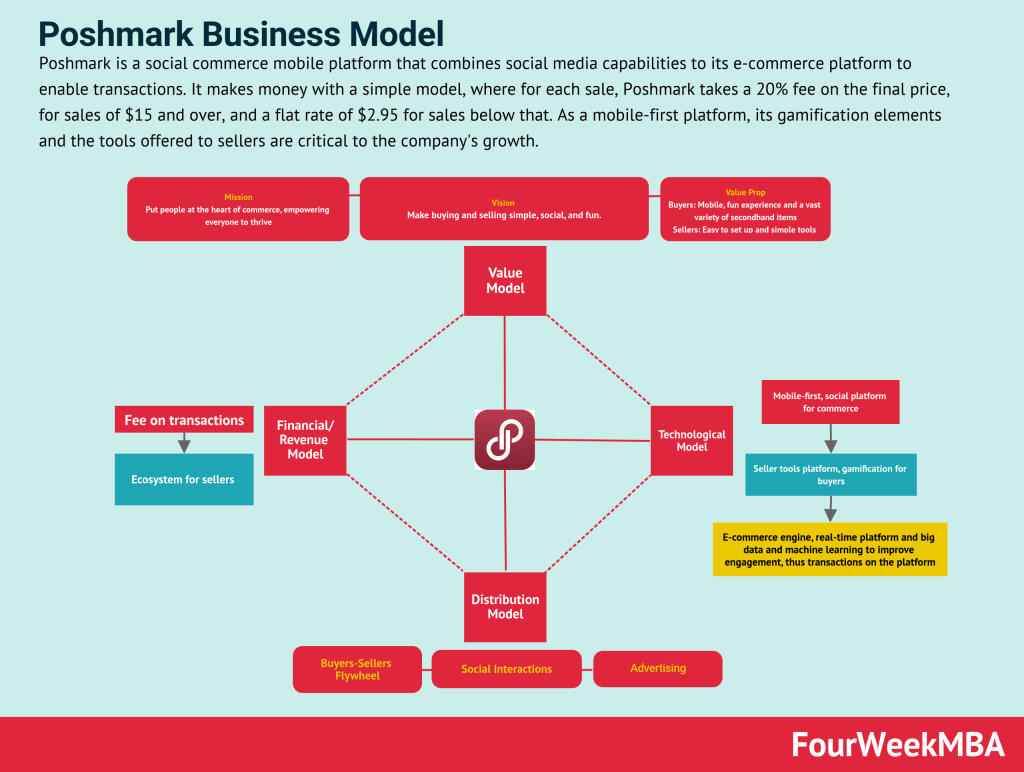
Poshmark is a social commerce mobile platform that combines social media capabilities with its e-commerce platform to enable transactions. It makes money with a simple model, where for each sale, Poshmark takes a 20% fee on the final price for sales of $15 and over and a flat rate of $2.95 for sales below that. Its gamification elements and the tools offered to sellers are critical to the company’s growth as a mobile-first platform.
Gennaro Cuofano is a CRO and tech executive who has worked in AI since late 2015, starting with bringing NLP, natural-language generation, voice and chatbot products to the marketing industry. His background is in law and finance: he holds a Master's degree in Law and an International MBA with an emphasis on corporate finance (LUISS Business School and the University of San Diego, 2012), and worked as a financial analyst at a real-estate investment firm in San Diego and as an assistant controller. His work focuses on business model strategy, business engineering and, more broadly, structural analysis: how companies make money, read from their own filings. He created FourWeekMBA and leads research there and at The Business Engineer, his newsletter on AI and business strategy, with over 95,000 subscribers and more than 1,000 published analyses. His writing has also appeared on Entrepreneur, HackerNoon and Search Engine People. Find him on LinkedIn and Substack. See how we source.
Scroll to Top
Discover more from FourWeekMBA
Subscribe now to keep reading and get access to the full archive.