The Coca-Cola Company is an American multinational beverage corporation founded in 1892 by pharmacist Asa Griggs Candler. From a single cola beverage, the company now owns over 500 different brands.
Coca-Cola and Diet Coke occupy two of the top five bestselling carbonated drinks worldwide. Two of the oldest brands the company owns are Fanta and Sprite.
In response to the healthier drink trend, Coca-Cola released Dasani, Ciel, and Smartwater bottled water. The company also owns sports drink Powerade, smoothie brand Innocent Drinks, and orange juice brands Minute Maid and Simply Orange.
Subsidiary / Brand
Business Category
Key Differentiator
Integration Strategy
Coca-Cola
Carbonated Soft Drinks
Iconic and globally recognized cola brand.
Flagship brand, representing the core of The Coca-Cola Company’s product portfolio. It drives brand recognition and sets the standard for quality and taste.
Diet Coke
Low-Calorie Carbonated Soft Drinks
Popular low-calorie alternative with various flavors.
Targets health-conscious consumers and complements the core Coca-Cola brand by offering reduced-calorie options.
Coca-Cola Zero Sugar
Sugar-Free Carbonated Soft Drinks
Sugar-free version with a taste close to original Coca-Cola.
Addresses the demand for sugar-free alternatives and appeals to consumers seeking a similar taste experience.
Sprite
Lemon-Lime Flavored Soft Drink
Refreshing lemon-lime taste with a clear brand identity.
Expands the product range by offering a different flavor profile, appealing to those seeking citrusy refreshment.
Fanta
Fruit-Flavored Carbonated Soft Drinks
Wide range of fruity flavors and vibrant branding.
Provides diversity in flavors and appeals to consumers who enjoy fruit-flavored sodas.
Powerade
Sports and Energy Drinks
Designed for hydration and energy replenishment.
Taps into the sports and energy drink market, complementing the beverage portfolio with functional drinks.
SmartWater
Premium Bottled Water
Vapor-distilled water with added electrolytes.
Expands beyond carbonated soft drinks, catering to health-conscious consumers looking for premium hydration options.
Honest Tea
Organic Iced Tea and Beverages
Organic and fair-trade beverages with various flavors.
Targets consumers seeking organic and ethically sourced options, diversifying the product offerings.
Minute Maid
Fruit Juices and Drinks
Wide range of fruit juices, punches, and lemonades.
Offers a variety of non-carbonated beverages, including juices, to appeal to different consumer preferences.
Odwalla
Natural Smoothies and Juices
Natural and wholesome fruit smoothies and juices.
Caters to consumers looking for nutritious and natural beverage options, complementing the product line.
Costa Coffee
Coffee and Coffeehouse Chain
International coffee brand and coffeehouse chain.
Diversifies The Coca-Cola Company’s portfolio into the coffee and café market, providing additional beverage choices.
Topo Chico
Sparkling Mineral Water
Premium sparkling water brand.
Addresses the demand for premium sparkling water and adds a non-soda option to the beverage portfolio.
Aquarius
Non-Carbonated Functional Beverages
Range of non-carbonated functional beverages.
Offers functional beverages beyond soda, catering to consumers seeking hydration and added benefits.
Simply
Premium Fruit Juices and Drinks
Premium fruit juices and smoothies.
Represents high-quality fruit-based beverages, diversifying the non-carbonated options within the portfolio.
Fuze Tea
Iced Tea and Fruit-Flavored Drinks
Range of iced tea and fruit-flavored beverages.
Expands into the iced tea and fruit-flavored drink market, appealing to consumers looking for alternative flavors.
ZICO
Coconut Water
Pure and natural coconut water.
Addresses the demand for coconut water as a healthy and natural beverage option, adding variety to the portfolio.
Georgia
Coffee and Tea Vending Machines
Coffee and tea solutions for vending machines.
Provides beverage solutions for out-of-home consumption, offering convenience to consumers.
The Coca-Cola Company is an American multinational beverage corporation founded in 1892 by pharmacist Asa Griggs Candler. Many consumers associate the company with its signature soda in a red can or bottle. In truth, however, The Coca-Cola Company owns a plethora of soft drink, juice, tea, coffee, and other beverage brands.
Diet Coke was later introduced in 1982 as a sugar-free derivative. Together, Coke and Diet Coke comprise two of the top five bestselling sparkling non-alcoholic beverages in the world.
Fanta and Sprite
Fanta and Sprite are two of The Coca-Cola company’s oldest brands.
Fanta was first introduced around 1941 and was the result of trade embargoes against Germany on cola syrup. This necessitated that a new drink is invented made from ingredients available within the country at the time.
Sprite, a lemon-lime soft drink, was introduced twenty years later in 1961 to compete with similar beverage 7 Up.
Dasani, Ciel, and Smartwater
In response to shifting consumer preferences for healthier beverage options, The Coca-Cola Company introduced several bottled water options.
These include:
Dasani – a line of filtered bottled water first released in 1999.
Ciel – purified bottled water sold in Mexico, Angola, and Morocco. The company also released a mineral water alternative called Ciel Mineralizada in several markets.
Powerade is a sports drink that rose to prominence after becoming the official drink of the Seoul 1988 Olympics.
In North American and elsewhere, Powerade competes with Gatorade – a sports beverage owned by PepsiCo.
Innocent Drinks
Innocent Drinks is a company producing smoothies and juices for supermarkets, cafés, and various other food and drink outlets. The company sells juice consisting of whole crushed fruit and does not use fruit concentrates. It also sells vegan nut and oat drinks and coconut water.
Though founded in the United Kingdom in 1998, Coca-Cola took a minor stake in the company in 2009. This stake increased to over 90% in 2013.
Minute Maid and Simply Orange
Coca-Cola acquired Minute Maid in 1960, marking its first acquisition of a non-carbonated beverage brand. Minute Maid is perhaps most associated with orange juice, but the company sells over 100 different juices and juice drinks.
In 2001, the Minute Maid division of Coca-Cola then launched the Simply Orange Juice Company. Simply Orange is a more premium orange juice because it uses computer modeling to blend different orange juice sources and maintain a consistent taste year-round.
Understanding Coca-Cola Business Model
Coca-Cola follows a business strategy (implemented since 2006) where through its operating arm – the Bottling Investment Group – it invests initially in bottling partners operations. As they take off, Coca-Cola divests its equity stakes, and it establishes a franchising model, as long-term growth and distributionstrategy.
Value Proposition:
Refreshing Taste: Coca-Cola offers consumers a wide range of refreshing beverages with unique and appealing flavors, providing moments of enjoyment and refreshment for people of all ages and lifestyles.
Iconic Brand: Coca-Cola is an iconic brand with a rich heritage and global recognition, symbolizing happiness, positivity, and togetherness. Through its timeless logo, memorable advertising, and cultural resonance, Coca-Cola creates emotional connections with consumers around the world.
Product Innovation: Coca-Cola continually innovates its product portfolio to meet evolving consumer preferences and trends, introducing new flavors, formulations, and packaging formats to cater to diverse tastes and lifestyles.
Quality and Consistency: Coca-Cola maintains high standards of quality and consistency across its beverage offerings, ensuring that every bottle or can delivers the same great taste and satisfaction, regardless of where it’s consumed.
Commitment to Sustainability: Coca-Cola is committed to sustainability and environmental stewardship, striving to minimize its environmental footprint, promote recycling initiatives, and enhance water stewardship to create a positive impact on communities and the planet.
Revenue Streams:
Beverage Sales: Coca-Cola generates the majority of its revenue from the sale of its beverages, including carbonated soft drinks, waters, juices, teas, sports drinks, and energy drinks, sold through various distribution channels, including retail stores, restaurants, convenience stores, vending machines, and online platforms.
Branded Syrups and Concentrates: Coca-Cola earns revenue from the sale of branded syrups and concentrates to its network of bottling partners and fountain customers, who use these ingredients to produce and dispense Coca-Cola beverages in fountain drinks, restaurants, bars, and entertainment venues.
Licensing and Merchandising: Coca-Cola generates revenue through licensing agreements and merchandising partnerships, allowing third-party manufacturers and retailers to produce and sell Coca-Cola-branded merchandise, including apparel, accessories, collectibles, and household goods.
Advertising and Sponsorships: Coca-Cola earns revenue from advertising campaigns, sponsorships, and marketing partnerships with sports leagues, events, festivals, concerts, and cultural initiatives, leveraging its brand visibility and recognition to promote its products and connect with consumers worldwide.
Investments and Ventures: Coca-Cola invests in strategic ventures, acquisitions, and partnerships with emerging brands, startups, and beverage companies to diversify its portfolio, expand into new categories, and capitalize on growth opportunities in the beverage industry.
Marketing Strategy:
Brand Marketing: Coca-Cola invests heavily in brandmarketing and advertising campaigns to reinforce its brand identity, engage consumers, and drive brand loyalty. Through television commercials, digital advertising, social media campaigns, and experiential marketing events, Coca-Cola promotes its beverages and values, emphasizing themes of happiness, joy, and unity.
Product Innovation: Coca-Cola focuses on productinnovation and new product development to introduce new flavors, formulations, and packaging innovations that resonate with consumer preferences and market trends. By continuously refreshing its product lineup and adapting to changing consumer tastes, Coca-Cola stays relevant and competitive in the beverage market.
Sponsorships and Partnerships: Coca-Cola leverages sponsorships and partnerships with sports leagues, teams, events, celebrities, influencers, and cultural icons to enhance its brand visibility and connect with target audiences. By associating its brand with popular events like the Olympic Games, FIFA World Cup, and music festivals, Coca-Cola expands its reach and fosters emotional connections with consumers.
Digital Engagement: Coca-Cola embraces digital marketing channels and social media platforms to engage with consumers, share brand stories, and facilitate two-way communication. Through interactive content, user-generated campaigns, influencer collaborations, and personalized messaging, Coca-Cola builds relationships with digital-savvy consumers and amplifies brand advocacy online.
Community Engagement: Coca-Cola prioritizes community engagement and corporate social responsibility initiatives to support local communities, address social issues, and promote sustainability. Through philanthropic programs, environmental initiatives, and community partnerships, Coca-Cola demonstrates its commitment to making a positive impact on society and fostering goodwill among consumers and stakeholders.
Key takeaways
Company Overview:
The Coca-Cola Company is a multinational beverage corporation founded in 1892 by Asa Griggs Candler.
It is known for its iconic Coca-Cola soda, but it owns a wide range of beverage brands.
Coca-Cola and Diet Coke:
Coca-Cola (Coke) is recognized globally and has distinctive red and white packaging.
Diet Coke, a sugar-free derivative, was introduced in 1982.
Coke and Diet Coke are among the top five bestselling sparkling non-alcoholic beverages.
Fanta and Sprite:
Fanta was introduced in the 1940s due to trade embargoes, creating a new drink from available ingredients.
Sprite, a lemon-lime soft drink, was introduced in 1961 to compete with 7 Up.
Bottled Water Brands:
In response to health trends, Coca-Cola introduced various bottled water options, including:
Dasani (filtered bottled water, 1999)
Ciel (purified bottled water in certain markets)
Smartwater (acquired through Glacéau in 2007, vapor-distilled water with added electrolytes)
Powerade:
Powerade is a sports drink that gained prominence as the official drink of the Seoul 1988 Olympics.
It competes with Gatorade, a sports beverage owned by PepsiCo.
Innocent Drinks:
Innocent Drinks produces smoothies, juices, and plant-based drinks.
Coca-Cola acquired a stake in the company in 2009, later increasing ownership to over 90% in 2013.
Minute Maid and Simply Orange:
Coca-Cola acquired Minute Maid in 1960, marking its first non-carbonated brand acquisition.
Minute Maid is known for orange juice and offers over 100 different juices.
The company launched Simply Orange Juice Company, using computer modeling for consistent taste.
Diverse Brand Portfolio:
The Coca-Cola Company owns over 500 different brands, ranging from carbonated drinks to juices, water, and more.
Coca-Cola follows a business strategy (implemented since 2006) where through its operating arm – the Bottling Investment Group – it invests initially in bottling partners operations. As they take off, Coca-Cola divests its equity stakes, and it establishes a franchising model, as long-term growth and distributionstrategy.
Coca-Cola’s top investors include Warren Buffet’s company, Berkshire Hathaway, with 9.25% of shares, and other mutual funds like The Vanguard Group, holding 8.51% of shares, and BlackRock owning over 7.19% of shares of the company. Other individual investors like Herbert A. Allen, director of The Coca-Cola Company since 1982, and Barry Diller, Chairman of the Coca-Cola board since 2002. And former CEO Muhtar Kent.
Coca-Cola generated $45.75 billion in revenue in 2023, compared to over $43 billion in revenue in 2022, and $10.7 billion in profits in 2023, compared to over $9.5 billion in net profits in 2022.
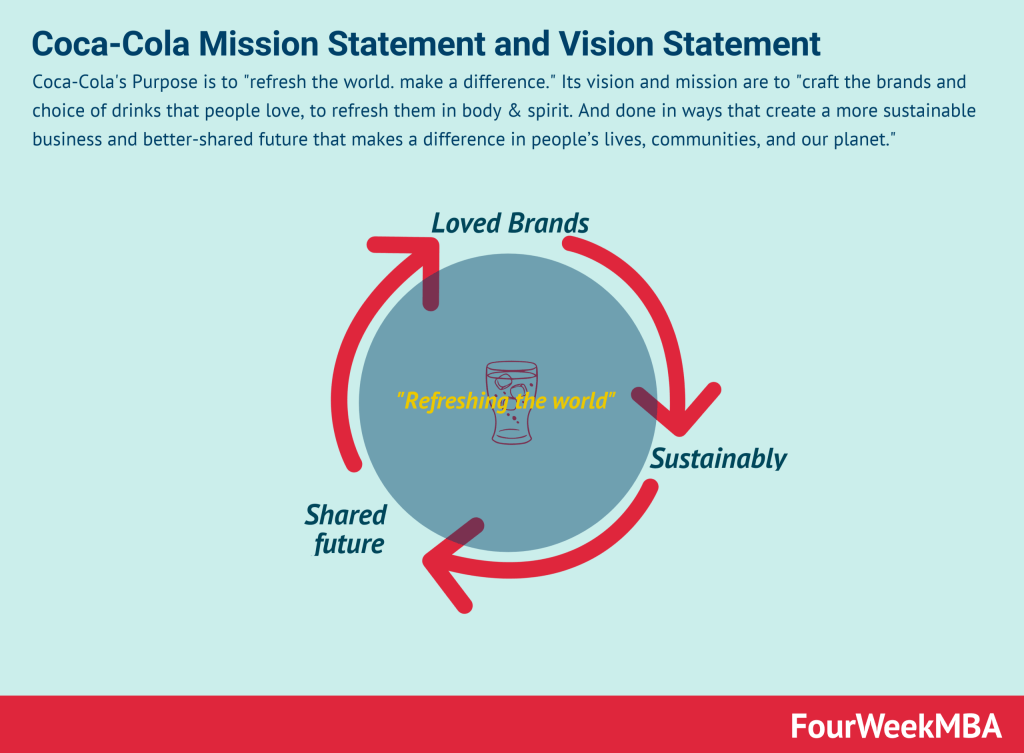
Coca-Cola’s Purpose is to “refresh the world. make a difference.” Its vision and mission are to “craft the brands and choice of drinks that people love, to refresh them in body & spirit. And done in ways that create a more sustainable business and better-shared future that makes a difference in people’s lives, communities, and our planet.”
Coca-Cola is the market leader of the soft drink industry. It is also the most widely recognized brand, with a Business Insider study revealing that a staggering 94% of the world population recognizes the red and white logo. However, Coca-Cola faces significant challenges with increasingly health-conscious consumers and less access to water resources.
The Coca-Cola Company is an American multinational beverage corporation founded in 1892 by pharmacist Asa Griggs Candler. Many consumers associate the company with its signature soda in a red can or bottle. In truth, however, The Coca-Cola Company owns a plethora of soft drink, juice, tea, coffee, and other beverage brands.
The Coca-Cola Company has 21 different billion-dollar brands or brands that generate more than $1 billion or more in revenue each year. The company also sells its products in nearly every country in the world, with Cuba and North Korea the only two countries where it is not sold officially. What’s more, the Coca-Cola brand is worth $87.6 billion, making it one of the most valuable among all companies. Though these figures allow Coca-Cola to enjoy market dominance in many countries, the company is nevertheless subject to intense competition.
Pepsi is owned by PepsiCo, the holding company which owns many brands spanning from drinks to food & snacks and more. PepsiCo generated $91.47 billion in revenue in 2023, and $9.07 billion in profits for the same period. PepsiCo is primarily owned by institutional investors like The Vanguard Group (8.9%) and BlackRock (7.6%). Top individual investors comprise Robert Pohlad, the company’s board member; and the company’s CEO, Ramon Laguarta.
PepsiCo was founded in 1902 by American pharmacist and businessman Caleb Bradham as the Pepsi-Cola Company. Bradham, who hoped to emulate the success of Coca-Cola, marketed the beverage from his pharmacy and registered a patent for its recipe the following year. Today, Pepsi is a global company with a portfolio of 23 billion-dollar brands, or brands earning more than $1 billion in annual revenue. Sixteen of these brands are beverage-related, while the remaining seven are associated with snacks and other food products.
In 1965, PepsiCo acquired Frito-Lay in what the chairmen of both companies called a “marriage made in heaven”. The resultant company transformed PepsiCo from a soft drink organization and set it on a path to becoming one of the world’s leading food and beverage companies. Today, PepsiCo claims to operate in more than 200 countries and territories around the world with seven distinct divisions and many successful brands.
PepsiCo generated $91.47 billion in revenue in 2023, over $86 billion in revenue in 2022, over $79 billion in revenue in 2021, and over $70 billion in 2020.
PepsiCo generated $9.07 billion in profits in 2023, compared to nearly $9 billion in profits in 2022, over $7.6 billion in profits in 2021 and over $7 billion in 2020.
Gennaro is the creator of FourWeekMBA, which reached about four million business people, comprising C-level executives, investors, analysts, product managers, and aspiring digital entrepreneurs in 2022 alone | He is also Director of Sales for a high-tech scaleup in the AI Industry | In 2012, Gennaro earned an International MBA with emphasis on Corporate Finance and Business Strategy.