The Toulmin model is a system of argumentation that is used to develop, analyze, and categorize arguments. The Toulmin model was created by British philosopher Stephen Toulmin in his 1958 book The Uses of Argument. In the model, an argument is separated into its constituent parts and each part is evaluated in terms of how well it contributes to the whole. In other words, how valid or effective is the argument?
Aspect
Explanation
Concept Overview
The Toulmin Model is a framework for analyzing arguments and assessing their effectiveness in persuasion and communication. It was developed by British philosopher Stephen Toulmin in his book “The Uses of Argument” in 1958. The model provides a structured approach to understanding how arguments are constructed and evaluated, emphasizing the need for clear reasoning and evidence. It has applications in various fields, including rhetoric, debate, critical thinking, and persuasive writing.
Components of the Model
The Toulmin Model consists of several key components: 1. Claim: The central statement or proposition that the argument aims to prove or support. 2. Data (Evidence): Information, facts, or evidence presented to support the claim. 3. Warrant: The underlying assumption or reasoning that connects the data to the claim. 4. Backing: Additional support or reasoning that reinforces the warrant. 5. Qualifier: Statements that indicate the strength or scope of the argument. Qualifiers may include words like “probably,” “possibly,” or “likely.” 6. Rebuttal: Acknowledgment of counterarguments or potential objections.
Function of Each Component
Each component of the Toulmin Model serves a specific function: – Claim: It represents the main point or assertion being argued. – Data (Evidence): Data provides the factual basis for the claim and supports its validity. – Warrant: The warrant explains the reasoning or logic behind how the data supports the claim. It bridges the gap between evidence and the assertion. – Backing: Backing provides additional support for the warrant, reinforcing the argument’s validity. – Qualifier: Qualifiers clarify the degree of certainty or the scope of the claim. They acknowledge the argument’s limitations or uncertainties. – Rebuttal: The rebuttal anticipates and addresses potential objections or counterarguments, strengthening the overall argument.
Applications
The Toulmin Model is widely used in various fields to analyze and construct persuasive arguments. It is valuable in debate, rhetoric, legal reasoning, academic writing, advertising, and public speaking. By breaking down arguments into their components, it allows for a systematic assessment of their strengths and weaknesses.
Real-World Examples
The Toulmin Model can be applied to real-world examples, such as assessing the effectiveness of a persuasive advertisement, evaluating a legal argument in court, or analyzing a political speech. By identifying the claim, evidence, reasoning, qualifiers, and rebuttals, one can critically evaluate the persuasiveness of the argument.
Critical Thinking Tool
The Toulmin Model serves as a valuable tool for critical thinking. It encourages individuals to examine the logical structure and evidence behind arguments, promoting more informed decision-making and better communication.
To determine validity, Toulmin argued that there are six parts factors to consider. Three of which are fundamental to every argument:
The claim – or the assertion that someone wants to prove to someone else. In other words, the main argument. For this article, let us assume that someone argues to someone else that they should purchase a new Ford pickup truck.
The grounds – or the evidence that helps support the claim. The grounds may include data, facts, or logical reasoning. The Ford F150 truck has been the best-selling truck in American for 10 years.
The warrant – or an assumption that links the grounds to the claim, thereby legitimizing it and making it relevant. The warrant can simply be implied or it can be stated explicitly. Ford trucks consistently score highly for consumer satisfaction.
The three remaining parts of the Toulmin model
The three remaining parts of the model are not considered fundamental to the Toulmin model.
Nevertheless, they can be used to construct robust, nuanced arguments.
Here is a look at each, using the Ford example from the previous section:
The backing – which gives additional support to the warrant by answering different questions. For example, Ford has dealerships right across America – even in small, rural towns.
The qualifier – describing the strength of the relationship between the data and the warrant. Qualifying statements usually include words such as “most”, “usually”, “sometimes”, or “always”. For example, most men in the 35 to 45 demographic own a new or used Ford truck.
The rebuttal – or the counter-argument that takes the form of continued dialogue or rebuttal during the initial presentation of the argument. The rebuttal is a form of argument in itself and must include a claim, warrant, backing, etc. A rebuttal to the argument of buying a Ford truck may be that the company has reliability issues. This could be countered by stating that Ford has recently improved quality control by building new production facilities in collaboration with other automakers.
Applications of the Toulmin model in business
The Toulmin model has benefits for committees and other business meetings. This is because most meetings rarely use the power of debate in making effective decisions. Getting the decision-making process right is particularly important when many stakeholders are involved. Have the needs of every stakeholder been adequately addressed? Debating the efficacy of a decision using argumentation minimizes the chances of stakeholder rebuttal.
To smooth this process, each committee member should be asked to fill out the six parts of the argument they want to put forth. Most individuals will find that their points of view (or perspectives) do not satisfy Toulmin’s criteria for a good argument. Indeed, the arguments that do satisfy all criteria are vastly superior to what might have been decided by not using the method.
Key takeaways
The Toulmin model is a tool used to develop effective argumentation by breaking down each argument into six parts.
The Toulmin model argues that three parts are fundamental to any argument: the claim, the grounds, and the warrant. The remaining three parts of the backing, qualifier, and rebuttal can be used to construct more nuanced arguments.
The Toulmin model has important implications for decision making in business. The systematic nature of deconstructing arguments ensures that only decisions likely to satisfy all stakeholders are implemented.
Key Highlights:
Toulmin Model of Argumentation:
The Toulmin model is an approach to developing, analyzing, and categorizing arguments.
Created by British philosopher Stephen Toulmin in his book “The Uses of Argument” (1958).
It breaks down arguments into components to assess their validity and effectiveness.
Components of the Toulmin Model:
Claim: The main assertion that someone wants to prove to someone else. For example, advocating the purchase of a new Ford pickup truck.
Grounds: Evidence supporting the claim, including data, facts, or logical reasoning. Example: The Ford F150 is the best-selling truck in America.
Warrant: Assumption linking grounds to the claim, legitimizing it. Example: Ford trucks score highly in consumer satisfaction.
Additional Components:
Backing: Provides extra support to the warrant by addressing different aspects of the argument. Example: Ford has dealerships across the country.
Qualifier: Describes the strength of the relationship between data and warrant using terms like “most” or “usually.” Example: Most men in the 35 to 45 age group own Ford trucks.
Rebuttal: Counter-argument that continues the dialogue, comprising a claim, warrant, backing, etc. Example: Rebuttal against buying a Ford truck due to reliability issues, countered by mentioning quality control improvements.
Application in Business:
The Toulmin model is useful in business meetings and decision-making.
Debating using the Toulmin model helps ensure thorough consideration of stakeholders’ needs and minimizes chances of rebuttal.
Committee members can use the model to structure their arguments effectively and make more informed decisions.
Key Takeaways:
The Toulmin model breaks arguments into six parts: claim, grounds, warrant, backing, qualifier, and rebuttal.
Fundamental parts are claim, grounds, and warrant; additional parts enhance argument nuance.
The model aids in systematic decision-making in business, satisfying stakeholders’ needs effectively.
Related Frameworks, Models, or Concepts
Description
When to Apply
Argumentation Theory
Argumentation Theory studies the principles and methods of constructing and evaluating arguments. The Toulmin Model is a key framework within Argumentation Theory, providing a structured approach to analyzing and assessing arguments by identifying their components, including claims, evidence, warrants, backing, qualifiers, and rebuttals.
Apply Argumentation Theory to understand the principles of persuasive communication and critical thinking. Use it alongside the Toulmin Model to analyze and evaluate arguments in various contexts, such as academic writing, public discourse, and decision-making processes.
Rhetorical Analysis
Rhetorical Analysis examines how language, structure, and persuasion techniques are used to influence audiences and convey messages effectively. The Toulmin Model complements Rhetorical Analysis by providing a systematic framework for analyzing arguments and identifying rhetorical strategies, such as appeals to logic, emotion, and authority.
Utilize Rhetorical Analysis to analyze speeches, advertisements, and other forms of communication to understand how persuasion techniques are employed to achieve specific objectives. Apply it alongside the Toulmin Model to assess the effectiveness of arguments and rhetorical strategies in influencing audience beliefs, attitudes, and behaviors.
Critical Thinking
Critical Thinking involves analyzing, evaluating, and synthesizing information to make reasoned judgments and decisions. The Toulmin Model supports Critical Thinking by providing a structured framework for analyzing arguments, identifying strengths and weaknesses, and making informed assessments based on evidence and reasoning.
Apply Critical Thinking skills to assess the validity and reliability of arguments, claims, and evidence presented in various contexts. Use the Toulmin Model as a tool for organizing thoughts, evaluating arguments, and communicating reasoned judgments in academic, professional, and everyday contexts.
Debate and Persuasion
Debate and Persuasion involve presenting arguments and evidence to convince others of a particular position or viewpoint. The Toulmin Model is commonly used in debate formats and persuasive communication to structure arguments, provide evidence, and respond to opposing viewpoints effectively.
Participate in debates, discussions, or persuasive presentations to practice applying the Toulmin Model in constructing and defending arguments. Use it to organize arguments logically, support claims with evidence, and counter opposing viewpoints persuasively to enhance argumentative skills and influence others effectively.
Legal Reasoning
Legal Reasoning involves applying legal principles, precedents, and arguments to analyze and resolve legal issues and disputes. The Toulmin Model is used in legal reasoning to structure legal arguments, present evidence, and justify legal conclusions based on logic, precedent, and legal authority.
Apply Legal Reasoning skills to analyze case law, statutes, and legal arguments in legal research and writing. Use the Toulmin Model to construct persuasive legal arguments, analyze judicial opinions, and advocate for clients’ interests effectively in legal proceedings and written submissions.
Academic Writing
Academic Writing involves the systematic and scholarly presentation of ideas, arguments, and research findings. The Toulmin Model is commonly used in academic writing to structure arguments, provide evidence, and engage in critical analysis and synthesis of ideas.
Apply Academic Writing principles to compose essays, research papers, and academic articles that present well-structured arguments supported by evidence and reasoning. Use the Toulmin Model as a framework for organizing arguments, evaluating sources, and synthesizing information to contribute to scholarly discourse and knowledge advancement in various academic fields.
Scientific Reasoning
Scientific Reasoning involves applying scientific methods, principles, and evidence to investigate phenomena, formulate hypotheses, and draw conclusions based on empirical data and logical reasoning. The Toulmin Model supports Scientific Reasoning by providing a framework for structuring scientific arguments, presenting evidence, and evaluating scientific claims and theories.
Apply Scientific Reasoning skills to design experiments, analyze data, and draw conclusions based on empirical evidence and logical reasoning. Use the Toulmin Model to communicate scientific findings, justify conclusions, and engage in peer-reviewed scientific discourse to advance scientific knowledge and understanding in various disciplines.
fixed mindset believes their intelligence and talents are fixed traits that cannot be developed. The two mindsets were developed by American psychologist Carol Dweck while studying human motivation.
Both mindsets are comprised of conscious and subconscious thought patterns established at a very young age. In adult life, they have profound implications for personal and professional success.
Individuals with a growth mindset devote more time and effort to achieving difficult goals and by extension, are less concerned with the opinions or abilities of others. Individuals with a fixed mindset are sensitive to criticism and may be preoccupied with proving their talents to others.
Constructive feedback is supportive in nature and designed to help employees improve or correct their performance or behavior. Note that the intention of such feedback is to achieve a positive outcome for the employee based on comments, advice, or suggestions.
High-performance coaches work with individuals in personal and professional contexts to enable them to reach their full potential. While these sorts of coaches are commonly associated with sports, it should be noted that the act of coaching is a specific type of behavior that is also useful in business and leadership.
The training of trainers model seeks to engage master instructors in coaching new, less experienced instructors with a particular topic or skill. The training of trainers (ToT) model is a framework used by master instructors to train new instructors, enabling them to subsequently train other people in their organization.
Active listening is the process of listening attentively while someone speaks and displaying understanding through verbal and non-verbal techniques. Active listening is a fundamental part of good communication, fostering a positive connection and building trust between individuals.
Active recall enables the practitioner to remember information by moving it from short-term to long-term memory, where it can be easily retrieved. The technique is also known as active retrieval or practice testing. With active recall, the process is reversed since learning occurs when the student retrieves information from the brain.
The phrase “baptism by fire” originates from the Bible in Matthew 3:11. In Christianity, the phrase was associated with personal trials and tribulations and was also used to describe the martyrdom of an individual. Many years later, it was associated with a soldier going to war for the first time. Here, the baptism was the battle itself. “Baptism by fire” is a phrase used to describe the process of an employee learning something the hard way with great difficulty.
The Dreyfus model of skill acquisition was developed by brothers Hubert and Stuart Dreyfus at the University of California, Berkeley, in 1980. The Dreyfus model of skill acquisition is a learning progression framework. It argues that as one learns a new skill via external instruction, they pass through five stages of development: novice, advanced beginner, competent, proficient, and expert.
The Kolb reflective cycle was created by American educational theorist David Kolb. In 1984, Kolb created the Experiential Learning Theory (ELT) based on the premise that learning is facilitated by direct experience. In other words, the individual learns through action. The Kolb reflective cycle is a holistic learning and development process based on the reflection of active experiences.
The Method of Loci is a mnemonic strategy for memorizing information. The Method of Loci gets its name from the word “loci”, which is the plural of locus – meaning location or place. It is a form of memorization where an individual places information they want to remember along with points of an imaginary journey. By retracing the same route through the journey, the individual can recall the information in a specific order. For this reason, many consider this memory tool a location-based mnemonic.
The Experience Curve argues that the more experience a business has in manufacturing a product, the more it can lower costs. As a company gains un know-how, it also gains in terms of labor efficiency, technology-driven learning, product efficiency, and shared experience, to reduce the cost per unit as the cumulative volume of production increases.
The Feynman Technique is a mental model and strategy for learning something new and committing it to memory. It is often used in exam preparation and for understanding difficult concepts. Physicist Richard Feynman elaborated this method, and it’s a powerful technique to explain anything.
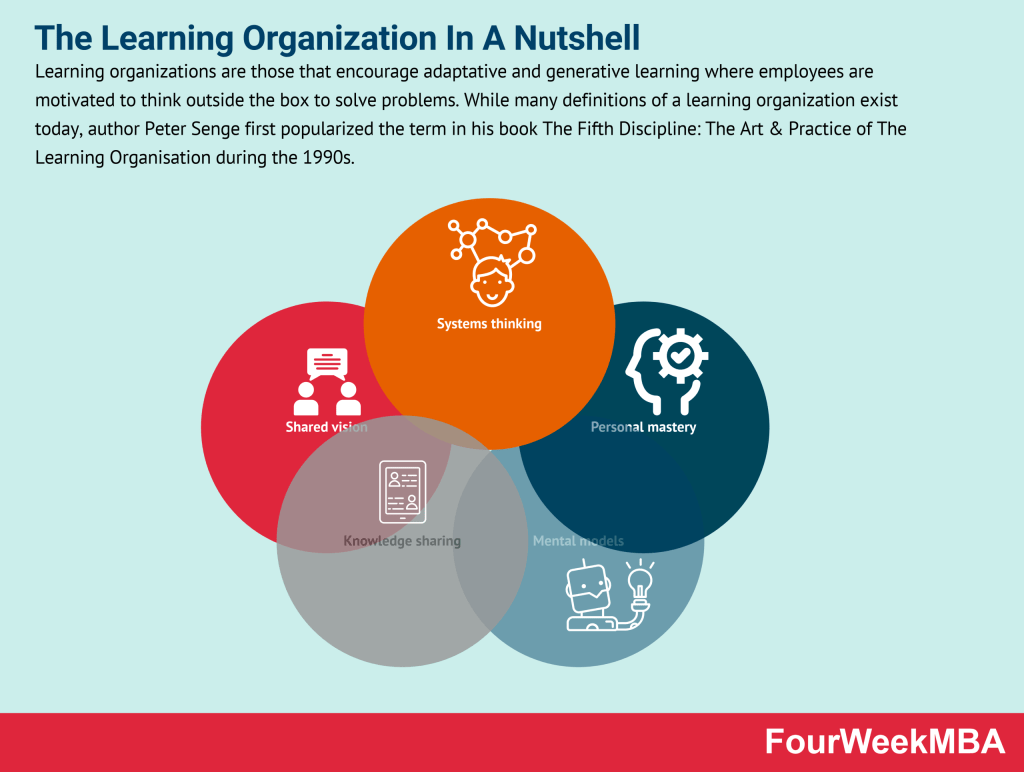
Learning organizations are those that encourage adaptative and generative learning where employees are motivated to think outside the box to solve problems. While many definitions of a learning organization exist today, author Peter Senge first popularized the term in his book The Fifth Discipline: The Art & Practice of The Learning Organisation during the 1990s.
The forgetting curve was first proposed in 1885 by Hermann Ebbinghaus, a German psychologist and pioneer of experimental research into memory. The forgetting curve illustrates the rate at which information is lost over time if the individual does not make effort to retain it.
Instructor-led training is a more traditional, top-down, teacher-oriented approach to learning that occurs in online or offline classroom environments. The approach connects instructors with students to encourage discussion and interaction in a group or individual context, with many enjoying ILT over other methods as they can seek direct clarification on a topic from the source. Instructor-led training (ILT), therefore, encompasses any form of training provided by an instructor in an online or offline classroom setting.
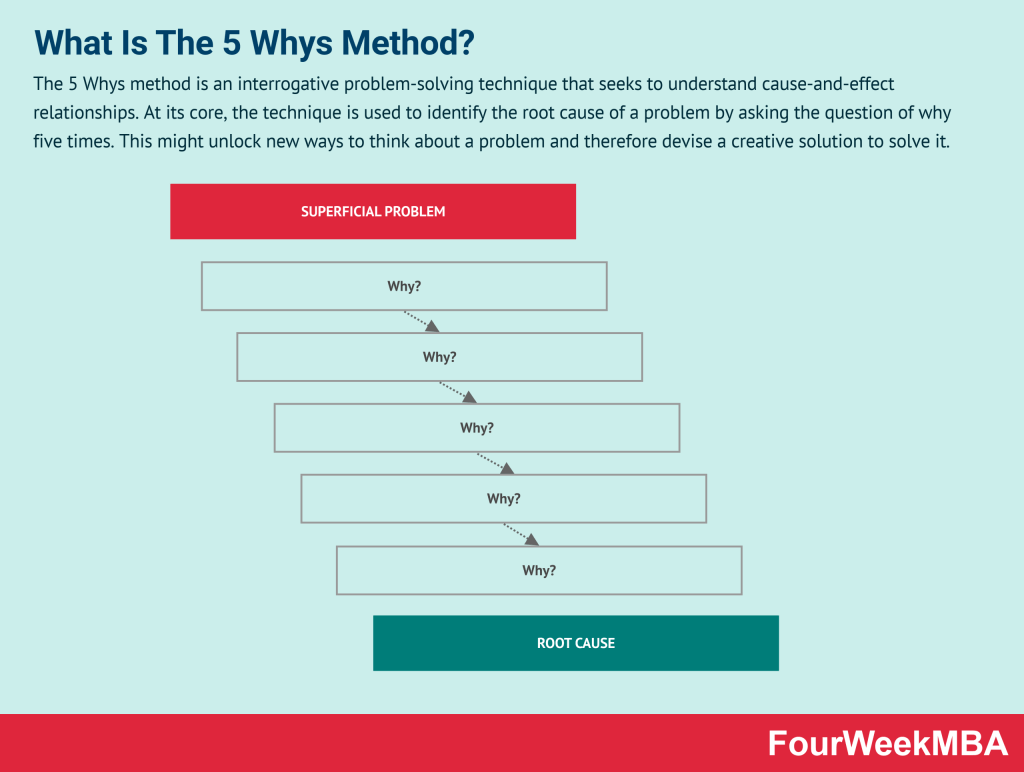
The 5 Whys method is an interrogative problem-solving technique that seeks to understand cause-and-effect relationships. At its core, the technique is used to identify the root cause of a problem by asking the question of why five times. This might unlock new ways to think about a problem and therefore devise a creative solution to solve it.
Single-loop learning was developed by Dr. Chris Argyris, a well-respected author and Harvard Business School professor in the area of metacognitive thinking. He defined single-loop learning as “learning that changes strategies of action (i.e. the how) in ways that leave the values of a theory of action unchanged (i.e. the why).” Single-loop learning is a learning process where people, groups, or organizations modify their actions based on the difference between expected and actual outcomes.
Spaced repetition is a technique where individuals review lessons at increasing intervals to memorize information. Spaced repetition is based on the premise that the brain learns more effectively when the individual “spaces out” the learning process. Thus, it can be used as a mnemonic technique to transform short-term memory into long-term memory.
Blended learning is a broad and imprecise field that makes it difficult to define. However, in most cases, it is considered to be a form of hybrid learning that combines online and offline instructional methods.
The term lessons learned refers to the various experiences project team members have while participating in a project. Lessons are shared in a review session which usually occurs once the project has been completed, with any improvements or best practices incorporated into subsequent projects.
Post-mortem analyses review projects from start to finish to determine process improvements and ensure that inefficiencies are not repeated in the future. In the Project Management Book of Knowledge (PMBOK), this process is referred to as “lessons learned”.
Instructor-led training is a more traditional, top-down, teacher-oriented approach to learning that occurs in online or offline classroom environments. The approach connects instructors with students to encourage discussion and interaction in a group or individual context, with many enjoying ILT over other methods as they can seek direct clarification on a topic from the source. Instructor-led training (ILT), therefore, encompasses any form of training provided by an instructor in an online or offline classroom setting.
The 5E Instructional Model is a framework for improving teaching practices through discussion, observation, critique, and reflection. Teachers and students move through each phase linearly, but some may need to be repeated or cycled through several times to ensure effective learning. This is a form of inquiry-based learning where students are encouraged to discover information and formulate new insights themselves.
Gennaro is the creator of FourWeekMBA, which reached about four million business people, comprising C-level executives, investors, analysts, product managers, and aspiring digital entrepreneurs in 2022 alone | He is also Director of Sales for a high-tech scaleup in the AI Industry | In 2012, Gennaro earned an International MBA with emphasis on Corporate Finance and Business Strategy.