Alternatives to Signal for secure messaging and encrypted voice/video calls comprise WhatsApp, Telegram, Threema, Wire, and Element for secure messaging. For encrypted voice/video calls, comprise alternatives like Signal, WhatsApp, Telegram, Jitsi, and Zoom. These apps provide various levels of privacy and security features for communicationneeds.
Alternative
Key Features
Core Strengths
Weaknesses
WhatsApp
1. End-to-End Encryption: Offers strong encryption for messages. 2. Voice and Video Calls: Provides voice and video calling features. 3. Large User Base: Wide adoption.
– Strong end-to-end encryption for secure messaging. – Voice and video call functionality. – Large user base for widespread communication.
– Owned by Facebook, raising privacy concerns for some users. – Closed-source, limiting transparency. – Requires a phone number for registration.
Telegram
1. Cloud-Based: Messages are stored in the cloud for easy access. 2. Stickers and Bots: Offers fun stickers and automation bots. 3. Group Chats: Supports large group chats.
– Cloud-based storage for messages and multimedia. – Extensive sticker and bot ecosystem. – Scalable for large group chats and communities.
– End-to-end encryption is not enabled by default for all chats. – May not be as privacy-focused as Signal. – Smaller user base compared to WhatsApp.
Wire
1. End-to-End Encryption: Provides secure messaging. 2. Voice and Video Calls: Offers high-quality calls. 3. Open Source: Transparency and security.
– Strong emphasis on security with end-to-end encryption. – High-quality voice and video calls. – Open-source for transparency and community auditing.
– Smaller user base compared to major messaging apps. – May not have as many features as WhatsApp or Telegram. – Less well-known in some regions.
Threema
1. End-to-End Encryption: Strong security measures. 2. Privacy Focus: Data protection and anonymity. 3. No Phone Number Required: Users can be identified by IDs.
– Strong commitment to end-to-end encryption and user privacy. – Allows users to be identified by IDs instead of phone numbers. – Supports voice calls and multimedia sharing.
– Smaller user base compared to major messaging apps. – Paid app with limited free features. – Some advanced features are available as paid add-ons.
Riot.im
1. Open Source: Transparency and community development. 2. Matrix Protocol: Uses the Matrix open standard. 3. End-to-End Encryption: Supports E2E encryption.
– Open-source with a focus on transparency and community-driven development. – Built on the Matrix protocol, allowing for decentralized communication. – Supports end-to-end encryption.
– User interface may not be as polished as some other apps. – Requires technical knowledge for self-hosting Matrix servers. – Smaller user base compared to mainstream apps.
Element
1. Matrix Protocol: Uses the Matrix open standard. 2. End-to-End Encryption: Offers secure communication. 3. Group Chat: Supports large group chats.
– Built on the Matrix protocol for decentralized communication. – Strong emphasis on end-to-end encryption. – Suitable for large group chats and communities.
– User interface may be less intuitive for casual users. – Requires technical knowledge for self-hosting Matrix servers. – Smaller user base compared to mainstream apps.
Founded in 2009 by Brian Acton, Jan Koum WhatsApp is a messaging app acquired by Facebook in 2014 for $19B. In 2018 WhatsApp rolled out customers’ interaction services. WhatsApp might be transitioning toward a set of features from video chats to social commerce that might transform WhatsApp into a Super App.
Signal is a non-profit organization founded by Moxie Marlinspike and former WhatsApp co-founder Brian Acton. The organization runs a messaging app that is safe, secure, and private.
Signal revenue generation is dependent on donations and grants. To become a larger player among messaging apps, Signal has also relied on a zero-interest loan from Acton with a long repayment period.
Many Signal donors are undisclosed. However, some of the known donors include Open Technology Fund, Freedom of the Press Foundation, and Elon Musk.
Mark Zuckerberg is the principal shareholder of the company. Not only he retains ownership and control of the company. Facebook, like Google, has issued two kinds of common stocks, Class A and Class B. Where the holders of Class B common stocks are entitled to ten votes per share, and holders of our Class A common stocks are entitled to one vote per share. Mark Zuckerberg has a total voting power of 57.9%.
In an asymmetric businessmodel, the organization doesn’t monetize the user directly. Still, it leverages the data users provide and technology, thus having a key customer pay to sustain the core asset. For example, Google makes money by leveraging users’ data and its algorithms sold to advertisers for visibility. This is how attention merchants make monetize their business models.
In an asymmetric businessmodel, the organization doesn’t monetize the user directly. Still, it leverages the data users provide and technology, thus having a key customer pay to sustain the core asset. For example, Google makes money by leveraging users’ data and its algorithms sold to advertisers for visibility.
Facebook, the main product of Meta, is an attention merchant. As such, its algorithms condense the attention of over 2.91 billion monthly active users as of June 2021. Meta generated $117.9 billion in revenues, in 2021, of which $114.9 billion was from advertising (97.4% of the total revenues) and over $2.2 billion from Reality Labs (the augmented and virtual reality products arm).
The ARPU, or average revenue per user, is a key metric to track the success of Facebook – now Meta – family of products. For instance, by the end of 2021, Meta’s ARPU worldwide was $11.57. While in US & Canada, it was $60.57, in Europe, it was $19.68, in Asia $4.89, and in the rest of the world, it was $3.43.
Facebook is characterized by a multi-faceted matrix organizational structure. The company utilizes a flat organizational structure in combination with corporate function-based teams and product-based or geographic divisions. The flat organizational structure is organized around the leadership of Mark Zuckerberg and the key executives around him. On the other hand, the function-based teams are based on the main corporate functions (like HR, productmanagement, investor relations, and so on).
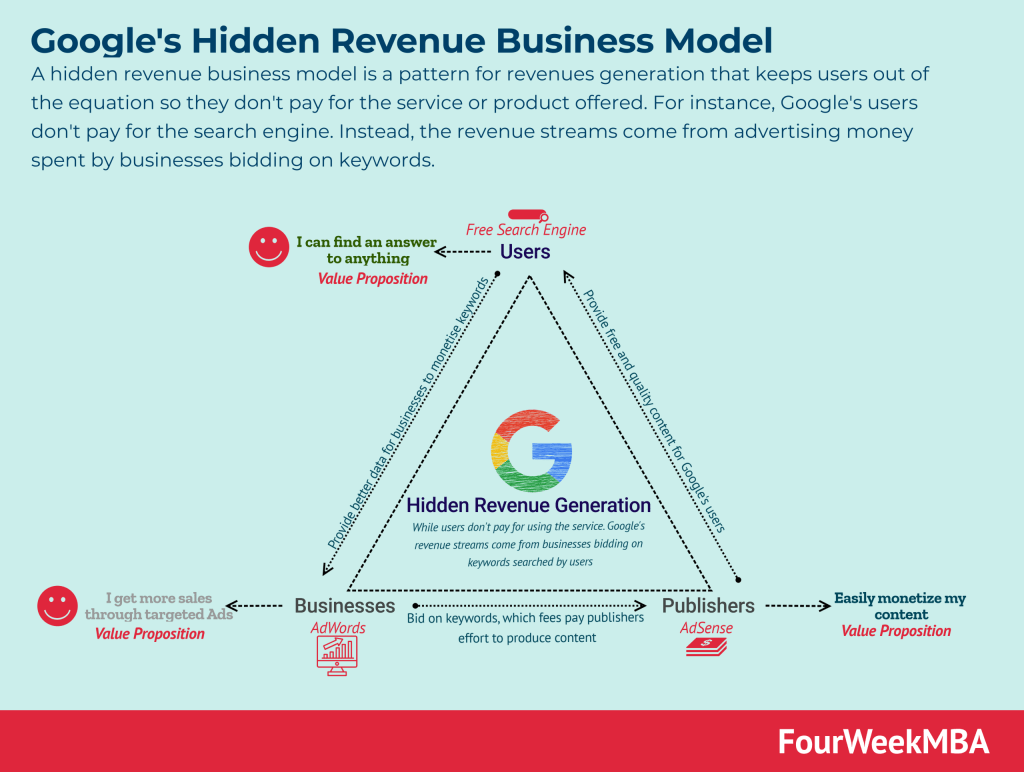
A hidden revenuebusiness model is a pattern for revenue generation that keeps users out of the equation, so they don’t pay for the service or product offered. For instance, Google’s users don’t pay for the search engine. Instead, the revenue streams come from advertising money spent by businesses bidding on keywords.
TikTok is a Chinese creative social media platform driven by short-form video content enabling users to interact and generate content at scale. TikTok primarily makes money through advertising, and it generated $4.6 billion in advertising revenues in 2021, thus making it among the most popular attention-based business models or attention merchants.
Instagram makes money via visual advertising. As part of Facebook products, the company generates revenues for Facebook Inc.’s overall businessmodel. Acquired by Facebook for a billion dollars in 2012, today Instagram is integrated into the overall Facebook business strategy. In 2018, Instagram founders, Kevin Systrom and Mike Krieger left the company, as Facebook pushed toward tighter integration of the two platforms.
YouTube was acquired for almost $1.7 billion in 2006 by Google. It makes money through advertising and subscription revenues. YouTube advertising network is part of Google Ads, and it generated more than $28B in revenue by 2021. YouTube also makes money with its paid memberships and premium content.
Twitter makes money in two ways: advertising and data licensing. In 2021, Twitter generated $4.5 billion from advertising and $570 million from data licensing. While Twitter generated $5 billion in total revenues, it lost 221 million.
Gennaro is the creator of FourWeekMBA, which reached about four million business people, comprising C-level executives, investors, analysts, product managers, and aspiring digital entrepreneurs in 2022 alone | He is also Director of Sales for a high-tech scaleup in the AI Industry | In 2012, Gennaro earned an International MBA with emphasis on Corporate Finance and Business Strategy.