KPIs for HR

KPIFormula to MeasureWhen to UseAdvantagesDrawbacks
Employee Turnover Rate(Number of Employees Who Left / Total Employees) * 100%Measure employee retention and job satisfactionIdentifies HR and management issuesIgnores hiring and training costs
Employee Satisfaction Index(Total Satisfied Employees / Total Surveyed Employees) * 100%Assess overall employee morale and engagementHelps improve workplace culture and retentionSubjective and dependent on survey quality
Time to Fill a Vacancy(Total Days to Fill All Vacancies / Number of Vacancies Filled)Evaluate recruitment efficiency and speedReduces downtime and cost of vacanciesIgnores variations in job complexity
Cost per Hire(Total Recruitment Costs / Number of Hires)Monitor recruitment expenses and efficiencyIdentifies cost-effective hiring methodsIgnores quality of hires
Training Hours per Employee(Total Training Hours / Total Number of Employees)Assess employee development and skill enhancementHelps improve workforce competence and productivityIgnores training quality
Absenteeism Rate(Total Days of Employee Absence / (Total Employee Workdays – Paid Time Off)) * 100%Measure employee attendance and reliabilityIdentifies trends in absenteeism and its impactIgnores legitimate absences
HR to Employee Ratio(Total HR Staff / Total Employees)Evaluate HR department size and workloadHelps optimize HR department staffingIgnores HR department efficiency
Compensation Ratio(Total Compensation Costs / Total Operating Costs) * 100%Assess the proportion of expenses dedicated to employee compensationIdentifies cost control and competitivenessIgnores non-compensation expenses
Benefits Cost per Employee(Total Benefits Costs / Total Number of Employees)Monitor employee benefits expensesHelps control benefits-related expendituresIgnores variations in benefits usage
Training Return on Investment (ROI)[(Gain from Training – Cost of Training) / Cost of Training] * 100%Evaluate the effectiveness of training programsMeasures the impact of training on performanceIgnores intangible benefits of training
Employee Engagement Score(Total Engaged Employees / Total Surveyed Employees) * 100%Assess employee commitment and enthusiasmIdentifies areas for improvement in engagementSubjective and dependent on survey quality
Leadership Development ROI[(Leadership Impact – Leadership Development Cost) / Leadership Development Cost] * 100%Evaluate the effectiveness of leadership development programsMeasures the impact of leadership trainingIgnores long-term leadership contributions
Diversity and Inclusion Index(Total Diverse and Inclusive Employees / Total Employees) * 100%Assess diversity and inclusion effortsHelps create a more inclusive and equitable workplaceSubjective and dependent on self-reporting
Employee Churn Rate(Number of Employees Who Left / Average Number of Employees) * 100%Monitor employee turnover and instabilityIdentifies issues causing rapid workforce changesIgnores temporary or seasonal fluctuations
Average Employee Tenure(Total Years of Service for All Employees / Total Number of Employees)Assess employee loyalty and retentionHelps create long-term workforce strategiesIgnores variations in job roles and levels
HR Technology Utilization(Number of HR Technology Users / Total HR Staff) * 100%Measure the adoption of HR technology solutionsIdentifies technology efficiency and effectivenessIgnores employee technology proficiency
Employee Health and Wellness Participation(Number of Employees Participating / Total Employees) * 100%Monitor employee participation in wellness programsPromotes a healthy workplace cultureIgnores employee health outcomes
Exit Interview Participation Rate(Number of Exit Interviews Conducted / Number of Employee Departures) * 100%Evaluate employee feedback collection effectivenessIdentifies reasons for employee departuresIgnores feedback quality and honesty
HR Compliance Rate(Number of Compliance Audits Passed / Total Compliance Audits Conducted) * 100%Ensure HR department adherence to legal and regulatory standardsAvoids legal penalties and risksIgnores underlying compliance issues
Employee Self-Service Adoption Rate(Number of Employees Using Self-Service Tools / Total Employees) * 100%Measure employee utilization of self-service HR toolsIncreases HR efficiency and employee empowermentIgnores non-adopters’ needs and preferences
Cost of Employee DisputesTotal Cost of Resolving Employee DisputesMonitor the financial impact of employee disputesIdentifies areas for conflict resolution improvementIgnores non-financial dispute aspects

Read Next: OKRSMART Goals.

Connected Business Frameworks and Concepts

Agile Leadership

agile-leadership
Agile leadership is the embodiment of agile manifesto principles by a manager or management team. Agile leadership impacts two important levels of a business. The structural level defines the roles, responsibilities, and key performance indicators. The behavioral level describes the actions leaders exhibit to others based on agile principles. 

Adaptive Leadership

adaptive-leadership
Adaptive leadership is a model used by leaders to help individuals adapt to complex or rapidly changing environments. Adaptive leadership is defined by three core components (precious or expendable, experimentation and smart risks, disciplined assessment). Growth occurs when an organization discards ineffective ways of operating. Then, active leaders implement new initiatives and monitor their impact.

Delegative Leadership

delegative-leadership
Developed by business consultants Kenneth Blanchard and Paul Hersey in the 1960s, delegative leadership is a leadership style where authority figures empower subordinates to exercise autonomy. For this reason, it is also called laissez-faire leadership. In some cases, this type of leadership can lead to increases in work quality and decision-making. In a few other cases, this type of leadership needs to be balanced out to prevent a lack of direction and cohesiveness of the team.

Distributed Leadership

distributed-leadership
Distributed leadership is based on the premise that leadership responsibilities and accountability are shared by those with the relevant skills or expertise so that the shared responsibility and accountability of multiple individuals within a workplace, bulds up as a fluid and emergent property (not controlled or held by one individual). Distributed leadership is based on eight hallmarks, or principles: shared responsibility, shared power, synergy, leadership capacity, organizational learning, equitable and ethical climate, democratic and investigative culture, and macro-community engagement.

Micromanagement

micromanagement
Micromanagement is about tightly controlling or observing employees’ work. Although in some cases, this management style might be understood, especially for small-scale projects, generally speaking, micromanagement has a negative connotation mainly because it shows a lack of trust and freedom in the workplace, which leads to adverse outcomes.

Maslow’s Hierarchy of Needs

maslows-hierarchy-of-needs
Maslow’s Hierarchy of Needs was developed by American psychologist Abraham Maslow. His hierarchy, often depicted in the shape of a pyramid, helped explain his research on basic human needs and desires. In marketing, the hierarchy (and its basis in psychology) can be used to market to specific groups of people based on their similarly specific needs, desires, and resultant actions.

Eisenhower Matrix

eisenhower-matrix
The Eisenhower Matrix is a tool that helps businesses prioritize tasks based on their urgency and importance, named after Dwight D. Eisenhower, President of the United States from 1953 to 1961, the matrix helps businesses and individuals differentiate between the urgent and important to prevent urgent things (seemingly useful in the short-term) cannibalize important things (critical for long-term success).

Moonshot Thinking

moonshot-thinking
Moonshot thinking is an approach to innovation, and it can be applied to business or any other discipline where you target at least 10X goals. That shifts the mindset, and it empowers a team of people to look for unconventional solutions, thus starting from first principles, by leveraging on fast-paced experimentation.

Lightning Decision Jam

lockes-goal-setting-theory
The theory was developed by psychologist Edwin Locke who also has a background in motivation and leadership research. Locke’s goal-setting theory of motivation provides a framework for setting effective and motivating goals. Locke was able to demonstrate that goal setting was linked to performance.

Herzberg’s Two-Factor Theory

herzbergs-two-factor-theory
Herzberg’s two-factor theory argues that certain workplace factors cause job satisfaction while others cause job dissatisfaction. The theory was developed by American psychologist and business management analyst Frederick Herzberg. Until his death in 2000, Herzberg was widely regarded as a pioneering thinker in motivational theory.

Lessons Learned

lessons-learned
The term lessons learned refers to the various experiences project team members have while participating in a project. Lessons are shared in a review session which usually occurs once the project has been completed, with any improvements or best practices incorporated into subsequent projects. 

Growth Engineering

growth-engineering
Growth engineering is a systematic, technical approach to the improvement of conversion and the user experience. Combined with business engineering it helps business people build valuable companies from scratch.

Retrospective Analysis

retrospective-analysis
Retrospective analyses are held after a project to determine what worked well and what did not. They are also conducted at the end of an iteration in Agile project management. Agile practitioners call these meetings retrospectives or retros. They are an effective way to check the pulse of a project team, reflect on the work performed to date, and reach a consensus on how to tackle the next sprint cycle.

OKR

what-is-okr
Andy Grove, helped Intel become among the most valuable companies by 1997. In his years at Intel, he conceived a management and goal-setting system, called OKR, standing for “objectives and key results.” Venture capitalist and early investor in Google, John Doerr, systematized in the book “Measure What Matters.”

Cog’s Ladder

cogs-ladder
Cog’s ladder is a model of group development. The ladder was created in 1972 by Procter & Gamble employee George Charrier to help management at the company understand how teams worked to make them more efficient. Cog’s ladder is a model of group formation and behavior that is used to help businesses understand how a team can work to achieve its goals.

GRPI Model

grow-model
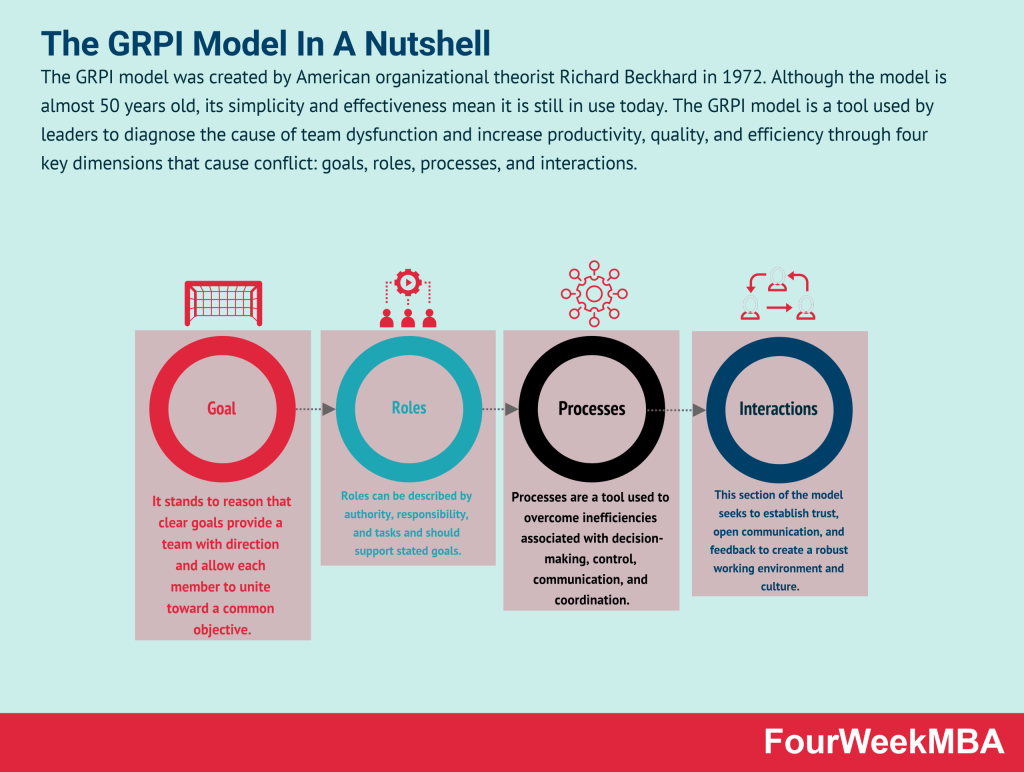
The GRPI model was created by American organizational theorist Richard Beckhard in 1972. Although the model is almost 50 years old, its simplicity and effectiveness mean it is still in use today. The GRPI model is a tool used by leaders to diagnose the cause of team dysfunction and increase productivity, quality, and efficiency through four key dimensions that cause conflict: goals, roles, processes, and interactions. 

High-Performance Coaching

high-performance-coaching
High-performance coaches work with individuals in personal and professional contexts to enable them to reach their full potential. While these sorts of coaches are commonly associated with sports, it should be noted that the act of coaching is a specific type of behavior that is also useful in business and leadership

OSKAR Coaching

oskar-coaching-model
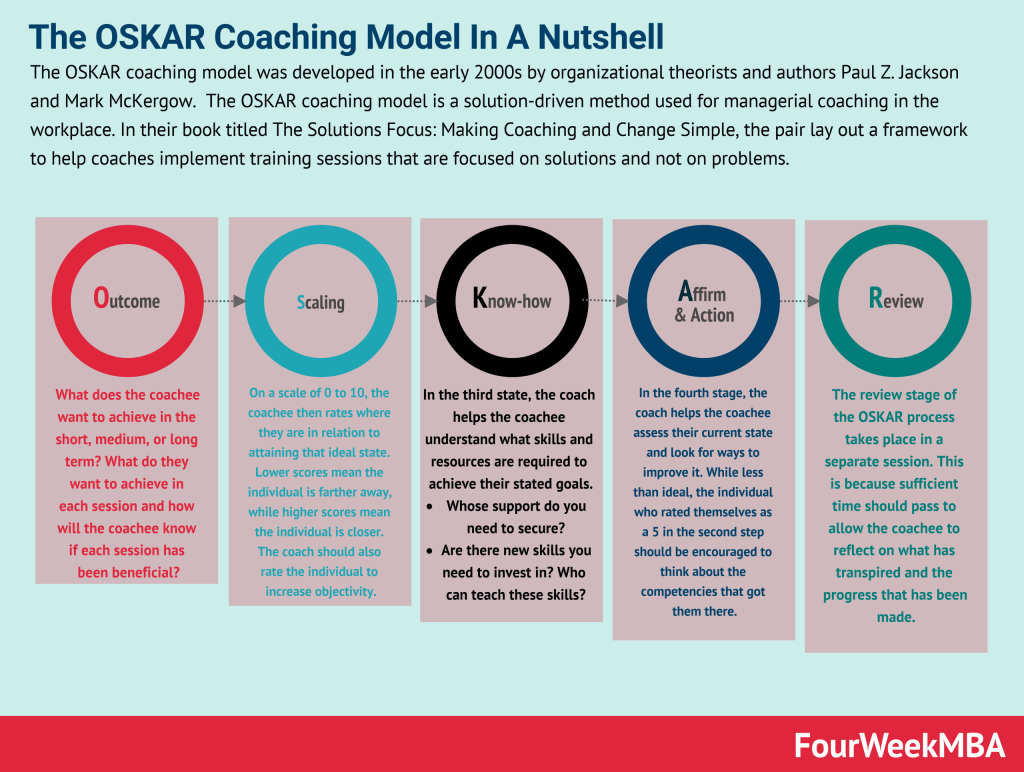
The OSKAR coaching model was developed in the early 2000s by organizational theorists and authors Paul Z. Jackson and Mark McKergow.  The OSKAR coaching model is a solution-driven method used for managerial coaching in the workplace. In their book titled The Solutions Focus: Making Coaching and Change Simple, the pair layout a framework to help coaches implement training sessions that are focused on solutions and not on problems.

Training of Trainers

training-of-trainers-model-tot
The training of trainers model seeks to engage master instructors in coaching new, less experienced instructors with a particular topic or skill. The training of trainers (ToT) model is a framework used by master instructors to train new instructors, enabling them to subsequently train other people in their organization.

GROW Model

grow-model
Though no single individual can claim to have created the GROW model, writers Graham Alexander and Alan Fine together with racing car champion John Whitmore played a significant part in developing the framework during the 80s and 90s. The GROW model is a simple way to set goals and solve problems during coaching sessions through four stages: goal, reality, options, and will (way forward).

Ulrich Model

ulrich-model
The Ulrich model helps large or complex organizations with many business units organize their human resource function. The Ulrich model was named for management coach David Ulrich after the release of his 1996 book Human Resource Champions: The Next Agenda for Adding Value and Delivering Results.

Read Next: SWOT AnalysisPersonal SWOT AnalysisTOWS MatrixPESTEL AnalysisPorter’s Five ForcesTOWS MatrixSOAR Analysis.

Read Next: BiasesBounded RationalityMandela EffectDunning-Kruger EffectLindy EffectCrowding Out EffectBandwagon Effect.

Main Free Guides:

Scroll to Top

Discover more from FourWeekMBA

Subscribe now to keep reading and get access to the full archive.

Continue reading

FourWeekMBA