Born on October 28, 1979, Jawed Karim is an American entrepreneur and software engineer of German and Bangladeshi descent. Karim is one of the co-founders of YouTube and was also the first person to upload a video to the platform in April 2005. In the low-resolution clip titled “Me at the zoo”, Karim briefly talks about the benefit of an elephant’s long trunk.
Category
Details
Full Name
Jawed Karim
Date of Birth
October 28, 1979
Place of Birth
Merseburg, East Germany (now Germany)
Nationality
German-American
Education
Bachelor of Science in Computer Science from the University of Illinois at Urbana-Champaign, Master of Science in Computer Science from Stanford University
Early Career
Worked at PayPal, Contributed to the development of PayPal’s real-time anti-fraud system
Major Companies Founded
YouTube
Positions
Co-founder of YouTube, Entrepreneur and investor
Major Projects
Co-founded YouTube, which became the world’s largest video-sharing platform
Notable Achievements
Uploaded the first video on YouTube, “Me at the zoo,” Played a key role in YouTube’s early development and success
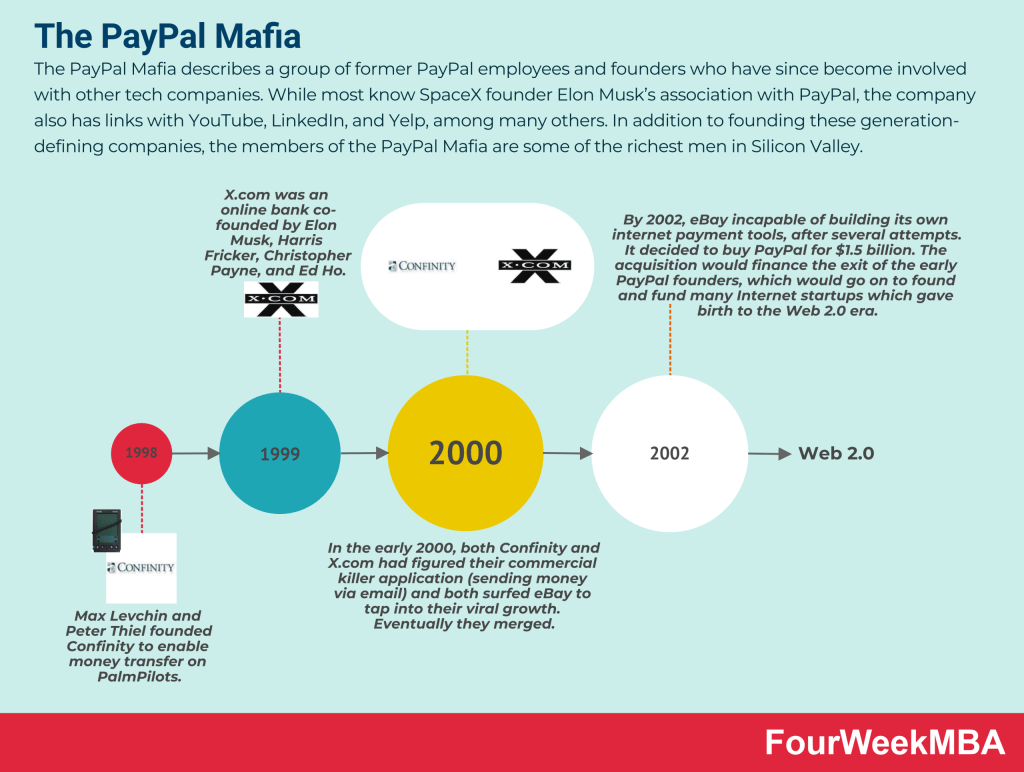
The PayPal Mafia describes a group of former PayPal employees and founders who have since become involved with other tech companies. While most know SpaceX founder Elon Musk’s association with PayPal, the company also has links with YouTube, LinkedIn, and Yelp, among many others. In addition to founding these generation-defining companies, the members of the PayPal Mafia are some of the richest men in Silicon Valley.
After graduating from high school in 1997, Karim became a student at the University of Illinois at Urbana-Champaign where he studied computer science.
During his time at university, Karim was an intern at Silicon Graphics, Inc., where he worked on voxel data management for very large data sets.
His position involved work on the Visible Human Project, an initiative aiming to provide cross-sectional, two-dimensional images of the body to better visualize human anatomy.
In 2000, Karim received a letter to join a fledgling company called PayPal who was impressed with his work at Silicon Graphics.
He agonized over the decision for two weeks with the realization that accepting the offer would disrupt his studies.
Karim ultimately accepted the position and worked remotely toward his degree under a reduced workload, eventually graduating in 2004.
Karim meets Steve Chen and Chad Hurley
Whilst at PayPal, Karim met Steve Chen and Chad Hurley – the two men with whom he would found YouTube in 2006.
While accounts vary between the founders on how the idea for YouTube came about, Karim recalled that he was inspired after not being able to find the video of Janet Jackson and Justin Timberlake’s infamous performance at the 2004 Super Bowl.
He thus imagined a video-sharing platform where people could easily find the videos they were looking for. The rest, as they say, is history.
Further education and consulting
Karim played an important role in YouTube’s early history, but it was not a project he was overly interested in capitalizing on.
As a result, he decided to continue his education at Stanford University and earned a Masters in Computer Science in 2006. He worked as an advisor to YouTube before it was launched and thereafter became an informal consultant.
Given his preference to focus on his studies, Karim’s share of the company was much lower than the other two founders. Nevertheless, when YouTube was acquired by Google in 2006, his 137,443 shares were worth about $64 million.
Venture capital firm and philanthropy
Karim founded VC firm Youniversity Ventures (now YVentures) with partners Kevin Hartz and Keith Rabois in 2008.
The firm is perhaps best known for its early investment in Airbnb and other companies such as Reddit, Postmates, and Eventbrite. YVentures also offers consultancy services to promising start-ups in the tech sector.
Over the years, Karim has also been a prominent public speaker on technology-related topics and has expressed a desire to provide consultancy services for early-stage tech companies in countries such as Malaysia.
The YouTube advertising empire
Today YouTube is an advertising empire that generated almost $30 billion in ad revenue!
By 2023, YouTube generated $31.51 billion in advertising revenue.
Thus, if we take YouTube alone, the company might be worth well over $300 billion in revenue.
However, it’s critical to point out that the reason why YouTube has become so successful is also thanks to the successful integration within Google, from two perspectives.
First, from a core product integration perspective, where YouTube has successfully transitioned to become the most popular video search engine on earth, Google’s team.
Indeed, that was not foregone at all at the time of Google’s acquisition of YouTube.
And while this acquisition represented probably one of the most successful ones in business history, Google’s team hat to work hard to make it work.
Indeed, YouTube had severe copyright issues, which Google had to solve early on.
In addition, Google has also successfully transitioned YouTube from a video search engine to a discovery video platform (more similar to TikTok than Google).
Second, from a revenue stream integration perspective, after making sure YouTube was solid as a product, Google successfully integrated it into its advertising machine, making of YouTube one of the most profitable segments for the company!
Key takeaways:
Born on October 28, 1979, Jawed Karim is an American entrepreneur and software engineer of German and Bangladeshi descent.
In 2000, Karim received a letter to join a fledgling company called PayPal who was impressed with his work at Silicon Graphics. At PayPal, Karim met Steve Chen and Chad Hurley with the trio founding YouTube in 2006.
More interested in obtaining further education in computer science, Karim worked as an advisor to YouTube and then as an informal consultant after it launched. Upon graduating, he founded VC firm YVentures with notable investments including Airbnb and Postmates.
Key Highlights
Early Life and Education:
Jawed Karim was born on October 28, 1979, and he is an American entrepreneur and software engineer of German and Bangladeshi descent.
He studied computer science at the University of Illinois at Urbana-Champaign, where he became an intern at Silicon Graphics, Inc., working on voxel data management and the Visible Human Project.
PayPal and Early Career Choices:
Karim received a job offer from PayPal based on his work at Silicon Graphics.
He joined PayPal, which was connected to the “PayPal Mafia” of tech entrepreneurs, including Elon Musk, and gained experience there.
YouTube Founding and Inspiration:
While at PayPal, Karim met Steve Chen and Chad Hurley, who would later co-found YouTube with him.
Karim was inspired to create YouTube after struggling to find a video of a specific event, leading to the idea of a video-sharing platform.
YouTube Creation and Role:
YouTube was founded by Karim, Chen, and Hurley in 2006, with Karim being the first person to upload a video to the platform.
He played a key role in YouTube’s early history, contributing to its development and concept.
Further Education and Consultancy:
Despite his role in YouTube, Karim continued his education, earning a Masters in Computer Science from Stanford University in 2006.
He served as an advisor and consultant to YouTube while pursuing further studies.
Venture Capital and Philanthropy:
Karim co-founded VC firm Youniversity Ventures (now YVentures) and invested in companies like Airbnb, Reddit, and Postmates.
He has been a public speaker on tech topics and expressed interest in providing consultancy services for tech companies.
Google is primarily owned by its founders, Larry Page and Sergey Brin, who have more than 51% voting power. Other individual shareholders comprise John Doerr (1.5%), a venture capitalist and early investor in Google, and CEO, Sundar Pichai. Former Google CEO Eric Schmidt has 4.2% voting power. The most prominent institutional shareholders are mutual funds BlackRock and The Vanguard Group, with 2.7% and 3.1%, respectively.
Google (now Alphabet) primarily makes money through advertising. The Google search engine, while free, is monetized with paid advertising. In 2023, Alphabet generated over $175B from Google search, $31.51B billion from the Network members (Adsense and AdMob), $31.31B billion from YouTube Ads, $33B from Google Cloud, and $34.69B billion from other sources (Google Play, Hardware devices, and other services). And $1.53B from its other bets.
Google is an attention merchant that – in 2022 – generated over $224 billion (almost 80% of revenues) from ads (Google Search, YouTube Ads, and Network sites), followed by Google Play, Pixel phones, YouTube Premium (a $29 billion segment), and Google Cloud ($26.2 billion).
Of Google’s (Alphabet) over $307.39 billion in revenue for 2023, Google also generated for the first time, well over 1.5 billion dollars in revenue from its bets, which Google considers potential moonshots (companies that might open up new industries). Google’s bets also generated a loss for the company of over $4 billion in the same year. In short, Google is using the money generated by search and betting it on other innovative industries, which are ramping up in 2023.
In 2023, Alphabet’s (Google) Cloud Business generated over $33 billion within Alphabet’s Google overall businessmodel, and it was also profitable, with over $1.7 billion in profits. Google Cloud is instrumental to Google’s AI strategy.
Google is an attention merchant that – in 2023 – generated $237.85 billion (over 77% of its total revenues) from ads (Google Search, YouTube Ads, and Network sites), followed by Google Play, Pixel phones, YouTube Premium (a $31.5 billion segment), and Google Cloud (over $33 billion).
The traffic acquisition cost represents the expenses incurred by an internet company, like Google, to gain qualified traffic – on its pages – for monetization. Over the years, Google has been able to reduce its traffic acquisition costs and, in any case, to keep it stable. In 2023 Google spent 21.39% ($50.9 billion) of its total advertising revenues ($237.8 billion) to guarantee its traffic on several desktop and mobile devices across the web.
YouTube was acquired for almost $1.7 billion in 2006 by Google. It makes money through advertising and subscription revenues. YouTube advertising network is part of Google Ads, and it reported more than $31B in revenues by 2023. YouTube also makes money with its paid memberships and premium content.
In 2023, Google’s search advertising machine, generated over 175 billion dollars. Whereas Microsoft’s Bing generated 12.2 billion dollars. Thus, as of 2023, Google’s search advertising machine is over 14x larger than Microsoft’s search advertising machine.
Google makes most of its money from advertising. Indeed total advertising revenue represented nearly 78% of Google’s (Alphabet) overall revenues for 2023. Google Search represented nearly 57% of Google’s total revenues. Google generated $307.39B in revenues in 2022, and $73.79B billion in net profits.
In 2023, Google generated $307.39 billion, comprising $175B in Google Search, $31.51B in YouTube ads, and $31.31B in Google network revenue. $34.69B in other revenue, $33B in Google cloud, $1.53B in other bets.
In 2023, Google generated 237.85B in revenue in advertising, which represented over 77% of its total revenues of $ 307.39 B. In 2022, Google generated $224.47B in revenues from advertising, which represented almost 80% of the total revenues, compared to $282.83B in total revenues. Therefore, most of the revenues from Alphabet, the mother company of Google, come from advertising.
At the end of December 2022, Google had over 190,000 employees. On January 20, Google announced the layoff of 12,000 employees within the company, thus bringing the number of total employees by December 2023 to 182,502 full-time employees.
Google generated $1,684,332 per employee in 2023, compared to $1,486,779 per employee in 2022. As of January 2023, as the company announced a mass layoff, it brought back its revenue per employee at $1,586,880, still behind the peak in 2021, for $1,840,330.
By 2022, most of Tesla’s shares are still owned by Elon Musk, among the company’s co-founders and the CEO. Elon Musk is the top individual investor, with a 23.5% stake in the company. At current rates, this is valued at around $145-50 billion, making Elon Musk one of the wealthiest men on earth. In addition, Musk also holds a significant stake in Twitter and SpaceX, which makes him worth anywhere between $180-90 billion.
Warren Buffett is an American investor, business tycoon, and philanthropist. Known as the “Oracle of Omaha,” Buffett is best known for his strict adherence to value investing and frugality despite his immense wealth. Warren Buffet owns an investment firm, Berkshire Hathaway. He owns 238,624 Class A shares which gives him control over the company. His stake in the company is valued at over $100 billion.
Jeff Bezos’ net worth is primarily based on his ownership stake in Amazon. Indeed, as of 2023, Bezos owned a 12.7% stake in Amazon, worth over $120 billion.
Tim Cook’s net worth is primarily comprised of his Apple stocks. As of 2023, he owned 3,279,898 worth about $480 million at the current rate. However, Tim Cook has sold part of his Apple stocks over the years for hundreds of millions of dollars, making him a billionaire.
Bill Gates was the co-founder and former CEO of Microsoft until 2000, and he was on the board of Microsoft until 2020. However, over the years, Gates sold various stakes in Microsoft and diversified away from it. As of 2019, Gates had a 1.34% stake in Microsoft, which he might still own, valued at about $25 billion.
As of 2022, Satya Nadella had 763,518, valued at $190 million at Microsoft’s current market value. Nadella also got a $2.5 million base salary in 2022, plus $42.27 million in stock awards and over $10 million in non-stock incentives. Nadella sold hundreds of millions of dollars of Microsoft stocks in the last ten years, making him a centi-millionaire. In 2022, 96% of Nadella’s salary was performance-based, whereas only 4% comprised a base salary.
Larry Page co-founded Google (now Alphabet) and Sergey Brin. He controls the company tightly via a dual share ownership structure (made of Class A and B stocks). Alphabet is worth over a trillion dollars, valuing Larry Page’s stake in the company at around $70 billion.
Sergey Brin co-founded Google (now Alphabet) together with Larry Page. He controls the company tightly via a dual share ownership structure (made of Class A and B stocks). Alphabet is worth over a trillion dollars, valuing Sergey Brin’s stake at around $66 billion.
Mark Zuckerberg is the co-founder and principal shareholder of Facebook (now Meta), in which he owns a controlling stake worth over $68 billion. Thus Mark Zucberkerbs’ net worth is around $68 billion in 2023.
Eduardo Luiz Saverin is a billionaire entrepreneur and angel investor. He co-founded Facebook with Mark Zuckerberg; he was later ousted. Yet later on, Facebook settled a lawsuit with Saverin giving him a good chunk of the company’s stock, now worth over ten billion dollars. Thus, Eduardo Saverin’s net worth is around $10.45 billion in 2023.
While Larry Ellison is a shareholder in various tech companies (such as Tesla), his primary wealth comes from his ownership stake in the company he founded, Oracle. He owns almost 43% of the company’s stock, valued at over $100 billion, making him among the wealthiest people on earth.
Howard Schultz’s net worth is over $2.2 billion. Indeed, he is the founder of Starbucks and a major institutional shareholder, with 1.88% ownership of the company, valued at over $2.2 billion at the current market value, making him a billionaire.
Daniel Ek is one of the founders and one of the principal shareholders of Spotify. Indeed, in 2023 with 16.5% of Spotify’s shares, he’s worth around $3.7 billion.
Gennaro is the creator of FourWeekMBA, which reached about four million business people, comprising C-level executives, investors, analysts, product managers, and aspiring digital entrepreneurs in 2022 alone | He is also Director of Sales for a high-tech scaleup in the AI Industry | In 2012, Gennaro earned an International MBA with emphasis on Corporate Finance and Business Strategy.