An Ideal Customer Profile is a comprehensive description of the perfect customer, incorporating demographics, behavior, and needs. By understanding these traits, businesses can create targeted marketing strategies, develop products that match customer preferences, and enhance overall customer satisfaction. Challenges include data collection and staying adaptable to changing customer preferences while maintaining inclusivity in the profile.
An Ideal Customer Profile (ICP) is a detailed and data-driven description of the type of customer or organization that derives the most significant value from your products or services.
It’s a strategic tool used by businesses to identify and focus on the customers who are most likely to make repeat purchases, remain loyal, and become advocates for your brand.
Crafting an ICP involves analyzing and categorizing your existing customer base to create a clear picture of your ideal customer.
Key Elements of an Ideal Customer Profile:
Demographics: Includes characteristics such as age, gender, location, job title, industry, and company size. Demographics provide a foundational understanding of your target audience.
Firmographics: For B2B businesses, this category encompasses factors like the industry, company revenue, number of employees, and geographic location of the ideal company or organization.
Psychographics: Delve into the psychological and behavioral aspects of your ideal customer. This might include their values, beliefs, pain points, motivations, and challenges.
Buying Behavior: Analyze the purchasing habits of your ideal customers. This includes how they research products, their preferred communication channels, and the factors that influence their buying decisions.
Needs and Pain Points: Understand the specific needs, challenges, and pain points that your products or services can address for your ideal customers.
Value Proposition: Identify what unique value your offerings provide to your ideal customers. What problems do you solve, and how do you differentiate yourself from competitors?
The Importance of an Ideal Customer Profile
Creating and leveraging an ICP offers several advantages to businesses, regardless of their size or industry. Here are some key reasons why ICPs are crucial:
Focused Marketing: An ICP enables businesses to direct their marketing efforts, resources, and budgets toward the segments of the market that are most likely to convert. This results in more efficient and cost-effective marketing campaigns.
Improved Customer Acquisition: By targeting customers who closely align with your ICP, you increase your chances of attracting high-quality leads who are more likely to become long-term, profitable customers.
Enhanced Product Development: Understanding your ideal customers’ needs and pain points informs product or service enhancements, leading to offerings that better cater to your target market.
Personalized Communication: An ICP enables you to tailor your messaging, content, and communication channels to resonate with your ideal customers, increasing engagement and conversion rates.
Loyalty and Advocacy: Customers who match your ICP are more likely to be satisfied with their purchases, leading to higher retention rates and potential advocacy for your brand.
Competitive Edge: Knowing your ideal customers and their preferences gives you a competitive edge by allowing you to outmaneuver competitors who may be targeting a broader and less defined customer base.
Strategies for Developing an Ideal Customer Profile
Creating an effective ICP requires careful research and analysis. Here are some strategies to help you develop a robust ICP:
Analyze Existing Customer Data: Begin by examining your current customer base. Look for common characteristics, behaviors, and traits among your most valuable and loyal customers.
Conduct Market Research: Conduct market research to gather insights into your target market. This can involve surveys, interviews, and competitor analysis to better understand your customers’ needs and preferences.
Segmentation: Divide your customer base into segments based on shared characteristics. This allows for more precise targeting and messaging for each group.
Customer Personas: Create detailed customer personas representing your ideal customers. These personas should encompass demographics, firmographics, psychographics, and buying behavior.
Feedback Loops: Establish feedback mechanisms to collect input from your customers. This includes feedback surveys, customer support interactions, and social listening to gain insights into their pain points and preferences.
CRM and Analytics Tools: Leverage Customer Relationship Management (CRM) systems and analytics tools to track customer interactions, behaviors, and purchasing patterns. These tools provide valuable data for refining your ICP.
Test and Refine: As your business evolves, regularly revisit and refine your ICP. Market dynamics change, and customer preferences may shift over time.
Collaboration: Involve various departments within your organization, such as marketing, sales, customer support, and product development, in the ICP development process. Cross-functional collaboration ensures a holistic view of your ideal customer.
Competitor Analysis: Analyze your competitors’ customer bases and strategies. Identify gaps in their approach and opportunities to differentiate yourself in the market.
Customer Lifetime Value (CLV): Calculate the CLV for different customer segments. This metric helps prioritize segments that yield the highest long-term value.
Applying Your Ideal Customer Profile
Once you’ve developed your ICP, it’s time to put it into action. Here’s how to effectively apply your ICP in your business strategies:
Targeted Marketing: Craft marketing campaigns, content, and advertisements that resonate specifically with your ideal customer segments. Use the language, imagery, and messaging that appeals to them.
Product Development: Align your product or service development efforts with the needs and preferences of your ideal customers. Focus on features and improvements that cater to their specific pain points.
Sales and Customer Service: Train your sales and customer service teams to identify and prioritize leads or inquiries that match your ICP. Tailor your sales pitches and support interactions accordingly.
Content Creation: Create content, such as blog posts, ebooks, and webinars, that addresses the challenges and interests of your ideal customers. This positions your brand as a valuable resource in their eyes.
Lead Generation: Optimize your lead generation strategies to attract prospects who fit your ICP. This includes targeting specific industries, job titles, or demographics in your advertising efforts.
Referral Programs: Encourage your satisfied customers who align with your ICP to refer others who share similar characteristics. This leverages the power of word-of-mouth marketing.
Retention Efforts: Focus on retaining and nurturing existing customers who align with your ICP. This includes personalized loyalty programs and ongoing engagement to strengthen their loyalty.
Monitoring and Adjusting: Continuously monitor the performance of your strategies targeting your ICP. Analyze metrics such as conversion rates, customer acquisition costs, and customer satisfaction. Adjust your strategies based on the data to optimize results.
Real-World Examples
Let’s explore a few real-world examples of how companies have effectively used their ICPs to drive success:
Salesforce: Salesforce, a leading customer relationship management (CRM) platform, tailors its marketing and messaging to specific industries and job functions. This approach allows them to address the unique needs of customers in various sectors.
HubSpot: HubSpot, an inbound marketing and sales platform, offers educational content targeted at marketers, sales professionals, and business owners. They provide resources and tools aligned with the challenges and interests of these customer segments.
Nike: Nike, the global sportswear giant, uses a combination of customer data and market research to personalize product recommendations and marketing messages. They create targeted campaigns for athletes, fitness enthusiasts, and lifestyle consumers.
SalesLoft: SalesLoft, a sales engagement platform, focuses on B2B companies looking to optimize their sales processes. Their ICP includes businesses of a certain size and specific industries, allowing them to offer tailored solutions and content.
Additional Examples of Ideal Customer Profiles
The application of Ideal Customer Profiles can be observed across diverse industries:
– Software Startup:
For a software startup, the ICP might revolve around identifying the perfect user for a new software application. This includes attributes like job role, industry, company size, and pain points that the software can address.
– Luxury Fashion Brand:
A luxury fashion brand may define its ideal customer as someone with specific demographic characteristics like a high income level, residing in affluent areas, and having a taste for luxury fashion products.
– B2B Service Provider:
A B2B service provider might create an ICP that represents businesses in need of specialized services. This includes characteristics like industry, revenue, growth stage, and the challenges they face.
Key Highlights of Ideal Customer Profile:
Ideal Customer Profile Overview:
An Ideal Customer Profile is a detailed description of the perfect customer, including demographics, behavior, and needs.
It enables businesses to create targeted marketing, design tailored products, and improve customer satisfaction.
Characteristics:
Demographics: Identifying attributes like age, location, and occupation.
Behavior: Understanding preferences, actions, and purchase patterns.
Needs: Defining pain points and requirements.
Use Cases:
Targeted Marketing: Tailoring campaigns to the right audience.
Product Development: Designing products for specific needs.
Sales Strategy: Focusing sales efforts on high-potential customers.
Examples of Ideal Customer Profile:
Software Startup: Identifying the perfect user for a new software application.
Luxury Fashion Brand: Defining ideal customers for high-end fashion.
B2B Service Provider: Profiling businesses for specialized services.
Benefits of Ideal Customer Profile:
Focused Marketing: Efficiently allocating resources for higher ROI.
Product-Market Fit: Creating products that meet customer needs.
Business development comprises a set of strategies and actions to grow a business via a mixture of sales, marketing, and distribution. While marketing usually relies on automation to reach a wider audience, and sales typically leverage a one-to-one approach. The business development’s role is that of generating distribution.
The more you move from consumers to enterprise clients, the more you’ll need a sales force able to manage complex sales. As a rule of thumb, a more expensive product, in B2B or Enterprise, will require an organizational structure around sales. An inexpensive product to be offered to consumers will leverage on marketing.
A sales cycle is the process that your company takes to sell your services and products. In simple words, it’s a series of steps that your sales reps need to go through with prospects that lead up to a closed sale.
RevOps – short for Revenue Operations – is a framework that aims to maximize the revenue potential of an organization. RevOps seeks to align these departments by giving them access to the same data and tools. With shared information, each then understands their role in the sales funnel and can work collaboratively to increase revenue.
In negotiation theory, BATNA stands for “Best Alternative To a Negotiated Agreement,” and it’s one of the key tenets of negotiation theory. Indeed, it describes the best course of action a party can take if negotiations fail to reach an agreement. This simple strategy can help improve the negotiation as each party is (in theory) willing to take the best course of action, as otherwise, an agreement won’t be reached.
In negotiation, WATNA stands for “worst alternative to a negotiated agreement,” representing one of several alternative options if a resolution cannot be reached. This is a useful technique to help understand what might be a negotiation outcome, that even if negative is still better than a WATNA, making the deal still feasible.
The ZOPA (zone of possible agreement) describes an area in which two negotiation parties may find common ground. Indeed, ZOPA is critical to explore the deals where the parties get a mutually beneficial outcome to prevent the risk of a win-lose, or lose-win scenario. And therefore get to the point of a win-win negotiation outcome.
Revenue modeling is a process of incorporating a sustainable financial model for revenue generation within a business model design. Revenue modeling can help to understand what options make more sense in creating a digital business from scratch; alternatively, it can help in analyzing existing digital businesses and reverse engineer them.
Customer experience maps are visual representations of every encounter a customer has with a brand. On a customer experience map, interactions called touchpoints visually denote each interaction that a business has with its consumers. Typically, these include every interaction from the first contact to marketing, branding, sales, and customer support.
AIDA stands for attention, interest, desire, and action. That is a model that is used in marketing to describe the potential journey a customer might go through before purchasing a product or service. The AIDA model helps organizations focus their efforts when optimizing their marketing activities based on the customers’ journeys.
Social selling is a process of developing trust, rapport, and a relationship with a prospect to enhance the sales cycle. It usually happens through tech platforms (like LinkedIn, Twitter, Facebook, and more), which enable salespeople to engage with potential prospects before closing the sale, thus becoming more effective.
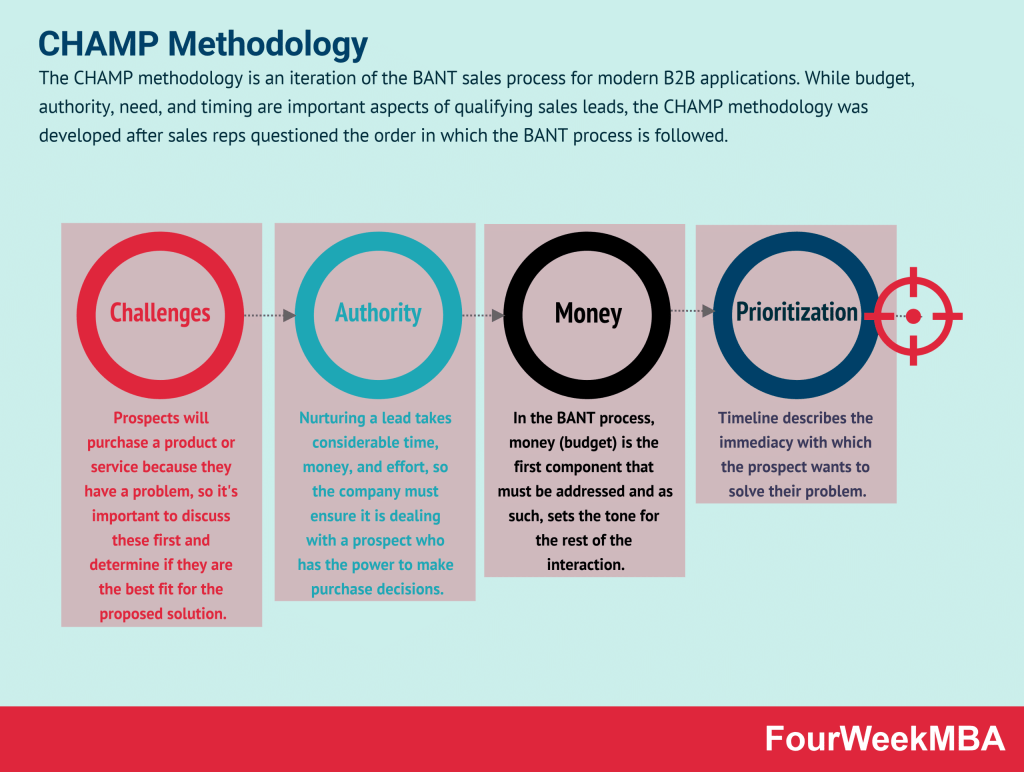
The CHAMP methodology is an iteration of the BANT sales process for modern B2B applications. While budget, authority, need, and timing are important aspects of qualifying sales leads, the CHAMP methodology was developed after sales reps questioned the order in which the BANT process is followed.
The BANT process was conceived at IBM in the 1950s as a way to quickly identify prospects most likely to make a purchase. Despite its introduction around 70 years ago, the BANT process remains relevant today and was formally adopted into IBM’s Business Agility Solution Identification Guide.
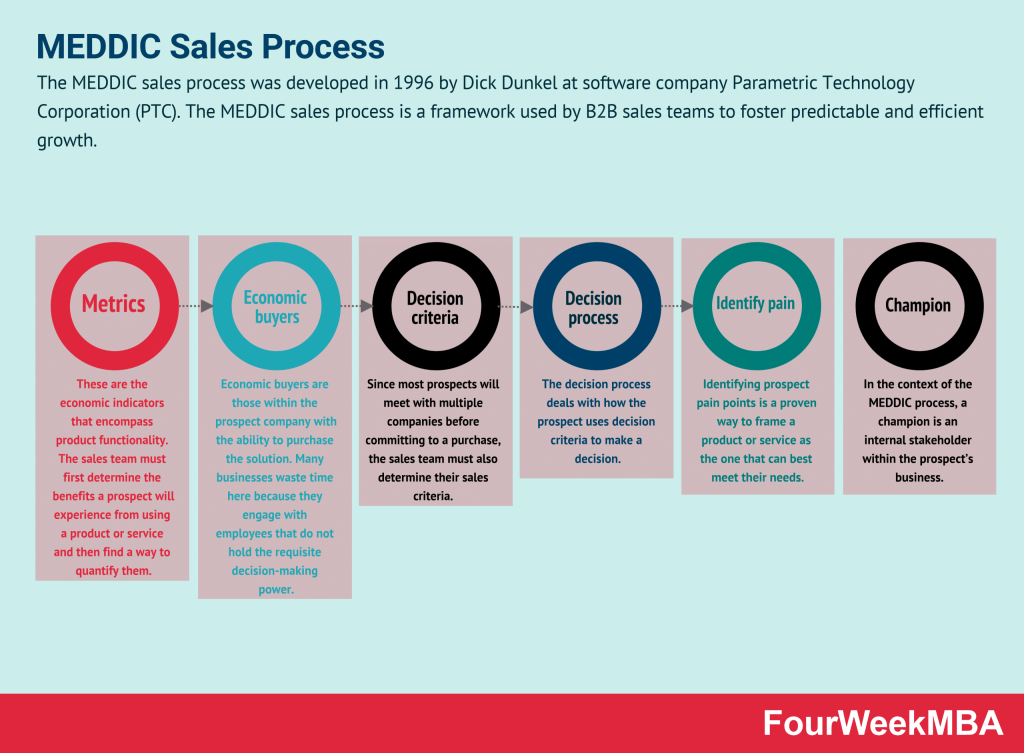
The MEDDIC sales process was developed in 1996 by Dick Dunkel at software company Parametric Technology Corporation (PTC). The MEDDIC sales process is a framework used by B2B sales teams to foster predictable and efficient growth.
STP marketing simplifies the market segmentation process and is one of the most commonly used approaches in modern marketing. The core focus of STP marketing is commercial effectiveness. Marketers use the approach to select the most valuable segments from a target audience and develop a product positioning strategy and marketing mix for each.
The sales funnel is a model used in marketing to represent an ideal, potential journey that potential customers go through before becoming actual customers. As a representation, it is also often an approximation, that helps marketing and sales teams structure their processes at scale, thus building repeatable sales and marketing tactics to convert customers.
Venture capitalist, Dave McClure, coined the acronym AARRR which is a simplified model that enables to understand what metrics and channels to look at, at each stage for the users’ path toward becoming customers and referrers of a brand.
The general concept of Bootstrapping connects to “a self-starting process that is supposed to proceed without external input.” In business, Bootstrapping means financing the growth of the company from the available cash flows produced by a viable business model. Bootstrapping requires the mastery of the key customers driving growth.
The virtuous cycle is a positive loop or a set of positive loops that trigger a non-linear growth. Indeed, in the context of digital platforms, virtuous cycles – also defined as flywheel models – help companies capture more market shares by accelerating growth. The classic example is Amazon’s lower prices driving more consumers, driving more sellers, thus improving variety and convenience, thus accelerating growth.
Business storytelling is a critical part of developing a business model. Indeed, the way you frame the story of your organization will influence its brand in the long-term. That’s because your brand story is tied to your brand identity, and it enables people to identify with a company.
Enterprise sales describes the procurement of large contracts that tend to be characterized by multiple decision-makers, complicated implementation, higher risk levels, or longer sales cycles.
Outside sales occur when a salesperson meets with prospects or customers in the field. This sort of sales function is critical to acquire larger accounts, like enterprise customers, for which the acquisition process is usually longer, more complex and it requires the understanding of the target organization. Thus the outside sales will cut through the noise to acquire a large enterprise account for the organization.
A freeterprise is a combination of free and enterprise where free professional accounts are driven into the funnel through the free product. As the opportunity is identified the company assigns the free account to a salesperson within the organization (inside sales or fields sales) to convert that into a B2B/enterprise account.
Zero to One is a book by Peter Thiel. But it also represents a business mindset, more typical of tech, where building something wholly new is the default mode, rather than building something incrementally better. The core premise of Zero to One then is that it’s much more valuable to create a whole new market/product rather than starting from existing markets.
Palantir is a software company offering intelligence services from governments and institutions to large commercial organizations. The company’s two main platforms Gotham and Foundry, are integrated at enterprise-level. Its business model follows three phases: Acquire, Expand, and Scale. The company bears the pilot costs in the acquire and expand phases, and it runs at a loss. Where in the scale phase, the customers’ contribution margins become positive.
Consultative selling is a sales approach favoring relationship building and open dialogue to adequately meet the needs of a prospective customer. By building trust quickly a consultative selling approach can help the customer better meet her/his expectations and the salesperson hit her/his targets more effectively.
A unique selling proposition (USP) enables a business to differentiate itself from its competitors. Importantly, a USP enables a business to stand for something that they, in turn, become known among consumers. A strong and recognizable USP is crucial to operating successfully in competitive markets.
Gennaro is the creator of FourWeekMBA, which reached about four million business people, comprising C-level executives, investors, analysts, product managers, and aspiring digital entrepreneurs in 2022 alone | He is also Director of Sales for a high-tech scaleup in the AI Industry | In 2012, Gennaro earned an International MBA with emphasis on Corporate Finance and Business Strategy.