Growth engineering is a systematic, technical approach to the improvement of conversion and the user experience. Combined with business engineering it helps business people build valuable companies from scratch.
Aspect
Explanation
Growth Engineering
Growth Engineering is a systematic approach to achieving business growth by combining elements of engineering, data analysis, and experimentation. It focuses on optimizing various aspects of a company’s operations, such as product development, marketing, and user experience, to drive sustainable and scalable growth.
Characteristics
– Data-Driven: Growth Engineering relies heavily on data analysis to inform decision-making and measure the impact of growth initiatives. – Iterative: It involves continuous cycles of experimentation, learning, and adaptation. – Cross-Functional: Teams from various departments collaborate to drive growth. – Customer-Centric: Prioritizes delivering value to customers. – Scalable: Strategies can be scaled as the business grows.
Key Elements
1. Data Analysis: Involves collecting and analyzing data to identify growth opportunities and customer behavior. 2. Experimentation: Conducting controlled experiments to test hypotheses and optimize strategies. 3. Cross-Functional Teams: Collaboration between product, marketing, engineering, and data teams. 4. Customer Insights: Understanding customer needs, pain points, and behavior.
Advantages
– Sustainable Growth: Promotes long-term and sustainable growth strategies. – Efficiency: Focuses resources on high-impact initiatives through data analysis. – Adaptability: Can quickly adapt to changing market conditions and customer preferences. – Customer Value: Prioritizes delivering value to customers. – Innovation: Encourages innovation through experimentation. – Scalability: Strategies can scale as the business grows.
Challenges
– Data Complexity: Analyzing and interpreting data can be complex and resource-intensive. – Organizational Alignment: Requires alignment and collaboration among different teams and departments. – Experimentation Risks: Not all experiments yield positive results, and failures can occur. – Resource Allocation: Balancing resources among growth initiatives can be challenging. – Continuous Learning: Keeping up with evolving customer behaviors and market trends.
Examples
– A/B Testing: Conducting experiments on website layouts, features, or marketing messages to determine which performs best. – Personalization: Using customer data to deliver personalized experiences and recommendations. – Iterative Product Development: Continuously improving products based on user feedback and data insights. – Content Optimization: Analyzing content performance and optimizing it for better engagement and conversion.
Importance
Growth Engineering is vital for businesses seeking sustainable and data-driven growth. It enables organizations to make informed decisions, allocate resources efficiently, and continuously adapt to changing customer needs. By fostering a culture of experimentation and collaboration, companies can drive innovation and achieve scalable growth in competitive markets.
Conclusion
Growth Engineering offers a systematic approach to achieving sustainable and scalable growth by leveraging data analysis, experimentation, and cross-functional collaboration. While it presents challenges related to data complexity and experimentation risks, its advantages include sustainable growth, efficiency, adaptability, customer focus, innovation, and scalability. Implementing growth engineering requires a commitment to data-driven practices and continuous learning.
Growth engineering is somewhat of a recent concept, having been pioneered by Facebook at a time when the social media network had around 50 million monthly active users. By moving away from a functional organizational structure toward functional growth teams, the company was able to rapidly grow its user base to over 2 billion in rapid time.
Facebook’s rise was caused by growth engineering, an intentional, scientific, metrics-driven approach that relies on hard data to improve conversions and user experience. To do this, it relies on experimentation and not on the intuitive, “quick-fix” mindset that is characteristic of growth hacking.
Every organization has a metric that it wants to improve on, but the role of a growth engineer is to break that metric down across various stages of a funnel. This results in a systematic and methodical way to build, manage, and improve processes, content, software, and organizations themselves. Funnels can also be used to increase the number of users, visitors, or customers with respect to budgetary constraints or existing capabilities.
An example of a growth engineering funnel
Funnels are used in growth engineering to clarify what it is that needs to be tested. Before a team can answer this question, however, it must have a detailed understanding of user behavior and areas that could be improved.
Australian software company Atlassian prefers to use the AARRR funnel. Also known as “pirate metrics”, the AARRR funnel was created by VC and accelerator fund founder Dave McClure. The funnel works on the idea that the more customers use a product, the more the company can invest in its features.
The sales funnel is a model used in marketing to represent an ideal, potential journey that potential customers go through before becoming actual customers. As a representation, it is also often an approximation, that helps marketing and sales teams structure their processes at scale, thus building repeatable sales and marketing tactics to convert customers.
This funnel is comprised of five stages:
Acquisition – how do customers discover a company?
Activation – do they have a great first experience?
Retention – do they stay, or do they churn?
Revenue – how does the company make money?
Referral – does the customer tell others about the experience?
Funnels vary in complexity, composition, and even nomenclature from one organization to the next. Atlassian also notes that some of its funnels contain multiple products, such as when a customer evaluates Confluence and Jira at the same time.
Growth teams may also focus on a specific part of the funnel. Activation teams may work on new user experiences while referral teams may identify ways for clients to invite their peers to use Atlassian products.
Perhaps intuitively, growth engineering will focus on different stages of the funnel according to the maturity of the company. Early-stage startups will prioritize experiments that focus on awareness and customer acquisition, while retention is most important for most companies at a later stage of maturity.
Case Studies
Facebook’s User Growth:
Background: When Facebook had about 50 million monthly active users, they recognized the need for rapid expansion.
Approach: They transitioned from a traditional organizational structure to functional growth teams.
Result: Using growth engineering, Facebook grew its user base to over 2 billion.
Atlassian’s Use of the AARRR Funnel:
Background: Atlassian, an Australian software company, wanted to understand and improve user behavior.
Approach: They adopted the AARRR funnel, also known as “pirate metrics,” which stands for Acquisition, Activation, Retention, Revenue, and Referral.
Result: The funnel helps Atlassian identify areas of improvement at every stage, from the initial discovery of the company to the point where customers refer others.
Startup’s Focus on Acquisition:
Background: An early-stage startup wants to spread awareness and gain an initial customer base.
Approach: Using growth engineering principles, the startup focuses on the “Acquisition” and “Activation” stages of the AARRR funnel.
Result: As a result, they prioritize experiments and initiatives that boost awareness and ensure a positive first-time user experience.
Mature Company’s Focus on Retention:
Background: A mature company with a substantial user base wants to maintain its customers.
Approach: The company’s growth teams prioritize the “Retention” stage of the funnel.
Result: Through continuous improvement in user experience and offering value, they ensure users remain loyal to the platform.
E-commerce Platform’s Revenue Boost:
Background: An e-commerce platform wants to increase its sales.
Approach: Using growth engineering, they focus on the “Revenue” stage of the AARRR funnel. They test various pricing strategies, bundle offers, and upselling techniques.
Result: The platform sees a significant uptick in average order values and overall revenue.
Software-as-a-Service (SaaS) Referral Program:
Background: A SaaS company wants its existing users to bring in new customers.
Approach: They zero in on the “Referral” stage of the funnel, creating a robust referral program offering benefits to both the referrer and the referred.
Result: There’s a surge in new sign-ups, driven by the successful referral program.
Mobile App’s Activation Improvements:
Background: A mobile application sees that many users download the app but don’t complete the registration.
Approach: The growth engineering team focuses on the “Activation” stage, streamlining the registration process, offering incentives, and providing a clearer value proposition.
Result: A higher percentage of users who download the app now complete the registration and become active users.
Key takeaways:
Growth engineering is a systematic, technical approach to the improvement of conversion and the user experience. It is a metrics-driven approach that differs from growth hacking, which mostly relies on intuition or gut feeling.
The role of a growth engineer is to break down a metric the organization wants to improve on across various stages of a funnel. The precise composition of the funnel will vary from one company to the next, but many use derivatives of the AARRR approach.
Growth teams may also focus on a specific part of the funnel according to the maturity level of the company, while other funnels may focus on multiple products simultaneously.
Key Insights
Growth Engineering: Growth engineering is a systematic and technical approach aimed at improving conversion rates and enhancing the user experience. It involves using metrics-driven strategies and experimentation, setting it apart from growth hacking’s intuitive and quick-fix methods.
Facebook’s Pioneering Role: Facebook pioneered growth engineering when it had around 50 million monthly active users. By adopting functional growth teams over a traditional organizational structure, the company achieved rapid growth, eventually surpassing 2 billion users.
Metrics-Driven Approach: Growth engineering relies on hard data and scientific methods to optimize conversions and user experience. It emphasizes experimentation and data analysis rather than relying on instinctive decision-making.
The Funnel Concept: A fundamental aspect of growth engineering is using funnels to break down a key metric across different stages. This allows for a methodical approach to building, managing, and improving processes, content, software, and organizations.
AARRR Funnel: The AARRR funnel, also known as “pirate metrics,” is a popular growth engineering funnel used by companies like Atlassian. It consists of five stages: Acquisition, Activation, Retention, Revenue, and Referral.
Tailored Funnel Composition: Funnel compositions may vary from one organization to another, and some may include multiple products within the funnel. For example, Atlassian may evaluate customers using Confluence and Jira simultaneously.
Focus Areas for Growth Teams: Growth teams may concentrate on specific stages of the funnel based on the company’s maturity level. Early-stage startups may prioritize customer acquisition, while retention becomes more critical for mature companies.
To Recap: Growth engineering is a data-driven approach for improving conversion rates and user experience. Growth engineers break down metrics using funnels, and these funnels can be tailored to each organization. Growth teams may focus on specific funnel stages based on the company’s maturity level, and funnels can also include multiple products simultaneously.
Related Frameworks, Models, or Concepts
Description
When to Apply
Agile Methodology
Agile methodology is an iterative approach to project management that emphasizes flexibility, collaboration, and customer feedback. In growth engineering, Agile allows teams to quickly adapt to changing market conditions, prioritize high-impact experiments, and accelerate learning cycles. Barriers may include resistance to change or inadequate team alignment.
Apply Agile principles to streamline growth experiments, increase team agility, and iterate rapidly on product enhancements. Utilize Agile ceremonies such as sprint planning, stand-up meetings, and retrospectives to foster collaboration and alignment among team members.
Lean Startup
The Lean Startup methodology focuses on validating assumptions and hypotheses through rapid experimentation and customer feedback. In growth engineering, Lean Startup principles help teams minimize waste, identify scalable growth strategies, and pivot quickly based on validated learning. Barriers may include over-reliance on vanity metrics or reluctance to pivot from initial ideas.
Implement Lean Startup practices such as MVP development, validated learning, and pivot or persevere decisions to accelerate growth experimentation and optimize resource allocation. Use Lean Startup techniques like customer interviews, A/B testing, and cohort analysis to gather actionable insights and refine growth strategies.
Design Thinking
Design thinking is a human-centered approach to innovation that emphasizes empathy, ideation, prototyping, and testing. In growth engineering, design thinking enables teams to deeply understand user needs, generate creative solutions, and iterate on product features iteratively. Barriers may include bias towards existing solutions or lack of interdisciplinary collaboration.
Apply design thinking methods such as empathizing with users, defining problem statements, ideating potential solutions, prototyping concepts, and testing with real users to drive customer-centric growth initiatives. Foster a culture of creativity, experimentation, and continuous improvement by incorporating design thinking principles into the growth engineering process.
Jobs to be Done (JTBD)
Jobs to be Done (JTBD) theory focuses on understanding the underlying motivations behind customer behavior and decision-making. In growth engineering, JTBD helps teams identify unmet customer needs, design products that fulfill specific jobs, and create compelling value propositions. Barriers may include difficulty in uncovering latent customer needs or misinterpreting job statements.
Utilize JTBD frameworks such as customer interviews, job mapping, and progress-making forces analysis to uncover actionable insights about customer motivations and preferences. Align product development and growth strategies with identified customer jobs to drive user engagement, retention, and satisfaction.
Pirate Metrics (AARRR)
Pirate Metrics, also known as AARRR (Acquisition, Activation, Retention, Referral, Revenue), provides a framework for analyzing and optimizing the user lifecycle. In growth engineering, Pirate Metrics help teams measure and improve key metrics at each stage of the user journey. Barriers may include focusing on vanity metrics or neglecting long-term retention and revenue goals.
Apply the AARRR framework to track and optimize acquisition channels, activation flows, retention strategies, referral programs, and revenue streams. Implement data-driven experimentation and iterative improvements to drive sustainable growth and maximize user value over time.
Customer Development Process
The Customer Development Process, popularized by Steve Blank, emphasizes validating product-market fit through customer discovery and validation. In growth engineering, Customer Development helps teams align product development efforts with real customer needs and preferences. Barriers may include confirmation bias or reliance on internal assumptions.
Conduct customer discovery interviews, prototype testing, and iterative feedback loops to validate product-market fit and identify scalable growth opportunities. Use Customer Development insights to refine product features, messaging, and value propositions for maximum user resonance and adoption.
OKRs (Objectives and Key Results)
OKRs (Objectives and Key Results) provide a framework for setting and aligning goals across organizations. In growth engineering, OKRs help teams define clear objectives, track measurable outcomes, and prioritize initiatives based on impact. Barriers may include setting overly ambitious goals or lack of alignment between teams.
Establish SMART (Specific, Measurable, Achievable, Relevant, Time-bound) OKRs to guide growth engineering initiatives and measure progress towards key outcomes. Cascade OKRs throughout the organization to ensure alignment between growth objectives and broader strategic goals. Regularly review and adapt OKRs based on performance data and market feedback to drive continuous improvement and accountability.
Data-Driven Decision Making
Data-driven decision-making involves leveraging data analysis and insights to inform strategic choices and prioritize initiatives. In growth engineering, data-driven approaches help teams identify growth opportunities, optimize experiments, and measure impact effectively. Barriers may include data silos or misinterpretation of metrics.
Establish a culture of data-driven decision-making by collecting relevant data, defining key metrics, and implementing robust analytics tools and processes. Use data analysis techniques such as cohort analysis, funnel visualization, and statistical hypothesis testing to identify trends, diagnose issues, and drive informed growth strategies.
Behavioral Economics
Behavioral economics applies psychological insights to understand and influence human behavior. In growth engineering, behavioral economics principles help teams design persuasive products, optimize user experiences, and drive desired actions. Barriers may include overlooking behavioral biases or ethical concerns.
Incorporate behavioral economics concepts such as loss aversion, social proof, and scarcity into product design, marketing messaging, and user engagement strategies to nudge users towards desired behaviors. Conduct experiments to test behavioral interventions and iteratively refine strategies based on behavioral insights and outcomes.
Network Effects
Network effects occur when the value of a product or service increases as more users adopt it. In growth engineering, harnessing network effects can lead to rapid user acquisition, engagement, and retention. Barriers may include overcoming the chicken-and-egg problem or competing against established network effects.
Design growth strategies that leverage network effects to create viral loops, drive user referrals, and expand user networks organically. Foster community engagement, incentivize user contributions, and optimize platform features to amplify network effects and accelerate growth momentum.
Business development comprises a set of strategies and actions to grow a business via a mixture of sales, marketing, and distribution. While marketing usually relies on automation to reach a wider audience, and sales typically leverage a one-to-one approach. The business development’s role is that of generating distribution.
Market development is a growth-centric strategy that businesses use to identify or develop new market segments for existing products. Companies utilize the market development strategy to discover new potential buyers of their products or services.
Growth engineering is a systematic, technical approach to the improvement of conversion and the user experience. Combined with business engineering it helps business people build valuable companies from scratch.
Growth marketing is a process of rapid experimentation, which in a way has to be “scientific” by keeping in mind that it is used by startups to grow, quickly. Thus, the “scientific” here is not meant in the academic sense. Growth marketing is expected to unlock growth, quickly and with an often limited budget.
fixed mindset believes their intelligence and talents are fixed traits that cannot be developed. The two mindsets were developed by American psychologist Carol Dweck while studying human motivation.
Both mindsets are comprised of conscious and subconscious thought patterns established at a very young age. In adult life, they have profound implications for personal and professional success.
Individuals with a growth mindset devote more time and effort to achieving difficult goals and by extension, are less concerned with the opinions or abilities of others. Individuals with a fixed mindset are sensitive to criticism and may be preoccupied with proving their talents to others.
The more you move from consumers to enterprise clients, the more you’ll need a sales force able to manage complex sales. As a rule of thumb, a more expensive product, in B2B or Enterprise, will require an organizational structure around sales. An inexpensive product to be offered to consumers will leverage on marketing.
STP marketing simplifies the market segmentation process and is one of the most commonly used approaches in modern marketing. The core focus of STP marketing is commercial effectiveness. Marketers use the approach to select the most valuable segments from a target audience and develop a product positioning strategy and marketing mix for each.
The sales funnel is a model used in marketing to represent an ideal, potential journey that potential customers go through before becoming actual customers. As a representation, it is also often an approximation, that helps marketing and sales teams structure their processes at scale, thus building repeatable sales and marketing tactics to convert customers.
Venture capitalist, Dave McClure, coined the acronym AARRR which is a simplified model that enables to understand what metrics and channels to look at, at each stage for the users’ path toward becoming customers and referrers of a brand.
The general concept of Bootstrapping connects to “a self-starting process that is supposed to proceed without external input.” In business, Bootstrapping means financing the growth of the company from the available cash flows produced by a viable business model. Bootstrapping requires the mastery of the key customers driving growth.
A sales cycle is the process that your company takes to sell your services and products. In simple words, it’s a series of steps that your sales reps need to go through with prospects that lead up to a closed sale.
Distribution represents the set of tactics, deals, and strategies that enable a company to make a product and service easily reachable and reached by its potential customers. It also serves as the bridge between product and marketing to create a controlled journey of how potential customers perceive a product before buying it.
Zero to One is a book by Peter Thiel. But it also represents a business mindset, more typical of tech, where building something wholly new is the default mode, rather than building something incrementally better. The core premise of Zero to One then is that it’s much more valuable to create a whole new market/product rather than starting from existing markets.
A digital channel is a marketing channel, part of a distributionstrategy, helping an organization to reach its potential customers via electronic means. There are several digital marketing channels, usually divided into organic and paid channels. Some organic channels are SEO, SMO, email marketing. And some paid channels comprise SEM, SMM, and display advertising.
RevOps – short for Revenue Operations – is a framework that aims to maximize the revenue potential of an organization. RevOps seeks to align these departments by giving them access to the same data and tools. With shared information, each then understands their role in the sales funnel and can work collaboratively to increase revenue.
In a logrolling negotiation, one party offers a concession on one issue to gain ground on another issue. In logrolling, there is no desire by either party to advertise the extent of their power, rights, or entitlements. This makes it a particularly effective strategy in complex negotiations where partial or complete impasses exist.
Win-win negotiations first rose to prominence during the 1980s, thanks in part to books like Roger Fisher, William Ury, and Bruce Patton’s bestseller Getting to Yes: Negotiating Agreement Without Giving In. Having said that, there was also a shifting mindset at the time as negotiators saw win-win negotiations as preferable to the then-dominant win-lose approach. A win-win negotiation is a negotiation outcome resulting in a mutually acceptable and beneficial deal for all involved parties.
In negotiation theory, BATNA stands for “Best Alternative To a Negotiated Agreement,” and it’s one of the key tenets of negotiation theory. Indeed, it describes the best course of action a party can take if negotiations fail to reach an agreement. This simple strategy can help improve the negotiation as each party is (in theory) willing to take the best course of action, as otherwise, an agreement won’t be reached.
In negotiation, WATNA stands for “worst alternative to a negotiated agreement,” representing one of several alternative options if a resolution cannot be reached. This is a useful technique to help understand what might be a negotiation outcome, that even if negative is still better than a WATNA, making the deal still feasible.
The ZOPA (zone of possible agreement) describes an area in which two negotiation parties may find common ground. Indeed, ZOPA is critical to explore the deals where the parties get a mutually beneficial outcome to prevent the risk of a win-lose, or lose-win scenario. And therefore get to the point of a win-win negotiation outcome.
Revenue modeling is a process of incorporating a sustainable financial model for revenue generation within a business model design. Revenue modeling can help to understand what options make more sense in creating a digital business from scratch; alternatively, it can help in analyzing existing digital businesses and reverse engineer them.
Customer experience maps are visual representations of every encounter a customer has with a brand. On a customer experience map, interactions called touchpoints visually denote each interaction that a business has with its consumers. Typically, these include every interaction from the first contact to marketing, branding, sales, and customer support.
AIDA stands for attention, interest, desire, and action. That is a model that is used in marketing to describe the potential journey a customer might go through before purchasing a product or service. The AIDA model helps organizations focus their efforts when optimizing their marketing activities based on the customers’ journeys.
Social selling is a process of developing trust, rapport, and a relationship with a prospect to enhance the sales cycle. It usually happens through tech platforms (like LinkedIn, Twitter, Facebook, and more), which enable salespeople to engage with potential prospects before closing the sale, thus becoming more effective.
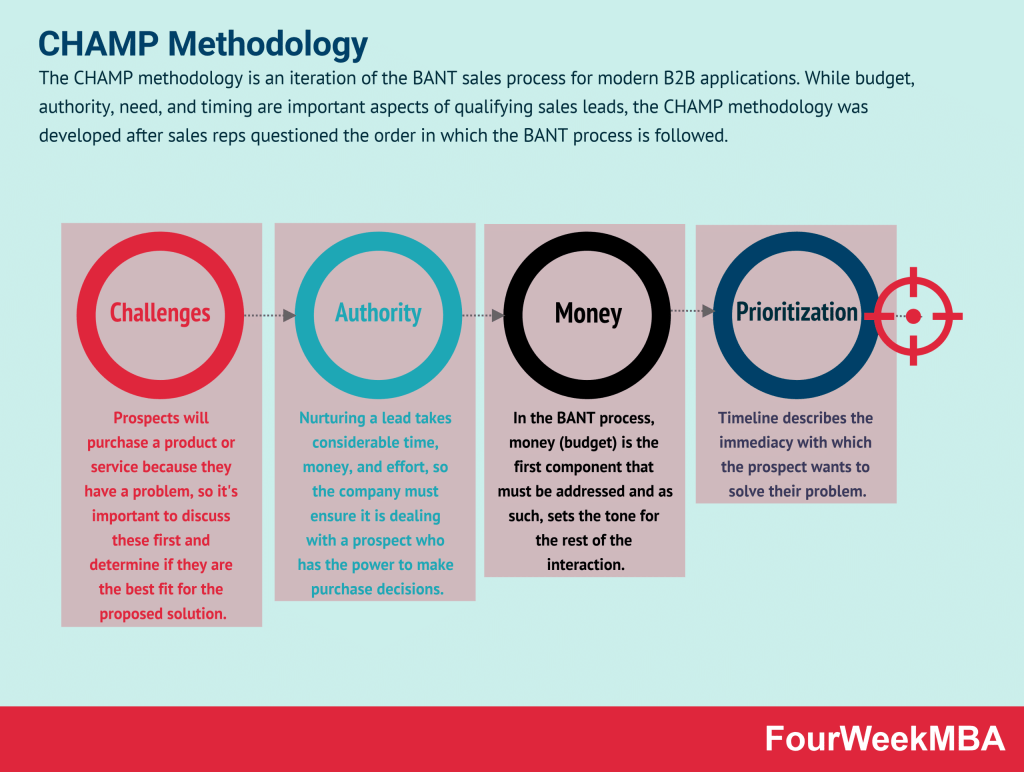
The CHAMP methodology is an iteration of the BANT sales process for modern B2B applications. While budget, authority, need, and timing are important aspects of qualifying sales leads, the CHAMP methodology was developed after sales reps questioned the order in which the BANT process is followed.
The BANT process was conceived at IBM in the 1950s as a way to quickly identify prospects most likely to make a purchase. Despite its introduction around 70 years ago, the BANT process remains relevant today and was formally adopted into IBM’s Business Agility Solution Identification Guide.
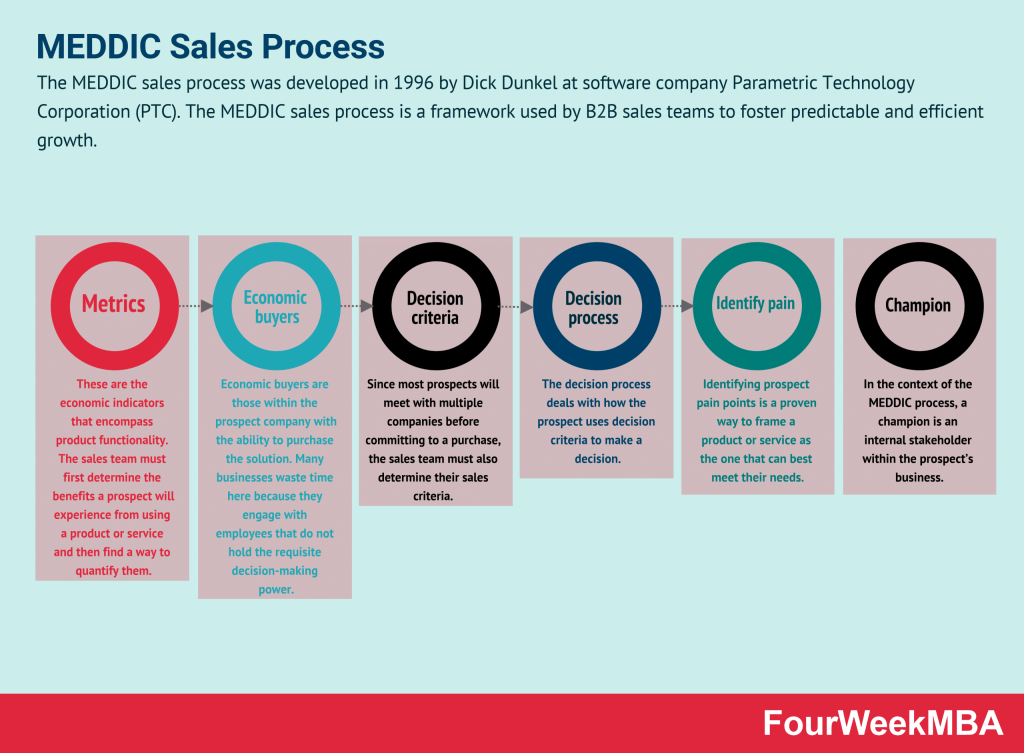
The MEDDIC sales process was developed in 1996 by Dick Dunkel at software company Parametric Technology Corporation (PTC). The MEDDIC sales process is a framework used by B2B sales teams to foster predictable and efficient growth.
The virtuous cycle is a positive loop or a set of positive loops that trigger a non-linear growth. Indeed, in the context of digital platforms, virtuous cycles – also defined as flywheel models – help companies capture more market shares by accelerating growth. The classic example is Amazon’s lower prices driving more consumers, driving more sellers, thus improving variety and convenience, thus accelerating growth.
Business storytelling is a critical part of developing a business model. Indeed, the way you frame the story of your organization will influence its brand in the long-term. That’s because your brand story is tied to your brand identity, and it enables people to identify with a company.
Enterprise sales describes the procurement of large contracts that tend to be characterized by multiple decision-makers, complicated implementation, higher risk levels, or longer sales cycles.
Outside sales occur when a salesperson meets with prospects or customers in the field. This sort of sales function is critical to acquire larger accounts, like enterprise customers, for which the acquisition process is usually longer, more complex and it requires the understanding of the target organization. Thus the outside sales will cut through the noise to acquire a large enterprise account for the organization.
A freeterprise is a combination of free and enterprise where free professional accounts are driven into the funnel through the free product. As the opportunity is identified the company assigns the free account to a salesperson within the organization (inside sales or fields sales) to convert that into a B2B/enterprise account.
Palantir is a software company offering intelligence services from governments and institutions to large commercial organizations. The company’s two main platforms Gotham and Foundry, are integrated at enterprise-level. Its business model follows three phases: Acquire, Expand, and Scale. The company bears the pilot costs in the acquire and expand phases, and it runs at a loss. Where in the scale phase, the customers’ contribution margins become positive.
Consultative selling is a sales approach favoring relationship building and open dialogue to adequately meet the needs of a prospective customer. By building trust quickly a consultative selling approach can help the customer better meet her/his expectations and the salesperson hit her/his targets more effectively.
A unique selling proposition (USP) enables a business to differentiate itself from its competitors. Importantly, a USP enables a business to stand for something that they, in turn, become known among consumers. A strong and recognizable USP is crucial to operating successfully in competitive markets.
Gennaro is the creator of FourWeekMBA, which reached about four million business people, comprising C-level executives, investors, analysts, product managers, and aspiring digital entrepreneurs in 2022 alone | He is also Director of Sales for a high-tech scaleup in the AI Industry | In 2012, Gennaro earned an International MBA with emphasis on Corporate Finance and Business Strategy.