Greiner’s growth model was originally proposed in 1972 by Larry E. Greiner. In a 1998 Harvard Business Review article entitled Evolution and Revolution as Organizations Grow, he posited that companies experience six phases of growth that are punctuated by so-called “revolutions”. Importantly, each revolution disturbs the status quo and allows the next stage to establish itself.
Element
Description
Implications
Examples
Applications
Model Overview
Greiner’s Growth Model is a framework developed by Larry Greiner in the 1970s to describe the stages of growth and evolution that organizations typically experience. It identifies phases of stability and crises.
– Provides insights into organizational challenges and changes.
– Stages of organizational growth and evolution. – Transitions from one stage to another.
– Analyzing organizational growth patterns, understanding challenges, and planning for future development.
Growth Phases
The model outlines five distinct phases that organizations go through: Creativity, Direction, Delegation, Coordination, and Collaboration. These phases represent periods of relative stability and crisis.
– Each phase has its unique characteristics and challenges.
– Creativity: Early stage with a focus on innovation. – Coordination: Focus on control and systems. – Transition points between phases.
– Diagnosing organizational issues, setting expectations for each phase, planning for growth, and adapting strategies accordingly.
Creativity Phase
In this phase, organizations are typically small and entrepreneurial, emphasizing innovation and creativity.
– Focus on new product development and market entry.
– Startups and small businesses with a strong emphasis on innovation and experimentation.
– Understanding the challenges and opportunities of early-stage organizations.
Direction Phase
As organizations grow, leadership becomes more formalized. The direction phase involves centralization of authority and a focus on clear goals and strategies.
– Need for strong leadership and strategic planning.
– Developing a centralized management structure. – Setting clear goals and strategies for expansion.
– Transitioning from startup to a more structured and efficient organization.
Delegation Phase
This phase sees decentralization of authority and delegation of decision-making to lower levels. It often leads to increased efficiency but can also create problems if not managed properly.
– Empowering employees and middle managers.
– Delegating decision-making authority to teams. – Balancing delegation with oversight and control.
– Adapting to increased complexity, empowering teams, and managing growth challenges.
Coordination Phase
Organizational growth can lead to silos and inefficiencies. The coordination phase focuses on improving communication and coordination across departments or units.
– Emphasis on cross-functional collaboration and efficiency.
– Implementing new communication and collaboration tools. – Breaking down silos and improving processes.
– Addressing challenges related to coordination, communication, and inefficiencies in larger organizations.
Collaboration Phase
In this phase, organizations aim to foster a culture of collaboration and innovation. They may explore partnerships, mergers, or acquisitions to further growth and competitiveness.
– Focus on fostering innovation and adaptability.
– Collaborating with external partners and competitors. – Embracing innovation and agility as core values.
– Navigating complex organizational structures, fostering innovation, and staying competitive in the market.
Crisis Points
Greiner’s model also highlights crisis points or triggers that can lead to transitions between growth phases. These crises are often the result of challenges that organizations face as they grow.
– Recognizing crises as opportunities for change and growth.
– Financial crises, leadership challenges, market shifts. – Responses to crises leading to phase transitions.
– Identifying and addressing crisis points, using them as opportunities for organizational development.
Greiner’s growth model, also known as the Greiner curve, describes the various phases and crises an organization may experience as it grows.
Greiner’s growth model is not specific to any industry, instead providing a general overview of the various problems a company may encounter as its size increases.
The model allows decision-makers to anticipate problems before they occur and, at least in theory, avoid them altogether.
What else can businesses take away from Greiner’s model? For one, growth is inherently difficult and presents many obstacles in terms of management and leadership.
It’s also vital that organizations develop a leadership structure that reflects their growth stage and can be adjusted as they increase in size. Otherwise, they risk being overtaken by the competition.
The six phases of Greiner’s growth model
Greiner developed five phases in 1972 and then added a sixth in 1998. Let’s take a look at each of them below and their associated crises.
Phase 1 – Growth through creativity
In the initial phase, the company’s skeleton staff are busy creating products and seeking external investment.
Informal communication is suitable at first, but as the company starts to recruit more staff, expand production, and secure capital, communication should become more formal.
According to Greiner, the first phase ends with a leadership crisis. At some point, professional management will be required to drive the company forward. The company founders may take on this role or hire outside help.
Phase 2 – Growth through direction
Growth continues as activities such as marketing and accounting are grouped into departments that collectively comprise an organizational structure. Company culture may also start to develop in this phase.
Inevitably, the current management team will find that they cannot manage every aspect of the increasingly complex and multi-faceted business.
The second phase ends in an autonomy crisis. Upper management is actively involved in running the company but must rely on the collaborative effort of lower-level managers to pick up the slack and drive the company forward.
Phase 3 – Growth through delegation
The organization continues to evolve and expand as middle management deals with daily operations and upper management consider more significant opportunities such as mergers and acquisitions.
In any case, decision-making is based on periodic reviews, and cost centers may be introduced.
Sometimes, these cost centers start to act autonomously and service their own needs instead of the needs of the organization.
As a consequence, the company may enter a crisis of control and require a more robust organizational design so that functional units can work together harmoniously.
Phase 4 – Growth through coordination and monitoring
In phase four, the mature company is characterized by multiple departments working toward the same goal with established processes and functions. Growth continues as the whole business is greater than the sum of its parts.
In some companies, however, a red-tape crisis ensues as productivity becomes stifled under bureaucracy. The implementation of a new structure and culture can remedy this situation.
Phase 5 – Growth through collaboration
Collaboration means the organization adopts a matrix structure where product-focused teams are spread across multiple functions.
This creates a positive culture where processes are simplified, teams are rewarded based on performance, and employees feel their work and ideas are contributing to organizational success.
While this facilitates growth, the company may reach a point where it cannot grow any larger with its existing processes and resources. This is known as the growth crisis, which can only be addressed by looking to expand externally.
Phase 6 – Growth through extra-organizational solutions
Greiner’s sixth and final phase notes that company growth can continue via mergers, acquisitions, outsourcing, networking, and any other external solution.
Real-World Case Studies
Case Study: Apple Inc.
Phase 1: Creativity Crisis – Leadership Crisis During the late 1980s and early 1990s, Apple faced a significant crisis characterized by stagnant growth and internal conflicts. The company struggled to maintain its innovative edge in the rapidly evolving technology market, and leadership conflicts arose between CEO John Sculley and founder Steve Jobs.
Trigger Event: The introduction of the Macintosh computer in 1984 was a groundbreaking innovation for Apple, but the company faced challenges in sustaining its initial success and expanding its product line.
Management Response: Apple’s management attempted various strategies to address the creativity crisis, including diversifying into new product categories (e.g., printers, digital cameras) and restructuring the organization. However, these efforts were largely unsuccessful in reigniting growth and resolving internal conflicts.
Outcome: Eventually, Apple’s board of directors ousted CEO John Sculley in 1993, marking the end of the creativity crisis phase. Steve Jobs returned to the company in 1997 and initiated a period of transformation and revitalization that would propel Apple to new heights of success.
Phase 2: Direction Crisis – Autonomy Crisis After Steve Jobs’ return to Apple, the company experienced a direction crisis as it struggled to define its strategic direction and regain market relevance. Apple faced intense competition from rivals such as Microsoft and struggled to differentiate its products in a crowded market.
Trigger Event: The proliferation of personal computers and the rise of Microsoft’s Windows operating system posed significant challenges to Apple’s Macintosh platform, leading to declining market share and profitability.
Management Response: Under Steve Jobs’ leadership, Apple embarked on a bold strategy focused on innovation and differentiation. The company introduced groundbreaking products such as the iMac, iPod, iPhone, and iPad, redefining entire industries and revitalizing Apple’s brand image.
Outcome: Apple’s focus on innovation and design excellence enabled the company to emerge from the direction crisis stronger than ever. The success of products like the iPod and iPhone transformed Apple into one of the world’s most valuable and influential technology companies.
Phase 3: Delegation Crisis – Control Crisis In recent years, Apple has faced challenges related to maintaining its innovative culture and managing its vast ecosystem of products and services. The company has grappled with issues such as supply chain disruptions, privacy controversies, and regulatory scrutiny.
Trigger Event: Increasing complexity in Apple’s product portfolio and global operations has strained the company’s ability to maintain tight control over its supply chain, manufacturing processes, and customer data.
Management Response: Apple has implemented measures to address the delegation crisis, including strengthening its supply chain resilience, enhancing data privacy protections, and investing in renewable energy and environmental sustainability initiatives.
Outcome: While Apple continues to face challenges related to delegation and control, the company remains resilient and adaptable. Through strategic investments in innovation, sustainability, and corporate responsibility, Apple aims to sustain its growth and leadership position in the technology industry.
Key takeaways:
Greiner’s growth model, also known as the Greiner curve, describes the various phases and crises an organization may experience as it grows.
Greiner’s growth model is not specific to any industry, instead providing a general overview of the various problems a company may encounter as its size increases. If nothing else, the model highlights the fact that growth is inherently difficult.
Greiner’s growth model is comprised of six phases, with each comprising a different stage of company maturity. These are growth through creativity, direction, delegation, coordination and monitoring, collaboration, and extra-organizational solutions.
Key Highlights:
Greiner’s Growth Model:
Greiner’s growth model, proposed by Larry E. Greiner in 1972, describes the phases of growth that organizations experience, marked by “revolutions” that disturb the status quo.
The model provides insights into the challenges organizations face as they grow and offers a framework to anticipate and address these challenges.
Six Phases of Greiner’s Growth Model:
Phase 1 – Growth through Creativity: Early stage with product creation and external investment. Ends with a leadership crisis, requiring professional management.
Phase 2 – Growth through Direction: Departments formed, company culture develops. Ends with an autonomy crisis, upper management relies on lower-level managers.
Phase 3 – Growth through Delegation: Middle management handles daily operations, focus on mergers. May face a crisis of control due to autonomy of cost centers.
Phase 4 – Growth through Coordination and Monitoring: Established processes, departments work together. Red-tape crisis possible due to bureaucracy.
Phase 5 – Growth through Collaboration: Matrix structure with cross-functional teams. Growth crisis occurs if existing processes hinder expansion.
Phase 6 – Growth through Extra-organizational Solutions: Growth through mergers, acquisitions, outsourcing, and networking.
Key Insights from Greiner’s Model:
Greiner’s model emphasizes that growth is challenging and comes with various obstacles in management and leadership.
Organizations must adapt their leadership structures as they grow to remain competitive.
The model provides a general overview applicable to diverse industries, highlighting the difficulties of growth.
Comparison’s Table
Greiner’s Growth Model
McKinsey 7-S Model
Kotter’s 8-Step Change Model
Type
Framework for understanding organizational growth and development.
Organizational framework focusing on seven key elements.
Change management model outlining eight steps for transformation.
Purpose
To identify stages of growth and associated challenges for organizations.
To analyze and align seven key elements within an organization.
To guide organizations through eight steps of successful change.
Key Components
– Growth stages: Identifies six stages of organizational growth, each characterized by specific challenges and management practices. – Crisis points: Recognizes points of crisis that trigger transitions between growth stages.
– Strategy: Defines the organization’s overall direction and plan for success. – Structure: Addresses the organization’s formal hierarchy and reporting relationships. – Systems: Refers to the processes and procedures that support operations. – Shared Values: Represents the organization’s core beliefs, culture, and norms. – Skills: Encompasses the competencies and capabilities of the workforce. – Style: Refers to leadership and management styles within the organization. – Staff: Represents the human resources and talent management practices.
– Create urgency: Establish a sense of urgency for change within the organization. – Build a guiding coalition: Form a diverse team to lead and support the change effort. – Form a strategic vision: Develop a clear vision and strategy for the future state. – Communicate the vision: Communicate the vision effectively and enlist others to support it. – Empower action: Remove obstacles and empower employees to act on the vision. – Generate short-term wins: Celebrate achievements and build momentum for change. – Consolidate gains: Reinforce changes and make adjustments as needed to maintain progress. – Anchor change: Institutionalize changes and ensure they become part of the organization’s culture.
Application
Used by organizations to understand their growth trajectory and anticipate challenges at each stage of development.
Utilized to analyze and align organizational elements for effective performance and growth.
Applied to guide organizations through successful change initiatives and transformations.
Focus
Focuses on identifying growth stages, understanding associated challenges, and implementing appropriate management practices.
Focuses on aligning strategy, structure, systems, shared values, skills, style, and staff within the organization.
Focuses on creating urgency, building support, communicating vision, empowering action, generating wins, consolidating gains, and anchoring change.
Benefits
– Provides a roadmap for organizational growth and development. – Helps anticipate challenges and proactively address them at each growth stage. – Offers insights into effective management practices for different stages of growth.
– Facilitates analysis and alignment of key organizational elements. – Enhances organizational performance and effectiveness by ensuring coherence and synergy among various components.
– Guides organizations through successful change initiatives. – Helps overcome resistance and obstacles to change. – Enables the transformation of organizational culture and practices.
Examples
– Identifying the entrepreneurial stage characterized by founder domination and limited formal structures. – Recognizing the crisis of leadership that may occur during the growth stage as the organization outgrows its founder. – Implementing professional management practices during the delegation stage to address coordination challenges.
– Aligning the organization’s strategy with its structure, systems, and culture to drive performance. – Assessing the skills and capabilities of the workforce and addressing gaps through training and development initiatives. – Creating a supportive leadership style and fostering a culture of collaboration and innovation.
– Creating a sense of urgency by highlighting the need for change and the risks of inaction. – Forming a coalition of leaders and change agents to drive the change effort forward. – Communicating the vision and strategy for change effectively to gain buy-in and commitment.
Business development comprises a set of strategies and actions to grow a business via a mixture of sales, marketing, and distribution. While marketing usually relies on automation to reach a wider audience, and sales typically leverage a one-to-one approach. The business development’s role is that of generating distribution.
Market development is a growth-centric strategy that businesses use to identify or develop new market segments for existing products. Companies utilize the market development strategy to discover new potential buyers of their products or services.
A total addressable market or TAM is the available market for a product or service. That is a metric usually leveraged by startups to understand the business potential of an industry. Typically, a large addressable market is appealing to venture capitalists willing to back startups with extensive growth potential.
Growth engineering is a systematic, technical approach to the improvement of conversion and the user experience. Combined with business engineering it helps business people build valuable companies from scratch.
Growth marketing is a process of rapid experimentation, which in a way has to be “scientific” by keeping in mind that it is used by startups to grow, quickly. Thus, the “scientific” here is not meant in the academic sense. Growth marketing is expected to unlock growth, quickly and with an often limited budget.
Blitzscaling is a business concept and a book written by Reid Hoffman (LinkedIn Co-founder) and Chris Yeh. At its core, the concept of Blitzscaling is about growing at a rate that is so much faster than your competitors, that make you feel uncomfortable. In short, Blitzscaling is prioritizing speed over efficiency in the face of uncertainty.
In the Lean Startup, Eric Ries defined the engine of growth as “the mechanism that startups use to achieve sustainable growth.” He described sustainable growth as following a simple rule, “new customers come from the actions of past customers.” The three engines of growth are the sticky engine, the viral engine, and the paid engine. Each of those can be measured and tracked by a few key metrics.
fixed mindset believes their intelligence and talents are fixed traits that cannot be developed. The two mindsets were developed by American psychologist Carol Dweck while studying human motivation.
Both mindsets are comprised of conscious and subconscious thought patterns established at a very young age. In adult life, they have profound implications for personal and professional success.
Individuals with a growth mindset devote more time and effort to achieving difficult goals and by extension, are less concerned with the opinions or abilities of others. Individuals with a fixed mindset are sensitive to criticism and may be preoccupied with proving their talents to others.
The more you move from consumers to enterprise clients, the more you’ll need a sales force able to manage complex sales. As a rule of thumb, a more expensive product, in B2B or Enterprise, will require an organizational structure around sales. An inexpensive product to be offered to consumers will leverage on marketing.
STP marketing simplifies the market segmentation process and is one of the most commonly used approaches in modern marketing. The core focus of STP marketing is commercial effectiveness. Marketers use the approach to select the most valuable segments from a target audience and develop a product positioning strategy and marketing mix for each.
The sales funnel is a model used in marketing to represent an ideal, potential journey that potential customers go through before becoming actual customers. As a representation, it is also often an approximation, that helps marketing and sales teams structure their processes at scale, thus building repeatable sales and marketing tactics to convert customers.
Venture capitalist, Dave McClure, coined the acronym AARRR which is a simplified model that enables to understand what metrics and channels to look at, at each stage for the users’ path toward becoming customers and referrers of a brand.
The general concept of Bootstrapping connects to “a self-starting process that is supposed to proceed without external input.” In business, Bootstrapping means financing the growth of the company from the available cash flows produced by a viable business model. Bootstrapping requires the mastery of the key customers driving growth.
A sales cycle is the process that your company takes to sell your services and products. In simple words, it’s a series of steps that your sales reps need to go through with prospects that lead up to a closed sale.
Distribution represents the set of tactics, deals, and strategies that enable a company to make a product and service easily reachable and reached by its potential customers. It also serves as the bridge between product and marketing to create a controlled journey of how potential customers perceive a product before buying it.
Zero to One is a book by Peter Thiel. But it also represents a business mindset, more typical of tech, where building something wholly new is the default mode, rather than building something incrementally better. The core premise of Zero to One then is that it’s much more valuable to create a whole new market/product rather than starting from existing markets.
A digital channel is a marketing channel, part of a distributionstrategy, helping an organization to reach its potential customers via electronic means. There are several digital marketing channels, usually divided into organic and paid channels. Some organic channels are SEO, SMO, email marketing. And some paid channels comprise SEM, SMM, and display advertising.
RevOps – short for Revenue Operations – is a framework that aims to maximize the revenue potential of an organization. RevOps seeks to align these departments by giving them access to the same data and tools. With shared information, each then understands their role in the sales funnel and can work collaboratively to increase revenue.
In a logrolling negotiation, one party offers a concession on one issue to gain ground on another issue. In logrolling, there is no desire by either party to advertise the extent of their power, rights, or entitlements. This makes it a particularly effective strategy in complex negotiations where partial or complete impasses exist.
Win-win negotiations first rose to prominence during the 1980s, thanks in part to books like Roger Fisher, William Ury, and Bruce Patton’s bestseller Getting to Yes: Negotiating Agreement Without Giving In. Having said that, there was also a shifting mindset at the time as negotiators saw win-win negotiations as preferable to the then-dominant win-lose approach. A win-win negotiation is a negotiation outcome resulting in a mutually acceptable and beneficial deal for all involved parties.
In negotiation theory, BATNA stands for “Best Alternative To a Negotiated Agreement,” and it’s one of the key tenets of negotiation theory. Indeed, it describes the best course of action a party can take if negotiations fail to reach an agreement. This simple strategy can help improve the negotiation as each party is (in theory) willing to take the best course of action, as otherwise, an agreement won’t be reached.
In negotiation, WATNA stands for “worst alternative to a negotiated agreement,” representing one of several alternative options if a resolution cannot be reached. This is a useful technique to help understand what might be a negotiation outcome, that even if negative is still better than a WATNA, making the deal still feasible.
The ZOPA (zone of possible agreement) describes an area in which two negotiation parties may find common ground. Indeed, ZOPA is critical to explore the deals where the parties get a mutually beneficial outcome to prevent the risk of a win-lose, or lose-win scenario. And therefore get to the point of a win-win negotiation outcome.
Revenue modeling is a process of incorporating a sustainable financial model for revenue generation within a business model design. Revenue modeling can help to understand what options make more sense in creating a digital business from scratch; alternatively, it can help in analyzing existing digital businesses and reverse engineer them.
Customer experience maps are visual representations of every encounter a customer has with a brand. On a customer experience map, interactions called touchpoints visually denote each interaction that a business has with its consumers. Typically, these include every interaction from the first contact to marketing, branding, sales, and customer support.
AIDA stands for attention, interest, desire, and action. That is a model that is used in marketing to describe the potential journey a customer might go through before purchasing a product or service. The AIDA model helps organizations focus their efforts when optimizing their marketing activities based on the customers’ journeys.
Social selling is a process of developing trust, rapport, and a relationship with a prospect to enhance the sales cycle. It usually happens through tech platforms (like LinkedIn, Twitter, Facebook, and more), which enable salespeople to engage with potential prospects before closing the sale, thus becoming more effective.
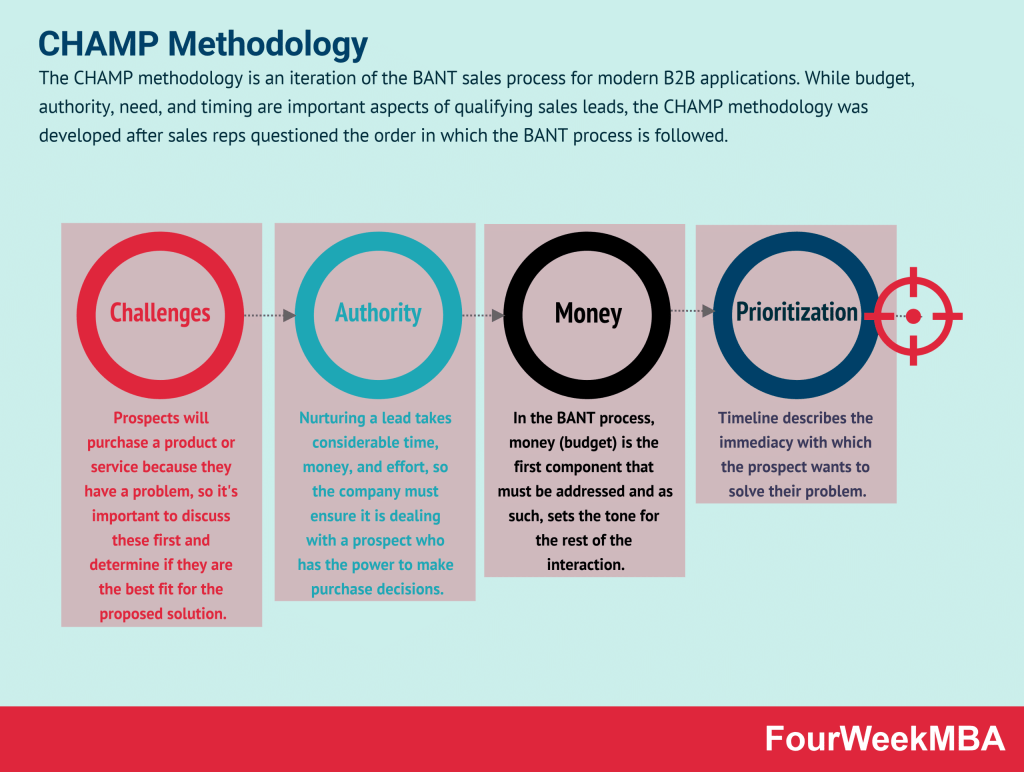
The CHAMP methodology is an iteration of the BANT sales process for modern B2B applications. While budget, authority, need, and timing are important aspects of qualifying sales leads, the CHAMP methodology was developed after sales reps questioned the order in which the BANT process is followed.
The BANT process was conceived at IBM in the 1950s as a way to quickly identify prospects most likely to make a purchase. Despite its introduction around 70 years ago, the BANT process remains relevant today and was formally adopted into IBM’s Business Agility Solution Identification Guide.
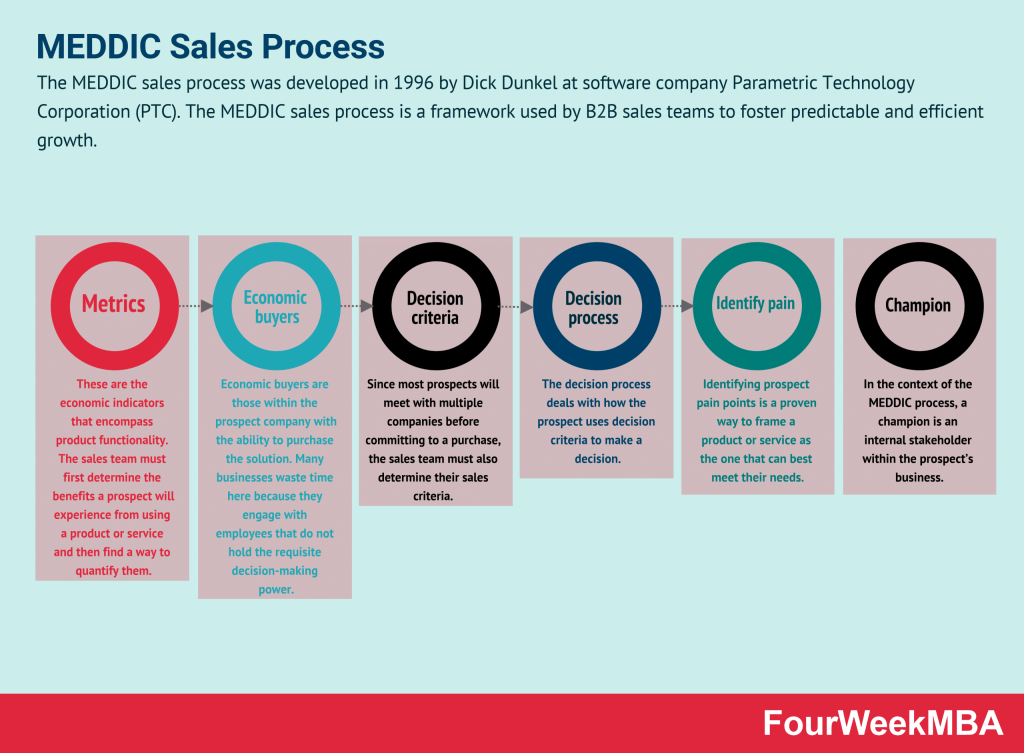
The MEDDIC sales process was developed in 1996 by Dick Dunkel at software company Parametric Technology Corporation (PTC). The MEDDIC sales process is a framework used by B2B sales teams to foster predictable and efficient growth.
The virtuous cycle is a positive loop or a set of positive loops that trigger a non-linear growth. Indeed, in the context of digital platforms, virtuous cycles – also defined as flywheel models – help companies capture more market shares by accelerating growth. The classic example is Amazon’s lower prices driving more consumers, driving more sellers, thus improving variety and convenience, thus accelerating growth.
Business storytelling is a critical part of developing a business model. Indeed, the way you frame the story of your organization will influence its brand in the long-term. That’s because your brand story is tied to your brand identity, and it enables people to identify with a company.
Enterprise sales describes the procurement of large contracts that tend to be characterized by multiple decision-makers, complicated implementation, higher risk levels, or longer sales cycles.
Outside sales occur when a salesperson meets with prospects or customers in the field. This sort of sales function is critical to acquire larger accounts, like enterprise customers, for which the acquisition process is usually longer, more complex and it requires the understanding of the target organization. Thus the outside sales will cut through the noise to acquire a large enterprise account for the organization.
A freeterprise is a combination of free and enterprise where free professional accounts are driven into the funnel through the free product. As the opportunity is identified the company assigns the free account to a salesperson within the organization (inside sales or fields sales) to convert that into a B2B/enterprise account.
Palantir is a software company offering intelligence services from governments and institutions to large commercial organizations. The company’s two main platforms Gotham and Foundry, are integrated at enterprise-level. Its business model follows three phases: Acquire, Expand, and Scale. The company bears the pilot costs in the acquire and expand phases, and it runs at a loss. Where in the scale phase, the customers’ contribution margins become positive.
Consultative selling is a sales approach favoring relationship building and open dialogue to adequately meet the needs of a prospective customer. By building trust quickly a consultative selling approach can help the customer better meet her/his expectations and the salesperson hit her/his targets more effectively.
A unique selling proposition (USP) enables a business to differentiate itself from its competitors. Importantly, a USP enables a business to stand for something that they, in turn, become known among consumers. A strong and recognizable USP is crucial to operating successfully in competitive markets.
Gennaro is the creator of FourWeekMBA, which reached about four million business people, comprising C-level executives, investors, analysts, product managers, and aspiring digital entrepreneurs in 2022 alone | He is also Director of Sales for a high-tech scaleup in the AI Industry | In 2012, Gennaro earned an International MBA with emphasis on Corporate Finance and Business Strategy.