The Golden Ratio, often represented by the Greek letter φ (phi), is a mathematical proportion that has fascinated artists, architects, and designers for centuries. It’s derived from the Fibonacci sequence and is approximately 1.61803398875. This ratio is believed to create an aesthetically pleasing and harmonious composition, often referred to as “divine proportion” or “golden mean.” In the context of design, the Golden Ratio is used as a guiding principle to create visually appealing and balanced layouts.
Proportion and Balance: The essence of the Golden Ratio lies in proportion and balance. It suggests that if the ratio of the sum of two quantities to the larger quantity is the same as the ratio of the larger quantity to the smaller one, the result is visually balanced and aesthetically pleasing. This proportion is often expressed as (A + B) / A = A / B.
Fibonacci Sequence: The Golden Ratio is closely related to the Fibonacci sequence, a mathematical sequence where each number is the sum of the two preceding ones (0, 1, 1, 2, 3, 5, 8, 13, and so on). As the Fibonacci sequence progresses, the ratios of consecutive numbers converge to the Golden Ratio. For example, 8/5 ≈ 1.6, and 13/8 ≈ 1.625, getting closer to the value of phi (Φ).
Benefits of the Golden Ratio:
Visual Harmony: Designs that adhere to the Golden Ratio tend to be visually harmonious and naturally appealing to the human eye. The balanced proportions create a sense of order and aesthetic satisfaction.
Cultural Significance: The Golden Ratio has historical and cultural significance in various fields. It has been used in ancient architecture, Renaissance art, and other forms of cultural expression. Its presence in these contexts reflects its enduring appeal.
Attention-Grabbing: Elements placed using the Golden Ratio often draw viewers’ attention. The ratio’s harmonious proportions can make certain design elements, such as focal points or key features, stand out effectively.
Challenges of the Golden Ratio:
Subjectivity: While the Golden Ratio offers a guideline for achieving visual balance, its application can be subjective. What is visually pleasing to one person may not be the same for another. Therefore, while it can be a useful tool, it does not guarantee universal aesthetic appeal.
Contextual Fit: Not all designs benefit from adhering strictly to the Golden Ratio. Some design contexts or branding styles may require a departure from this proportion to convey a specific message or achieve a unique look. Flexibility and creativity are essential in design.
Examples of the Golden Ratio:
Architecture: The Parthenon in Athens, Greece, is often cited as a prime example of the Golden Ratio’s application in architecture. The proportions of its columns and dimensions are believed to align with the Golden Ratio.
Artwork: Renowned artist Leonardo da Vinci is believed to have incorporated the Golden Ratio in his works. “Vitruvian Man” and “Mona Lisa” are often analyzed for their adherence to the Golden Ratio in their compositions.
Design Layouts: In contemporary design, from web design to logo creation, the Golden Ratio is used to arrange elements and establish visual balance. It helps designers create aesthetically pleasing and engaging layouts.
Key Highlights of Golden Ratio in Design:
Visual Harmony: The Golden Ratio creates visually harmonious and aesthetically pleasing designs that appeal to the human eye.
Historical Significance: The ratio has historical and cultural significance in architecture, art, and design, with examples dating back to ancient civilizations.
Fibonacci Connection: The Golden Ratio is closely tied to the Fibonacci sequence, a mathematical pattern found in nature and art.
Attention-Grabbing: Designs following the Golden Ratio often draw attention to key elements, making it useful for highlighting focal points.
Subjectivity: While a guideline, the application of the Golden Ratio can be subjective and may not suit all design contexts.
Universal Appeal: Despite subjectivity, the Golden Ratio’s proportions are generally perceived as visually appealing across cultures.
Diverse Applications: It’s used in architecture, art, logo design, web layouts, and various creative fields to achieve balanced compositions.
Balanced Proportions: The ratio’s emphasis on balance guides designers in arranging elements for a sense of equilibrium.
Enduring Relevance: The Golden Ratio’s enduring presence in design demonstrates its timeless impact on visual aesthetics.
Cultural Legacy: Its role in historical masterpieces showcases its cultural and artistic importance throughout history.
Framework
Description
When to Apply
Golden Ratio in Design
A mathematical ratio (approximately 1:1.618) that is often used in design and art to create visually pleasing compositions. It is found in nature and has been applied in architecture, graphic design, and product design.
– When creating visual compositions such as logos, websites, or advertisements to achieve aesthetic balance and harmony. – During product design to optimize proportions and enhance user experience through visually appealing layouts.
Proportional Harmony
The golden ratio provides a guideline for creating proportions that are perceived as harmonious and aesthetically pleasing. Design elements, such as the size and placement of objects, can be scaled according to the golden ratio to achieve balanced compositions.
– When designing layouts for websites, brochures, or interfaces to ensure visual coherence and balance between elements. – During branding projects to create logos and visual identities that convey professionalism and visual appeal.
Natural Aesthetics
The golden ratio is observed in various natural phenomena, such as the spiral patterns of shells and the proportions of human faces and bodies. Incorporating this ratio in design can evoke associations with beauty, balance, and harmony found in nature.
– When designing architectural structures or interiors to create spaces that feel harmonious and inviting. – During brand identity development to evoke positive associations with natural beauty and symmetry.
Fibonacci Sequence
The golden ratio is closely related to the Fibonacci sequence, where each number is the sum of the two preceding ones (0, 1, 1, 2, 3, 5, 8, 13, …). This sequence often appears in growth patterns in nature and can inspire organic and dynamic design solutions.
– When creating illustrations or patterns for textiles, wallpapers, or decorative elements to incorporate dynamic and visually engaging motifs. – During user interface (UI) design to add visual interest and flow to digital interfaces.
Visual Hierarchy
By applying the golden ratio, designers can establish a visual hierarchy that guides the viewer’s attention through a composition. Elements proportioned according to the golden ratio naturally draw the eye and create a sense of order and priority.
– When designing marketing materials such as posters, flyers, or banners to emphasize key messages and guide viewer engagement. – During typography design to establish hierarchy and readability in printed or digital materials.
Grid Systems
Grid systems based on the golden ratio provide a framework for organizing content in design layouts. These grids ensure consistency and coherence while allowing for flexibility and creativity in arranging elements according to the principles of proportion and balance.
– When designing responsive layouts for websites or mobile apps to maintain consistency and structure across different screen sizes and devices. – During editorial design to create visually appealing publications with clear hierarchy and flow.
Psychological Impact
The application of the golden ratio in design can evoke positive psychological responses, such as a sense of order, symmetry, and aesthetic pleasure. This can enhance user experience, increase engagement, and foster a connection between the viewer and the design.
– When designing brand assets or marketing materials to create a positive emotional response and enhance brand perception. – During user experience (UX) design to improve usability and engagement through visually appealing interfaces.
Iterative Design Process
Incorporating the golden ratio in the design process often involves iterative refinement and experimentation to achieve the desired balance and aesthetic effect. Designers may explore multiple compositions and variations before settling on the final design solution.
– Throughout the design process, from initial concept development to final implementation, to iteratively refine and optimize design compositions. – During design critiques to evaluate how effectively the golden ratio enhances visual aesthetics and composition.
Cross-Disciplinary Applications
The golden ratio transcends specific design disciplines and has been applied in various fields, including architecture, graphic design, industrial design, and photography. Its versatility and universality make it a valuable tool for creating compelling and visually impactful designs.
– When collaborating with multidisciplinary teams or engaging in cross-disciplinary projects to leverage the universal appeal and effectiveness of the golden ratio in design. – During design education to introduce students to fundamental principles of aesthetics and composition.
AIOps is the application of artificial intelligence to IT operations. It has become particularly useful for modern IT management in hybridized, distributed, and dynamic environments. AIOps has become a key operational component of modern digital-based organizations, built around software and algorithms.
Agile started as a lightweight development method compared to heavyweight software development, which is the core paradigm of the previous decades of software development. By 2001 the Manifesto for Agile Software Development was born as a set of principles that defined the new paradigm for software development as a continuous iteration. This would also influence the way of doing business.
Agile Program Management is a means of managing, planning, and coordinating interrelated work in such a way that value delivery is emphasized for all key stakeholders. Agile Program Management (AgilePgM) is a disciplined yet flexible agile approach to managing transformational change within an organization.
Agile project management (APM) is a strategy that breaks large projects into smaller, more manageable tasks. In the APM methodology, each project is completed in small sections – often referred to as iterations. Each iteration is completed according to its project life cycle, beginning with the initial design and progressing to testing and then quality assurance.
Agile Modeling (AM) is a methodology for modeling and documenting software-based systems. Agile Modeling is critical to the rapid and continuous delivery of software. It is a collection of values, principles, and practices that guide effective, lightweight software modeling.
Agile Business Analysis (AgileBA) is certification in the form of guidance and training for business analysts seeking to work in agile environments. To support this shift, AgileBA also helps the business analyst relate Agile projects to a wider organizational mission or strategy. To ensure that analysts have the necessary skills and expertise, AgileBA certification was developed.
Agile leadership is the embodiment of agile manifesto principles by a manager or management team. Agile leadership impacts two important levels of a business. The structural level defines the roles, responsibilities, and key performance indicators. The behavioral level describes the actions leaders exhibit to others based on agile principles.
The andon system alerts managerial, maintenance, or other staff of a production process problem. The alert itself can be activated manually with a button or pull cord, but it can also be activated automatically by production equipment. Most Andon boards utilize three colored lights similar to a traffic signal: green (no errors), yellow or amber (problem identified, or quality check needed), and red (production stopped due to unidentified issue).
Bimodal Portfolio Management (BimodalPfM) helps an organization manage both agile and traditional portfolios concurrently. Bimodal Portfolio Management – sometimes referred to as bimodal development – was coined by research and advisory company Gartner. The firm argued that many agile organizations still needed to run some aspects of their operations using traditional delivery models.
Business innovation is about creating new opportunities for an organization to reinvent its core offerings, revenue streams, and enhance the value proposition for existing or new customers, thus renewing its whole business model. Business innovation springs by understanding the structure of the market, thus adapting or anticipating those changes.
Business modelinnovation is about increasing the success of an organization with existing products and technologies by crafting a compelling value proposition able to propel a new business model to scale up customers and create a lasting competitive advantage. And it all starts by mastering the key customers.
A consumer brand company like Procter & Gamble (P&G) defines “Constructive Disruption” as: a willingness to change, adapt, and create new trends and technologies that will shape our industry for the future. According to P&G, it moves around four pillars: lean innovation, brand building, supply chain, and digitalization & data analytics.
That is a process that requires a continuous feedback loop to develop a valuable product and build a viable business model. Continuous innovation is a mindset where products and services are designed and delivered to tune them around the customers’ problem and not the technical solution of its founders.
A design sprint is a proven five-day process where critical business questions are answered through speedy design and prototyping, focusing on the end-user. A design sprint starts with a weekly challenge that should finish with a prototype, test at the end, and therefore a lesson learned to be iterated.
Tim Brown, Executive Chair of IDEO, defined design thinking as “a human-centered approach to innovation that draws from the designer’s toolkit to integrate the needs of people, the possibilities of technology, and the requirements for business success.” Therefore, desirability, feasibility, and viability are balanced to solve critical problems.
DevOps refers to a series of practices performed to perform automated software development processes. It is a conjugation of the term “development” and “operations” to emphasize how functions integrate across IT teams. DevOps strategies promote seamless building, testing, and deployment of products. It aims to bridge a gap between development and operations teams to streamline the development altogether.
Product discovery is a critical part of agile methodologies, as its aim is to ensure that products customers love are built. Product discovery involves learning through a raft of methods, including design thinking, lean start-up, and A/B testing to name a few. Dual Track Agile is an agile methodology containing two separate tracks: the “discovery” track and the “delivery” track.
eXtreme Programming was developed in the late 1990s by Ken Beck, Ron Jeffries, and Ward Cunningham. During this time, the trio was working on the Chrysler Comprehensive Compensation System (C3) to help manage the company payroll system. eXtreme Programming (XP) is a software development methodology. It is designed to improve software quality and the ability of software to adapt to changing customer needs.
Feature-Driven Development is a pragmatic software process that is client and architecture-centric. Feature-Driven Development (FDD) is an agile software development model that organizes workflow according to which features need to be developed next.
A Gemba Walk is a fundamental component of lean management. It describes the personal observation of work to learn more about it. Gemba is a Japanese word that loosely translates as “the real place”, or in business, “the place where value is created”. The Gemba Walk as a concept was created by Taiichi Ohno, the father of the Toyota Production System of lean manufacturing. Ohno wanted to encourage management executives to leave their offices and see where the real work happened. This, he hoped, would build relationships between employees with vastly different skillsets and build trust.
GIST Planning is a relatively easy and lightweight agile approach to product planning that favors autonomous working. GIST Planning is a lean and agile methodology that was created by former Google product manager Itamar Gilad. GIST Planning seeks to address this situation by creating lightweight plans that are responsive and adaptable to change. GIST Planning also improves team velocity, autonomy, and alignment by reducing the pervasive influence of management. It consists of four blocks: goals, ideas, step-projects, and tasks.
The ICE Scoring Model is an agile methodology that prioritizes features using data according to three components: impact, confidence, and ease of implementation. The ICE Scoring Model was initially created by author and growth expert Sean Ellis to help companies expand. Today, the model is broadly used to prioritize projects, features, initiatives, and rollouts. It is ideally suited for early-stage product development where there is a continuous flow of ideas and momentum must be maintained.
An innovation funnel is a tool or process ensuring only the best ideas are executed. In a metaphorical sense, the funnel screens innovative ideas for viability so that only the best products, processes, or business models are launched to the market. An innovation funnel provides a framework for the screening and testing of innovative ideas for viability.
According to how well defined is the problem and how well defined the domain, we have four main types of innovations: basic research (problem and domain or not well defined); breakthrough innovation (domain is not well defined, the problem is well defined); sustaining innovation (both problem and domain are well defined); and disruptive innovation (domain is well defined, the problem is not well defined).
The innovation loop is a methodology/framework derived from the Bell Labs, which produced innovation at scale throughout the 20th century. They learned how to leverage a hybrid innovation management model based on science, invention, engineering, and manufacturing at scale. By leveraging individual genius, creativity, and small/large groups.
The Agile methodology has been primarily thought of for software development (and other business disciplines have also adopted it). Lean thinking is a process improvement technique where teams prioritize the value streams to improve it continuously. Both methodologies look at the customer as the key driver to improvement and waste reduction. Both methodologies look at improvement as something continuous.
A startup company is a high-tech business that tries to build a scalable business model in tech-driven industries. A startup company usually follows a lean methodology, where continuous innovation, driven by built-in viral loops is the rule. Thus, driving growth and building network effects as a consequence of this strategy.
As pointed out by Eric Ries, a minimum viable product is that version of a new product which allows a team to collect the maximum amount of validated learning about customers with the least effort through a cycle of build, measure, learn; that is the foundation of the lean startup methodology.
Kanban is a lean manufacturing framework first developed by Toyota in the late 1940s. The Kanban framework is a means of visualizing work as it moves through identifying potential bottlenecks. It does that through a process called just-in-time (JIT) manufacturing to optimize engineering processes, speed up manufacturing products, and improve the go-to-market strategy.
Jidoka was first used in 1896 by Sakichi Toyoda, who invented a textile loom that would stop automatically when it encountered a defective thread. Jidoka is a Japanese term used in lean manufacturing. The term describes a scenario where machines cease operating without human intervention when a problem or defect is discovered.
The PDCA (Plan-Do-Check-Act) cycle was first proposed by American physicist and engineer Walter A. Shewhart in the 1920s. The PDCA cycle is a continuous process and product improvement method and an essential component of the lean manufacturing philosophy.
RAD was first introduced by author and consultant James Martin in 1991. Martin recognized and then took advantage of the endless malleability of software in designing development models. Rapid Application Development (RAD) is a methodology focusing on delivering rapidly through continuous feedback and frequent iterations.
Retrospective analyses are held after a project to determine what worked well and what did not. They are also conducted at the end of an iteration in Agile project management. Agile practitioners call these meetings retrospectives or retros. They are an effective way to check the pulse of a project team, reflect on the work performed to date, and reach a consensus on how to tackle the next sprint cycle. These are the five stages of a retrospective analysis for effective Agile project management: set the stage, gather the data, generate insights, decide on the next steps, and close the retrospective.
Scaled Agile Lean Development (ScALeD) helps businesses discover a balanced approach to agile transition and scaling questions. The ScALed approach helps businesses successfully respond to change. Inspired by a combination of lean and agile values, ScALed is practitioner-based and can be completed through various agile frameworks and practices.
The SMED (single minute exchange of die) method is a lean production framework to reduce waste and increase production efficiency. The SMED method is a framework for reducing the time associated with completing an equipment changeover.
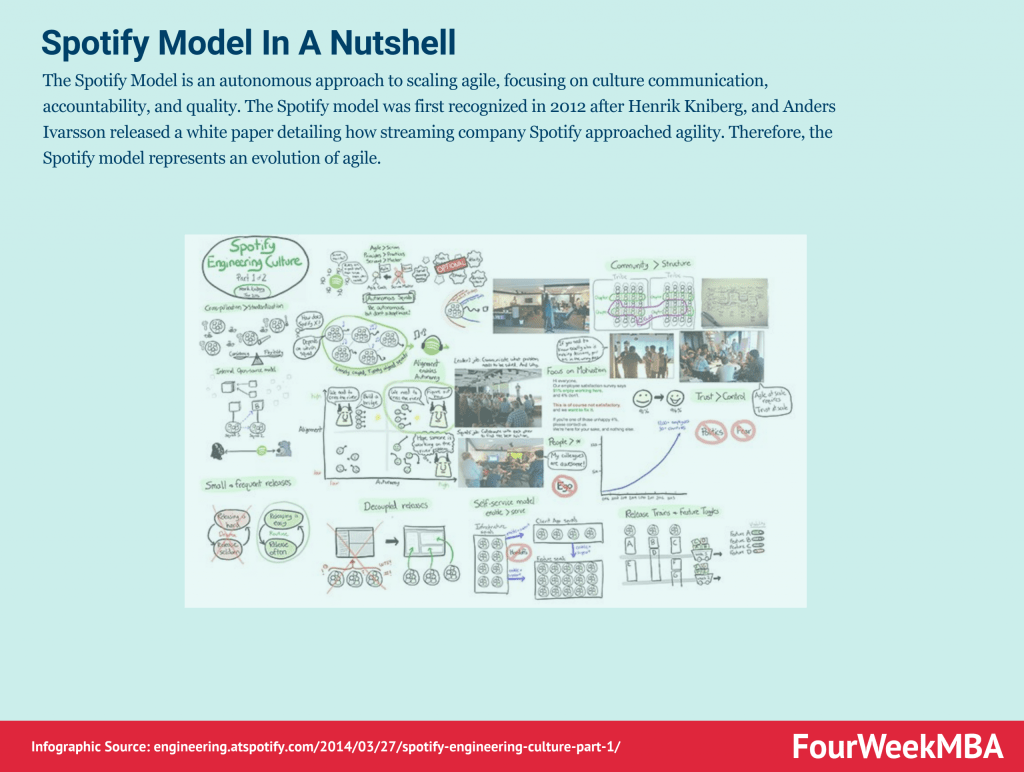
The Spotify Model is an autonomous approach to scaling agile, focusing on culture communication, accountability, and quality. The Spotify model was first recognized in 2012 after Henrik Kniberg, and Anders Ivarsson released a white paper detailing how streaming company Spotify approached agility. Therefore, the Spotify model represents an evolution of agile.
As the name suggests, TDD is a test-driven technique for delivering high-quality software rapidly and sustainably. It is an iterative approach based on the idea that a failing test should be written before any code for a feature or function is written. Test-Driven Development (TDD) is an approach to software development that relies on very short development cycles.
Timeboxing is a simple yet powerful time-management technique for improving productivity. Timeboxing describes the process of proactively scheduling a block of time to spend on a task in the future. It was first described by author James Martin in a book about agile software development.
Scrum is a methodology co-created by Ken Schwaber and Jeff Sutherland for effective team collaboration on complex products. Scrum was primarily thought for software development projects to deliver new software capability every 2-4 weeks. It is a sub-group of agile also used in project management to improve startups’ productivity.
Scrumban is a project management framework that is a hybrid of two popular agile methodologies: Scrum and Kanban. Scrumban is a popular approach to helping businesses focus on the right strategic tasks while simultaneously strengthening their processes.
Scrum anti-patterns describe any attractive, easy-to-implement solution that ultimately makes a problem worse. Therefore, these are the practice not to follow to prevent issues from emerging. Some classic examples of scrum anti-patterns comprise absent product owners, pre-assigned tickets (making individuals work in isolation), and discounting retrospectives (where review meetings are not useful to really make improvements).
Scrum at Scale (Scrum@Scale) is a framework that Scrum teams use to address complex problems and deliver high-value products. Scrum at Scale was created through a joint venture between the Scrum Alliance and Scrum Inc. The joint venture was overseen by Jeff Sutherland, a co-creator of Scrum and one of the principal authors of the Agile Manifesto.
Six Sigma is a data-driven approach and methodology for eliminating errors or defects in a product, service, or process. Six Sigma was developed by Motorola as a management approach based on quality fundamentals in the early 1980s. A decade later, it was popularized by General Electric who estimated that the methodology saved them $12 billion in the first five years of operation.
Stretch objectives describe any task an agile team plans to complete without expressly committing to do so. Teams incorporate stretch objectives during a Sprint or Program Increment (PI) as part of Scaled Agile. They are used when the agile team is unsure of its capacity to attain an objective. Therefore, stretch objectives are instead outcomes that, while extremely desirable, are not the difference between the success or failure of each sprint.
The Toyota Production System (TPS) is an early form of lean manufacturing created by auto-manufacturer Toyota. Created by the Toyota Motor Corporation in the 1940s and 50s, the Toyota Production System seeks to manufacture vehicles ordered by customers most quickly and efficiently possible.
The Total Quality Management (TQM) framework is a technique based on the premise that employees continuously work on their ability to provide value to customers. Importantly, the word “total” means that all employees are involved in the process – regardless of whether they work in development, production, or fulfillment.
The waterfall model was first described by Herbert D. Benington in 1956 during a presentation about the software used in radar imaging during the Cold War. Since there were no knowledge-based, creative software development strategies at the time, the waterfall method became standard practice. The waterfall model is a linear and sequential project management framework.
Gennaro is the creator of FourWeekMBA, which reached about four million business people, comprising C-level executives, investors, analysts, product managers, and aspiring digital entrepreneurs in 2022 alone | He is also Director of Sales for a high-tech scaleup in the AI Industry | In 2012, Gennaro earned an International MBA with emphasis on Corporate Finance and Business Strategy.