E-commerce, short for electronic commerce, refers to the buying and selling of goods and services over the internet.
It encompasses various online transactions, including retail sales, digital downloads, subscription services, and business-to-business (B2B) transactions.
E-commerce has transformed the way consumers shop and businesses operate, offering convenience, accessibility, and global reach in the digital marketplace.
Company
Key Characteristics and Business Strategies
Core Value Proposition
Customer Segments
Distribution Channels
Amazon
1. Vast Product Selection: Amazon offers a wide range of products. 2. Prime Membership: Membership with benefits like free shipping. 3. Marketplace: Third-party sellers can list products.
Providing a one-stop-shop for consumers with extensive product options, convenience, and Prime benefits like fast shipping and streaming services.
Online shoppers, Prime members
Online platform, mobile app, Amazon Web Services (AWS).
Alibaba
1. B2B and B2C Marketplace: Alibaba operates e-commerce platforms for businesses and consumers. 2. Global Expansion: Expanding globally. 3. Payment Services: Offering payment solutions.
Connecting businesses and consumers worldwide, facilitating global trade, and offering a range of services including e-commerce and finance.
Businesses, consumers
Online platforms, mobile apps, AliExpress, Alipay.
eBay
1. Auction and Buy-It-Now: eBay offers both auction-style and fixed-price listings. 2. Seller Community: Empowering individual sellers. 3. Global Marketplace: Access to international buyers.
Creating a global marketplace where individuals can buy and sell a wide range of products through auctions, fixed-price listings, and a vibrant seller community.
Individual sellers, collectors, bargain hunters
Online platform, mobile app, seller tools.
Walmart
1. Brick-and-Mortar Presence: Walmart combines online and in-store shopping. 2. Everyday Low Prices: Focus on affordability. 3. eCommerce Expansion: Expanding its online presence.
Offering a combination of physical and online shopping, providing affordability, and increasing convenience through various fulfillment options and services.
Bargain shoppers, families
Online platform, mobile app, brick-and-mortar stores.
Shopify
1. eCommerce Platform: Shopify provides tools for businesses to set up online stores. 2. Customization: Users can design their storefronts. 3. Payments: Integrated payment solutions.
Empowering entrepreneurs and businesses to create customized online stores with ease, offering a range of e-commerce tools and payment options.
Entrepreneurs, small to medium-sized businesses
Online platform, mobile app, Shopify Payments.
Zalando
1. Fashion Focus: Zalando specializes in fashion and apparel. 2. Marketplace: Partnering with various brands and sellers. 3. Personalized Shopping: Tailored product recommendations.
Offering a fashion-focused online marketplace with a wide range of brands, personalized shopping experiences, and convenient delivery and return options.
Fashion-conscious shoppers
Online platform, mobile app.
Rakuten
1. Reward Program: Rakuten offers a loyalty program for users. 2. Global Expansion: Expanding into international markets. 3. Diverse Offerings: A wide range of products and services.
Providing users with rewards and incentives for shopping, along with access to a diverse range of products and services through its marketplace.
Online shoppers, loyalty program members
Online platform, mobile app.
Etsy
1. Handmade and Unique Items: Etsy is known for its unique and handmade products. 2. Seller Community: Supporting independent sellers. 3. Vintage: Offering vintage items.
Connecting buyers with sellers offering unique, handmade, and vintage products, fostering a sense of community and creativity in e-commerce.
1. Fashion and Beauty Focus: ASOS specializes in fashion and beauty products. 2. Global Reach: Shipping to many countries. 3. Branded and Own Label: Offering both branded and ASOS label items.
Offering a wide selection of fashion and beauty products, global accessibility, and a blend of branded and own-label items, targeting style-conscious shoppers.
Fashion enthusiasts, trend followers
Online platform, mobile app.
JD.com
1. eCommerce Giant: JD.com is one of China’s largest e-commerce platforms. 2. Fast Delivery: Emphasis on speedy delivery. 3. Own Logistics: Owning its logistics network.
Providing a wide range of products with a focus on speedy and reliable delivery, ensuring quality control, and leveraging an extensive logistics network in China.
Chinese consumers, online shoppers
Online platform, mobile app, JD Logistics.
Taobao
1. Online Marketplace: Taobao is a popular online marketplace in China. 2. C2C and B2C: Supporting consumer-to-consumer and business-to-consumer transactions. 3. Discounts: Offering competitive prices.
Offering a vast online marketplace where individuals and businesses can buy and sell products, often at competitive prices, catering to a wide range of consumer needs.
Chinese consumers, sellers, bargain hunters
Online platform, mobile app.
Farfetch
1. Luxury Fashion: Farfetch specializes in luxury fashion and designer items. 2. Global Boutiques: Partnering with global boutiques and brands. 3. Curated Selection: Offering carefully curated items.
Providing access to a curated selection of luxury fashion items from global boutiques, enhancing the luxury shopping experience with a wide range of unique products.
Luxury fashion enthusiasts, collectors
Online platform, mobile app.
Newegg
1. Electronics and Tech Focus: Newegg specializes in electronics and tech products. 2. Tech Community: Catering to tech enthusiasts. 3. Product Reviews: Providing detailed product information.
Focusing on electronics and tech products, catering to tech-savvy consumers, and offering detailed product information and a supportive tech community.
Tech enthusiasts, gamers
Online platform, mobile app.
Wayfair
1. Home Furnishings: Wayfair focuses on home furnishings and decor. 2. Vast Catalog: Offering a vast range of products. 3. Personalized Recommendations: Tailoring shopping experiences.
Specializing in home furnishings and decor, providing a wide product selection, and enhancing the shopping journey with personalized recommendations and insights.
Homeowners, interior decorators
Online platform, mobile app.
ThredUp
1. Secondhand Fashion: ThredUp is a leading platform for secondhand fashion. 2. Sustainability: Promoting sustainable shopping. 3. Convenience: Simplifying the thrift shopping experience.
Offering sustainable and affordable secondhand fashion, promoting eco-conscious shopping choices, and making thrift shopping convenient and accessible to all.
Sustainable shoppers, budget-conscious buyers
Online platform, mobile app.
Instacart
1. Grocery Delivery: Instacart focuses on grocery delivery and pick-up. 2. Retail Partnerships: Partnering with various grocery stores. 3. Convenience: Simplifying grocery shopping.
Offering convenient and fast grocery delivery from local stores, partnering with various retailers, and making grocery shopping hassle-free and time-saving for consumers.
Busy individuals, families
Mobile app, online platform.
Wish
1. Affordable Shopping: Wish offers affordable products from various sellers. 2. Mobile Shopping: Primarily accessed via mobile. 3. Discounts: Providing discounted prices.
Making shopping more affordable by connecting consumers with sellers offering a wide range of products at competitive prices, primarily through mobile devices.
Budget-conscious shoppers, deal hunters
Mobile app, online platform.
Coupang
1. South Korean eCommerce: Coupang is a major e-commerce player in South Korea. 2. Rocket Delivery: Fast and reliable delivery service. 3. Tech Integration: Utilizing technology for efficiency.
Offering a diverse range of products with a focus on fast and efficient delivery, enhancing the overall e-commerce experience with technology-driven solutions in South Korea.
South Korean consumers, online shoppers
Online platform, mobile app, Rocket Delivery.
Shopbop
1. Fashion and Accessories: Shopbop specializes in fashion and accessories. 2. Designer Brands: Offering products from designer brands. 3. Global Shipping: Delivering worldwide.
Providing a curated selection of fashion and accessories from top designer brands, catering to a global audience and offering high-end fashion choices.
E-commerce platforms serve as digital storefronts where businesses showcase their products and services to online shoppers.
These platforms provide features such as product listings, search functionality, and secure payment gateways, enabling users to browse, select, and purchase items from anywhere at any time.
Personalization and Recommendation:
E-commerce leverages data analytics and artificial intelligence to personalize the shopping experience and provide tailored product recommendations to customers.
Algorithms analyze user behavior, preferences, and purchase history to offer relevant suggestions, discounts, and promotions, increasing engagement and conversion rates.
Logistics and Fulfillment:
E-commerce relies on efficient logistics and fulfillment networks to deliver orders to customers’ doorsteps in a timely and cost-effective manner.
Fulfillment centers, transportation services, and last-mile delivery solutions optimize the supply chain and ensure seamless order fulfillment and customer satisfaction.
Key Features of E-commerce:
Multi-channel Presence:
E-commerce enables businesses to establish a presence across multiple online channels, including websites, mobile apps, social media platforms, and online marketplaces.
Omni-channel strategies integrate these channels to provide a seamless shopping experience across devices and touchpoints, enhancing customer engagement and loyalty.
Payment Options and Security:
E-commerce platforms offer a variety of payment options, including credit cards, digital wallets, bank transfers, and alternative payment methods.
Secure payment processing systems and encryption technologies protect sensitive financial information and ensure safe and secure transactions for both buyers and sellers.
Customer Support and Service:
E-commerce platforms provide customer support and service through various channels, including live chat, email, phone, and self-service portals.
Prompt assistance, order tracking, and hassle-free returns and exchanges enhance the shopping experience and build trust and loyalty among customers.
Benefits of E-commerce:
Global Reach and Accessibility:
E-commerce transcends geographical boundaries, allowing businesses to reach customers anywhere in the world and expand their market reach.
Online storefronts are accessible 24/7, providing convenience and flexibility for shoppers to browse and purchase products at their convenience.
Cost Efficiency and Scalability:
E-commerce reduces overhead costs associated with traditional brick-and-mortar retail, such as rent, utilities, and staffing.
Scalable infrastructure, automated processes, and digital marketing strategies enable businesses to grow and adapt to changing market demands without significant capital investment.
Data Insights and Analytics:
E-commerce platforms generate valuable data insights and analytics that help businesses understand customer behavior, preferences, and trends.
Data-driven decision-making allows businesses to optimize marketing campaigns, product offerings, and pricing strategies to maximize sales and profitability.
Challenges of E-commerce:
Competition and Saturation:
E-commerce markets are highly competitive, with numerous businesses vying for customers’ attention and market share.
Standing out in a crowded marketplace requires differentiation, innovation, and strategic marketing to attract and retain customers.
Cybersecurity Threats:
E-commerce platforms are vulnerable to cybersecurity threats such as data breaches, phishing attacks, and fraud.
Protecting customer data, securing payment systems, and implementing robust security measures are essential to mitigate risks and maintain trust and credibility with customers.
Logistics and Supply Chain Constraints:
E-commerce relies on efficient logistics and supply chain operations to fulfill orders and deliver goods to customers in a timely manner.
Challenges such as inventory management, shipping delays, and last-mile delivery issues can impact customer satisfaction and retention.
Case Studies of E-commerce:
Amazon:
Amazon is a global e-commerce giant that offers a wide range of products and services through its online marketplace.
The company’s Prime subscription service provides fast and free shipping, streaming media, and other benefits, driving customer loyalty and retention.
Alibaba:
Alibaba is a Chinese e-commerce conglomerate that operates online marketplaces, cloud computing services, and digital payment platforms.
The company’s Singles’ Day shopping event is one of the largest online shopping festivals in the world, generating billions of dollars in sales annually.
Shopify:
Shopify is a leading e-commerce platform that enables businesses to create and manage online stores with ease.
The platform provides a range of tools and features for website customization, payment processing, and order management, empowering entrepreneurs to start and scale their e-commerce businesses.
Conclusion:
E-commerce has revolutionized retail and commerce in the digital age, offering businesses and consumers unprecedented convenience, accessibility, and global reach. By embracing principles such as digital storefronts, personalization, and logistics optimization, e-commerce platforms provide seamless shopping experiences and drive growth and innovation in the marketplace. While challenges such as competition, cybersecurity threats, and logistics constraints exist, the benefits of e-commerce in terms of global reach, cost efficiency, and data-driven insights make it a strategic imperative for businesses seeking to thrive in today’s digital economy. Ultimately, by leveraging e-commerce technologies and strategies, businesses can unlock new opportunities for growth, resilience, and customer satisfaction in the ever-evolving landscape of online commerce.
Alipay is a Chinese mobile and online payment platform created in 2004 by entrepreneur Jack Ma as the payment arm of Taobao, a major Chinese eCommerce site. Alipay, therefore, is the B2C component of Alibaba Group. Alipay makes money via escrows transaction fees, a range of value-added ancillary services, and through its Credit Pay Instalment fees.Taobao is a Chinese eCommerce website, and it is among the most visited websites in the world. Within it also comprises its payment arm, Alipay. Taobao is part of the Alibaba Group, founded by Chinese tech entrepreneur Jack Ma. The company makes money via its Tmalls (e-commerce platform), and through Alipay, mostly via its Escrow service fees.
Google has a diversified business model, primarily making money via its advertising networks that, in 2019, generated over 83% of its revenues, which also comprise YouTube Ads. Other revenue streams include Google Cloud, Hardware, Google Playstore, and YouTube Premium content. In 2019 Google made over $161 billion in total revenues.
Amazon has a diversified business model. Amazon’s primary revenue streams comprise its e-commerce platform, made of Amazon labeled products and Amazon third-party stores. In addition to that, Amazon makes money via third-party seller services (like fulfilled by Amazon), advertising on its platform, AWS cloud platform, and Prime membership. Amazon is a consumer e-commerce platform with a diversified business model spanning across e-commerce, cloud, advertising, streaming, and more. Over the years, Amazon acquired several companies. As it operates across several industries, Amazon has a wide range of competitors across each of those industries. For instance, Amazon E-commerce competes with Shopify, Wix, Google, Etsy, eBay, BigCommerce.
While from a superficial look at its revenues streams, Best Buy seems the same company it was back in 2012. In reality, in the last decade, Best Buy has gone through a massive transformation of its business model.
Carvana is online-based used car retailer known for its collection of 24 used car vending machines. Carvana makes money when the company can sell a car for more than it paid, thus making a profit. Carvana also makes money by charging interest on their car finance options.
Craiglist is a local posting website that enables people to post any sort of classifieds on the platform, mostly for free, except for some categories of ads and the advertising of vehicles on the website. Therefore, craigslist monetizes based on some premium categories of listings (like job postings or apartment rentals).
eBay core business is a platform business model that makes money from transaction fees happening through its marketplaces (eBay and StubHub). eBay also makes money through advertising on its classifieds marketplace and other services. The company primarily makes money by charging fees on successfully closed transactions.
Etsy is a two-sided marketplace for unique and creative goods. As a marketplace, it makes money via transaction fees on the items sold on the platform. Etsy’s key partner is comprised of sellers providing unique listings, and a wide organic reach across several marketing channels.
With one of the broadest audiences and psychographics on earth, Facebook is still one of the most effective marketing platforms for brands to build both brand awareness and sales funnels. As part of a digital marketingstrategy, leveraging social media can effectively build a solid company. Instagram makes money via visual advertising. As part of Facebook products, the company generates revenues for Facebook Inc. overall business model. Acquired by Facebook for a billion dollar in 2012, today Instagram is integrated into the overall Facebook business strategy. In 2018, Instagram founders, Kevin Systrom and Mike Krieger, left the company, as Facebook pushed toward tighter integration of the two platforms. Founded in 2009 by Brian Acton, Jan Koum WhatsApp is a messaging app acquired by Facebook in 2014 for $19B. In 2018 WhatsApp rolled out customers’ interaction services. WhatsApp might be transitioning toward a set of features from video chats to social commerce that might transform WhatsApp into a Super App.
Pinterest makes money by selling advertising for marketers and companies that can gain visibility for their brands and more sales for their shops. In 2018, Pinterest made over $755 million in advertising revenue and it had 250 million monthly active users.
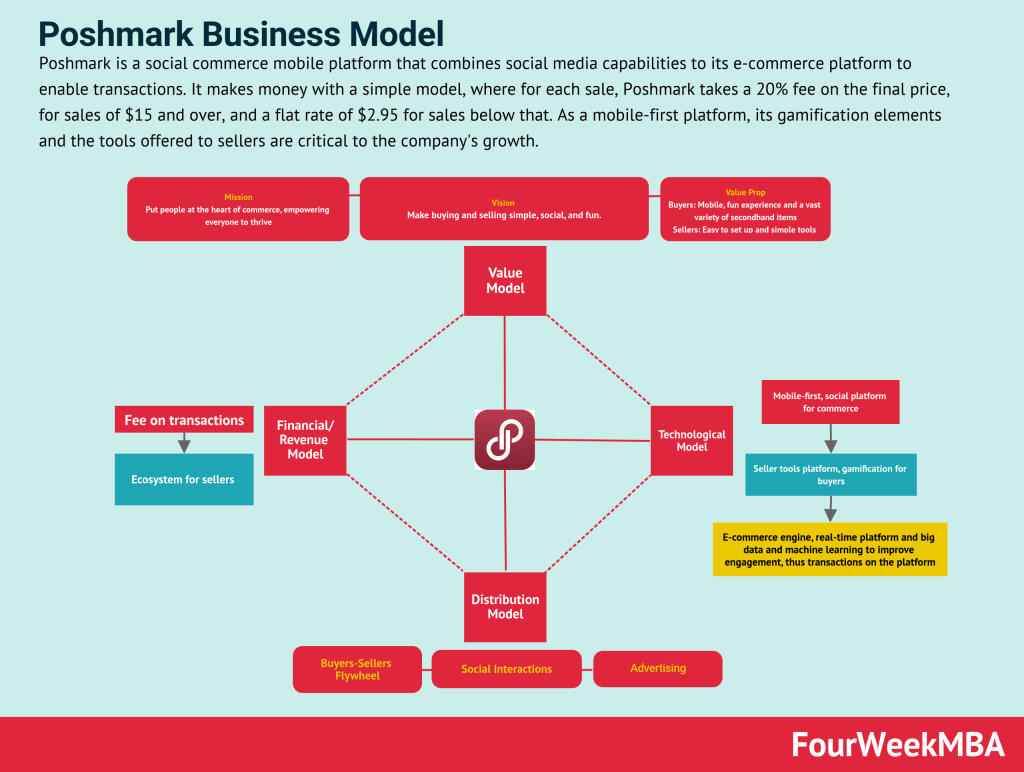
Poshmark is a social commerce mobile platform that combines social media capabilities to its e-commerce platform to enable transactions. It makes money with a simple model, where for each sale, Poshmark takes a 20% fee on the final price, for sales of $15 and over, and a flat rate of $2.95 for sales below that. As a mobile-first platform, its gamification elements and the tools offered to sellers are critical to the company’s growth.
Postmates is a food delivery service built as a last-mile delivery service platform connecting locals with shops. Postmates makes money by collecting fees (commission, delivery, service, cart, and cancellation fees). It also makes money via its subscription service (called Unlimted – $9.99/month or $99.99 annually) giving free delivery on every order of more than $12.
Shopify is an e-commerce platform enabling merchants to commercialize their products via a monthly subscription fee, and additional services provided by the platform. Its core business is subscription-based, even though in 2018, the company made over 50% of its revenues from another stream called merchant solutions.In just fifteen short years, Shopify has grown from humble beginnings to become one of the fastest-growing eCommerce platforms online. The Shopify eCommerce solution is perhaps best suited to users who desire an easy, flexible and affordable starter solution for their online store. The provider now has upwards of 820,000 stores accounting for 20% of the total market share. However, the continued success of any company in the dynamic digital market is never guaranteed.
Squarespace is a North American hosting and website building company. Founded in 2004 by college student Anthony Casalena as a blog hosting service, it grew to become among the most successful website building companies. The company mostly makes money via its subscription plans. It also makes money via customizations on top of its subscription plans. And in part also as transaction fees for the website where it processes the sales.
Tencent is a Chinese multinational conglomerate founded in 1998 by Ma Huateng, Zhang Zhidong, and Xu Chenye. Among its various global subsidiaries are companies in the online services, music, and artificial intelligence industries. But it is perhaps best known for its interest in the video game sector – both as a game developer for the Chinese market and the acquirer of several established gaming companies. Tencent is a vast company with a stake in more than 600 companies. Following is a look at some of the companies and subsidiaries it has a majority stake in.WeChat is a “super app” or an app that can do many things, from messaging to mobile payments and social media. Developed by Tencent, WeChat is among the most popular Super Apps in China. WeChat makes money via value-added services (with services like Moments, Public Accounts, and Gaming), advertising, and payments on the transaction processed through it.
Vinted is an online shopping marketplace with a strong secondhand component. The company makes money via its buyer protection service. The buyer pays a fee to Vinted in exchange for services like customer support, insurance, and tracked shipping; Shipping costs; Wardrobe Spotlight (helping users boost the visibility of their items). And Bumping listed items.
Vroom runs a peer-to-peer e-commerce platform selling used vehicles. The company makes money through the sales of used vehicles that passed the quality standards to be sold on the platform; Wholesale auction revenues for vehicles that didn’t meet quality standards to be sold directly on the platform; and fees from value-added products (insurance and financing).
With over $495 in net sales as of January 2018, and over $4.5 billion coming from Membership and other income. The company operates three primary units that in 2018 comprise Walmart U.S. (approximately 64% of our net sales), Walmart International (about 24% of net sales), and Sam’s Club (approximately 12% of its net sales) a membership-only warehouse clubs and operates in 44 states in the U.S. and in Puerto Rico, as well as eCommerce.
Wish is a mobile-first e-commerce platform in which users’ experience is based on discovery and customized product feed. Wish makes money from merchants’ fees and merchants’ advertising on the platform and logistic services. The mobile platform also leverages an asset-light business model based on a positive cash conversion cycle where users pay in advance as they order goods, and merchants are paid in weeks.
Zalando is a multi-national eCommerce company founded in 2008 by David Schneider and Robert Gentz, created under the name Ifansho, changed to Zalando as a reference to the Italian word zalare – or “making jokes”. Zalando generates revenues by purchasing stock and then selling it for a profit. Zalando also charges brands it partners with a commission for the privilege of selling on its platform. The commission Zalando collects on each sale is undisclosed. Zalando also collects advertising revenue from ads placed on its website and app.
Gennaro is the creator of FourWeekMBA, which reached about four million business people, comprising C-level executives, investors, analysts, product managers, and aspiring digital entrepreneurs in 2022 alone | He is also Director of Sales for a high-tech scaleup in the AI Industry | In 2012, Gennaro earned an International MBA with emphasis on Corporate Finance and Business Strategy.