Data monetization describes the process of a business using data to obtain an economic benefit. In essence, data monetization is the process of utilizing data to increase revenue. According to management firm McKinsey & Company, an increasing share of the most successful companies in the world incorporate data and analytics to fuel their growth.
Aspect
Explanation
Definition
Data monetization refers to the process of generating revenue or extracting value from the data an organization collects or possesses. It involves identifying opportunities to leverage data assets for financial gain, either by selling data directly, using data to enhance existing products and services, or creating new data-driven offerings. Data monetization has become increasingly important in the digital age as organizations recognize the value of data as a strategic asset. It encompasses various approaches, including data sales, data analytics services, data-driven advertising, and more. Successful data monetization requires a clear strategy, data privacy compliance, and the ability to extract meaningful insights from data.
Key Concepts
– Data Assets: Organizations possess data assets that can be transformed into valuable resources. – Data Value Chain: The process of data collection, storage, analysis, and application to create value. – Monetization Models: Various models, such as data sales, data licensing, subscription models, and data analytics services. – Data Privacy: Compliance with data privacy regulations to protect consumer information. – Data-Driven Innovation: Leveraging data for new product development, improved decision-making, and enhanced customer experiences. – Data Marketplace: Platforms or exchanges facilitating the buying and selling of data.
Characteristics
– Data Variety: Data monetization encompasses structured, unstructured, and semi-structured data. – Analytics Capabilities: The ability to extract insights from data is essential. – Data Governance: Proper management, quality control, and privacy compliance are critical. – Business Model Diversity: Different organizations adopt various data monetization models based on their industries and objectives. – Value Creation: Data monetization creates value not only through sales but also through improved operations and decision-making.
Implications
– Revenue Generation: Data monetization can be a significant source of revenue for organizations. – Competitive Advantage: Effectively leveraging data assets can provide a competitive edge. – Enhanced Customer Experiences: Data-driven insights lead to improved customer experiences. – Innovation: Data can fuel innovation and the development of new products and services. – Data Privacy: Organizations must prioritize data privacy and security to avoid legal and reputational risks.
Advantages
– Revenue Generation: Data monetization offers opportunities to generate revenue streams beyond core business activities. – Enhanced Insights: Extracting insights from data can lead to more informed decision-making. – Competitive Edge: Effective data monetization can provide a competitive advantage in the market. – Innovation: Data-driven innovation can lead to the development of new products and services. – Value Creation: Data monetization can create value not only for the organization but also for customers and partners.
Drawbacks
– Data Privacy Risks: Mishandling of data can lead to data privacy breaches and legal consequences. – Data Quality Issues: Poor data quality can result in inaccurate insights and decisions. – Data Monetization Costs: Developing data monetization capabilities can be costly. – Market Saturation: In some industries, data markets can become saturated, making it challenging to stand out. – Ethical Considerations: Balancing data monetization with ethical use of customer data is crucial for reputation and trust.
Applications
Data monetization is applied across various industries, including finance, healthcare, e-commerce, advertising, and more. It is used for purposes such as targeted marketing, risk assessment, personalized recommendations, and predictive analytics.
Use Cases
– Data Sales: Organizations sell their data to other businesses, researchers, or third-party data brokers. – Data Analytics Services: Providing data analytics services to other organizations seeking insights from their data. – Data-Driven Advertising: Using data to target advertising to specific audiences. – Subscription Models: Offering access to data through subscription-based services. – Product Enhancement: Using data to improve existing products or create new ones. – Risk Assessment: In industries like insurance, data is used for risk assessment and pricing. – Healthcare Analytics: Analyzing healthcare data to improve patient outcomes and reduce costs. – Smart Cities: Leveraging data for urban planning and improving city services.
Data is becoming increasingly ubiquitous as the widespread adoption of big data systems and Internet of Things (IoT) devices allow consumers and businesses alike to collect data on anything and everything. In fact, it is estimated that the world creates around 2.5 million terabytes of data every day, with more than 90% created in the past two years.
Despite the relative ease with which data can be collected and analyzed, the practice of monetizing data remains relatively uncommon. Research out of Germany discovered that less than one in five companies had established data monetization initiatives and a mere 0.5% use data in decision making. Instead, most companies spend vast amounts of time and money storing their data instead of determining how they can make money from it.
Data has undebatable intrinsic value, but the most value is derived when the business demonstrates the ability to derive insights from that data and monetize it accordingly.
How is data monetized?
Different data monetization methods will be appropriate to different companies according to their particular business strategies, growth stage, or industry.
Here are a few ways data can be monetized:
Data as a service – the most simple method where data is sold to customers in a raw, anonymous, or aggregate form. The customer is responsible for analyzing the data to facilitate a financial gain.
Analytics-enabled platform as a service – these are platforms sold to customers that provide scalable and versatile data analytics in real-time. They can be cloud-based or installed on-premise and can incorporate a wide array of data formats.
Insight as a service – where internal and external data sources are combined and analyzed to generate insights. This method tends to be confined to specific contexts and datasets. For example, John Deere combined external soil and weather data with internal crop timing and fertilizer usage data to create an intelligent farming system that is sold to farmers
How can businesses successfully incorporate data monetization?
To understand how a business can incorporate data monetization, consider these pointers:
Understand the role and value of data
In theory, data should facilitate business performance, reduce risk, and prove compliance. However, this can only occur when the business understands the relevance of its data and how valuable it is. Some companies fail to realize this as they do not consider data to be an asset.
Data monetization must be embedded into strategy
Business strategy should always be underpinned by data management initiatives and vice versa. It is important management understands how data is connected to strategy before it implements structures to monetize it.
This requires the company to assemble a cross-functional, multi-disciplinary team with members from sales, marketing, operations, and data management.
Communicating the value of data to facilitate growth
As the studies mentioned in previous sections have demonstrated, data monetisation remains a mystery in some organizations. Even when the practice is in place, employees may not understand the underlying reasons for its success.
Communicating the value of data monetisation to internal and external stakeholders will become paramount in ensuring market competitiveness, among other things.
Key takeaways:
Data monetization describes the process of a business using data to obtain an economic benefit. Despite the relative ease with which data can now be collected, the practice remains relatively uncommon.
Data monetization can be monetized in a few different ways. These include data as a service, analytics-enabled platform as a service, and insight as a service.
To ensure businesses make the most of their data, it is important they first understand its role and value. Data and business strategy must also support each other and the value of data should be understood by internal and external stakeholders.
Related Concepts
Description
When to Apply
Data Monetization
Data monetization is the process of generating revenue or economic value from data assets. It involves leveraging data resources, such as customer information, transaction records, or sensor data, to create new revenue streams, improve operational efficiency, or enhance decision-making. Data monetization strategies may include selling data products, licensing data access, or using data analytics to optimize business processes and customer experiences.
Apply in organizations seeking to capitalize on their data assets to drive business growth and innovation. Data monetization initiatives can help maximize the value of data assets, generate additional revenue, or gain competitive advantages in the marketplace. Understanding data monetization strategies informs data-driven business models, investment decisions, and digital transformation efforts aimed at harnessing the potential of big data and analytics.
Data Assets
Data assets refer to the digital resources or information assets that organizations collect, store, and analyze to support their business operations and strategic objectives. Data assets include various types of structured and unstructured data, such as customer demographics, purchase history, social media interactions, or IoT sensor readings, which hold value for decision-making and insight generation.
Apply when assessing an organization’s data ecosystem and identifying valuable data assets that can be leveraged for monetization opportunities. Data assets play a crucial role in drivingbusiness value, innovation, and competitive advantage, making it essential to manage and optimize them effectively through data governance, quality management, and strategic alignment with business goals.
Revenue Streams
Revenue streams are the sources of income or financial gains that organizations derive from their products, services, or assets. In the context of data monetization, revenue streams may come from selling data products, licensing data access, monetizingdata insights, or using data analytics to optimize revenue-generating processes. Diversifying revenue streams through data monetization can increaseprofitability and resilience in competitive markets.
Apply when exploring opportunities to diversifyrevenue and unlockadditionalvalue from data assets. Identifying and capitalizing on new revenue streams through data monetization requires strategicplanning, marketanalysis, and alignment with customer needs and market trends. Developing innovativebusiness models and partnerships can further enhancerevenue generation and sustainable growth through data-drivenstrategies.
Business Growth
Business growth refers to the expansion or development of a company or organization over time, typically measured by increases in revenue, market share, customer base, or productportfolio. Data monetization can fuel business growth by unlockingnew revenue streams, improving operational efficiency, and enablingdata-driveninnovation and decision-making.
Apply when planning and executingstrategies to scalebusiness operations, enter new markets, or diversifyproduct offerings. Data-drivengrowth initiatives leverage data analytics, market insights, and customer intelligence to identifyopportunities, optimizeoperations, and enhancecustomer experiences. Embracing data-drivenculture and agilepractices fosters continuousimprovement and adaptation to changingmarket dynamics.
Innovation
Innovation refers to the creation or adoption of new ideas, products, processes, or business models that deliver value or addressunmet needs in the marketplace. Data monetization can drive innovation by leveragingdata analytics, machine learning, or AI to uncover insights, predicttrends, and personalizecustomer experiences. Innovativedatamonetizationstrategies can pioneernew markets and transformindustrypractices.
Apply when exploringopportunities to innovate and differentiateproducts or services through data-driveninsights and capabilities. Data-driveninnovation requires cross-functional collaboration, experimentation, and risk-taking to generatebreakthroughideas and solutions. Embracing emergingtechnologies and data-drivenapproaches fosters a culture of innovation, adaptation, and continuous learning to staycompetitive in dynamic markets.
Big Data Analytics
Big data analytics refers to the process of examininglargeandcomplex datasets to uncoverhidden patterns, trends, and insights that informbusinessdecisions and strategicinitiatives. Data monetization relies on advanced analytics techniques such as predictive modeling, data mining, or natural language processing to extract value from big data, enablepersonalization, and optimizeoperationalperformance.
Apply when leveragingbig dataanalytics to deriveactionable insights and createbusinessvalue from large and diverse datasets. Big data analytics empower organizations to identifyopportunities, mitigate risks, and improvedecision-making across variousfunctions, from marketing and sales to supply chainmanagement and customerservice. Investing in dataanalytics capabilities enhances competitiveadvantage and agility in data-drivenorganizations.
An effective business model has to focus on two dimensions: the people dimension and the financial dimension. The people dimension will allow you to build a product or service that is 10X better than existing ones and a solid brand. The financial dimension will help you develop proper distribution channels by identifying the people that are willing to pay for your product or service and make it financially sustainable in the long run.
Business modelinnovation is about increasing the success of an organization with existing products and technologies by crafting a compelling value proposition able to propel a new business model to scale up customers and create a lasting competitive advantage. And it all starts by mastering the key customers.
Digital and tech business models can be classified according to four levels of transformation into digitally-enabled, digitally-enhanced, tech or platform business models, and business platforms/ecosystems.
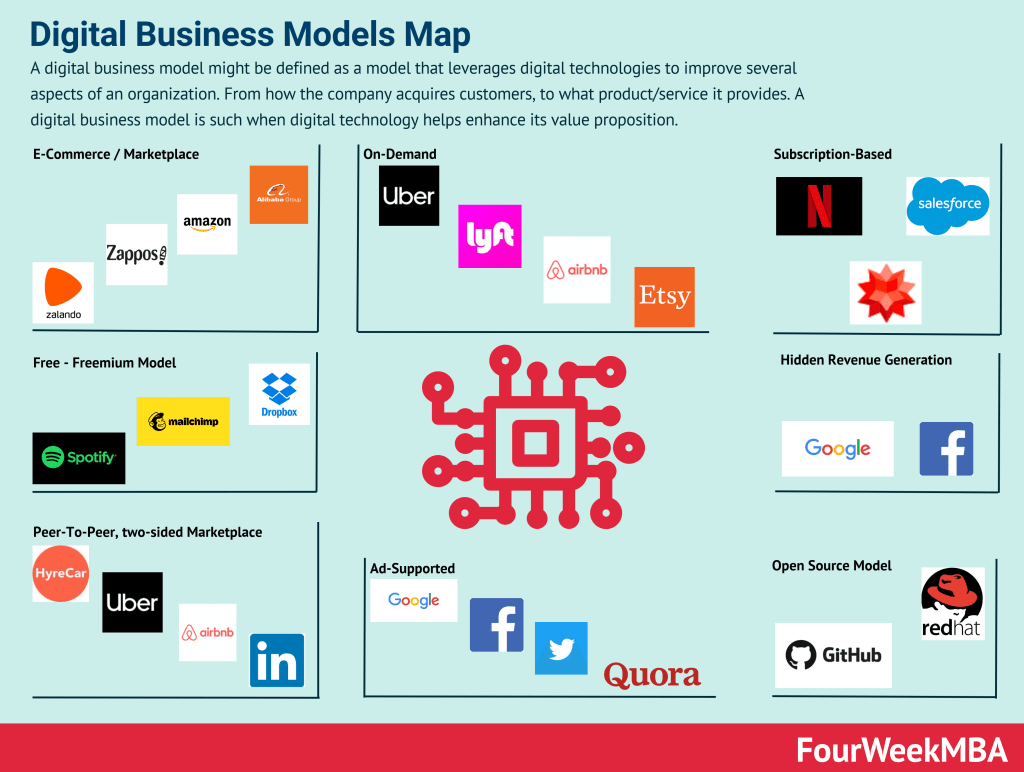
A digital business model might be defined as a model that leverages digital technologies to improve several aspects of an organization. From how the company acquires customers, to what product/service it provides. A digital business model is such when digital technology helps enhance its value proposition.
A tech business model is made of four main components: value model (value propositions, mission, vision), technological model (R&D management), distribution model (sales and marketingorganizational structure), and financial model (revenue modeling, cost structure, profitability and cash generation/management). Those elements coming together can serve as the basis to build a solid tech business model.
A platform business model generates value by enabling interactions between people, groups, and users by leveraging network effects. Platform business models usually comprise two sides: supply and demand. Kicking off the interactions between those two sides is one of the crucial elements for a platform business model success.
A Blockchain Business Model is made of four main components: Value Model (Core Philosophy, Core Value and Value Propositions for the key stakeholders), Blockchain Model (Protocol Rules, Network Shape and Applications Layer/Ecosystem), Distribution Model (the key channels amplifying the protocol and its communities), and the Economic Model (the dynamics through which protocol players make money). Those elements coming together can serve as the basis to build and analyze a solid Blockchain Business Model.
In an asymmetric businessmodel, the organization doesn’t monetize the user directly, but it leverages the data users provide coupled with technology, thus have a key customer pay to sustain the core asset. For example, Google makes money by leveraging users’ data, combined with its algorithms sold to advertisers for visibility.
In an asymmetric businessmodel, the organization doesn’t monetize the user directly, but it leverages the data users provide coupled with technology, thus having a key customer pay to sustain the core asset. For example, Google makes money by leveraging users’ data, combined with its algorithms sold to advertisers for visibility. This is how attention merchants make monetize their business models.
While the term has been coined by Andrew Lampitt, open-core is an evolution of open-source. Where a core part of the software/platform is offered for free, while on top of it are built premium features or add-ons, which get monetized by the corporation who developed the software/platform. An example of the GitLab open core model, where the hosted service is free and open, while the software is closed.
Cloud business models are all built on top of cloud computing, a concept that took over around 2006 when former Google’s CEO Eric Schmit mentioned it. Most cloud-based business models can be classified as IaaS (Infrastructure as a Service), PaaS (Platform as a Service), or SaaS (Software as a Service). While those models are primarily monetized via subscriptions, they are monetized via pay-as-you-go revenue models and hybrid models (subscriptions + pay-as-you-go).
Open source is licensed and usually developed and maintained by a community of independent developers. While the freemium is developed in-house. Thus the freemium give the company that developed it, full control over its distribution. In an open-source model, the for-profit company has to distribute its premium version per its open-source licensing model.
The freemium – unless the whole organization is aligned around it – is a growth strategy rather than a business model. A free service is provided to a majority of users, while a small percentage of those users convert into paying customers through the sales funnel. Free users will help spread the brand through word of mouth.
A freeterprise is a combination of free and enterprise where free professional accounts are driven into the funnel through the free product. As the opportunity is identified the company assigns the free account to a salesperson within the organization (inside sales or fields sales) to convert that into a B2B/enterprise account.
A marketplace is a platform where buyers and sellers interact and transact. The platform acts as a marketplace that will generate revenues in fees from one or all the parties involved in the transaction. Usually, marketplaces can be classified in several ways, like those selling services vs. products or those connecting buyers and sellers at B2B, B2C, or C2C level. And those marketplaces connecting two core players, or more.
B2B, which stands for business-to-business, is a process for selling products or services to other businesses. On the other hand, a B2C sells directly to its consumers.
A B2B2C is a particular kind of business model where a company, rather than accessing the consumer market directly, it does that via another business. Yet the final consumers will recognize the brand or the service provided by the B2B2C. The company offering the service might gain direct access to consumers over time.
Direct-to-consumer (D2C) is a business model where companies sell their products directly to the consumer without the assistance of a third-party wholesaler or retailer. In this way, the company can cut through intermediaries and increase its margins. However, to be successful the direct-to-consumers company needs to build its own distribution, which in the short term can be more expensive. Yet in the long-term creates a competitive advantage.
The C2C business model describes a market environment where one customer purchases from another on a third-party platform that may also handle the transaction. Under the C2C model, both the seller and the buyer are considered consumers. Customer to customer (C2C) is, therefore, a business model where consumers buy and sell directly between themselves. Consumer-to-consumer has become a prevalent business model especially as the web helped disintermediate various industries.
A retail business model follows a direct-to-consumer approach, also called B2C, where the company sells directly to final customers a processed/finished product. This implies a business model that is mostly local-based, it carries higher margins, but also higher costs and distribution risks.
The wholesale model is a selling model where wholesalers sell their products in bulk to a retailer at a discounted price. The retailer then on-sells the products to consumers at a higher price. In the wholesale model, a wholesaler sells products in bulk to retail outlets for onward sale. Occasionally, the wholesaler sells direct to the consumer, with supermarket giant Costco the most obvious example.
The term “crowdsourcing” was first coined by Wired Magazine editor Jeff Howe in a 2006 article titled Rise of Crowdsourcing. Though the practice has existed in some form or another for centuries, it rose to prominence when eCommerce, social media, and smartphone culture began to emerge. Crowdsourcing is the act of obtaining knowledge, goods, services, or opinions from a group of people. These people submit information via social media, smartphone apps, or dedicated crowdsourcing platforms.
In a franchained business model (a short-term chain, long-term franchise) model, the company deliberately launched its operations by keeping tight ownership on the main assets, while those are established, thus choosing a chain model. Once operations are running and established, the company divests its ownership and opts instead for a franchising model.
Businesses employing the brokerage business model make money via brokerage services. This means they are involved with the facilitation, negotiation, or arbitration of a transaction between a buyer and a seller. The brokerage business model involves a business connecting buyers with sellers to collect a commission on the resultant transaction. Therefore, acting as a middleman within a transaction.
Dropshipping is a retail business model where the dropshipper externalizes the manufacturing and logistics and focuses only on distribution and customer acquisition. Therefore, the dropshipper collects final customers’ sales orders, sending them over to third-party suppliers, who ship directly to those customers. In this way, through dropshipping, it is possible to run a business without operational costs and logistics management.
Gennaro is the creator of FourWeekMBA, which reached about four million business people, comprising C-level executives, investors, analysts, product managers, and aspiring digital entrepreneurs in 2022 alone | He is also Director of Sales for a high-tech scaleup in the AI Industry | In 2012, Gennaro earned an International MBA with emphasis on Corporate Finance and Business Strategy.