Both Apple and Microsoft have diversified business models.
Elements
Apple
Microsoft
Similarities
Differences
Competitive Advantage
Customer Segments
Consumer electronics, software, services
Software, cloud services, hardware
Both target consumers and businesses, offering a range of products and services.
Apple primarily focuses on consumer electronics, software, and services. Microsoft offers a wide array of software, cloud services, and hardware products targeting both consumers and enterprises.
Strong consumer electronics and software focus (Apple). Diverse software and cloud offerings (Microsoft).
Value Proposition
Innovative design, user experience, ecosystem
Software, productivity tools, cloud solutions
Both provide software solutions, but with different emphases.
Apple emphasizes innovative design, user experience, and its ecosystem (hardware, software, and services). Microsoft focuses on software, productivity tools, and cloud solutions, often integrating them to enhance business efficiency.
Ecosystem and user experience (Apple). Productivity and cloud solutions (Microsoft).
Channels
Apple Stores, online platforms, partnerships
Online platforms, channel partners, direct sales
Both use online platforms, partnerships, and direct sales channels for distribution.
Apple relies on its Apple Stores, online platforms, and partnerships for distribution. Microsoft leverages online platforms, channel partners, and direct sales to reach its target audience, particularly in the enterprise market.
Both offer customer support but with different delivery methods.
Apple emphasizes the in-person retail experience, complemented by customer support. Microsoft provides customer support and maintains customer relationships through licensing agreements, particularly for its software products.
Iconic retail stores and personal support (Apple). Licensing agreements and software support (Microsoft).
Key Activities
Hardware design, software development
Software development, cloud infrastructure
Both involve software development activities but differ in focus.
Apple’s key activities include hardware design (for products like iPhones and Macs) and software development for its ecosystem. Microsoft’s activities revolve around software development, cloud infrastructure management, and services that cater to businesses and consumers.
Hardware design and ecosystem development (Apple). Cloud infrastructure and enterprise focus (Microsoft).
Key Resources
Design talent, manufacturing facilities
Software engineers, cloud infrastructure
Both rely on their core resources.
Apple’s key resources include design talent for product innovation and manufacturing facilities for hardware production. Microsoft’s resources are primarily software engineers and cloud infrastructure for delivering its suite of software and services.
Design innovation and manufacturing (Apple). Software expertise and cloud infrastructure (Microsoft).
Key Partnerships
App developers, suppliers, app ecosystem
OEMs, software developers, strategic alliances
Both collaborate with partners to enhance their offerings.
Apple partners with app developers, suppliers, and maintains a robust app ecosystem. Microsoft collaborates with original equipment manufacturers (OEMs), software developers, and forms strategic alliances with other tech companies to expand its reach and integration across various platforms.
Strong app ecosystem and developer relationships (Apple). Extensive partnerships and integration (Microsoft).
Both generate revenue from hardware sales and services.
Apple generates revenue from hardware sales (e.g., iPhones, Macs), services (e.g., App Store, Apple Music), and app sales. Microsoft’s revenue streams include software licensing (e.g., Windows), cloud services (e.g., Azure), and hardware sales (e.g., Surface devices, Xbox).
Diverse revenue sources including services (Apple). Extensive software and cloud revenue (Microsoft).
Cost Structure
Manufacturing costs, R&D, marketing
R&D, cloud infrastructure, marketing
Both incur costs related to R&D, marketing, and infrastructure.
Apple’s cost structure includes manufacturing costs, extensive R&D investment, and marketing expenses for promoting its products and services. Microsoft’s cost structure comprises R&D expenses, cloud infrastructure maintenance, and marketing efforts for its software and cloud solutions.
Manufacturing and design costs (Apple). Cloud infrastructure and software development costs (Microsoft).
Though each of these companies has a core business.
For Microsoft, it’s the Windows set of products. While for Apple, it’s the iPhone, around which the company has developed a trillion-dollar mobile ecosystem.
Apple and Microsoft, while they might have some overlap, they are fundamentally different companies.
Microsoft is a software-first company, and while, over the years, it also started to develop its own line of PCs and tablets, it’s still primarily a software company.
Apple, on the other side, combines hardware, software, and marketplace to enhance a business ecosystem through its App store and iPhone.
Microsoft has been diversifying in various areas, also investing massively in new areas like AI, with the partnership with OpenAI.
Apple, on its side, has consolidated its business model through the mobile platform while it has been looking to expand into other platforms like AR and mixed reality.
Year
Apple
Google
2022
$394.33B
$198.27B
FourWeekMBA Intelligence – Data: Financials
Key Highlights
Apple:
Core Focus: Apple’s primary revenue driver is the iPhone, around which it has built a trillion-dollar ecosystem of hardware, software, and services.
Diversified Ecosystem: The iPhone ecosystem includes devices like Mac, iPad, Apple Watch, and services like App Store, iCloud, and Apple Music.
Revenue Breakdown: In 2022, Apple’s revenue exceeded $394 billion, with iPhone sales accounting for a significant portion, followed by services, Mac, iPad, and accessories.
Seamless Integration: Apple excels in creating a seamless user experience by tightly integrating its hardware, software, and services.
Expansion into AR: Apple has been exploring new frontiers, particularly in augmented reality (AR), hinting at its interest in future technologies beyond its current offerings.
Microsoft:
Diversified Business Model: Microsoft’s business spans software, cloud services, gaming (Xbox), professional networking (LinkedIn), and more.
Core Product: Microsoft’s flagship product is the Windows operating system, but it has expanded into cloud services (Azure), productivity software (Office), and hardware (Surface).
Revenue Streams: In 2021, Microsoft generated over $198 billion in revenue, with major contributions from cloud services, Office products, and server products.
AI Integration: Microsoft has invested in AI technologies, integrating them into products like Edge browser, Office suite, and its Azure cloud platform.
OpenAI Partnership: Microsoft partnered with OpenAI to advance AI technology, resulting in the Azure AI Supercomputer and integration of AI models into its products and services.
In Conclusion:
Apple’s success is anchored in its iPhone-driven ecosystem, with a strong emphasis on hardware, software, and services integration.
Microsoft’s strength lies in its diversified offerings, ranging from software and cloud services to gaming and professional tools, supported by strategic partnerships and AI integration.
Major shareholders comprise co-founder Bill Gates, who stepped down from the company’s board in 2020, which is why these shares are no longer publicly reported. In 2019, Gates still owned a stake of 103 million stocks, which accounted for 1.34% of the company’s ownership (worth over $23 billion in January 2023). Other individual shareholders comprise Satya Nadella, the company’s CEO, Brad Smith (former president), Jean-Philippe Courtois (EVP), and Amy Hood (former CFO).
In 2022, on over $198 billion in revenue, Microsoft generated over $72.7 billion. The company had over $104 billion in liquid assets (which can be easily converted into cash).
Microsoft is among the largest companies on earth, with a diversified portfolio. Owned by billionaire Bill Gates, Microsoft acquired other companies like LinkedIn, GitHub, Skype, and more over the years. Today, Microsoft is a tech empire that spans software, social media, gaming, and more.
Microsoft’s first acquisition in 1987, Forethought, was the developer of a presentation program that would later become PowerPoint. Since then, the company has made an average of six purchases every year, with fourteen of those exceeding the $1 billion mark. Today’s Microsoft business model spans various segments thanks to an acquisition strategy, which saw Microsoft involved in multiple acquisitions.
Microsoft’s mission is to empower every person and every organization on the planet to achieve more. With over $110 billion in revenues in 2018, Office Products and Windows are still the main products. Yet the company also operates in Gaming (Xbox), Search Advertising (Bing), Hardware, LinkedIn, Cloud, and more.
Microsoft has a diversified businessmodel, spanning from Office to gaming (with Xbox), LinkedIn, search (with Bing), and enterprise services (with GitHub). In 2021, Microsoft made over $168 billion in revenues, of which over $52 billion came from Server products and cloud services, and $39.8 billion came from Office products and cloud services. Windows generated over $23 billion, Gaming generated over $15 billion, LinkedIn over $10 billion, and search advertising (through Bing) over $8.5 billion.
Founded in 1975 by Bill Gates and Paul Allen, Microsoft is a revolutionary company in the world of personal computing. The company designs and manufactures software, hardware, operating systems, apps, and devices. Indeed, Windows and Microsoft Office are staples in billions of homes worldwide.
Microsoft has a product-type divisional organizational structure based on functions and engineering groups. As the company scaled over time, it also became more hierarchical while maintaining its hybrid approach between functions, engineering groups, and management.
OpenAI is an artificial intelligence research laboratory that transitioned into a for-profit organization in 2019. The corporate structure is organized around two entities: OpenAI, Inc., which is a single-member Delaware LLC controlled by OpenAI non-profit, And OpenAI LP, which is a capped, for-profit organization. The OpenAI LP is governed by the board of OpenAI, Inc (the foundation), which acts as a General Partner. At the same time, Limited Partners comprise employees of the LP, some of the board members, and other investors like Reid Hoffman’s charitable foundation, Khosla Ventures, and Microsoft, the leading investor in the LP.
OpenAI has built the foundational layer of the AI industry. With large generative models like GPT-3 and DALL-E, OpenAI offers API access to businesses that want to develop applications on top of its foundational models while being able to plug these models into their products and customize these models with proprietary data and additional AI features. On the other hand, OpenAI also released ChatGPT, developing around a freemium model. Microsoft also commercializes opener products through its commercial partnership.
OpenAI and Microsoft partnered up from a commercial standpoint. The history of the partnership started in 2016 and consolidated in 2019, with Microsoft investing a billion dollars into the partnership. It’s now taking a leap forward, with Microsoft in talks to put $10 billion into this partnership. Microsoft, through OpenAI, is developing its Azure AI Supercomputer while enhancing its Azure Enterprise Platform and integrating OpenAI’s models into its business and consumer products (GitHub, Office, Bing).
Stability AI is the entity behind Stable Diffusion. Stability makes money from our AI products and from providing AI consulting services to businesses. Stability AI monetizes Stable Diffusion via DreamStudio’s APIs. While it also releases it open-source for anyone to download and use. Stability AI also makes money via enterprise services, where its core development team offers the chance to enterprise customers to service, scale, and customize Stable Diffusion or other large generative models to their needs.
As of 2023, major Apple shareholders comprised Warren Buffet’s Berkshire Hathaway with 5.73% of the company’s stock (valued at over $130 billion). Followed by other individual shareholders like Tim Cook, CEO of Apple, with about 3.3 million shares, Artur Levinson, chairman of Apple, with over 4.5 million shares, and others.
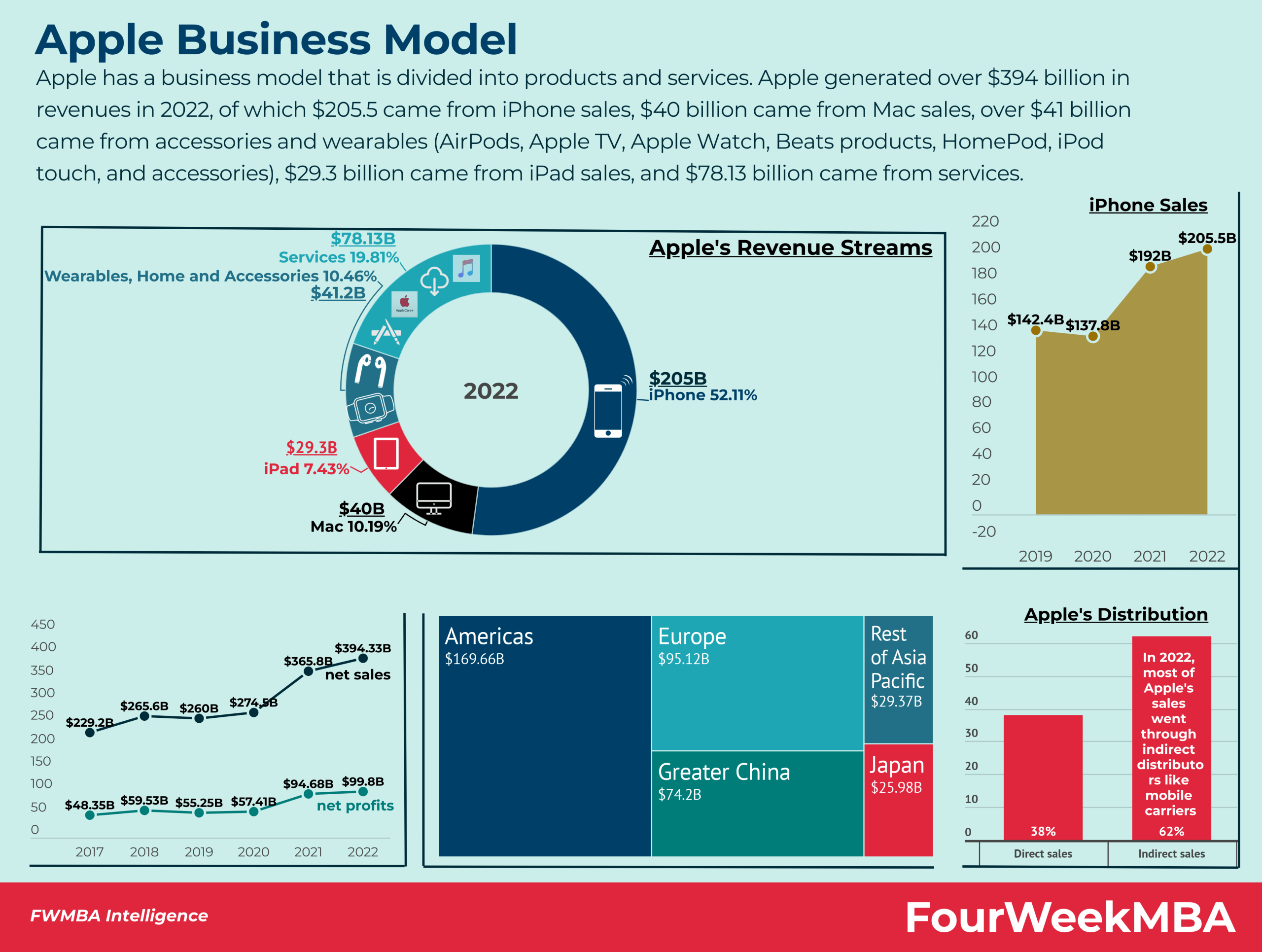
Apple has a business model that is divided into products and services. Apple generated over $394 billion in revenues in 2022, of which $205.5 came from iPhone sales, $40 billion came from Mac sales, over $41 billion came from accessories and wearables (AirPods, Apple TV, Apple Watch, Beats products, HomePod, iPod touch, and accessories), $29.3 billion came from iPad sales, and $78.13 billion came from services.
iPhone and Services sales represented the main revenue drivers in 2022. Within the service revenues, the fastest growing sub-segment was the advertising business Apple built on top of the App Store, followed by the Mac, Accessories & Wearables, and the iPad.
In 2022, most of Apple’s sales (62%) came from indirect channels (comprising third-party cellular networks, wholesalers/retailers, and resellers). These channels are critical for sales amplification, scale, and subsidies (to enable the iPhone to be purchased by many people). In comparison, the direct channel represented 38% of the total revenues. Stores are critical for customer experience, enabling the service business, and branding at scale.
In 2022, Apple generated 62% from indirect channels vs. 38% from its direct channel. In 2021, 64% of Apple’s sales came by indirect channels vs. 36% from its direct channels in 2021.
Apple is a tech giant, and as such, it encompasses a set of value propositions that make Apple’s brand recognized, among consumers. The three fundamental value propositions of Apple’s brand leverage the “Think Different” motto; reliable tech devices for mass markets; and starting in 2019, Apple also started to emphasize more and more privacy to differentiate itself from other tech giants.
Apple’s mission is “to bring the best user experience to its customers through its innovative hardware, software, and services.” And in a manifesto dated 2019 Tim Cook set the vision specified as “We believe that we are on the face of the earth to make great products and that’s not changing.”
In 2022, Apple is worth two and a half trillion dollars. Apple generated over $205 billion from iPhone sales in 2022, which accounted for over 52% of its net sales—followed by services revenues at over $78 billion, wearables and accessories at over $41 billion, Mac sales at $40 billion, and iPad sales at over $29 billion.
Apple’s mission is “to bring the best user experience to its customers through its innovative hardware, software, and services.” And in a manifesto dated 2019 Tim Cook set the vision specified as “We believe that we are on the face of the earth to make great products and that’s not changing.”
It costs Apple $501 to make an iPhone 14 Pro Max, and the company sells it at a base price of $1099. This makes Apple’s base markup on the latest iPhone model at 119% Apple is the only tech company able to sell its tech products at a such a premium, thanks to a combination of hardware, software and marketplace.
While Apple Tim Cook’s salary has been $3 million since 2016, most of Tim Cook’s compensation is performance-based. For instance, in 2022, while the salary of Tim Cook was $3 million, he had total compensation of over $99 million, which comprised stock awards and other incentives and bonuses.
Gennaro is the creator of FourWeekMBA, which reached about four million business people, comprising C-level executives, investors, analysts, product managers, and aspiring digital entrepreneurs in 2022 alone | He is also Director of Sales for a high-tech scaleup in the AI Industry | In 2012, Gennaro earned an International MBA with emphasis on Corporate Finance and Business Strategy.