In 2022 Uber launched its advertising segment, which comprises revenue from sponsored listing fees paid by merchants and brands in exchange for advertising on the platform. By the end of the year, Uber advertising had generated $500 million in revenue from 315K merchants.
By 2023, the advertising business of Uber generated billion dollars in revenue!
By Q3 2022, it was clear that Uber’s advertising business launch had been a success.
Indeed, Uber’s advertising already generated $350 million by Q3 of 2022, right as it was launched.
For some context, Pinterest’s only revenue stream is advertising, which generated $684 million in the same period.
Recently, Uber launched a new ad format for brands to connect with consumers throughout the ride or delivery process.
Uber is shooting to generate over a billion dollars of advertising revenue by 2024.
”We have a global audience of valuable, purchase-minded consumers who, as part of our core business, tell us where they want to go and what they want to get,”
Said Dr. Grether, General Manager for Uber’s advertising division, further explained:
“Through our advertising division, we can help leading brands grow their relationships with consumers by connecting them at a moment when a customer is uniquely attentive. By tapping into our mobility media network, our pilot campaigns have surpassed expectations in terms of brand lift, engagement, and other campaign goals. We’re eager to continue working with our partners to identify best-in-class offerings – such as in-car tablet advertising – that will ensure they’re engaging with captive and engaged audiences.”
Currently, most revenues seem to come from the sponsored listings, on Uber Eats.
But Uber’s advertising platform comprises a few more formats.
Sponsored Listings
The sponsored listing ad format consists of placements across Uber Eats to position a brand ahead of the competition and grab users’ attention, ready to purchase.
By 2022, Uber Eats (thanks also for the further contribution from ads revenue) reached almost $11 billion in revenue.
In 2023 Uber Eats generated $12.2 billion in revenue, compared to nearly $11 billion in 2022, $8.3 billion in revenue in 2021, and $3.9 billion in revenue in 2020.
Journey Ads
As Uber explains, this ad format is thought to capture consumers’ attention on Uber trips as they move with purpose by featuring ads that drive purchases and brand awareness.
The Uber Mobility platform is still the core business for Uber, which has used the network effects on this platform to launch the other two segments (Delivery and Freight).
Uber’s mobility platform generated nearly $20 billion in 2023, followed by the delivery platform (Uber Eats), with $12.2 billion in revenue, and the freight platform, with $5.24 billion in revenue. The mobility platform represents the core business model of Uber, and it has accelerated again after the end of the Covid-19 pandemic. On the other hand, thanks to the company restructuring in the last few years, Uber has built two multi-billion dollar segments from delivery and freight on top of the core platform.
Homepage Billboards
These comprise display ads for brand messages on the homepage of the Uber Eats app.
Storefront Ads
This ad format is thought for consumer packaged goods, which can display their products on the digital storefront of Uber.
In-Menu Ads
With this ad format, merchants can feature their seasonal or specially priced menu items to entice consumers to take advantage of the promotional offer on top of Uber.
Post-checkout Ads
With this ad format, brands can prompt consumers as they await for their orders to go through.
Sponsored Emails
Merchants on the Uber Eats platform can also promote exclusive offers for Uber and Uber Eats users through sponsored emails delivered directly to their inboxes.
Car Tops Ads
Another attractive format is the high-visibility digital OOH Car Top Ads (out-of-home opportunity, cartop advertising), which let brands message consumers based on location and time of day across top US cities and metro areas while transforming Uber’s cars, part of its network as moving billboards!
Uber’s principal individual shareholders comprise Yasir Al-Rumayyan (3.64%), the Governor of the Public Investment Fund, the sovereign wealth fund of the Kingdom of Saudi Arabia, and Dara Khosrowshahi, CEO of Uber. Institutional investors comprise Morgan Stanley, with 7.32% ownership, Fidelity, with 6.34%, and The Vanguard Group, with 5.85% ownership.
Uber is a two-sided marketplace, a platform business model that connects drivers and riders, with an interface with gamification elements that make it easy for two sides to connect and transact. Uber makes money by collecting fees from the platform’s gross bookings.
For the first time in its history, in 2023, Uber became profitable, with nearly $1.9 billion in net profits. Indeed on net revenues of over $37 billion, Uber posted a net profit of $1.88 billion, compared with a net loss of $9.14 billion in 2022. In 2021, Uber posted a lower net loss ($496 million), primarily thanks to the business divestitures of various assets. Throughout its history, on an annual basis, Uber has never made a profit except for 2023, when it finally reached profitability, thanks to a shifted focus toward operational efficiency.
Uber Mobility, which is the core platform of Uber, had a 28.8% take rate in 2023, and a 19.15% take rate for the delivery platform (Uber Eats) in the same period. In 2022, Uber mobility took 27% of each booking on the platform. At the same time, Uber Eats took 20% of each booking on the delivery platform. The take rate varies according to demand and supply but also market dynamics. In short, in periods of increased competition, the service might charge lower take rates to keep up with it. In 2022, Uber pushed on efficiency, thus raising its take rates, to move toward profitability.
Uber Platform Users
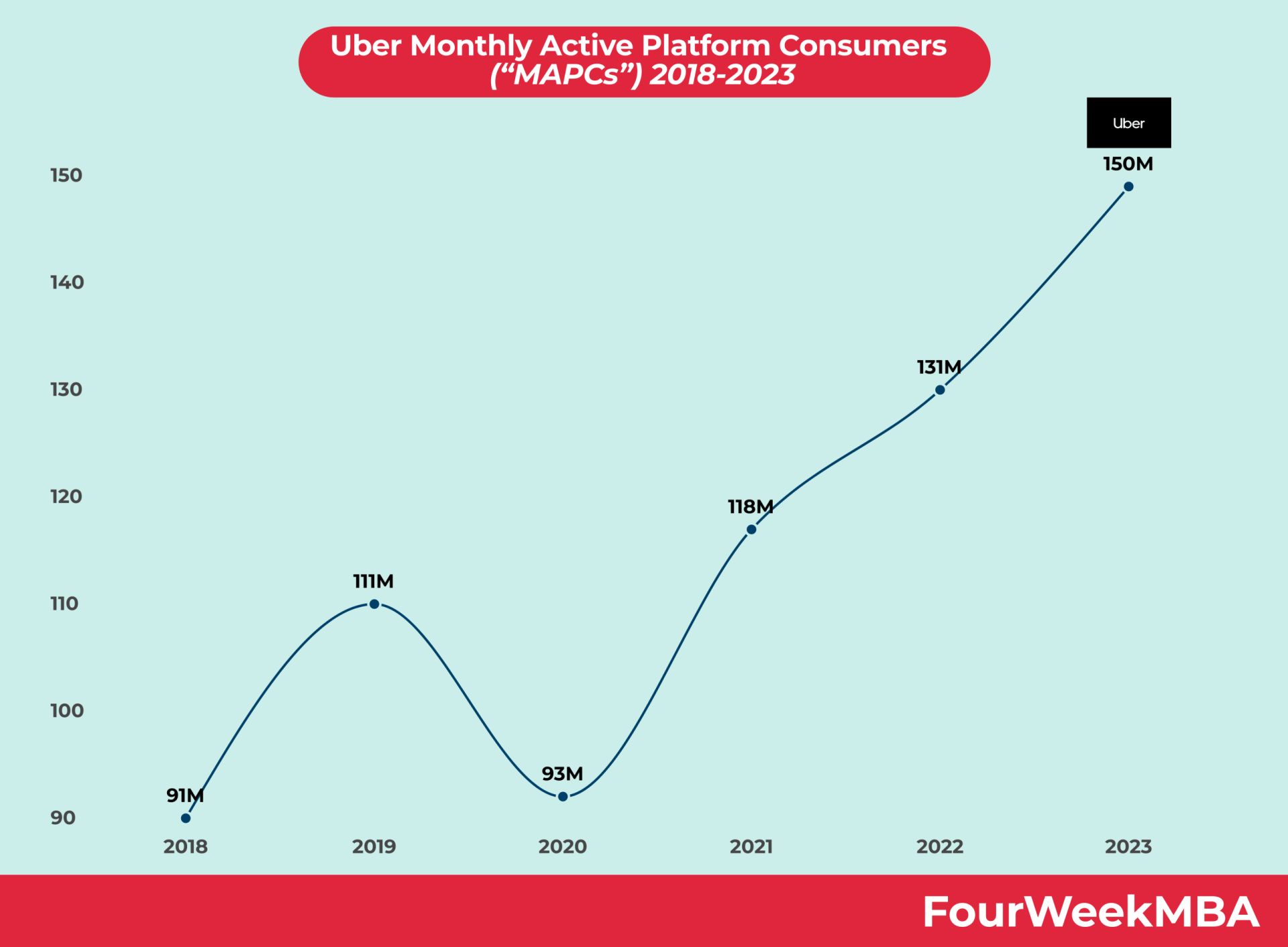
Uber had 150 million Monthly Active Platform Consumers in 2023. In 2022, Uber had 131 million Monthly Active Platform Consumers, compared to 118 million in 2021, and 93 million in 2020.
Uber Eats is a three-sided marketplace connecting a driver, a restaurant owner, and a customer with the Uber Eats platform at the center. The three-sided marketplace moves around three players: Restaurants pay commission on the orders to Uber Eats; Customers pay small delivery charges, and at times, cancellation fees; Drivers earn through making reliable deliveries on time.
In 2023 Uber Eats generated $12.2 billion in revenue, compared to nearly $11 billion in 2022, $8.3 billion in revenue in 2021, and $3.9 billion in revenue in 2020.
If we look at EBITDA, Uber Eats was a profitable segment, generating $1.5 billion in EBITDA in 2023. For the first time since its inception, Uber Eats’ EBITDA (Earnings Before Interest, Taxes, Depreciation, and Amortization) – which measures a company’s operational efficiency – turned positive for $551 million in 2022, compared to negative $348 million in 2021; negative $870 million in negative EBIDTA in 2020; and over $1.3 billion negative EBIDTA in 2019.
Uber Freight is a platform that connects carriers with shippers, which generated $5.24 billion in revenue in 2023, slowing down from $6.95 billion in revenue in 2022, and it’s now one of the three core segments (Mobility, Delivery, and Freight) within the Uber Business Model.
In 2023, Uber generated nearly $20 billion from its core platform (mobility), followed by delivery (Uber Eats) with $12.2 billion and freight, with $5.24 billion in revenue.
In 2022 Uber launched its advertising segment, which comprises revenue from sponsored listing fees paid by merchants and brands in exchange for advertising on the platform. By the end of the year, Uber advertising had generated $500 million in revenue from 315K merchants. By 2023, the advertising business of Uber generated a billion dollars in revenue!
Uber and Lyft are both mobility ride-sharing apps. Uber generated $37.28 billion in revenue in 2023, compared with Lyft, which generated $4.4B billion in the same year. A key difference is that while Lyft has primarily stayed in the mobility industry, Uber’s business model today spans various categories beyond mobility, such as delivery (Uber Eats) and freight.
In the food delivery business model companies leverage technology to build platforms that enable users to have the food delivered at home. This business model usually is set up as a platform and multi-sided marketplace, where the food delivery company makes money by charging commissions to the restaurant and to the customer.
DoorDash is a platform business model that enables restaurants to set up no-cost delivery operations. At the same time, customers get their food at home, and dashers (delivery people) earn some extra money. DoorDash makes money by markup prices through delivery fees, memberships, and advertising for restaurants on the marketplace.
Glovo is a Spanish on-demand courier service that purchases and delivers products ordered through a mobile app. Founded in 2015 by Oscar Pierre and Sacha Michaud as a way to “uberize” local services. Glovo makes money via delivery fees, mini-supermarkets (fulfillment centers that Glovo operates in partnership with grocery store chains), and dark kitchens (enabling restaurants to increase their capacity).
Instacart’s business model relies on enabling an easy set up for grocery stores, the comfort for customers to get their shopping delivered at home, and an additional income stream for personal shoppers. Instacart makes money by charging service fees, via memberships, and by running performance advertising on its platform.
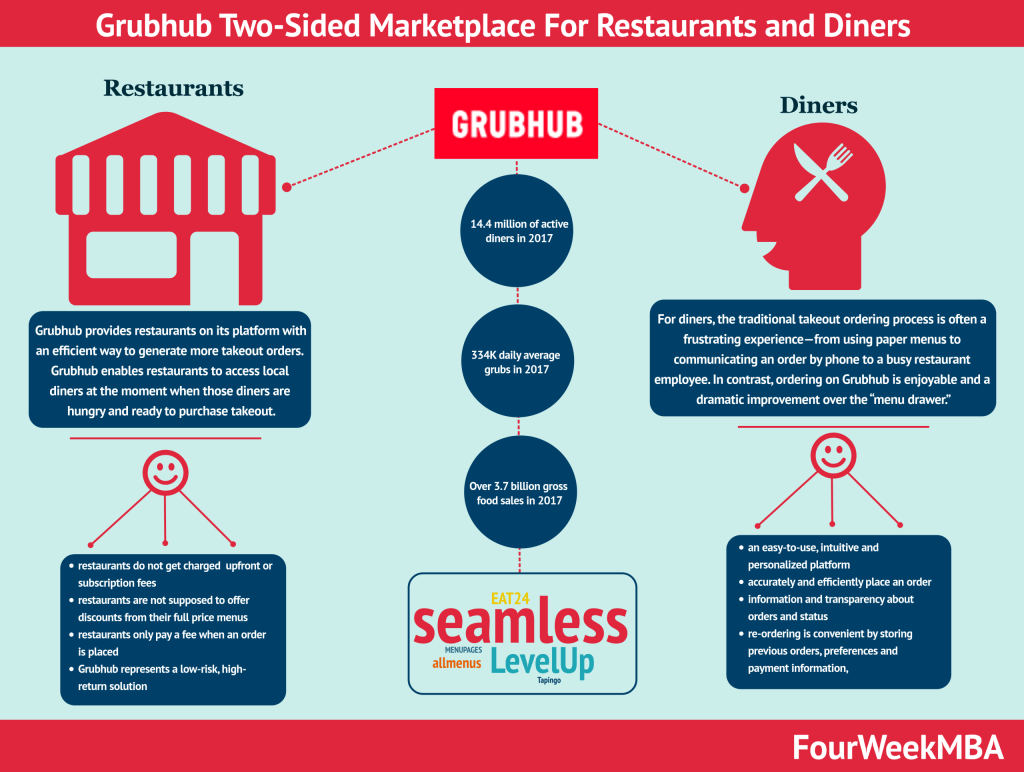
Grubhub is an online and mobile platform for restaurant pick-up and delivery orders. In 2018 the company connected 95,000 takeout restaurants in over 1,700 U.S. cities and London. The Grubhub portfolio of brands like Seamless, LevelUp, Eat24, AllMenus, MenuPages, andTapingo. The company makes money primarily by charging restaurants a pre-order commission and it generates revenues when diners place an order on its platform. Also, it charges restaurants that use Grubhub delivery services and when diners pay for those services.
Shipt is a North American integrated delivery service for groceries, home products, and electronics initially funded by Bill Smith, a highly experienced entrepreneur with a history of creating successful start-ups; in 2014, Smith used $3 million of his own money to create the first iteration of Shipt, the company was acquired by Target in 2017 in a cash deal worth $550 million. Membership fees predominantly drive Shipt revenue generation.
Postmates is a food delivery service built as a last-mile delivery service platform connecting locals with shops. Postmates makes money by collecting fees (commission, delivery, service, cart, and cancellation fees). It also makes money via its subscription service (called Unlimted – $9.99/month or $99.99 annually) giving free delivery on every order of more than $12.
Gennaro is the creator of FourWeekMBA, which reached about four million business people, comprising C-level executives, investors, analysts, product managers, and aspiring digital entrepreneurs in 2022 alone | He is also Director of Sales for a high-tech scaleup in the AI Industry | In 2012, Gennaro earned an International MBA with emphasis on Corporate Finance and Business Strategy.